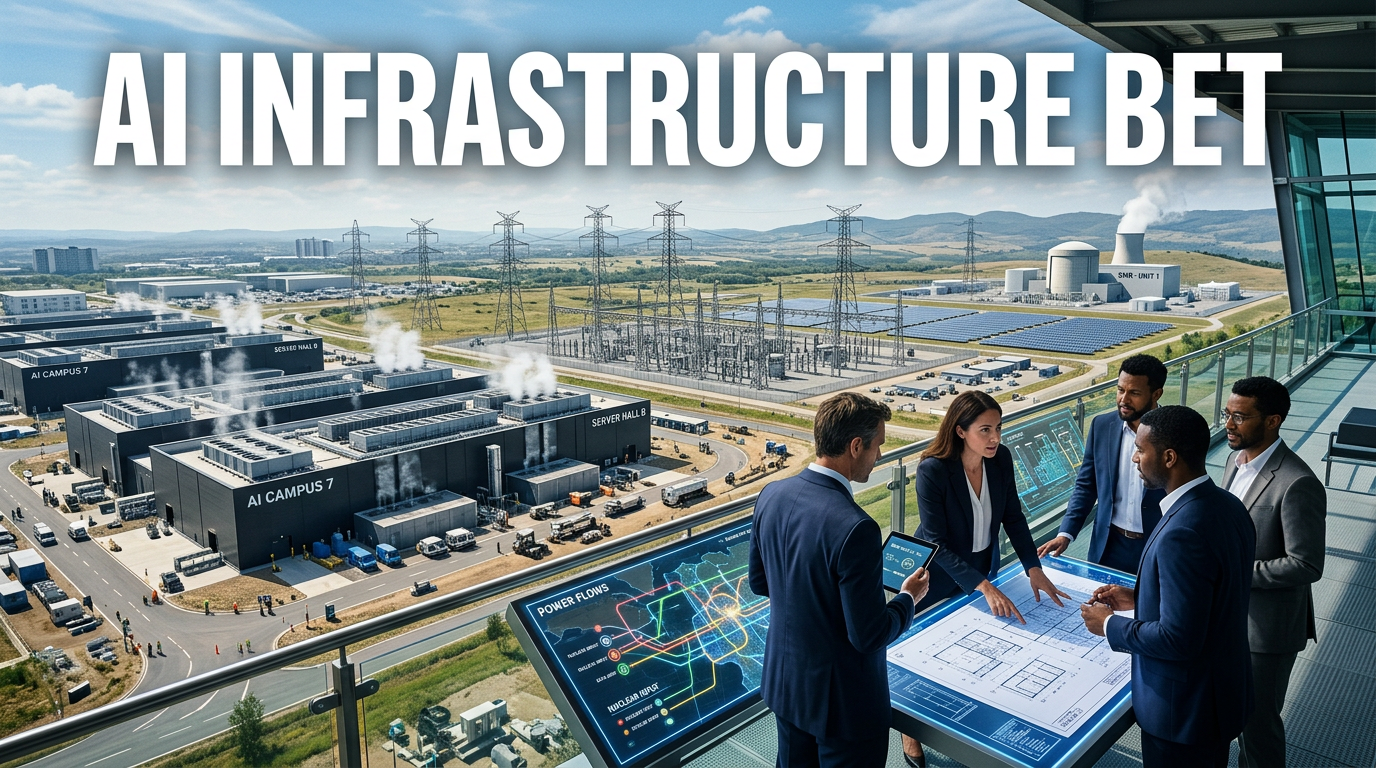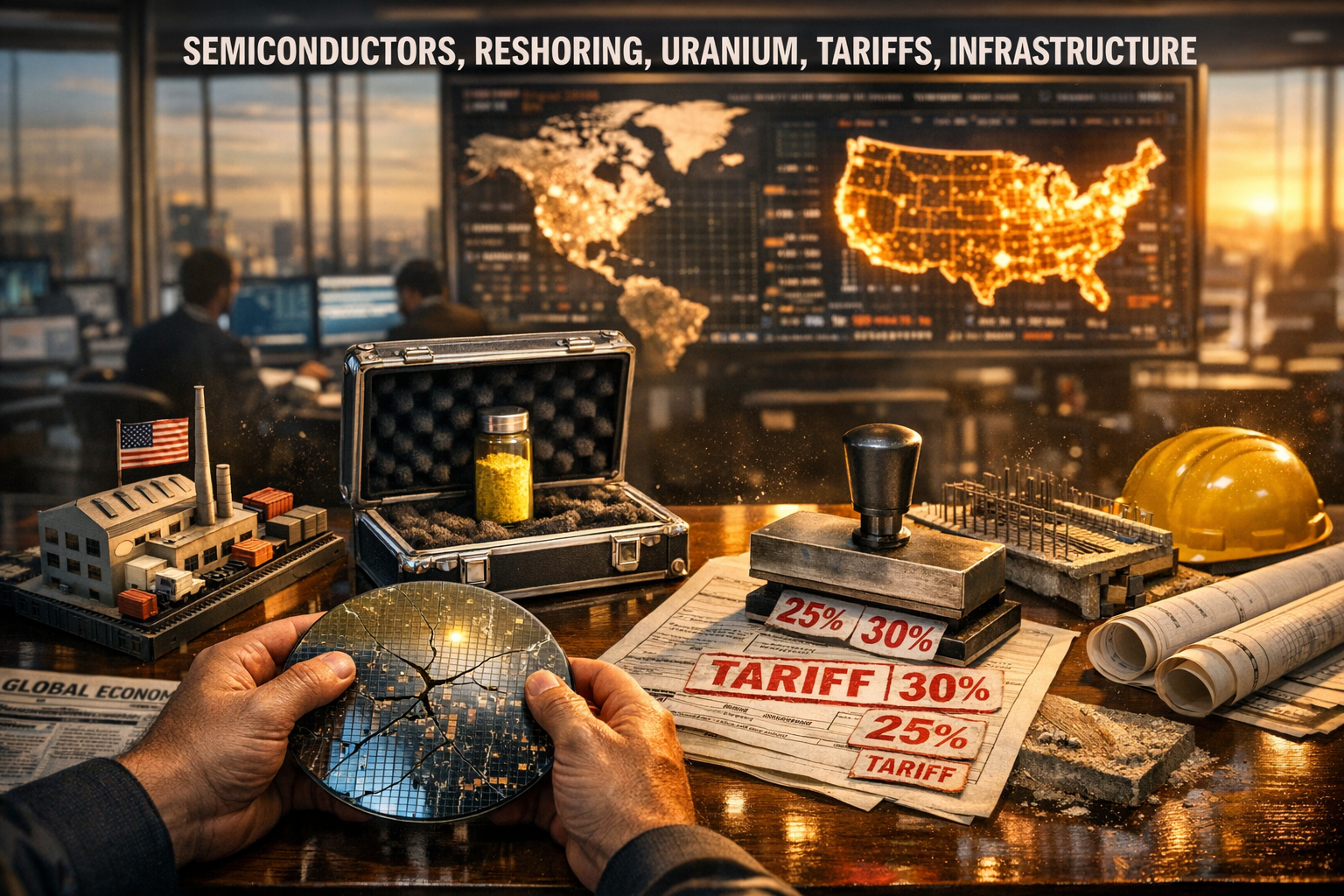
● Semiconductor Supercycle, US Reshoring Boom, Nuclear Uranium Crunch, Trump Tariff Shock
Semiconductor Supercycle + US Manufacturing Reshoring + Nuclear/Uranium Shortage + Trump Tariff Escalation (Greenland): Key Profit Drivers for 2026
This report covers four topics.
① Why a USD 10B-scale open-market purchase of Micron by a former TSMC chairman is a meaningful market signal
② How TSMC earnings upside transmits into semiconductor equipment equities
③ Where the primary beneficiaries are as the US attempts to relocate the semiconductor supply chain “in full” via reshoring
④ Why nuclear power/uranium is re-emerging as a core commodity amid AI infrastructure power constraints, and how Trump tariff actions can amplify volatility
1) [News Brief] Why semiconductors are dominating top large-cap returns since January
Key summary
Year-to-date, a large share of the top performers within the S&P 500 has been concentrated in semiconductors, storage, and semiconductor equipment.
This is better interpreted as an industrial cycle signal—“AI infrastructure capex → memory/foundry capacity expansion → equipment orders”—rather than a short-lived theme.
Current market leadership clusters
Semiconductors (memory/foundry/equipment)
Data centers (including power)
Geopolitics (tariffs/conflict → defense/commodities)
2) [Hot Issue ①] A former TSMC chairman bought Micron near peak levels: a higher-quality insider signal
What happened
A former second chairman of TSMC, currently a Micron director, executed large open-market purchases.
The key point is that this was an open-market cash purchase rather than an option exercise or compensation-related acquisition.
Why markets reacted
Insider buying is not consistently predictive, but it often signals that internal views are not materially negative.
In this case, the buyer is not a typical executive but a top-tier industry veteran with multiple cycle experiences, increasing the weight of interpretation.
Investor checklist (condensed)
Whether the memory price spike reflects a temporary shortage or structurally tight conditions driven by AI demand
Micron CAPEX and supply expansion pace vs. durability of hyperscaler orders
Insider buying after a substantial price move may indicate medium-term confidence in industry conditions rather than a short-term trade
3) [Hot Issue ②] TSMC earnings surprise: benefits flow to semiconductor equipment
What happened
TSMC reported results and guidance above market expectations.
On concerns around an “AI bubble,” management emphasized ongoing customer validation, financial strength, and monetization progress, reinforcing demand visibility.
Why equipment stocks move with it
Higher TSMC investment implies incremental capacity additions.
Capacity additions translate directly into equipment purchase orders.
Core transmission pathway
Rising AI demand → tighter HBM/DRAM → foundry/advanced packaging expansion → demand for equipment/materials/power infrastructure
Key market terms
Semiconductor equipment (global leaders), process complexity, advanced packaging and leading-edge investment
4) [US Policy Drive] “Relocating the semiconductor supply chain to the US” is increasingly reflected in factory counts
Most relevant policy point
In US–Taiwan negotiations, the central outcome is US-based fab expansion.
When plans shift from general commitments to explicit plant counts (e.g., from 6 to 5+ additional), the narrative transitions from theme to physical investment execution.
Beneficiary sequence in a US reshoring capex cycle
1) Semiconductor manufacturers (foundry/memory)
2) Semiconductor equipment/materials
3) Industrial construction (heavy equipment/rental/engineering)
4) Power infrastructure (transmission/distribution, generation, nuclear)
One-line conclusion
Reshoring is not limited to semiconductors; it can extend into construction, power infrastructure, and commodities via a broad physical capex cycle.
5) [Hidden Winner in AI Infrastructure] The leading data center theme is power; power exposure is narrowing toward nuclear/uranium
Why nuclear is positioned as a dual-beneficiary
AI data centers are power-intensive, and grid stability requires firm baseload generation.
Geopolitical drivers (reduced reliance on Russia, energy security) also support a nuclear build-out directionally.
Primary bottleneck
Fuel supply (uranium).
Accordingly, the investment focus is expanding from “nuclear equities” to “uranium shortage” as a commodity theme.
Key checkpoints
Uranium trending back toward new highs
Institutional research (e.g., BofA) outlining upside scenarios based on supply deficits
High volatility suggests phased positioning and pullback-based execution rather than momentum chasing
6) [Commodities x AI] Why Amazon is seeking to pre-secure copper: AI infrastructure is reshaping commodity demand
Core point
Copper has historically been linked to cyclical growth, infrastructure, and geopolitics; AI data center power, cabling, and cooling requirements add incremental demand logic.
Implications
Big Tech efforts to lock in long-term commodity contracts typically emerge when supply chains are tightening.
Commodity producer cycles are prolonged; entry timing risk can be significant if positioned incorrectly.
7) [Geopolitics/Tariff Risk] Trump’s “Greenland tariff card” as a volatility trigger
Observed pattern
Pressure tactics involving stepwise tariff increases on select European countries.
While framed as tariffs, the underlying objective is negotiating leverage tied to Greenland-related interests.
Investor-relevant takeaway
This is primarily a short-term volatility driver rather than a long-duration investment thesis.
As a result, leadership themes such as defense, commodities, and energy security may retain structural attention alongside AI infrastructure power exposure.
8) [Key Point] Semiconductor beneficiaries are entering a second-stage diffusion phase
Why it matters
Many narratives stop at “Micron insider buying,” “TSMC strength,” or “ASML upside.”
Historically, broader upside often emerges when policy, physical capex, power infrastructure, and commodities expand the opportunity set beyond first-order beneficiaries.
Second-stage diffusion framework
① US reshoring is increasingly confirmed by explicit fab counts
② Fab expansion propagates from equipment to construction/heavy equipment/rental
③ Data center build-out creates power constraints; nuclear/uranium increasingly appears as a terminal solution
④ Geopolitical risk (tariffs/conflict) can raise risk premia for defense/commodities while reinforcing energy-security-aligned power themes
One-line summary
The current market is not a single-theme semiconductor trade; it reflects a multi-factor cycle combining supply-chain reconfiguration, AI infrastructure capex, and energy security.
9) Near-term calendar (volatility catalysts)
US market holiday (Martin Luther King Jr. Day): near-term shock absorption may increase
Davos: monitor shifts in policy/regulatory tone and AI investment messaging
Earnings season: range-bound conditions likely until major Big Tech results
Bank of Japan liquidity: asset sales/interest-rate events may intermittently trigger global volatility
Core SEO keywords (context-aligned)
Global economic outlook
US interest rates
Inflation
AI semiconductors
USD exchange rate
< Summary >
Micron open-market insider buying by a former top TSMC executive can be interpreted as a signal of medium-term confidence in memory-cycle conditions.
TSMC earnings upside and higher investment intentions transmit directly to semiconductor equipment via capacity expansion orders.
US reshoring can extend beyond semiconductors into construction/heavy equipment/rental and power infrastructure as a physical capex cycle.
AI data center power constraints increasingly point toward nuclear/uranium, with geopolitical dynamics reinforcing the energy-security narrative.
Trump tariff actions tied to European pressure and Greenland-related leverage may amplify short-term volatility, supporting selective consideration of defense/commodities/energy-security exposures.
[Related articles…]
- Semiconductor supercycle: five critical factors for a 2026 investment framework
- Is a uranium shortage materializing? Key takeaways on nuclear power and the data center power race
*Source: [ 소수몽키 ]
– 반도체 전설도 급하게 매수? 미국 반도체 띄우기의 수혜주들
● Stagflation Shock, US-China Power War, Supply Chain Split
Davos Forum Warning on the 2026–2030 Global Economy: The US–China Hegemonic Rivalry Is Simultaneously Shaping “Low Growth + Supply-Chain Reconfiguration”
This report focuses on three points:
1) Why the World Economic Forum (WEF) frames its baseline as “persistent low growth,” not a discrete “crisis”
2) Evidence of weakening multilateralism (globalization) using “trade growth vs. GDP growth”
3) Why the four fronts of the US–China rivalry (resources, currency, technology, manufacturing) function as an integrated system
A separate section highlights practical implications that are often underemphasized in mainstream coverage.
1) News Briefing: WEF’s One-Line Summary of the 2026–2030 Global Economy
WEF’s baseline is not preparation for a large-scale financial crisis, but adaptation to persistent low growth.
The central message is structural adjustment for an extended period of subdued growth rather than short-term cyclical risk management.
This low-growth regime is presented as the combined result of geopolitical risk and simultaneous supply-chain reconfiguration.
2) Core WEF Agenda: Weakening Multilateralism (Globalization) = Geoeconomic Fragmentation
WEF emphasizes “fragmentation,” i.e., a shift from a single integrated market toward bloc formation, reducing cross-border trade, investment, and technology cooperation.
2-1) WEF’s Quantitative Signal of Globalization Erosion
WEF highlights a key divergence:
“Global GDP growth (e.g., 3.2%) exceeds goods trade growth (e.g., 2.4%).”
Implication: while the global economy expands, cross-border trade grows more slowly, indicating a relative decline in the trade intensity of growth and increased emphasis on domestic demand, protection, and bloc-based commerce.
2-2) Variable WEF Identifies as the Strongest Shock to Multilateralism
WEF identifies deterioration in “peace & security” as the most significant negative contributor.
Rising conflict and military tensions increase the cost of cooperation, weakening the foundational conditions for global integration.
2-3) Corporate Survey Signal: Reduced Willingness to Cooperate
Survey results indicate a broad preference for less cooperation going forward.
The reduction is most pronounced in technology and innovation, directly intersecting with AI-related strategic competition.
3) The US–China Rivalry Through 2030: Four Fronts (WEF-Framed)
3-1) Resource Competition: The Core Bottleneck Is Refining and Magnet Manufacturing, Not Mining
The primary dependency is not limited to extraction; it extends deeply into refining and magnet production.
As a result, incremental mining capacity alone is insufficient. The highest-cost and longest-lead-time segments are processing, refining, and materials conversion.
Strategic inputs such as rare earths, nickel, aluminum, and palladium link directly to EVs, batteries, defense, and semiconductors. Resource leverage therefore constrains technology and manufacturing capacity.
3-2) Currency Competition: Implications of a Less Stable Petrodollar Structure
The thesis: the US reserve-currency position has been reinforced by dollar settlement in energy trade, while China, as the largest crude importer, has increasing incentives and leverage to promote RMB settlement.
Separately, RMB share in FX settlement has been rising. This does not imply imminent dollar displacement; it suggests incremental multipolarity in trade, commodity, and financial settlement that could exert long-term pressure on the dollar premium.
3-3) Technology Competition: AI, Semiconductors, and Data Centers Become National Infrastructure
The competition is shifting from firm-level rivalry to state-backed, quasi-wartime infrastructure investment.
Semiconductors, compute, and data centers are simultaneously growth assets and security-critical infrastructure.
AI should be assessed not only by model performance, but by the resilience of the AI supply chain spanning power, chips, data, and cloud capacity.
3-4) Manufacturing Competition: China’s “Price + Scale + Value Chain” Is Already Deeply Embedded
A key observation, illustrated by the BYD case: China’s manufacturing penetration targets not only premium segments but can also dominate mid- and value-oriented mass markets.
Manufacturing strength is not merely factory throughput:
- Scale in manufacturing drives demand leverage over strategic resources (resource front).
- Export competitiveness affects settlement currency dynamics (currency front).
- Higher value-add manufacturing depends on semiconductors and AI (technology front).
The four fronts reinforce each other as a single system.
4) Highest-Impact Points Often Underemphasized
4-1) “Persistent Low Growth” Requires KPI and Policy Regime Changes, Not Cyclical Adjustments
The issue is not only headline growth rates. Persistent low growth implies changes in corporate and government targets:
revenue-growth KPIs shift toward cash flow, supply assurance, and regulatory/geopolitical risk management.
4-2) The Core of Fragmentation Is the Breakdown of Cooperation Defaults, Not Tariffs
Tariffs are a surface-level mechanism; the core constraint is diminished trust.
Restrictions on technology collaboration, joint R&D, standards-setting, and cross-border data flows reduce productivity and can structurally depress long-run growth. Cost inflation may persist as an embedded feature of the operating environment rather than a temporary spike.
4-3) AI Competitive Advantage Likely Shifts from “Models” to “Power, Chips, and Data Centers”
In a fragmented environment, reliable access to GPUs, electricity, and cloud capacity becomes a decisive advantage.
This increases strategic relevance for AI semiconductors, power infrastructure, data center REITs/infrastructure investments, and thermal management/cooling technologies.
4-4) Practical Checklist for Immediate Action
- Import/export companies: quantify and document supply-chain reconfiguration scenarios (China exposure, sanctions risk, alternative sourcing).
- Investment perspective: USD, commodities, defense, energy, and AI infrastructure increasingly trade as a connected bundle (“fragmentation trade”).
- Talent/career perspective: combined capabilities in AI utilization, data/cloud fundamentals, and regulatory/security literacy are increasingly required.
5) Macro Scenario Summary for 2026–2030 (Keywords)
1) The global economy is likely to prioritize optimization under a low-growth regime rather than a return to high-growth expansion.
2) Geopolitical risk increases cost, while supply-chain reconfiguration introduces inefficiency; inflationary pressure may become more structural.
3) The US–China rivalry is not separable into independent issues; resources, currency, technology, and manufacturing operate as an integrated package.
4) AI remains a technology theme and simultaneously expands as a national competitiveness, security, and infrastructure theme.
< Summary >
WEF frames the 2026–2030 global economy as adaptation to persistent low growth rather than crisis preparation.
Multilateralism weakens as goods trade growth lags GDP growth, while deteriorating peace and security accelerates fragmentation.
The US–China rivalry is an integrated contest across resources, currency, technology, and manufacturing, with potential to persist beyond 2030.
AI competition is likely to expand from model-level performance toward infrastructure access, including power, chips, and data centers.
[Related Articles…]
-
https://NextGenInsight.net?s=AI
AI Infrastructure Competition: Why Data Centers, Power, and Semiconductors Are Becoming the Key Battleground -
https://NextGenInsight.net?s=supply%20chain
Supply-Chain Reconfiguration: Risk Checklist for Korean Companies
*Source: [ 경제 읽어주는 남자(김광석TV) ]
– 다보스포럼이 본 미래 : “미중 패권전쟁 장기화로 다자주의가 흔들릴 것” 지경학적 분절화의 시대 [경읽남 228화]
● Nvidia Bio Blitz, AI Megacycle Ignites Drug Discovery Hospitals Data Centers
The Strategic Rationale Behind Jensen Huang’s Focus on “Biology”: The Next AI Megacycle Emerging Across Drug Discovery, Hospitals, and Data Centers
Key points:
1) Why NVIDIA views biotech not as a “new business,” but as a catalyst for the next wave of computing demand
2) How partnerships between leading pharma and leading tech companies reshape market structure (industry landscape, not just technology)
3) Why biotech follows robotics, and how both share the same infrastructure stack
4) How to assess the theme through cash-flow pathways (revenue, CAPEX, regulation) rather than sentiment
5) The most material constraint in biotech innovation is not ideas, but compute, data, and clinical execution
1) Summary (News-Style): Why “Top Big Tech + Top-Tier Pharma Collaboration” Matters
The core signal is the collaboration itself: when a leading AI infrastructure provider partners with a top-tier global pharma company, it indicates institutional commitment to the sector.
The sequence is also notable: robotics discussion precedes an expansion toward life sciences, implying broadening end-market demand.
This naturally leads to investor questions about sector leadership and beneficiary positioning.
In market terms:
Biotech is being reframed from a thematic trade into an industry that structurally drives AI infrastructure demand.
2) Why NVIDIA Is Prioritizing Biotech: Beyond GPU Sales Toward Platform Standard-Setting
2-1. Biotech as a Sector Where AI Has Sustained, High-Depth Applicability
Life sciences involve large-scale datasets (genomics, proteomics, imaging, electronic medical records), high experimental and clinical costs, and low baseline success probabilities.
As a result, even incremental improvements in AI performance can produce outsized cost reductions and meaningful increases in expected economic value.
2-2. From NVIDIA’s Perspective, Biotech Represents a High-Intensity, Long-Duration GPU Demand Vertical
A key bottleneck in biotech R&D is not ideation but computational throughput and iterative experimentation.
Protein structure and interaction modeling, candidate screening, generative chemistry, medical imaging analysis, and safety prediction are compute-intensive workloads.
As adoption scales, data center investment (CAPEX) tends to scale with it.
This directly links biotech expansion to broader growth in AI data center buildouts.
2-3. Pharma Partnerships Are Less About Demonstrations and More About Securing Long-Term Buyers
Many narratives emphasize technological feasibility (e.g., faster drug discovery), but the commercial objective is more concrete:
establishing durable procurement by pharma and large hospital systems, and making NVIDIA’s software and workflow ecosystem the operating standard.
3) Why Biotech Follows Robotics: Both Monetize Physical-World Data
3-1. Robotics and Biotech Both Depend on Simulation Plus Field Data
Robotics improves through sensor data from factories, logistics, and homes, complemented by simulation-based training.
Biotech improves through data generated in labs, clinical trials, and hospital settings, with computation compressing the search space for candidates and protocols.
Shared mechanism:
as real-world data accumulates, model performance improves cumulatively, and compute demand rises over time.
3-2. A Single Megatrend Through the AI Infrastructure Lens
Whether robotics or biotech, the infrastructure implication is similar: sustained demand for compute, storage, and networking.
This supports interpretation as a structural CAPEX cycle that may be less sensitive to short-term macro deceleration than typical thematic trades.
4) Why “No Deaths in 20 Years” Narratives Are Misleading: Focus on Scalable Pathways
Longevity claims are not actionable for investment analysis. More relevant pathways include:
– In oncology and rare disease, increased conversion of lethal conditions into manageable chronic diseases
– Reduced failure rates via improved candidate selection and clinical trial design
– Hospital productivity gains through automation of diagnostics, imaging workflows, and documentation
The investable point is not “longer lifespans,” but:
capital allocation into compute, data infrastructure, and clinical execution required to deliver innovation.
This aligns with NVIDIA’s incentive to target high-probability, recurring spend categories.
5) Macro Framework: Why Biotech x AI Can Be Relatively Resilient to Rates, USD, and FX Cycles
Markets remain sensitive to inflation, interest rates, USD strength, and FX volatility. Healthcare AI can exhibit relative resilience due to:
– Medical demand characteristics that are less cyclical than discretionary spending
– Productivity and cost-reduction initiatives that can remain justified even under higher rates
– Regulatory and reimbursement frameworks that, once standardized, tend to persist
While near-term volatility may remain, the long-term configuration can support concurrent expansion of AI semiconductors, data centers, and healthcare digitization.
6) Critical Constraint Often Understated: The Bottleneck Is Clinical Execution, Not Compute
A common framing stops at “AI can generate drug candidates.” In practice, the binding constraints are frequently:
clinical trial design, patient recruitment, site operations, data quality, and regulatory compliance.
To scale materially, NVIDIA’s role likely needs to extend beyond GPU supply into operational packages such as:
– standardization of hospital and clinical data pipelines
– EMR- and imaging-based AI workflows integrated into care delivery
– privacy-, security-, and compliance-ready computing architectures (on-premises and private cloud)
This explains the strategic importance of partnerships with pharma and major hospital systems:
the competition shifts from model performance to control of the clinical operating stack.
This is structurally more durable than short-term sector rotation dynamics.
7) Practical Investor Checklist: Five Indicators Beyond Sentiment
1) Pharma AI and computing CAPEX trajectory (data centers, GPU procurement, cloud commitments)
2) Standardization of hospital, imaging, and clinical data (signals of platform lock-in)
3) Regulatory guidance updates (scope of acceptance for medical AI and AI-assisted drug development)
4) Measurable changes in the share of pipelines using AI and in success-rate trends (even marginal improvements)
5) Data center supply-chain co-investment: power, cooling, and networking buildouts
8) Conclusion: The Key Question Is Whether Biotech Becomes a Persistent Buyer of AI Infrastructure
The intuition that “leaders partnering with leaders implies sector validation” is directionally consistent.
For investment assessment, the higher-resolution question is whether biotech is a transient narrative or a long-duration driver of AI infrastructure demand.
Core conclusion:
NVIDIA’s biotech focus is primarily driven by the probability that life sciences become one of the longest-lasting, highest-value, and most recurrent buyers of AI computing.
< Summary >
NVIDIA’s collaboration with top-tier pharma signals biotech as a structural driver of AI infrastructure demand rather than a short-term theme.
Robotics and biotech both leverage physical-world data, implying sustained growth in compute requirements.
The critical bottleneck is clinical execution, regulation, and data pipelines, not ideation alone.
For investors, prioritize pharma CAPEX, hospital data standardization, regulatory evolution, pipeline outcomes, and supporting investments in power/cooling/networking.
[Related Articles…]
- After NVIDIA: Why the AI Data Center Investment Cycle May Prove More Enduring Than Expected
- A Framework for Global Growth Equities Under FX Volatility, USD Cycles, and Interest-Rate Regimes
*Source: [ Jun’s economy lab ]
– 엔비디아 젠슨황이 바이오에 꽂힌 충격 이유