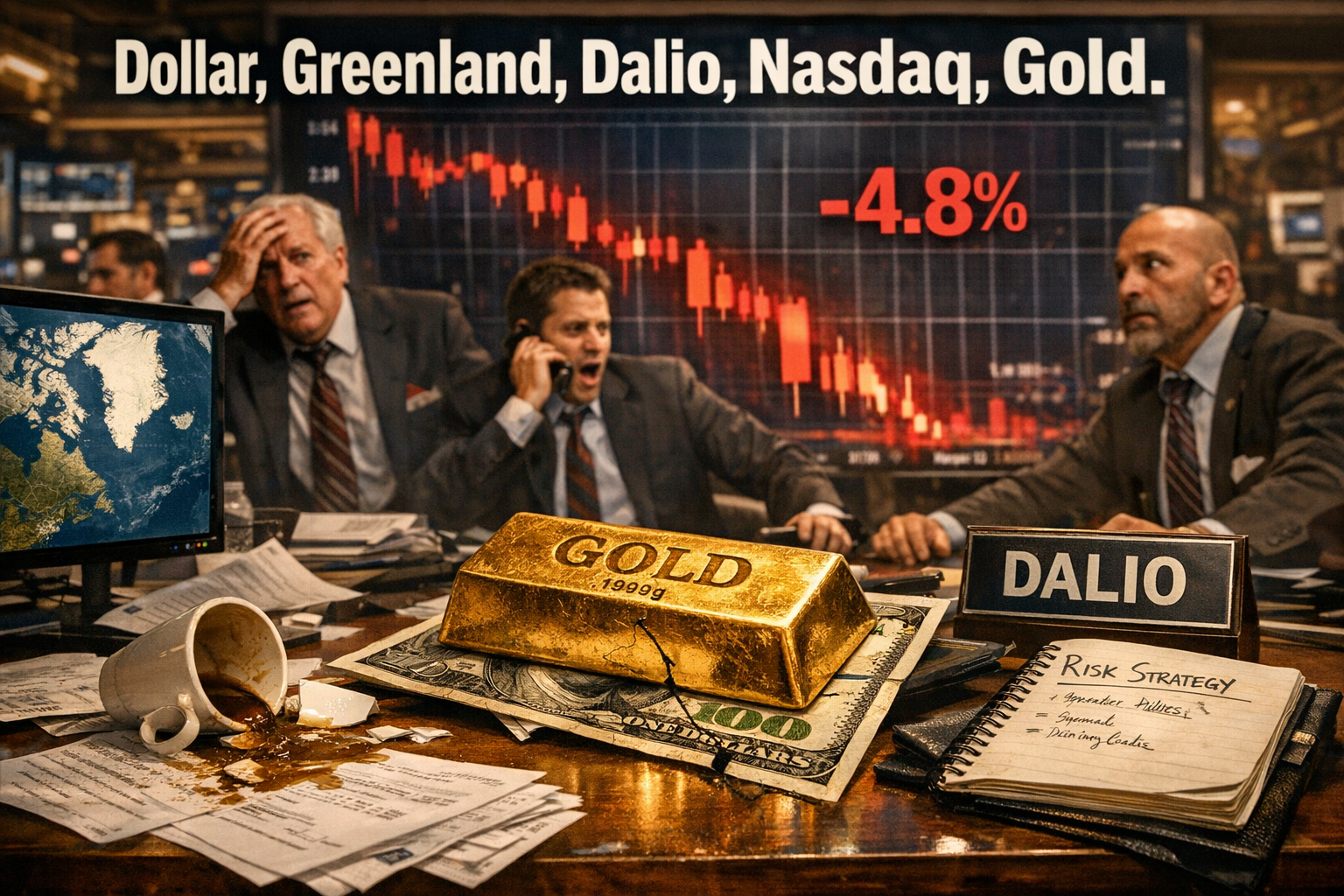
● Nasdaq Plunge, Greenland Shock, Japan Bond Spike, Dollar Order Cracks
Nasdaq Sell-Off: Is This a Genuine Signal of “Dollar Collapse”? Two Triggers (Greenland, Japanese Bonds) and the Link to Ray Dalio’s “Breakdown of the Monetary Order”
This report covers:
- Why U.S. equities, including the Nasdaq, declined “simultaneously” (geopolitical friction tied to Greenland + a spike in Japanese super-long government bond yields), with a continuous cause-and-effect chain.
- Whether this move directly implies an erosion of dollar hegemony, or should be viewed as a “near-term shock plus longer-term structural change.”
- How Dalio’s framework of capital conflict and shifting monetary order is transmitted into market pricing, and what investors should reassess in portfolio construction.
1) Market Decline Briefing: Not an “Equity-Only” Story; Bonds and Alliance Friction Were Hit at the Same Time
1-1. Trigger A: The “Greenland Issue” Signaled Alliance Tension, Expanding Into Concern Over Selling Pressure in U.S. Assets
The market’s sensitivity was less about Greenland itself and more about a potential weakening in U.S.-Europe relations.
- Images implying “Greenland is U.S. territory” circulated via an official Trump account, escalating controversy.
- Major European countries responded forcefully, emphasizing sovereignty is not negotiable and criticizing the approach as inconsistent with the current international order.
- Trump referenced tariff pressure on eight opposing European countries (e.g., 10% in February, 25% in June).
- Europe signaled possible retaliatory tariffs; markets repriced the risk of “alliance fractures → shifts in capital flows.”
Key point:Given Europe’s substantial holdings of U.S. Treasuries and U.S. equities, political escalation can raise concerns that “U.S. assets could be sold,” which becomes a direct headwind for U.S. financial markets. Markets typically treat capital flows as more consequential than trade flows.
1-2. Trigger B: Japanese Super-Long Government Bond Yields Spiked, Lifting U.S. Long-Term Yields
The second shock originated in Japan.Political developments interpreted as enabling higher spending (e.g., early election dynamics, large-scale fiscal expansion/tax cuts/defense buildup) tend to be priced as:
- Japanese government: higher probability of expanded spending
- Result: increased JGB issuance (supply up)
- Impact: bond prices down, yields up
Super-long maturities are especially sensitive to supply-demand shifts. If investors believe the Bank of Japan will not fully defend the long end, yields can adjust more abruptly.
Critical linkage:Higher Japanese yields can reduce the incentive for Japanese investors to hold U.S. bonds. This opens a channel of “U.S. bond selling → higher U.S. long-term yields → valuation pressure on growth equities (particularly the Nasdaq).”
Net summary:Geopolitical risk (U.S.-Europe friction) + a global rates shock (Japan-driven) created a configuration in which both equities and bonds were destabilized.
2) Does This Equal “Dollar Collapse”? Reframing Through Dalio’s “Monetary Order Breakdown” Lens
2-1. What Constitutes the “Existing Monetary Order”?
A simplified structure:
- The dollar anchors global trade and settlement.
- Central banks hold U.S. Treasuries as core reserve assets.
- The U.S. has financed persistent current-account and fiscal deficits via Treasury issuance.
This framework depends on one premise:Trust that U.S. Treasuries are the primary safe asset and the dollar is a neutral settlement medium.
2-2. Dalio’s Core Claim: When Trust Weakens, Treasury Demand Becomes Politicized
Dalio’s “capital war” concept focuses on a structural imbalance:
- The U.S. must keep issuing debt to fund deficits (supply up).
- As geopolitical conflicts intensify, other countries may question the rationale for continuously financing U.S. liabilities (demand down).
This combination is structurally negative for bond markets:With higher supply and weaker demand, bond prices face downward pressure and yields face upward pressure.
2-3. Why Gold Moved: Not Primarily Speculation, but Central-Bank Reallocation
A key interpretation:The sharp rise in gold is better explained by changes in central-bank behavior—reducing exposure to dollar assets and increasing demand for gold as a quasi-reserve, neutral asset.
In this context, Dalio has advocated maintaining a strategic allocation to gold (e.g., 5–15%), aligned with a broader preference to reduce bond exposure and increase neutral stores of value.
This is not an assertion that “the dollar fails imminently.”It is closer to a scenario in which sustaining dollar-centric global liquidity becomes more costly, while alternative stores of value and settlement options incrementally expand.
3) Investor Checklist: Implications for Nasdaq and AI
3-1. Near Term: Nasdaq Is Highly Sensitive to Rates and Risk Sentiment
The Nasdaq is structurally vulnerable to rising long-term yields.When U.S. long-term yields increase, the present value of future earnings declines, compressing valuations. A Japan-driven rates shock typically hits the Nasdaq early in the risk-off sequence.
3-2. Medium Term: Geopolitical Tension Can Elevate AI/Defense/Cybersecurity as Budget Priorities
Geopolitical stress can trigger risk-asset de-risking, but also raises the strategic importance of AI, drones, and cyber capabilities, potentially shifting spending toward these sectors through government budgets.
Accordingly, the more material downside catalyst for large-cap technology may be:
- A break in the AI capex cycle (e.g., recognition of overinvestment), or
- Clear evidence that AI demand is not translating into earnings.
3-3. Long Term: The Core Theme Is Portfolio Rebalancing, Not Binary “De-Dollarization”
A more plausible path:
- The dollar remains the dominant settlement and reserve currency.
- The “U.S. Treasuries as unquestioned safe asset” premium gradually erodes.
- The residual demand is partially absorbed by gold, select real assets, energy/commodities, and more regionally segmented trade/settlement structures.
This is likely a prolonged repricing process rather than a discrete event, shaped by cumulative forces such as inflation, fiscal deficits, tariff conflicts, and rising security costs.
Key macro variables remain tightly linked:U.S. Treasury yields, inflation, global supply chains, FX, and recession risk.
4) Underemphasized but High-Impact Points
4-1. Greenland Is Less an “Territorial Issue” Than a Shock to the Price of U.S. Credibility
Markets rarely price moral considerations directly, but they do price the consequences of deteriorating trust through higher funding costs and risk premia. Critiques that the U.S. is consuming its credibility reflect this transmission mechanism.
4-2. The Japan Bond Shock Is Not a Local Story; It Implicates a Global Long-Rate Anchor
Focusing only on U.S. yields can fail to explain sudden moves. A frequent driver is Japan-linked portfolio rebalancing. Structural shifts in Japanese yields can materially change global bond supply-demand conditions and become a hidden accelerant for Nasdaq drawdowns.
4-3. The “Dollar Collapse” Frame Is Risky Because It Encourages Premature, Extreme Positioning
Dollar dominance is not best modeled as a binary outcome. It resembles:
- Rising costs of maintaining a dollar-centric system,
- A more distributed definition of safe assets, and
- A gradual repricing of the premium embedded in U.S. assets.
Applying an immediate-collapse narrative to short-term equity declines can distort risk management and portfolio sizing.
< Summary >
The Nasdaq decline is not a definitive signal of dollar-system failure; it reflects the simultaneous impact of Greenland-linked alliance friction and a Japan-driven surge in long-term yields that disrupted bond demand and risk sentiment. Dalio’s central message is not imminent dollar failure but a warning that if trust and demand for U.S. Treasuries become politicized, capital conflict can intensify and neutral reserve assets such as gold can gain structural demand. Near-term volatility is plausible; the medium-to-long-term inflection for U.S. technology is more likely tied to whether the AI investment cycle turns and whether AI demand converts into earnings, while geopolitical tension can also expand AI/defense/cybersecurity budgets.
[Related…]
- Dollar strength and FX volatility: 2026 investment strategy checkpoints (https://NextGenInsight.net?s=dollar)
- Rising-yield regime: U.S. Treasury yields and global bond-market risk (https://NextGenInsight.net?s=rate)
*Source: [ 내일은 투자왕 – 김단테 ]
– 나스닥 폭락은 달러의 붕괴인가? (ft. 레이달리오)
● Gold Smashes 4700, Fed Pick Shock, Greenland Rare Earth Clash, Big Tech Sinks, America First Chips Surge
Gold Surges Past $4,700/oz for the First Time, Greenland Rare-Earth Conflict, and the Upcoming “Fed Chair Nomination”: A Consolidated View of the Market’s Current Fault Lines
This report focuses on five core points:
1) Why gold and silver are surging (beyond a simple flight to safety).
2) How Trump’s focus on Greenland connects resources to US fiscal and industrial policy.
3) Why Bessent’s “Do not oppose the United States” functions as a negotiation framework.
4) The near-term shock channels from next week’s Fed Chair selection to equities, bonds, and the dollar.
5) Why Intel and Micron rose amid a mega-cap tech selloff: the “America First beneficiary” structure.
1) One-line market summary: “Uncertainty (politics + tariffs + resources) drove a volatility shock”
Nasdaq -1.77%, S&P 500 -1.42%, with the Dow and Russell also down more than 1%.
Markets typically reprice more aggressively on uncertainty than on known negative news.
Greenland developments, potential EU frictions, tariff-related legal risk, and Fed personnel headlines coincided, lifting the risk premium abruptly.
2) Mega-cap tech declined broadly; why did Intel and Micron rise?
Major mega-cap tech names (Nvidia, Broadcom, Amazon, Tesla, Google, Meta) fell broadly.
Intel and Micron gained (intraday up to the mid-single digits).
-
Core interpretation
A rotation is emerging between “AI growth beta” and “America First” beneficiaries tied to supply-chain localization, defense, and strategic industries.
As EU tension and resource/security headlines intensify, narratives favoring “domestic production/procurement” tend to strengthen. -
Key monitoring points
Even within semiconductors, names most sensitive to global value chains (and mega-cap capex cycles) can underperform, while those aligned with strategic industrial policy and domestic buildout narratives can show relative resilience.
3) Gold at $4,700 and silver at record highs: factors beyond “safe-haven demand”
Gold broke above $4,700/oz and silver remained strong (around the $90 level).
The move is not fully explained by geopolitical risk alone. A key driver is the perception that US Treasuries are becoming less reliable as the default safe asset.
-
Historical pattern
Crisis → equities down → Treasury buying → yields down (bond prices up) → portfolio defense -
Current break in the pattern
During stress periods, Treasuries may not function as a consistent safe haven and can be viewed as exposed to political, fiscal, and potential retaliatory selling risks.
With inflation sensitivity still elevated, capital is reallocating toward “scarce assets” that cannot be expanded by policy discretion. This supports a more structural repricing of gold and silver rather than a purely event-driven spike.
4) The meaning of Bessent’s “Do not oppose the United States”: effectively a negotiation rule-set
Bessent’s repeated message reads less as rhetoric and more as an explicit framework: resisting raises costs, cooperation opens pathways, consistent with a high-pressure negotiating posture.
-
Market impact
Higher policy-risk premia as the probability of escalation with the EU/China is priced more materially.
Tariffs, sanctions, and export controls are treated as more likely to move from headlines into implementation. -
Link to corporate fundamentals
If tariffs materialize, margin pressure, supply-chain redesign, and price pass-through can occur simultaneously. Earnings expectations can weaken, and valuation compression can lead the adjustment.
5) Trump’s focus on Greenland: not only “rare earths,” but a policy rationale for subsidies and state-led industrial capacity
Estimated rare-earth resources in southern Greenland (reported at 1.5 million tons, with references to potential 42 million tons) are the surface-level catalyst.
The deeper point is that Greenland provides a compelling frame for “projects the state must do even if private economics are weak.”
-
Market-oriented objections (economics and execution)
Limited power, roads, and ports imply very high upfront costs, with claims of “$1 trillion-scale” infrastructure needs.
In rare earths, refining capacity is more critical than mining, and refining is heavily concentrated in China.
China could disrupt project economics through pricing pressure. -
Why the initiative can still advance
If private capital cannot justify the investment, the state can treat it as security infrastructure.
The framing shifts from “a profitable mine” to a national asset supporting supply chains for fighter aircraft, EVs, and AI data centers.
If US legislative activity escalates (including proposals referencing acquisition/statehood concepts), markets can begin to price “actionable options” rather than rhetoric, increasing volatility.
6) Trump–Macron private-message disclosure and a 200% tariff threat on French wine: EU frictions become an economic variable
Disclosing private messages is highly atypical in diplomatic practice.
Subsequent references to 200% tariffs on French wine and champagne can be interpreted as signaling limited exemptions for Europe.
EU-related risk matters because it transmits through pricing, logistics, FX, and consumer confidence for multinational firms. Global equities are highly sensitive to tariff headlines, which can quickly translate into broader volatility.
7) Next week’s “Fed Chair selection” signal: a near-term inflection point for rates, the dollar, and equities
Trump’s indication that a Fed Chair selection (nomination) will occur next week is a significant event risk.
This is less about marginal rate-path changes and more about repricing the “Fed independence premium.”
-
Near-term calendar watch
Trump’s Davos remarks (tone-dependent risk-asset sensitivity)
US GDP revision
PCE inflation (the Fed’s preferred inflation gauge), increasing sensitivity ahead of the next FOMC -
Investor positioning implications
When policy credibility is questioned, demand can shift toward gold, cash-like instruments, and defensives, independent of near-term rate-cut expectations.
8) Real economy: “Strong data, weak sentiment”; consumption patterns reinforce AI/platform beneficiaries
Headline indicators such as GDP and employment remain firm, but household sentiment reflects post-inflation fatigue.
-
Observed changes
Higher perceived burden from services inflation (coffee, dining out, tipping norms near 18%)
Increased sensitivity to everyday basket costs and fewer perceived discount benefits -
Direction of consumption habits
Reduced “automatic spending” and more frequent price checking
Increased home-centered consumption: home coffee (capsules), meal kits, and in-home subscriptions such as streaming and video platforms
This is not merely lifestyle drift; it can influence revenue mix and margin structure, favoring online, subscription, and home-economy exposure versus in-person discretionary services.
9) Headline recap
- US equities sold off: uncertainty around Greenland, tariffs, and potential EU conflict increased risk premia
- Mega-cap tech fell; Intel and Micron rose: capital rotated toward “America First” beneficiaries
- Gold $4,700 and silver at record highs: weaker Treasury safe-haven confidence and stronger scarce-asset preference
- Bessent: “Do not oppose the United States”: elevated probability of escalation and enforcement
- Trump signaled a Fed Chair selection next week: renewed debate over Fed independence
- Greenland rare earths: refining, infrastructure, and China price transmission are critical variables
- US real economy: strong macro prints but weak sentiment; home-centered consumption strengthening
10) Key takeaways often underemphasized in mainstream coverage
-
1) Greenland is less about resources and more about justifying state subsidies and infrastructure under a security mandate
Weak private economics can reinforce, not weaken, the argument for state-led action. The topic links directly to industrial policy (reshoring and strategic materials). -
2) The gold rally may reflect a decline in the “Treasury trust premium,” not only risk aversion
If bonds do not consistently hedge crises, gold’s portfolio role expands and price levels can reset. This can evolve into a longer-horizon asset-allocation debate. -
3) Intel and Micron strength signals politically mediated beneficiaries more than a pure semiconductor-cycle call
Outperformance on risk-off days often reflects policy-driven flows before fundamentals reprice. -
4) The Fed Chair issue can affect the credibility of the dollar-centered policy framework more than it affects rates by a few basis points
In a high fiscal-burden environment, credibility shocks can dominate traditional rate sensitivity.
< Summary >
Gold and silver gains reflect not only safe-haven demand but also diminished confidence in Treasuries and a stronger preference for scarce assets.
Trump’s Greenland strategy appears less about rare earths alone and more about legitimizing subsidies and infrastructure as security priorities.
Bessent’s “do not oppose” message increases perceived escalation risk and raises policy-risk premia.
Next week’s Fed Chair nomination risk centers on institutional independence and policy credibility, potentially amplifying volatility.
Intel and Micron resilience amid mega-cap weakness highlights rotation toward “America First” beneficiaries.
[Related Links…]
- https://NextGenInsight.net?s=gold
- https://NextGenInsight.net?s=rare%20earths
*Source: [ Maeil Business Newspaper ]
– 금값, 사상 첫 온스당 4700달러 돌파ㅣ베센트 “미국에 맞서지 마라”ㅣ트럼프, 다음주 중 연준 의장 선정ㅣ홍키자의 매일뉴욕