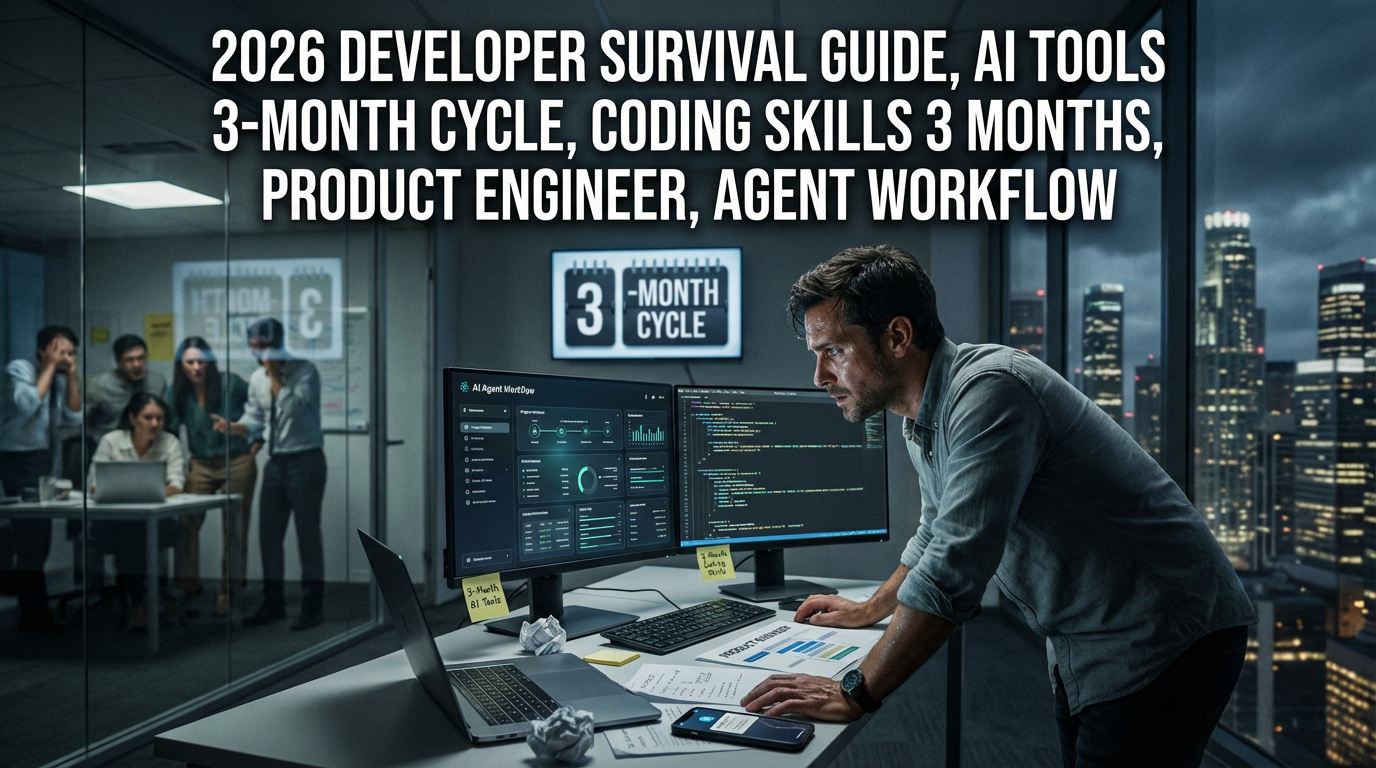

● AI Coding Boom Shatters Jobs Playbook, Tool Wars Ignite, Product Engineers Surge
I will summarize the core points of the ‘2026 Developer Survival Guide and the Future of AI’ revealed by Professor Andrew Ng at Stanford. This isn’t just a technological forecast; it’s a very raw and concrete survival strategy on how the job landscape will change within the next 2-3 years. Please pay close attention, especially to the shocking insight that ‘coding skills have a shelf life of 3 months’ and the ‘collapse of the 1:8 rule’, insights you won’t hear anywhere else.
AI Bubble Theory? Not at All, We Are at the Beginning of ‘Explosive Growth’
1. Broken Scorecards and AI’s True Fundamental Stamina
You’ve probably heard people asking, “Hasn’t the speed of AI development slowed down?” They say there hasn’t been tangible innovation since GPT-4. However, Andrew Ng dismissed this as being due to a ‘broken scorecard (Benchmark)’.
Simply put, the exam paper we give AI is out of 100 points, and AI has already scored 100. Even if AI studies all night and its ability reaches 200 or 500 points, the report card still only shows 100, creating the illusion of a flat graph.
The truly important metric here is ‘Thinking Time’.In the GPT-2 era, it only processed questions as light as a feather, giving answers in 1 second. But now, AI is performing tasks as heavy as a rock, such as writing complex code that would take humans days or finding logical errors.According to research, the depth of thought AI can solve (effective work time) is doubling every 7 months. This means the fundamental stamina of Deep Learning intelligence is exploding at a rate 3.5 times faster than Moore’s Law for semiconductors.
2. The ‘Quantum Jump’ of Coding Ability: The Fear of a 70-Day Doubling Time
The most shocking part is the speed of development in the coding field. The time it takes for AI’s coding skills to jump two-fold, or the ‘doubling time’, is merely 70 days.What does this mean? It means code that a human developer struggles for an hour to write now will be processed instantly without blinking an eye by the AI of 2026.
We now hold ‘AI building blocks’ like Large Language Models (LLM), Retrieval-Augmented Generation (RAG), and Agentic Workflows in our hands. A ‘golden age for individual developers’ has opened, where huge projects that used to require hundreds of PhD-level engineers can now be assembled and created from a corner of a room with just a laptop.
The End of Developers? No, the ‘War of Tools’ Has Begun
1. The Throne Changes Every 3 Months, Do Not Be Deceived by Familiarity
Andrew Ng described the current evolution of Software Engineering tools as “fluctuating crazily.”The speed at which tools like Cursor, Copilot, Claude, and Gemini compete and evolve gives us no time to adapt.
If someone asks, “What is the best coding tool right now?”, the answer will change every 3 months.In this field, if you stick to technology from just half a generation ago—merely 3 to 6 months prior—your productivity will fall behind to an irrecoverable degree.The moment you settle because a familiar tool is comfortable, you become obsolete. Andrew Ng strongly warned that “the flexibility to switch to the latest tools at any time is the only way to survive.”
2. Implementation Has Become Free, the Deciding Factor is ‘Decision’
In the past, ‘implementation’—translating ideas into code—was the most expensive and difficult bottleneck. However, thanks to AI, the cost of implementation is converging to almost ‘0’.So, where is the new bottleneck? It is exactly at the stage of deciding ‘what to make (Product Management)’.
Now, a developer must not be a laborer moving bricks, but a site foreman who looks at the house built by AI and commands, “This pillar isn’t good, build it again.”Rather than technical implementation skills, Product Management skills—quickly reflecting user feedback and giving clear instructions to AI—have become much more critical.
The Collapse of the 1:8 Rule and the Rise of the ‘Product Engineer’
1. The Boundary Between Engineer and Planner Disappears
Silicon Valley traditionally held a golden ratio of ‘8 engineers per 1 planner (PM)’. This was because engineers’ coding speed was slow, so it took a long time to digest the plans thrown by one PM.However, as engineering speed became as fast as a spaceship due to AI coding, this ratio has completely collapsed.
On the front lines right now, the PM to engineer ratio is moving to 2:1, or even 1:1.There is no place for ‘passive developers’ waiting for plans to come down. Only ’empathetic engineers (Product Engineers)’ who read users’ minds, decide what to make themselves, and even code it directly can survive.Now, people who are only good at coding have become the easiest entities to be replaced by AI.
2. The Trap of Big Corporate Brands: The Tragedy of the ‘Java Payment Team’
There was a truly bone-hitting story in the career advice section.”Never go to a company that doesn’t tell you which team you’ll be on, but promises to place you in a good spot once you join.”In fact, there is a case where a promising AI major from Stanford went to a famous big tech company, but instead of cutting-edge AI research, they wasted a year being placed in a team maintaining 10-year-old legacy Java code in the third basement floor.
The company’s flashy signboard doesn’t improve your skills.What makes you grow are colleagues with whom you fiercely debate and exchange code reviews every morning.It’s better to find a place, even if it’s a startup with a humble signboard, where real experts gather and the ‘intellectual density’ is high. That is the only way to launch your career into the stratosphere.
< Summary >
- No AI Bubble: The benchmark scorecard is just broken; AI’s inference capability and coding skills are exploding exponentially.
- Tool Shelf Life is 3 Months: The development speed of coding tools is insane. If you are deceived by familiarity and use old tools, you will be obsolete in an instant. Switch to the latest tools unconditionally.
- Planning Over Implementation: Thanks to AI, coding (implementation) has become easy. Now, the ability to decide ‘what to make’ and design is the key takeaway.
- Collapse of the 1:8 Ratio: With engineering speed increasing, the era of 1 engineer per 1 planner has arrived. Become a ‘Product Engineer’ who does both planning and development.
- Don’t Ask for Permission, Just Build: The cost of failure is only ‘two days of the weekend’. Don’t wait for anyone’s permission; use AI agents right now to build something.
- Colleagues Are Everything: You might end up touching legacy code if you just look at the company signboard. Choose a team with smart colleagues where you can grow together.
*Source: Science Adam