● Trump Dangles Greenland Grab, Bond Yields Dive, Dollar Slips, Nasdaq Rips
The Real Rationale Behind Trump Raising “Ownership of Greenland” at Davos: The Transmission Mechanism Behind the Immediate Market Moves (UST Yields, USD, Nasdaq)
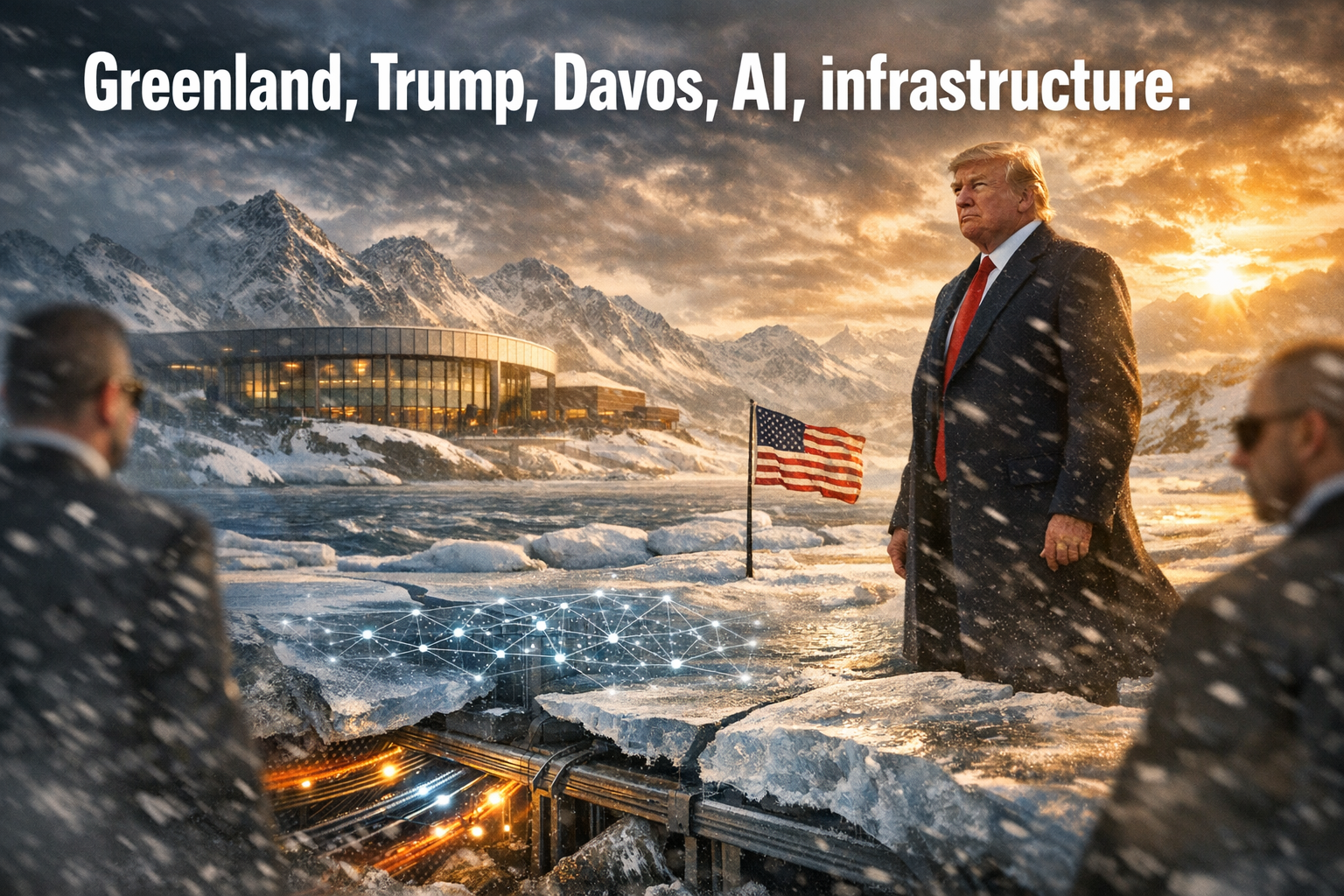
This report consolidates: (i) why Trump publicly stated at Davos that “only the United States can protect Greenland,” (ii) how that statement influenced U.S. Treasury yields, the dollar index, and Nasdaq performance, and (iii) why “no use of force” can signal stronger pressure via tariffs, finance, and supply chains. It also highlights a core point often missed: the Greenland issue is less about resource endowment than about processing, magnets, and power for data centers.
1) News Briefing: Key Davos Remarks
During his WEF (Davos) remarks, Trump stated publicly that no country other than the United States can ensure Greenland’s security.
While expressing “respect” for Denmark and Greenland’s citizens, he referenced a “defense obligation,” establishing a rationale for ownership.
He indicated an intent to pursue negotiations on the premise that ownership (acquisition) is necessary to protect Greenland.
He added that he would not use military force, moderating the tone to reduce near-term escalation risk.
Toward Denmark, he invoked World War II precedent to argue that the United States “protected” Denmark, framing opposition as ungrateful and increasing pressure.
2) Immediate Market Reaction: Why UST Yields ↓, USD ↓, Nasdaq ↑ Occurred Together
The market-relevant point was the implicit acknowledgement of a key risk: if the Greenland issue escalates, Europe could reduce U.S. Treasury holdings.
When that risk is perceived to ease, U.S. Treasury yields typically decline first.
Lower yields reduce the discount-rate burden on risk assets (especially growth equities), supporting Nasdaq.
At the same time, declining yields reduce support for dollar strength, allowing the dollar index to soften.
Mechanism:
“Reduced concern over Europe-driven UST selling (escalation risk)” → U.S. Treasury yields decline → volatility (VIX) declines → risk appetite improves (Nasdaq-led) → USD strength partially moderates
In this context, the “no use of force” line functioned as a near-term stabilizer for global equities.
3) Geopolitical Interpretation: What “No Use of Force” Signals
A pledge not to use force should not be interpreted as reduced pressure.
The more likely approach is maximum leverage through economic instruments rather than military escalation.
The messaging implied conditional retaliation, consistent with tariff, trade, and financial pressure.
The strategic shift is from military confrontation to trade confrontation.
Key variable: EU response options.
Beyond retaliatory tariffs, the EU can deploy non-tariff tools (public procurement limits, investment restrictions, and IP-related measures). The issue may therefore evolve from an apparent territorial dispute into a broader contest over rules, trade, and supply-chain architecture across the North Atlantic and Arctic.
This links directly to supply-chain realignment, with Greenland potentially serving as a justification to accelerate U.S.-centered value-chain reshoring.
4) Consolidated Economic Messaging: Four Davos Themes
1) “If the U.S. is strong, the world is strong” framing
Trump criticized the Biden era as defined by war and inflation, positioning his return as a catalyst for global recovery. This also functions as a negotiating message implying U.S. policy sets the global baseline.
2) Energy and inflation framing (oil and electricity costs)
He criticized Europe’s energy policy (renewables expansion), arguing it raises costs and benefits China. The implicit prescription is that lower energy prices reduce inflation, enable lower rates, and support equities.
3) Tariffs as a “cooperation and relocation” tool
Tariffs were framed not only as punishment but as a mechanism to pull production and value chains into the United States, increasing domestic investment and, by extension, supporting global growth.
4) Digital assets and crypto positioning (rules and legislation)
Statements referencing a “crypto capital” and legislative progress can be interpreted as near-term support for digital-asset markets. However, the impact should be assessed in relation to U.S. Treasury demand, the dollar system, and financial hegemony. A larger stablecoin footprint can increase short-duration Treasury demand, aligning with a liquidity-oriented strategy.
These themes converge on inflation and the policy tension with the Federal Reserve’s monetary stance.
5) Checklist for Korean/Asian Investors: Potential Stress Points
1) U.S. Treasury yield volatility (especially long duration)
If the Greenland topic re-escalates, the “European UST selling” narrative can re-emerge. This increases rate volatility and can pressure growth and technology equities.
2) Defense/shipbuilding/shipping vs. semiconductors/AI
Even without military escalation, focus on Arctic routes, defense infrastructure, and strategic supply chains can support defense and shipbuilding. If markets shift into stabilization mode, lower yields can re-support AI and semiconductors.
3) Dollar direction
A path of “de-escalation concerns → lower yields → softer USD” is plausible. Conversely, “intensified tariff conflict → safe-haven demand → stronger USD” is also plausible. Going forward, rates may be more determinative for the USD than headlines.
4) Commodities and rare earths
The core is less about resource presence than about refining, processing, magnets, and supply-chain control. A simple “resource theme” approach may be riskier than it appears.
6) Key Point Often Missed (Core Takeaways)
Point A: Greenland is not primarily about “large rare-earth deposits,” but about a packaged contest over processing, magnets, and power
In an AI-driven cycle, rare earths matter less as mines than as control over the chain from processing to materials, components, defense applications, and data-center infrastructure. Greenland symbolizes an integrated bundle: Arctic raw materials, strategic basing, and power/infrastructure.
Point B: “No use of force” is not a peace pledge; it is tone management to prosecute trade conflict without destabilizing markets
Explicit military signaling at Davos can spike VIX and drive abrupt rate repricing. The messaging suggests preference for tariff and trade leverage while avoiding immediate market shock.
Point C: The issue ultimately ties to U.S. Treasury supply-demand dynamics
If Denmark (or Europe) signals meaningful UST selling, markets react as a flow and funding shock, not as politics. The real-time indicator is the U.S. Treasury yield curve rather than diplomatic statements, explaining why investors track rates before headlines.
7) Three Forward Scenarios (Probability-Framed)
Scenario 1) “Dialogue mode maintained”
Negotiation framing persists and tensions are managed. Typically supportive for markets (rate stability, relative strength in technology).
Scenario 2) “Tariff/trade pressure intensifies”
Even without military escalation, higher trade-war intensity can lift volatility. Supply-chain realignment accelerates, and pressure for U.S.-located production and investment increases.
Scenario 3) “Financial instruments emerge (UST flow conflict)”
If Europe materially reduces UST exposure, market reaction is likely to be the most severe. The primary risk becomes abrupt yield increases rather than inflation expectations.
< Summary >
Trump reaffirmed the intent to pursue Greenland ownership at Davos while moderating escalation risk through a “no use of force” statement. This combination can support a pattern of lower U.S. Treasury yields, softer USD pressure, Nasdaq outperformance, and lower VIX via reduced geopolitical tail-risk pricing. The core issue is not territorial control per se, but an integrated contest over rare-earth processing and magnets, AI-era power and infrastructure, and the potential reactivation of Europe-related UST flow risk.
[Related Posts…]
Why the Greenland Issue Can Disrupt Global Supply-Chain Realignment
How U.S. Treasury Yield Volatility Drives Equity Market Dynamics
*Source: [ 경제 읽어주는 남자(김광석TV) ]
– [속보] “그린란드 지킬 나라 미국뿐.” “그린란드 지키려면 소유해야…무력은 안쓸것”…트럼프, 다보스포럼 연설에서 야욕 드러내 [즉시분석]
● Trump Tames Greenland Shock, Davos Ignites Trillion Dollar AI Infrastructure War, Korea Memory Cashes In
The “AI Infrastructure War” Was Formalized in Davos: A De-Risking Signal on Trump + Jensen Huang’s “Trillion-Dollar Map” + Where Korean Semiconductors Monetize
Key points in three lines:
First, Trump reduced perceived tail risk around a potential Greenland military scenario, compressing volatility (VIX down) and supporting a risk-asset rebound.
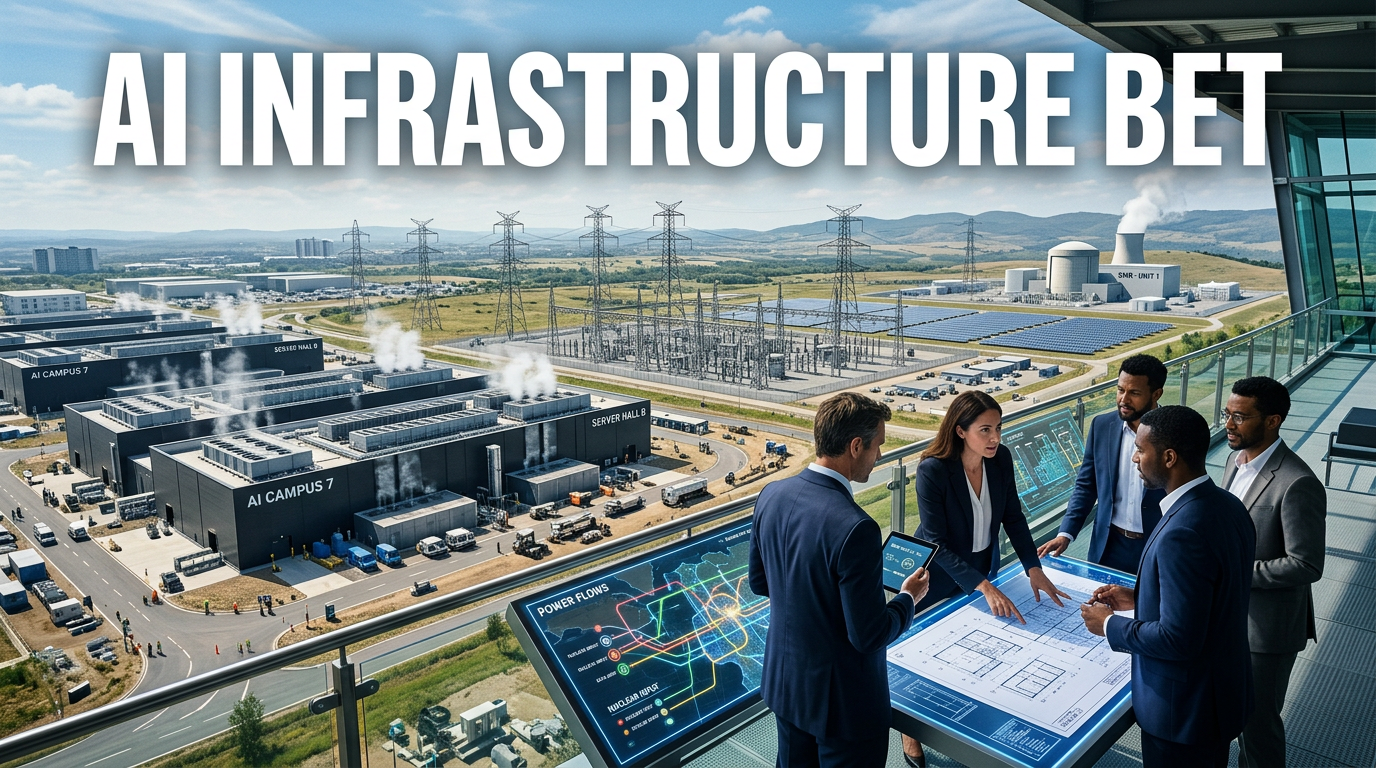
Second, in Davos, Jensen Huang defined AI as the largest infrastructure buildout in modern history and presented a clear capital-flow stack (energy → semiconductors → cloud/data centers → models → applications).
Third, he explicitly referenced SK hynix and Samsung Electronics, underscoring that memory, advanced packaging, and supply-chain constraints are critical bottlenecks in AI infrastructure.
1) The sentence that moved markets: “I will not seize Greenland by force”
News-style summary
– The speech largely reiterated prior messages, but provided a clear signal of reduced geopolitical risk.
– The VIX declined sharply and equities, particularly semiconductors, rebounded.
Key interpretation
– Markets are highly sensitive to policy uncertainty.
– Unexpected geopolitical events (military/territorial) typically command a larger risk premium than tariffs and other economic issues.
– The statement was interpreted as deprioritizing an extreme tail-risk scenario.
2) Davos focal point: Jensen Huang × Larry Fink and the “AI Infrastructure Roadmap”
News-style summary
– Jensen Huang: AI infrastructure is still in its early phase; additional investment of several trillion dollars will be required.
– AI monetization is not limited to models; profitability depends on completion of multiple upstream layers.
Huang’s AI layers (sequence of capital deployment)
1) Energy: As inference scales, power becomes the foundational constraint.
2) Computing/Semiconductors: GPUs, HBM, advanced packaging, networking.
3) Cloud/Data centers: Physical sites where “AI factories” are deployed.
4) AI models: Open vs. closed competition; proliferation of enterprise-specific models.
5) Applications: Primary layer for revenue and cash flow generation, contingent on upstream infrastructure.
Implication
– The investment scale is framed as structurally necessary due to the breadth of required infrastructure.
– This reframes AI from a software-driven theme to an industrial/infrastructure capex cycle.
3) Supply-chain evidence: TSMC, Foxconn, Micron + explicit reference to Korean memory
News-style summary
– TSMC: referenced construction of 20 new semiconductor fabs.
– Foxconn: referenced construction of 30 computing factories with Nvidia.
– Micron: referenced ongoing large-scale investment.
– Jensen Huang: cited “major achievements” by SK hynix and Samsung Electronics.
Why the Korean memory reference matters
– The performance bottleneck is shifting from the GPU alone toward HBM (High Bandwidth Memory) and packaging/power/thermal optimization.
– Korean firms are increasingly positioned not as correlated beneficiaries, but as essential suppliers required for AI infrastructure operation.
– Semiconductor performance may therefore track AI infrastructure capex more directly than traditional cyclical end-demand.
4) Why DeepSeek was framed as demand-accretive rather than a threat
News-style summary
– Huang characterized DeepSeek as a leading open-based inference model.
– Open inference model adoption enables enterprises, universities, and startups to build domain-specific models.
– Conclusion: open model proliferation may expand, rather than reduce, GPU demand.
Key interpretation
– Efficiency gains do not necessarily reduce aggregate compute demand; they often broaden participation.
– Lower barriers increase the number of model builders, raising total training and inference workload volume.
– This mirrors recurring IT patterns where unit-cost reductions expand total usage.
5) Reframing the “AI displaces jobs” debate through an infrastructure lens
News-style summary
– AI infrastructure buildout requires substantial construction, installation, and operations labor.
– Demand rises for skilled trades and technical roles (electricians, plumbers, steel/construction labor, network technicians, equipment installation teams).
– In the U.S., wage pressure has been observed, with compensation often exceeding $100,000 for AI/semiconductor construction-related roles.
Investor-relevant implications
– AI is not solely a software-driven phenomenon; it impacts power, facilities, cooling, networks, components, and labor markets.
– These dynamics can influence inflation (wages) and rates (infrastructure financing), elevating the importance of macro monitoring.
6) On “Is AI a bubble?”: the argument that GPU capacity is deployed and still scarce
News-style summary
– Nvidia GPUs are already installed at scale across major cloud platforms.
– Despite this, access remains constrained and spot pricing has risen in some cases.
– Drivers include rapid increases in the number of AI companies and broad reallocation of corporate R&D budgets toward AI.
– Example cited: pharmaceutical companies (e.g., Eli Lilly) shifting toward AI supercomputing and AI research investment.
Key takeaway
– Practical demand indicators include GPU procurement difficulty/pricing and internal R&D budget reallocation, rather than equity performance alone.
– Persistence would support the view of AI as a structural, multi-year industrial transition.
7) Under-discussed but material takeaways
1) The center of gravity is shifting from “model competition” to “power and capex competition”
– Positioning energy at the base layer is directionally important.
– Analysis may increasingly prioritize access to power, cooling, components, process capacity, and packaging throughput over model-level differentiation.
2) Open models can function as an ecosystem-expansion strategy for Nvidia
– A larger open ecosystem expands the customer base beyond a small group of hyperscalers.
– Spillover demand can extend beyond GPUs to HBM, networking, and data-center equipment.
3) The message that pension funds should participate signals capital-market positioning
– Market pricing may be driven less by short-term narratives and more by how long-duration institutional capital embeds AI infrastructure exposures.
– AI infrastructure-like assets (data centers, power, semiconductor value chain) may increasingly be treated as strategic portfolio allocations.
8) Key variables to monitor (macro + industry)
– Inflation: infrastructure buildouts can lift wages and materials costs.
– Rates: large capex programs are sensitive to financing costs; rate direction affects valuations.
– Tariffs: semiconductor/equipment/component supply chains face potential cost shocks that pressure margins.
– Recession risk: whether AI infrastructure capex remains resilient or is deferred during downturns is a core issue.
– Semiconductors: focus on bottlenecks across HBM, packaging, power, and networking, not GPUs alone.
< Summary >
Trump’s comments reduced perceived geopolitical tail risk, compressing volatility and supporting a rebound led by semiconductors.
Jensen Huang defined AI as a historic infrastructure buildout and outlined a layered capital stack: energy → semiconductors → cloud/data centers → models → applications.
By referencing TSMC, Foxconn, Micron investment plans and explicitly citing SK hynix and Samsung Electronics, he highlighted memory, packaging, and supply-chain constraints as key bottlenecks.
The spread of open inference models such as DeepSeek may expand customers and aggregate workloads, potentially increasing compute demand.
AI is increasingly characterized as an infrastructure-driven industrial cycle affecting power, facilities, and skilled-trade labor markets, with implications for macro conditions.
[Related Articles…]
- The semiconductor supercycle: why AI infrastructure is structurally different
- When rate direction shifts: valuation impacts on growth equities and infrastructure assets
*Source: [ Maeil Business Newspaper ]
– [속보] 젠슨황 “SK하이닉스, 삼성전자 엄청난 성과내는 중”. 트럼프 달래기에 화답한 증시 | 홍장원의 불앤베어