● Tesla Driverless Robotaxi Ignites Fare Collapse, Wage Reset, Power War, Humanoid Rush
Tesla’s “Driverless Robotaxi” Switch: (1) Transport Fare Compression (2) Manufacturing Labor Cost Reset (3) Electricity as the Core AI Power Contest (4) A 2027 Humanoid Commercialization Path — Consolidated Overview
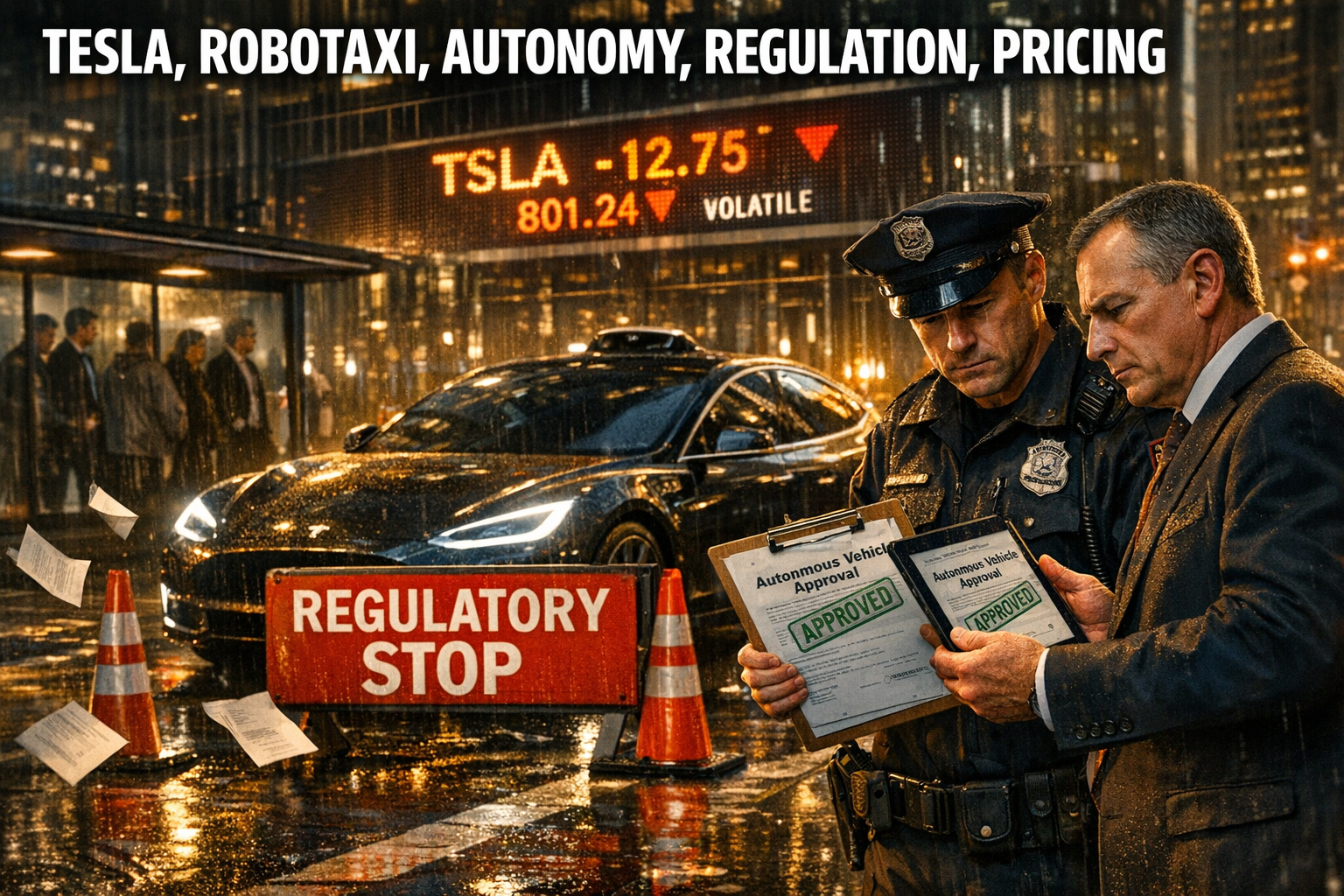
The significance of “an empty driver’s seat” reportedly observed in Austin extends beyond a technology demonstration. The implications should be assessed through (i) economics (cost structure), (ii) regulation (Europe and China), and (iii) power infrastructure (solar + Megapack).
1) Breaking Update: Reported Observation in Austin of Unsupervised Driverless Operation
Footage shared from Austin (Texas) reportedly shows a vehicle with an empty driver’s seat and no onboard safety monitor.
Key Takeaways
This is being interpreted as a signal that operations have moved closer to true driverless deployment. It suggests Tesla may believe, based on internal data, that human intervention is no longer operationally necessary in certain conditions. The commercialization inflection point is shifting from technical capability to regulatory authorization and monetization structure.
Link to Davos Messaging: “Autonomy Is Essentially a Solved Problem”
Such messaging frames autonomy as moving from engineering to scaling and approvals. At this stage, valuation sensitivity shifts from technical debates toward where and under what conditions autonomous services can generate revenue.
2) Near-Term Variable (February): Significance of Messaging Around Europe and China Approvals
The text references expectations for near-term approval of a supervised version in Europe and China.
Why This Matters
China is the largest EV market and typically enforces stringent requirements on data governance, mapping, and regulatory sovereignty. Europe generally applies strict safety rules and lengthy certification processes.
Market Implications
If approvals progress, Tesla’s revenue mix can shift from one-time vehicle sales toward software and subscription-style recurring revenue with network effects. This can move the investment narrative toward a platform-like cash flow model rather than being dominated by short-term macro variables.
3) Core Disruption from Robotaxis: Structural Price Pressure on the Mobility Market
A 5 km trip cost comparison is used as an illustrative benchmark.
Fare Benchmarks (as presented)
- Waymo: ~KRW 27,000 (approximately USD 19) example
- Kakao Taxi: ~KRW 9,400 (approximately USD 6.5)
- Tesla (ARK estimate): cost ~USD 0.25 per mile → ~KRW 3,000 range for 5 km
The Central Issue: Cost Structure
Waymo’s cost base can reflect high sensor costs (e.g., lidar) and operational overhead. Traditional taxis embed labor as a major cost. A Tesla-style robotaxi model targets near-zero driver labor cost, shifting the cost stack toward vehicle capex, insurance, maintenance, depreciation, and electricity.
If sustained, this can compress the mobility price reference point and blur boundaries between taxis and mass transit, lowering the baseline cost of commuting.
4) If the “Vehicle Brain” Scales, the Next Deployment Surface Is Humanoids (Optimus)
The argument is that if general driving intelligence is validated across complex environments (intersections, pedestrians, adverse weather), porting that capability into a humanoid platform becomes a timeline and execution question.
2026–2027 Scenario (as presented)
- 2026: robotaxi scaling and early mass adoption signals
- 2027: expansion of Optimus commercial sales and factory deployment
Economic Interpretation
In transport, driver labor cost is removed. In manufacturing, assembly, welding, and intralogistics labor economics are redefined. This may represent a broader global manufacturing cost-curve shift rather than a company-specific upside.
5) Quantifying Manufacturing Impact: UAW High-Wage Structure vs Humanoid Operating Cost
The text provides a simplified comparison.
Human Labor (U.S. Auto Manufacturing)
- All-in wage + benefits cited at ~USD 80/hour (~KRW 110,000)
- Additional constraints include labor negotiations, strike risk, and shift scheduling requirements
Optimus (cited via industry analysis-style assumptions)
- Operating cost ~USD 5.7/hour (~KRW 8,000), assuming electricity, maintenance, and upfront cost allocation
- Target utilization: ~22 hours/day (excluding charging/battery swap time)
Strategic Paths for Companies
1) Margin expansion (hold pricing; increase operating leverage)
2) Price compression (pass through cost reductions; force competitor exit)
Investor focus can shift from EV unit growth to the magnitude and speed of manufacturing cost-curve reduction, with implications for supply-chain reconfiguration.
6) Korea / Hyundai Union Dynamics: Robot Adoption as Political Economy, Not Engineering
The text highlights resistance to robot adoption within organized labor dynamics.
The Key Variable: Adoption Speed
If automation deployment is delayed by prolonged labor negotiations or social consensus processes, cost competitiveness can deteriorate. The trade-off is that slowing automation may not preserve jobs if it results in production footprint risk.
This can broaden from a single-company issue into a national manufacturing productivity–employment–distribution policy challenge.
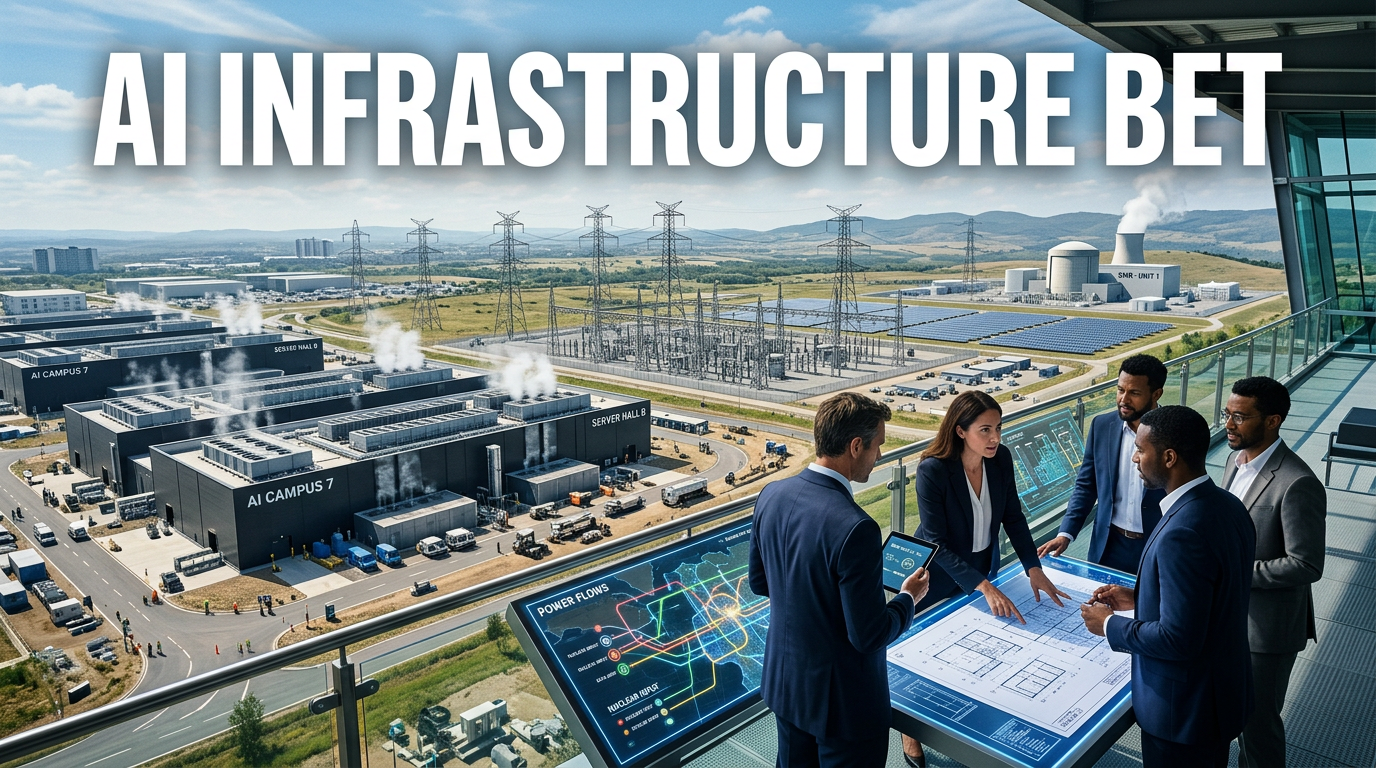
7) Tesla’s Primary Strategic Shift: AI Bottlenecks Moving from Semiconductors to Electricity
The text asserts a pivot: the limiting factor for AI progress becomes electricity availability and cost rather than chips.
Why Power Becomes the Constraint
Robotaxi fleets increase transport electricity demand. Humanoid deployment increases factory electricity demand. AI data centers (training and inference) add additional load. Electricity therefore becomes a binding cap on scaling.
This ties directly to energy security, grid investment, transmission expansion, and generation mix policy (nuclear/solar/gas).
Tesla’s Proposed Approach (as described)
Large-scale solar deployment on Texas-like land footprints plus Megapack storage to reduce grid dependence and stabilize/decline marginal energy cost.
The text cites an aggressive directional plan: within ~3 years, Tesla + SpaceX each at 100 GW of solar, totaling 200 GW. If executed, the company’s model trends toward vertical integration of energy generation, storage, and consumption (vehicles/robots/data centers), potentially increasing resilience to inflation and commodity volatility.
8) Why Korea Faces Higher Constraints: Land and Grid Expansion Limitations
Large contiguous solar deployments can be structurally harder in geographies with limited suitable land and higher siting conflict. With fusion commercialization not near-term (the text references 2050), the 2027–2040 gap increases the importance of energy policy and power market design.
This is positioned as a national competitiveness issue for manufacturing and AI, not merely a technology race.
9) Frequently Missed Core Points
(1) Robotaxis Redefine the Mobility Price Reference Point
If fares approach bus/subway levels, the purchase decision shifts from ownership to on-demand mobility. This implies redistribution of revenue pools from vehicle sales to mobility services rather than a simple reduction in addressable market.
(2) Tesla’s Competitive Set Extends Beyond Automakers to Power, Cities, and Labor Regulation
After technical feasibility, constraints include approvals, insurance and liability frameworks, power grids, and city operations. Execution depends on navigating institutional and infrastructure bottlenecks.
(3) The Fundamental Value of Optimus Is a New Production Function Below Global Minimum Wage Cost
The key impact is not “replacing workers” but structurally altering cost accounting for production. This links to labor markets, income distribution, and welfare finance sustainability.
(4) The AI Contest Becomes a kWh Price and Reliability Contest
At scale, electricity pricing and supply stability can dominate operational advantage, even amid intense semiconductor competition. Jurisdictions and firms with lower-cost, reliable power can capture higher AI productivity.
(5) “FSD Approval” Is a Cash-Flow Model Transition, Not a One-Off Event
As approvals expand, recurring software/service revenue can outweigh hardware-driven revenue. Valuation sensitivity can shift toward long-duration cash flow visibility.
10) Practical Verification Checklist
- Geographic scope of driverless operation (urban/suburban/night/rain)
- Liability and responsibility structure in incidents (insurance, product liability)
- Approval conditions in Europe and China (data localization, mapping rules, safety standards)
- Whether robotaxi pricing reflects temporary promotion or sustainable unit economics
- Optimus real task coverage (logistics/assembly/inspection) and reliability/maintenance system
- Scale and linkage of power infrastructure investment (solar, batteries, data centers) to monetization model
Summary
Reported observation of driverless operation without a safety monitor in Austin suggests a potential transition from demonstration to early operational deployment. Near-term attempts to secure Europe and China approvals could shift Tesla from vehicle-sales dependence toward recurring software and service revenue. If robotaxi economics compress fares toward mass-transit levels, the mobility price reference point may reset and ownership behavior may shift. Optimus could redefine manufacturing labor economics, enabling margin expansion or price-driven competitive disruption. The primary scaling constraint for AI may shift from semiconductors to electricity, with Tesla positioning solar + storage vertical integration as a mitigation strategy.
Related Links
- https://NextGenInsight.net?s=Robotaxi
- https://NextGenInsight.net?s=Power
*Source: [ 오늘의 테슬라 뉴스 ]
– 속보!! 테슬라 마지막 퍼즐 무인 로보택시 시작, 테슬라 2027년 로봇 상용 판매 시작!!
● Driverless Tesla Robotaxis Hit Austin, Stock Pops
Tesla Launches “Unsupervised Robotaxi” Operations: Now Rideable in Austin, and Why the Market Reacted Immediately
This report covers:
1) Where and how “unsupervised (no safety driver)” robotaxis have begun operating in real conditions.
2) Early operating design observed in videos (chase/validation vehicles, feature constraints, UI flow) and signals consistent with pre-commercial readiness.
3) The economic impact of robotaxi unit costs (cost per mile), and potential implications for inflation and labor markets.
4) The Cybercab production S-curve and how scaling speed links to revenue and valuation.
5) The primary takeaway: this is not a “technology reveal,” but the beginning of an operational (Ops) transition.
1) News Briefing: Confirmed Facts Only
Headline : Footage confirms Tesla “unsupervised robotaxi” vehicles operating in Austin, indicating formal rollout sequencing has begun.
What happened
– Video-based evidence shows the vehicle operating without an in-cabin safety driver (monitoring driver removed).
– Statements circulated that passengers can already ride the robotaxi service in Austin; ride content is spreading.
– Commentary noted the stock moved sharply higher shortly after video confirmation, consistent with markets pricing an “operations start,” not a concept demonstration.
Where
– Austin, Texas (notable as a core testbed and proximate to Giga Texas).
How it runs (as observed)
– A Model Y followed the robotaxi as a chase/validation and response vehicle.
– Passengers rode in the rear seat and viewed destination/ETA on the in-car screen (e.g., “13 minutes remaining”).
– User experience was described as largely similar to supervised rides, implying the product flow was already established.
2) What “Unsupervised” Means: Regulatory and Operational Leverage Over Pure Technology
Unsupervised is an operating-cost inflection, not a technology demo
– Removing the safety driver materially changes the cost structure.
– Robotaxi economics are fundamentally a transportation-services problem, where labor is typically the dominant cost component.
– This shift supports a valuation framework that moves from “vehicle manufacturer” toward “AI-enabled mobility platform.”
Current stage is not full scale autonomy; it is the first step in an Ops transition
– The presence of a chase vehicle indicates risk reduction while accumulating operational data and procedures.
– This phased approach can simplify risk communication with regulators during city and state expansion.
3) Product Status From Ride Footage: “Near-Commercial” Signals vs. “Still Locked” Functions
Near-commercial signals
– Reported stable operation during higher-traffic conditions, suggesting baseline robustness in mixed traffic.
– Robotaxi-oriented UI appears organized (passenger display, ETA, entertainment).
– Pricing was reportedly set at levels comparable to existing robotaxi offerings, implying pricing and billing readiness.
Still-locked functions (material)
– Mid-ride destination changes were attempted but not allowed in the current unsupervised mode.
– This indicates prioritization of operational stability over feature completeness, limiting dispatch and routing variability to reduce incident probability.
Early quality issues (operational detail)
– Stop-position optimization (stopping slightly beyond the passenger’s location) was observed; while minor, it can affect customer satisfaction and ratings.
– Such issues typically improve with operational data and iterative tuning during early scaling.
4) Pricing and Economics: The Implication of $4.31 for 3.3 Miles
A shared example cited $4.31 for a 3.3-mile trip.
Why markets react
– The price point was characterized as roughly “half of traditional taxis” and “below Uber” in comparable scenarios.
– If chase-vehicle costs decline and utilization scales, cost per mile could compress further, reinforcing the deflationary potential of autonomous transport.
Macro implications
– Lower mobility, logistics, and last-mile costs can create structural pressure on service-sector prices over time.
– Reallocation of driving-related labor demand would be a likely second-order effect.
Investor framing
– The core sensitivity is margin structure, not only revenue.
– Vehicle sales are more cyclical and rate-sensitive, while platform-like transportation services can exhibit operating leverage if network utilization improves.
5) Cybercab and the S-Curve: Scaling Is Constrained by Production as Much as Software
Commentary connected potential Cybercab production start timing (from April) with the expectation that new models follow an S-curve ramp.
Why the S-curve matters
– Early volumes may appear limited, but process stabilization, supply-chain optimization, and learning effects can accelerate output in later quarters.
– In robotaxi economics, “city expansion” and “fleet insertion rate” jointly cap revenue capacity.
Model Y now, Cybercab later
– The current phase appears to use Model Y vehicles.
– Over time, the fleet could shift toward Cybercab as production scales.
– A dedicated robotaxi platform is structurally advantaged for minimizing cost per mile, the primary competitive metric.
6) Regulation and Expansion: Signals From State-Level to Federal-Level Pathways
There was an implication that progress is being made toward a federal-level framework rather than purely state-by-state approvals.
Why this would be high impact if realized
– Robotaxi rollout is typically slowed by fragmented city/state rules on permits, insurance, and liability.
– Movement toward federal standards or guidance could materially increase scaling speed.
China and global expansion
– Discussion referenced a pattern of FSD availability in China being enabled, constrained, and potentially re-enabled.
– Demonstrated unsupervised operations in the U.S. could raise external pressure for adoption in other markets, shifting the issue toward national industrial and transportation policy.
7) Why the Market Watches Insurance: The Value of Third-Party Validation
The discussion highlighted Lemonade and insurance context related to Tesla/FSD.
Core logic
– Aggressive pricing by an external insurer implies confidence in risk and expected loss outcomes.
– Third-party underwriting signals can carry more weight than internal safety claims.
Operational implication
– Robotaxi scaling depends on an integrated stack: technology, regulation, insurance, and operations.
– When insurance becomes established, the business becomes more cash-flow modelable, increasing sensitivity to macro variables such as rates and risk appetite.
8) Key Takeaways Often Underemphasized
1) This is an Ops transition, not a pure autonomy milestone
– Safety-driver removal is more consequential at the business-model and unit-economics level than as a standalone technical claim.
– The shift is from “reducing accidents via algorithms” toward “managing incidents through operational systems.”
2) “No destination change” is a rational commercialization constraint
– Many edge cases originate from user-driven variability.
– Locking variables early and unlocking features after stabilization can increase scaling velocity.
3) Chase vehicles are an operational risk-control and regulatory data pipeline
– They reduce risk while creating response protocols and evidence for incident handling.
– This can strengthen the approval case during geographic expansion.
4) The primary competition is cost per mile and utilization, not ride smoothness
– Commercial outcomes are driven by utilization, maintenance, and insurance costs.
– At scale, this can translate into a productivity impulse with broader macro relevance.
9) Forward Watchlist (Investing, Macro, AI)
– Edge-case evidence: performance in rare scenarios (wildlife, construction zones, sudden cut-ins) as incident logs accumulate.
– Feature-unlock roadmap: timing for destination changes, reroutes, and stop-position optimization as service features.
– Cybercab ramp: production trajectory in later quarters as a key determinant of expectations.
– Insurance and incident-rate data: third-party datasets as the catalyst for market confidence.
– Macro linkage: if robotaxi penetration pressures service inflation, it could marginally influence policy-rate expectations.
< Summary >
– Tesla’s “unsupervised robotaxi” has been observed operating and carrying riders in Austin, indicating progression toward commercialization.
– Chase-vehicle accompaniment and feature constraints (e.g., no destination changes) align with an early-stage operational risk-management strategy.
– The cited $4.31 for 3.3 miles illustrates potential price disruption, with longer-term implications for service inflation and labor-market structure.
– Cybercab production scaling (S-curve) is a central driver of deployment speed; insurance and third-party validation are likely to accelerate market acceptance as data becomes available.
[Related Links…]
How Robotaxi Adoption Reshapes the Mobility Industry
Checkpoints for Growth Stocks (Including Tesla) When Rate Trends Shift
*Source: [ 허니잼의 테슬라와 일론 ]
– [테슬라 라이브] 대형 속보! 드디어 최초의 ‘무감독’ 로보택시가 나왔습니다!
● Essential-spend surge, dining crash, rice-cooker boom
Reinterpreting the “Rice Cooker” Video Transcript Through an Economic and Investment Lens: Consumers Are Allocating Spend Only to Core Value (“Staple Meals”), Consistent With the Likely 2026 Macro Backdrop
This report covers:
- How to read the video’s core message as consumer-psychology signal rather than advertising copy.
- Why “value-for-money durable goods” (rice cookers) are regaining demand in a high-inflation, high-rate environment.
- A frequently missed point: the product is positioned as “home-meal automation” and “time savings,” not cooking.
- Consumer trends likely to persist through 2026 and implications for companies and investors.
1) News-Style Summary: What Occurred in the Source Content
[Scene 1] “Today I will drop economics and try cooking.”
This is positioning, not a literal shift in topic. The speaker adopts a “relatable messenger” stance rather than an “expert,” a common trust-building tactic in categories with high information asymmetry (economics/investing/appliances).
[Scene 2] Feature walk-through: high-pressure/non-pressure, ultra-fast, baby food, steaming/soup
Differentiation is communicated as problem-solving rather than feature listing. Core claim:
“One rice cooker covers rice + cooking + baby food; it can substitute for dining out.”
[Scene 3] 15-minute cooking, various dishes
The objective is not culinary sophistication but proof of feasibility under time constraints. “Ultra-fast cooking” reduces the primary adoption barrier (friction/effort) and accelerates switching to home meals.
[Scene 4] Closing: “Rice carried the meal,” “Staple meals drive the household,” “Food-cost savings”
As an economic signal, this indicates demand reallocation:
Dining out (services) → Home meals (goods + appliances + groceries)
This substitution tends to strengthen during elevated inflation.
2) Macro-Relevant Points Embedded in the Content
2-1. In high inflation, consumption reallocates from “small luxuries” to “large savings.”
As dining-out prices rise, households rationalize spend on durable goods that reduce recurring costs. Rice cookers function as “savings-enabling purchases,” which gain legitimacy as inflation persists.
2-2. High-rate psychology: as financing becomes costlier, consumers buy only high-utility items.
Spending slows but does not stop; criteria tighten. “Nice-to-have” demand weakens while “avoid-loss” purchases remain. The product is positioned as the latter.
2-3. FX and import-cost volatility can structurally reinforce home-meal substitution.
When exchange rates are unstable, imported inputs and energy costs fluctuate and are more readily passed through to restaurant pricing, encouraging households to revert to home meals. The sensitivity increases with FX volatility.
2-4. Recession risk elevates “substitutes.”
Consumers seek tools that replicate dining-out satisfaction at home. Premiumization and multi-cooker functionality act as central substitutes.
3) AI and Automation Lens: What the Appliance Trend Indicates
3-1. The future of cooking is process automation, not recipes.
The key value is automation elements—pressure/non-pressure modes, time compression, and reduced failure risk—rather than the specific dishes. This is a core entry point for AI-enabled appliances.
3-2. AI adoption is driven first by reducing failure probability, not maximizing taste.
A major barrier to home cooking is fear of poor outcomes. Sensors and automated programs increase usage frequency by lowering failure rates. The “rice carried the meal” framing underscores reliability as the value driver.
3-3. Data accumulation supports appliances evolving into personalization platforms.
Cook times, texture preferences, usage patterns, and menu frequency can enable personalized recommendations and integrated commerce flows:
Appliances → dietary habits → commerce
4) Key Points Commonly Underemphasized
Point A. The content sells “justification for substituting dining out,” not the cooker itself.
The price point is secondary to the household budget logic:
Good staple quality enables at-home satisfaction → lower food expenditure
This is budget narrative engineering rather than product-only marketing.
Point B. “Non-expert posture” is a high-conversion persuasion style in low-trust environments.
Peer-like delivery can outperform authority-based messaging when institutional trust is weak.
Point C. The core message is “buy time,” not “buy features.”
Comparisons such as “faster than buying ready-made rice” monetize time savings. Current demand increasingly prices time efficiency into purchase decisions.
5) Investment and Business Implications: How to Track the Next Leg
5-1. Within durables, “food-cost reduction” categories show relative resilience.
Prolonged inflation supports spending on “home-meal infrastructure”: rice cookers, multi-cookers, air fryers, freezing/storage, and compact kitchen appliances, which often move as a basket.
5-2. Premium does not disappear; only “explainable premium” persists.
Higher price points sustain where the value equation is explicit and measurable (taste quality + time savings + functional breadth).
5-3. Content commerce is shifting toward “life-solution” formats.
The center of gravity is moving from product reviews to outcome-based narratives: “one-meal solution,” “food-cost savings,” and “low-failure for beginners.” This format is likely to strengthen when combined with AI personalization and recommendations.
Frequently co-cited global variables that reshape consumption:
- Inflation
- Interest rates
- Exchange rates
- Recession risk
- Supply chains
< Summary >
The source content presents as cooking entertainment, but functionally supports durable-goods demand by legitimizing “dining-out substitution” and “time savings” in a high-inflation, high-rate environment. The message can be reduced to “reliable staples carry the meal,” aligning with automation trends that reduce failure probability and increase usage. Given ongoing inflation and FX uncertainty, demand for home-meal infrastructure and food-cost-reduction appliances may remain comparatively durable through 2026.
[Related Articles…]
-
https://NextGenInsight.net?s=exchange%20rates
Why household consumption and investment positioning shift together amid exchange-rate volatility -
https://NextGenInsight.net?s=inflation
A framework for “survivable consumption” under persistent inflation
*Source: [ Jun’s economy lab ]
– 두쫀쿠 장사 시작합니다(ft.최강록 버전)