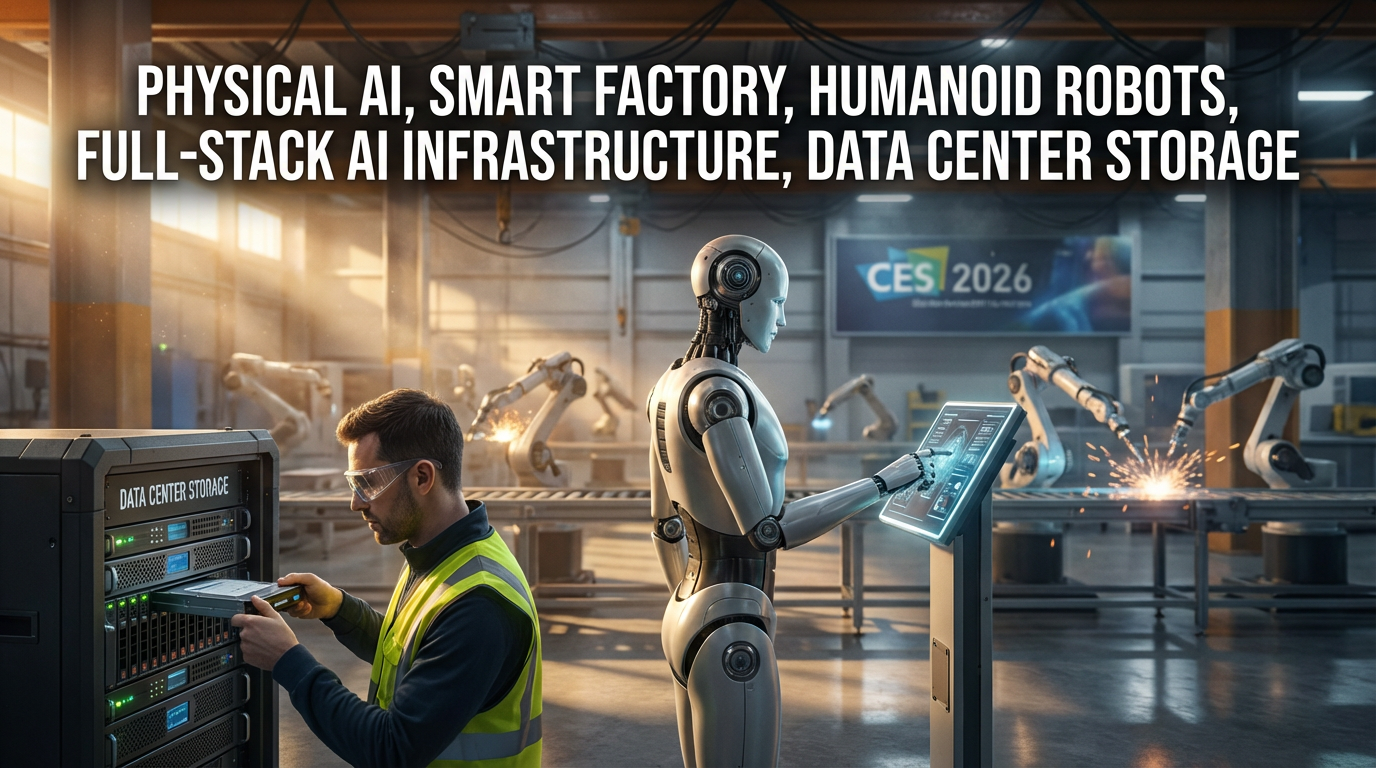
● CES 2026 Shock, Physical AI Takes Over, Robots Autonomy XR Power Data Centers Win
CES 2026, Why I was convinced “Physical AI is everything”: A comprehensive roundup from robots and autonomous driving to XR and AI infrastructure
The real important thing at CES 2026 was not just “there were a lot of robots.”
The commercial rollout speed of Physical AI (robots and autonomous driving) accelerated faster than expected, and
it is not that the LLM era has ended but LLMs have become the default, and now the contest will be decided by AI infrastructure (power, data centers, storage) + operations + manufacturing (smart factories) — that was the core point.
Moreover, based on on-site impressions, China’s “quality + vertical integration” was much more threatening than expected as well.
1) One-line conclusion from CES 2026: It’s turning from CES to ‘BES (Business Expo)’
Originally the C in CES stood for Consumer.
But the atmosphere in 2026 felt so B2B that you would wonder “Is this really a consumer electronics fair?”
The reason is simple.
The core point was Physical AI, and this is not yet a product you put one in every home, but an area where companies make money first.
Digital health and mobility still feel CES-like, but
humanoids, factory automation, autonomous driving, and AI operations infrastructure were typical B2B plays.
2) Korea’s presence: 206 out of 347 Innovation Awards went to Korean companies
The fact that 206 out of 347 Innovation Awards went to Korean companies is quite symbolic.
It can be read as a signal that “Korea is still strong in hardware/manufacturing-based innovation,”
and at the same time it’s a task: now Korea must take a larger role in the B2B Physical AI chain to survive.
3) Main news from CES 2026: Robots and mobility are merging into ‘Physical AI’
What captured everyone’s attention at CES was robots,
and among those robots, humanoids definitely rose to the mainstream.
Robots and autonomous driving (mobility) are no longer separate but are opening markets grouped as
AI that moves and works in the real world = Physical AI.
4) More important than flashy shows is the hand: Dexterity determines productivity
One of the most practical things I heard on site was this.
Backflips, boxing, tricks… of course they’re flashy as demos, but
what makes money in the end is the hand.
The reason is companies buy robots for productivity, not for show.
As hand dexterity improves, what is possible expands significantly.
- Assembly (electronics/automotive parts)
- Inspection/sorting/packaging
- Logistics picking (picking items in warehouses)
- Replacing hazardous work (harmful environments)
From here the logic changes from “robots are fascinating” to “robots yield ROI compared to humans.”
5) Humanoid adoption speed outlook: 2025 is ‘the start’, post-2030 is the ‘explosion phase’
The original estimate for humanoid production in 2025 was about 15,000 units.
At that level, it’s true that “very hyped but actual adoption is still limited.”
But the important point is not 2027–2029;
from 2030 onward, annual figures of 1 million to 2 million units began to be mentioned.
At that stage it becomes an ‘industry’ rather than a ‘product.’
6) The most frightening scene: The owner of CES Central Hall has become China
In the past “a central good spot = top-tier companies like Samsung/LG” was the strong image,
but this time TCL, Hisense, Dreami and other Chinese companies had a much stronger presence — that was the core observation.
The point here goes beyond “cheap.”
Now in many areas quality has also improved, allowing them to encroach on the market.
7) The essence of Chinese robots: In 10 years ‘20% component self-sufficiency → 80%’ completing vertical integration
This percentage almost explains everything.
The scary thing about China is not just “they make robots well” but that
they can run components-manufacturing-procurement-cost-scaling all at once.
That’s why there are views that humanoid costs could drop from $150,000 to around $100,000.
When costs fall, adoption opens up, and when adoption opens, software/platforms attach,
and at that moment the growth curve can steepen like AI.
8) A cold point from an investment perspective: Valuations can overheat until mass production is achieved
Demos like Boston Dynamics’ Atlas shake stock prices and sentiment a lot.
But what investors must ultimately check are below.
- Actual mass production feasibility (production lines/supply chain/yield)
- Buyers (who is buying, at what unit price, and how many)
- After-sales/service and operating costs (widespread adoption is hindered if field operation is unexpectedly expensive)
- CAPEX scale and payback period
In short, “robots working in demos” and “making money from robots” are different stages.
This distinction will become especially important in the 2026–2028 market.
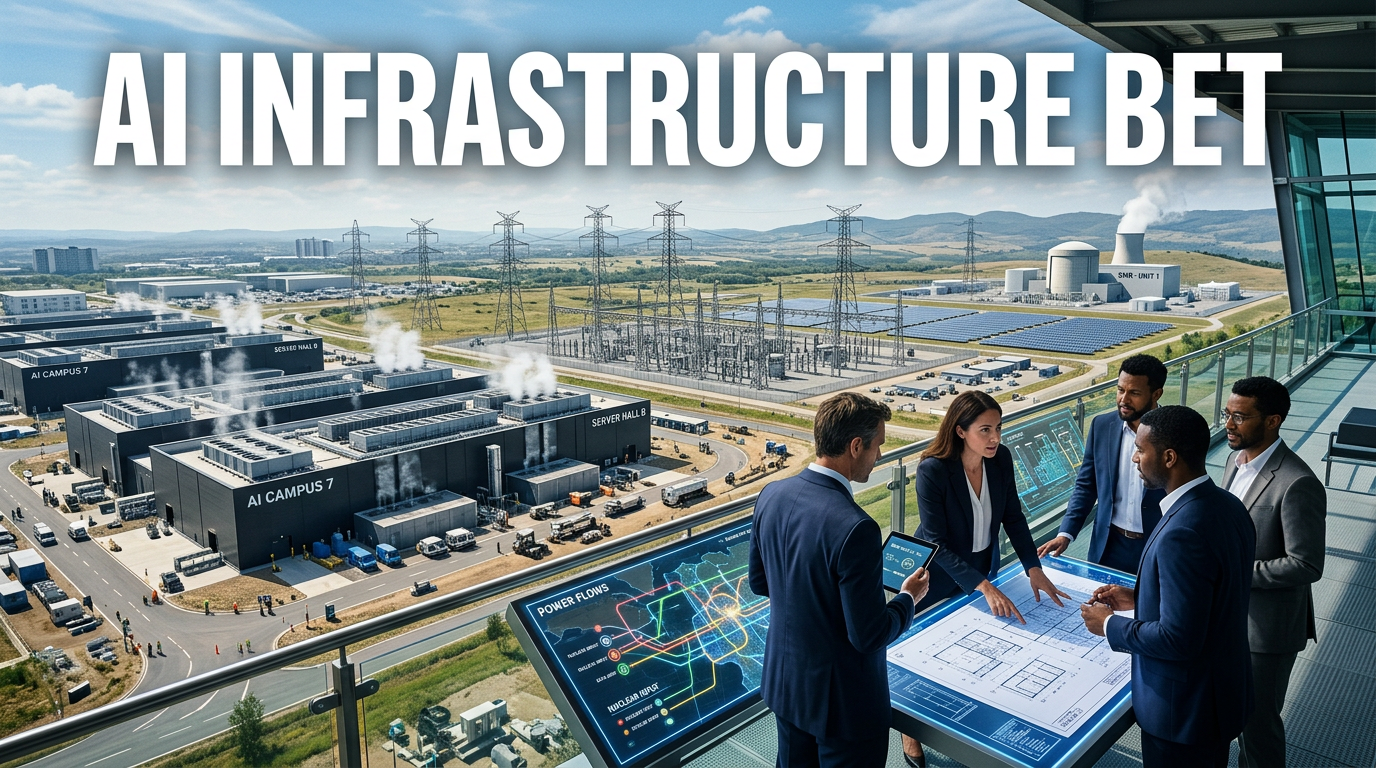
9) CES 2026’s hidden main message: From LLM to ‘full-stack AI (infrastructure + operations)’ shift in emphasis
Now LLMs (chatbots) are a baseline feature,
and the winners will be “companies that actually keep scaling and operating AI without interruption.”
If you realistically divide the axes that make up full-stack AI, it feels like this.
- Power infrastructure: Without electricity, neither GPUs nor factory automation can function
- Data centers: The factories for training/serving AI models
- Semiconductor supply chain: Not only GPUs/HBM but memory overall
- Operations: You must manage outages/costs/scalability for it to become a business
- Endpoint form factors: Ultimately AI must attach to the user to spread (after smartphones, XR is possible)
This trend is already strongly reflected in global stock markets,
and it is directly connected to macro variables like interest rates and inflation.
(Expanding data centers inevitably explodes CAPEX and power demand.)
10) Conclusion from trying XR glasses: The next form factor might be glasses, not the smartphone
Smartphone-based AI has improved, but the flow of use is interrupted.
Taking it out, capturing, inputting, then checking again is more cumbersome than expected.
XR/AI glasses take a different direction.
They can use vision as direct input, and combined with voice + camera + display they provide real-time assistance.
Ultimately they become a hardware agent.
- Real-time translation/subtitles
- Information overlay of what you’re looking at (AR)
- Recording (daily summaries, automatic work logs)
- Immediacy in work/travel (reducing friction)
And the scary point here is that Chinese companies quickly follow at “half the price.”
11) Manufacturing value rises again: Physical AI is completed by the ‘smart factory’
There used to be a strong perception that “R&D and services are high-margin while production has thin margins.”
But when Physical AI is adopted widely, the story changes.
Factories themselves become optimized by software (digital twin),
robots remove human bottlenecks,
and if supply chains are reorganized due to geopolitical risk (reshoring/friendshoring),
production capacity itself becomes a strategic asset.
Here ‘smart factory’ is not simple automation but includes stages where AI simulates processes, optimizes equipment operation, and reduces defects.
This phase moves in tandem with global supply chain realignment, so it can react sensitively to exchange rates and trade policy changes.
12) Why storage is being revalued: “AI cannot run on HBM alone”
One of the sharpest investment points in the original text was this.
For a while the market ran on AI = GPU = HBM,
but in reality DRAM and NAND (storage) are also required to complete the puzzle.
The core logic is as follows.
As inference grows, the memory structure that handles context/cache (such as KV cache) becomes a bottleneck,
and if this is well-designed up to the storage tier, performance/cost efficiency changes significantly.
Therefore, data center investment expansion → increased demand for storage → revaluation of related companies is the flow being created.
This trend is likely to continue structurally along with data center expansion, not just a fad.
13) Checklist to watch during earnings season: Only companies that convert AI into revenue remain
AI has entered a phase where ‘hype’ and ‘cash flow’ diverge.
When reviewing earnings, look beyond simple EPS to the following.
- Has the AI feature actually driven revenue growth?
- Did AI adoption bring cost reductions (labor costs/operational costs/customer support, etc.)?
- Does it achieve both at the same time (a truly strong case)?
- AI-related CAPEX has increased, but is there a visible payback structure?
Ultimately the companies that survive here are more likely to become the next leaders of global stock markets.
14) The most important points that other news/YouTube often don’t mention, summarized separately
- The essence of CES 2026 is not a ‘robot show’ but a ‘B2B shift’
→ It has become more an “exhibition where companies make money” than consumer electronics, and investment focus is moving that way - The battleground for humanoids is the ‘hand (dexterity)’
→ Tricks aside, task execution ability creates ROI - China’s real weapon is not ‘low price’ but ‘vertical integration (component self-sufficiency)’
→ Cost reductions and mass-production speed could create gaps - The LLM era is not over but has become ‘the default’, and now the contest is full-stack AI (power, data centers, operations)
→ AI infrastructure is why long-term winners are likely - The next fight in AI memory is not HBM alone but the ‘memory stack’ including DRAM+NAND
→ Storage could be the key to solving performance/cost bottlenecks
15) 2026–2030 scenarios seen as economic keywords (practical framework)
All these changes ultimately converge to economic variables.
- Interest rates: Data center/manufacturing automation CAPEX expansion ties directly to cost of capital
- Inflation: Robot adoption can absorb labor cost pressures (potential structural factor for price stability)
- Exchange rates: Supply chain realignment and manufacturing competitiveness affect export company performance
- Global stock markets: Capital may continue to flow into AI infrastructure, robotics, and power-related sectors
- Data centers: Investments cascade across power/storage/networking/cooling (the ‘spine’ of industrial convergence)
< Summary >
CES 2026 resembled a B2B-centered “Physical AI exhibition” more than a consumer electronics show.
The core point is that the commercialization of robots and autonomous driving has accelerated, the battleground for humanoids is dexterity of the hand, and China is dominating cost and mass production through vertical integration rather than mere low price.
Also, LLMs have become the default, and the contest is likely to be decided by full-stack AI infrastructure and operations, including power, data centers, and storage.
[Related articles…]
- Physical AI era, a complete investment framework for robots and autonomous driving
- Why data centers and power infrastructure are moving global stock markets
*Source: [ 월텍남 – 월스트리트 테크남 ]
– CES 2026 다녀오고 확신했습니다… “피지컬 AI”가 전부입니다.

● Amazon Layoff Bloodbath AI Driven White Collar Purge
Unprecedented Cutbacks Since Inception: The Shocking Message Amazon’s Mass Layoffs Send to Us
In this article, beyond simply the news that Amazon is firing employees,
I will analyze why this is a ‘structural turning point for big tech companies’,
and the decisive reason why, although they talk about organizational culture on the surface, it is actually inevitably **’a signal flare for AI replacing human jobs’**.
This is not just simple economic news.
Please stay focused until the end as this is **a story about survival** that can be directly linked to your career.
1. [NEWS] Amazon, Unstoppable Job Cuts… Pushing Through Restructuring of ‘Unimaginable’ Scale
■ Fact Check: Scale and Schedule of Layoffs
News reports state that Amazon, the world’s largest e-commerce giant, has embarked on massive workforce reductions once again.
Despite letting go of over 14,000 colleagues last October, Reuters reports that they plan additional job cuts starting next week.
Anonymous sources believe the scale of these cuts will be similar to last year’s.
In other words, a massive workforce totaling about 30,000 people, centered on office workers, will be leaving the company.
This is expected to be recorded as the **largest layoffs in history** since Amazon was founded in 1994.
■ Targeted Departments and Areas
What is scary about these cutbacks is that departments acting as the company’s core brain are the targets.
Specifically, Amazon Web Services (AWS), the retail division, Prime Video, and the Human Resources (HR) division have entered the direct impact zone.
In particular, the fact that even AWS, the absolute powerhouse of the cloud market, is included in the reduction targets
starkly shows how much the big tech industry is wringing out dry towels to prepare for **economic recession**.
Currently, Amazon’s total workforce is about 1.58 million, but the vast majority are field workers in fulfillment centers, and this target is clearly focused on ‘office workers’.
2. [Deep Dive] Two-Faced Reasons for Layoffs: Organizational Culture or AI Revolution?
■ Mixed Messages from Management
Here is the most interesting and chilling point we need to pay attention to.
It is that the management’s words regarding the cause of the layoffs are subtly conflicting.
Beth Galetti, Amazon’s Senior Vice President, openly mentioned **’Artificial Intelligence Innovation’** as the background for the reductions last October.
She said, “Current AI is the most innovative technology since the Internet revolution, and it allows companies to innovate faster than ever before.”
In other words, she hinted that people are less needed because AI can replace them.
■ The CEO’s Evolution and Hidden Intentions
On the other hand, CEO Andy Jassy changed his tune slightly in the subsequent Q3 earnings announcement.
He drew a line saying, “The reductions are not due to financial factors or AI, but due to organizational culture.”
However, CEO Jassy also admitted early last year that “The office workforce will decrease over time due to efficiency improvements from AI utilization.”
Ultimately, as **Generative AI** maximizes work efficiency,
it is reasonable to suspect that the company is improving its constitution into a ‘high-efficiency structure’ where fewer people can produce more results.
3. [Expert Insight] The Real Core Point Not Mentioned in the News: The Start of the ‘White-Collar Recession’
■ Not Simple Cost Cutting, but ‘Structural Replacement’
Most media interpret this situation only as cost-cutting due to a simple economic downturn.
However, I would like to redefine this as the **’cruel flip side of the 4th Industrial Revolution’**.
If past automation replaced blue-collar workers in factories, the current **Big Tech restructuring** trend clearly targets office jobs, that is, white-collar workers.
Look at the fact that the Human Resources (HR) department is included in the reduction targets. It is evidence that a significant part of recruitment, evaluation, and management tasks are already being replaced by data and algorithms.
■ The Future Organizational Chart Amazon Envisions
Amazon might currently be experimenting with a ‘system that runs without people’.
Reducing personnel even in high-value-added business units like AWS or Prime Video
shows the will to automate the business processes themselves with AI and dramatically boost **economic efficiency**.
In the future, companies will not hire people for ‘growth’,
but will show a pattern of adopting AI for ‘profitability defense’ and cutting labor costs accordingly.
This is not just Amazon’s problem, but will soon become a standard spreading to all global companies.
< Summary >
- Unprecedented Reductions: Following 14,000 people last year, Amazon plans additional reductions of a similar scale, proceeding with restructuring of about 30,000 people, the largest since its inception.
- Key Targets: The main targets are not simple manual laborers but key office departments such as AWS, Prime Video, and HR.
- Real Cause: While management uses organizational culture as an excuse, practically, work efficiency through AI technology adoption and workforce replacement are the fundamental backgrounds.
- Future Outlook: This is not a temporary phenomenon but the starting point of an ‘office worker layoff’ trend where AI structurally replaces white-collar jobs.
[Related Posts…]
1. Amazon Layoff Crisis, What is the Butterfly Effect on the Global Economy?
2. Is My Job Safe? Essential Survival Guide for the AI Era
*Source: YTN