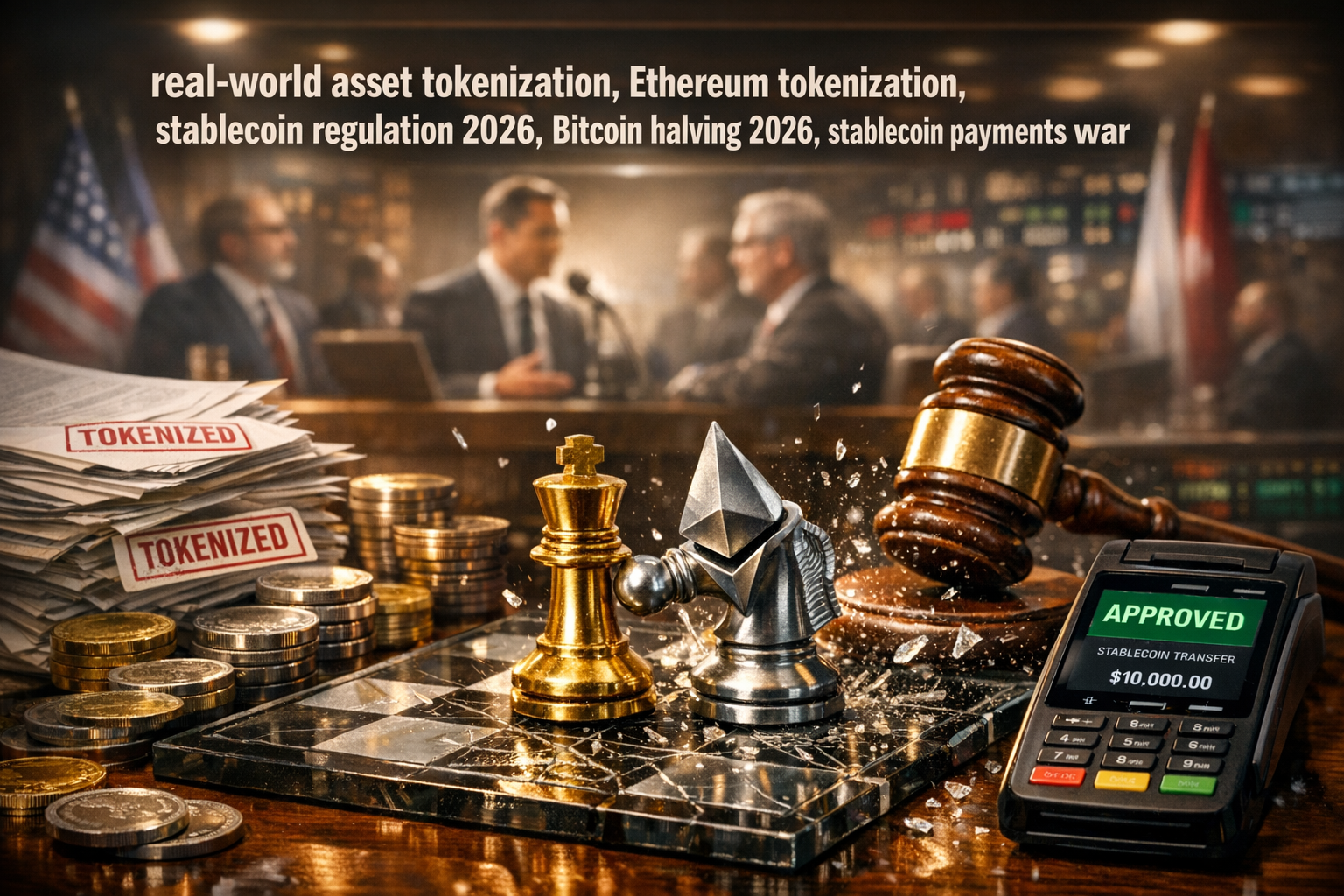
● Crypto Paradigm Shock, Bitcoin Cycle Breaks, Ethereum Tokenization Boom, Stablecoin Payment War
2026 “Crypto Paradigm Shift”: End of the Bitcoin Cycle, the First Year of Ethereum and Tokenization, and Real-World Scenarios for the Stablecoin War
This report isolates three decisive points.
1) Why 2026 is the first year of value creation in crypto (tokenization: completion of the market–technology–regulatory triangle)
2) The real reasons the Bitcoin halving/four-year cycle is weakening (whales, politics, liquidity, and the “$100,000 wall”)
3) Why the stablecoin war is the “payments war” following tariff and FX conflicts (including U.S.–China geopolitics and Trump-related policy direction)
1) News Briefing: One-page summary of the “2026 crypto shift”
1-1. Market (capital allocation) is changing: from “crypto-only rallies” to “traditional financial infrastructure”
The core message is that 2026 shifts crypto from price-driven expectations to functional deployment within the financial system.
Tokenization (asset tokenization) is the key mechanism. If successful, blockchain networks—particularly the Ethereum stack—move into sustained value production.
1-2. Technology (capability) is ready: RWA tokenization and on-chain finance
Tokenization of real-world assets (RWA) such as real estate, bonds, and equities is described as reaching operational maturity: fractionalization, continuous liquidity, and cross-border transferability.
This differs from prior crypto-native loops (e.g., NFT speculation, DeFi yield farming) by migrating traditional financial products on-chain.
1-3. Regulation (the final constraint) is easing: the U.S. accelerates institutionalization in 2026
The argument emphasizes that market demand and technology exist, but regulation has been the gating factor.
If the U.S. provides regulatory clarity and enablement, 2026 could be the first year the tokenization triangle—market, technology, and regulation—fully aligns.
2) Bitcoin: Rationale behind “a halving season ending with limited momentum”
2-1. Why the four-year cycle weakens: “immature asset structure + whale-dominated market”
Bitcoin price formation is characterized as still materially influenced by a small cohort of large holders (described as roughly ~100 participants), enabling discretionary timing effects.
The halving cycle is therefore framed less as a structural law and more as a repeated behavioral pattern reinforced by concentrated ownership.
2-2. Meaning of “the market feels weak without a crash”
A 30–40% decline is framed as a typical correction rather than a crash.
The interpretation is that upside was limited, downside was also limited, but price action nevertheless gave back much of the prior gains.
2-3. The $100,000 wall: potential whale-driven psychological resistance
Distribution by long-term holders near $100,000 is presented as signaling that a subsequent phase requires sufficient demand to absorb legacy supply.
3) Why Ethereum becomes the 2026 “context”: the settlement rail for tokenization
3-1. The key driver is not price but standardization (avoiding ecosystem fragmentation)
The central point is interoperability and standardization rather than token price.
Even institutions with private chains (e.g., large banks) are described as recognizing that without a public standard such as Ethereum, token ecosystems risk becoming isolated and non-scalable.
3-2. Tokenized MMF links directly to stablecoins
Tokenizing money market funds (MMF) can deliver stablecoin-like payment and settlement functionality within a regulatory framework.
The focus is less on high issuer margins and more on control of payments and settlement infrastructure.
4) Stablecoin war (2026): payments supremacy as the primary battleground
4-1. “GENIUS”-type regulation is interpreted as effectively targeting Tether
An 18-month transition window is framed as forcing incumbent issuers to restructure.
Stricter reserve requirements (e.g., short-dated U.S. Treasuries) could constrain models that previously relied on alternative assets (e.g., gold, Bitcoin) for incremental returns.
4-2. Stablecoins are not an investment product but a “payments war” instrument
A recurring misconception is that stablecoin issuers will generate outsized profits; the regulatory design is described as limiting margin expansion.
Large technology companies (e.g., Samsung, Meta, Google, Apple, Naver) are framed as entering not primarily for coin profit, but to control payment rails and distribution.
This links payment infrastructure to supply chains, rate cycles, and dollar strength/weakness dynamics.
4-3. Dollar stablecoins erode local currencies: already observable in Latin America and Africa
Dollar stablecoins are described as contributing to deposit substitution and de facto dollarization, supported by IMF-referenced framing.
As this grows, national monetary policy transmission (rates and FX management) may weaken, implying structural shifts in the global financial system.
5) Korea: Why the Naver–Dunamu (Upbit) partnership is positioned as a “payments + tokenization” play
5-1. For Naver, payments rails are positioned as the post-search/ads strategy
AI is described as disrupting the search–advertising model, pushing Naver further toward commerce and payments.
Future payments are framed as potentially shifting from bank rails to crypto payment rails anchored by dollar stablecoins.
5-2. Strategic role of major exchanges: securing a liquidity hub
High-liquidity exchanges reduce slippage and act as gateways between on-chain and off-chain systems.
Exchanges are positioned not only as speculative venues but as core hubs for cross-border payments and asset tokenization across B2B and B2C.
5-3. Separation of banking and commerce slows Korea’s policy response
The comparison is that the U.S. is moving toward faster rule redesign with active alignment between regulators and market infrastructure players.
Korea is described as over-weighting risk and lagging in institutional adaptation, with the risk that domestic asset trading and payments migrate to offshore platforms.
6) Key points often underemphasized elsewhere
6-1. 2026 is less about price targets and more about standards for financial infrastructure
The emphasis is on structural change rather than price forecasting.
If tokenization enters regulated mainstream distribution, it becomes a reconfiguration of global payments, settlement, and collateral systems, changing the role of Bitcoin, Ethereum, and tokenized assets within financial markets.
6-2. The critical point is not “Ethereum is good,” but the moment standards become non-negotiable even for big tech
If large technology firms cannot credibly impose a competing standard, and traditional finance converges on an interoperable public standard, that signals industrial standard formation.
6-3. Stablecoins evolve from a business model to a policy instrument linking Treasuries, tariffs, FX, and geopolitics
The most aggressive hypothesis is a transition from tariff conflict to FX conflict, followed by a payments conflict in which dollar stablecoins become embedded as conditions in trade and settlement.
This is framed as a strategy to anchor dollar influence through digital payment rails, not merely crypto regulation.
7) Practical checklist: monitoring points through 2026 (individuals / corporates / policymakers)
- U.S. regulation: pace of rulemaking for tokenization/on-chain securities and stablecoin legislation (alignment across SEC, Congress, and the executive branch)
- Liquidity: rate cuts, signals of renewed quantitative easing (QE), and M2 trend (liquidity expansions historically transmit early into crypto risk assets)
- Exchanges: evolution from trading venues to payment/FX/collateral hubs
- Tokenization: legal feasibility of tokenizing and distributing real estate, bonds, and equities (tax, accounting, and rights enforcement as the core constraints)
- Korea policy: ability to match global pace on banking–commerce separation, FX controls, and stablecoin legislation
< Summary >
The 2026 crypto thesis centers on financial infrastructure transition rather than price.
If tokenization completes the market–technology–regulatory triangle, platforms such as Ethereum may become standardized rails for regulated finance.
Bitcoin is framed as retaining characteristics of a concentrated and politically/liquidity-sensitive market, with $100,000 as a key psychological and supply-absorption zone.
Stablecoins are positioned as instruments in a payments war, potentially linking tariffs, FX, Treasuries, and geopolitics into a single policy toolkit.
Korea has meaningful technology and market potential, but slower institutional adaptation may increase the risk of ceding trading and payments leadership to offshore platforms.
[Related Articles…]
- Stablecoin War: Why Payments Supremacy May Shift in 2026 (https://NextGenInsight.net?s=stablecoin)
- How Tokenization Changes Financial Market Structure in Five Stages (https://NextGenInsight.net?s=tokenization)
*Source: [ 경제 읽어주는 남자(김광석TV) ]
– [풀버전] 2026년, 크립토 패러다임이 바뀌는 결정적 순간. 크립토 판에 거대한게 온다. | 경읽남과 토론합시다 | 오태민 교수
● Liquidity Crunch, KOSPI 5000 Trap, Cashflow Stock Hunt
Why Equity Investing in 2026 Should Shift from “Index Chasing” to “Cash-Flow Stock Selection” (KOSPI 5000, US Liquidity, and the AI/Semiconductor Supercycle)
This report addresses the following core points.
First, why a “three-year consecutive bull market” (2023–2025) was possible, and how the AI narrative and rate expectations supported markets.
Second, why the key 2026 variable shifts from “liquidity shortage” to the “liquidity transmission channel” (Federal Reserve vs. fiscal policy).
Third, why numeric targets such as KOSPI 5000 can be risky (the “index up, my holdings flat” trap).
Fourth, how far the semiconductor supercycle can extend given the tension between “AI is secular” and “semiconductors are cyclical,” and the key checkpoints to monitor.
Fifth, why a 2026 strategy of “core diversification plus selective concentration” is pragmatic.
1) Market Briefing: One-Sentence Summary of the 2026 Investment Environment
In 2026, equity markets may remain constructive, but chasing indices after a substantial run-up increases risk; security selection is likely to be the primary determinant of returns.
Five key variables should be assessed jointly: inflation, rate cuts, liquidity, AI semiconductors, and recession risk.
2) Three Drivers Behind the US “Three-Year Bull Run” (2023–2025)
2-1. Why Mega-Cap Tech Held Up Despite High Rates: Early Pricing of a “No Further Hikes” Constraint
After the rapid rate increases of 2022, markets quickly priced the view that further tightening would threaten financial stability.
Following banking-sector stress (e.g., SVB), policy actions combined tightening with stabilizing tools, limiting systemic risk.
2-2. The AI Narrative Justified Concentration in Technology
Post-ChatGPT, AI was framed as an Internet-scale technological shift, driving flows into mega-cap technology and reinforcing concentration dynamics such as the “M7.”
A meaningful portion of the rally was narrative-driven rather than purely cyclical or growth-driven.
2-3. “Managed Tightening,” Not Full Liquidity Withdrawal, Supported Risk Assets
Even as the Federal Reserve signaled balance-sheet tightening, stabilizing mechanisms operated in parallel, preventing a broad and sustained risk-off regime.
Markets focused less on tightening itself and more on tightening that avoided destabilizing the financial system.
3) The 2026 US Variable: How “Liquidity Conditions” Actually Affect Equities
3-1. The Key Question Is Not “Does the Fed Ease,” but “Does Fiscal Policy Inject Liquidity”
The Federal Reserve, as an independent institution, faces limits on overt market-support actions driven by political considerations.
Fiscal channels (tax cuts, industrial subsidies, increased Treasury issuance) can become the dominant liquidity transmission path and may support risk assets.
3-2. Fiscal Expansion Can Trigger a Headwind: Higher Treasury Yields
Fiscal stimulus can lift growth expectations, but increased Treasury supply may push long-term yields higher.
Higher long-end yields pressure growth-equity valuations and can raise equity volatility.
3-3. Rate-Cut Expectations Are Not an Automatic Tailwind
In 2026, the rationale for rate cuts is likely to matter more than the cuts themselves.
Cuts driven by growth deterioration (recession risk) can destabilize equities in the near term.
Cuts driven by disinflation and normalization are more likely to be supportive for risk assets.
4) Korea: Why Numeric Targets Such as “KOSPI 5000” Can Be Structurally Risky
4-1. A Regime Where “The Index Rises but My Stocks Do Not”
Index-level slogans can boost sentiment, but breadth often deteriorates and not all stocks participate.
Indices can be lifted by a small set of mega-caps (notably semiconductors), while investor experience diverges.
4-2. Reducing the “Korea Discount” Is Directionally Valid, but Execution Risk Matters
Simplistic valuation comparisons (e.g., PBR-based arguments that Korea should re-rate to US levels) can be misleading.
Discount-reduction policies may be constructive, but explicit index targets can encourage non-fundamental excess.
5) The Semiconductor Supercycle: The Core Tension Between “Secular AI” and “Cyclical Semiconductors”
5-1. AI Demand Is Structural, but Semiconductors Remain Cyclical
AI investment (data centers, cloud, training/inference) has secular characteristics.
However, semiconductor earnings remain sensitive to supply, inventory cycles, and capex dynamics.
5-2. After Large Rallies, Scaling Down and Rebalancing Becomes Rational
Even in a constructive market, elevated valuations warrant reassessment.
Given semiconductors’ outsized contribution to index performance, risk management via position sizing becomes more important as prices overheat.
6) Real Estate vs. Equities: Why 2026 Flows May Tilt Toward Equities
6-1. Real Estate Is Constrained by Regulation, Leverage Limits, and Transaction Costs
Taxes and transaction costs are high, and lending constraints limit leverage-driven surges in activity.
Downside may be supported by structural frictions, but a rapid boom is less likely to re-emerge under tight financing conditions.
6-2. Equities Exhibit Higher Policy Sensitivity
Equities reprice quickly to policy signals, industrial policy, and regulatory changes.
Near-term flows may therefore favor equities over real estate.
7) 2026 Strategy: “Skip the Index, Focus on Stocks”
7-1. Leveraged ETFs as a Late-Cycle Index-Chasing Tool Are Not Preferred
In a market that has already appreciated substantially, index and leveraged index products are more vulnerable to volatility.
The 2026 setup may reward earnings quality and cash-flow durability over broad directional exposure.
7-2. The Practical Framework: “Core Diversification + Selective Concentration”
Full diversification can reduce drawdowns but may dilute returns.
High concentration can materially impair portfolios when the thesis is wrong.
A balanced approach is to maintain diversified core exposure while selectively overweighting a limited set of companies with verified earnings power, cash-flow strength, and sustainable growth.
8) Sector Checklists: AI, Energy, Stablecoins, Robotics, Quantum
8-1. AI: Shift Focus from Hardware (Semiconductors) to Monetizing Software and Services
AI remains a long-duration theme, but markets have already priced substantial optimism.
Relative resilience may favor companies where rising capex translates into earnings and where cash flows are robust.
8-2. Energy: Power Infrastructure Remains Critical in the Data-Center Era
Expanding AI data centers structurally increases power demand.
Across the energy spectrum, electricity grids, gas, nuclear (including SMR/MMR), and related infrastructure remain medium- to long-term themes.
8-3. Stablecoins: Prefer “Infrastructure and Beneficiaries” Over Direct Token Exposure, with Tight Position Sizing
Legislative and regulatory developments (e.g., the GENIUS Act) may create momentum, but volatility and conflicts of interest remain material.
Approach is better framed as small, selective exposure following pullbacks, focusing on entities with financial resilience.
8-4. Robotics: The Next AI Battleground, Conditional on Revenue Conversion
Given high expectations, the key is whether demand converts into revenue and margin expansion.
Identify where profits accrue across the supply chain (components, sensors, control software).
8-5. Quantum: Extreme Volatility; Closer to Tactical Trading Than Core Allocation
The addressable theme is large, but volatility is elevated.
Exposure is more suitable as a limited satellite position within defined risk limits.
9) Under-Discussed but High-Impact Point
9-1. In 2026, “Liquidity Cost” (Long-Term Yields) May Matter More Than “Liquidity Quantity”
Markets often react first to stimulus headlines, but portfolio outcomes are frequently driven by the direction of long-term yields.
Fiscal expansion can raise the probability of higher Treasury yields, which can compress growth-equity premia.
9-2. “KOSPI 5000” Is Political/Policy Language, Not an Investment Strategy
Allocating based on index slogans can underdeliver if gains are concentrated in a narrow set of mega-caps.
In 2026, the primary question shifts from index levels to which companies can expand cash flows.
9-3. The “AI-Only Growth” Framing Increases the Need for Selection
If AI is disproportionately supporting macro growth, dispersion between cash-generative firms and narrative-driven firms can widen.
In this regime, correctly identifying a theme may be insufficient; security selection becomes the decisive factor.
< Summary >
The 2023–2025 bull market reflected a combination of the AI narrative, rate-cut expectations, and policy backstops that reduced systemic stress.
In 2026, the dominant variable may be the liquidity transmission channel (Federal Reserve vs. fiscal) and long-term yield volatility, rather than liquidity scarcity per se.
For Korea, numeric index targets such as KOSPI 5000 can be misleading; avoiding index chasing and emphasizing earnings and cash-flow-based selection is more defensible.
AI is secular, but semiconductors remain cyclical; rebalancing becomes more important in overheated conditions.
A pragmatic structure is diversified core exposure with selective concentration in companies with validated fundamentals.
[Related Articles…]
- AI Investing: In 2026, Only “Proven Monetizers” Are Likely to Remain
- Currency War 2026: How Dollar Strength Impacts Asset Markets
*Source: [ Jun’s economy lab ]
– 2026년 주식투자 이렇게 하세요(ft.조원경 교수 2부)
● Supersized Plates, Tip Shock, Stay-Home Spending Surge, Automation Boom
The Structural Drivers Behind US Oversized “Single Portions,” the Economics of “Staying In,” and the Resulting Investment and AI Implications
This note covers three core points:1) The unusually large portion sizes in US restaurants are a deliberate value-perception design (price psychology), not generosity.
2) Strong headline macro indicators can coexist with weak consumer sentiment (“vibecession”), driven primarily by rising labor, tipping norms, and service inflation.
3) As discretionary enjoyment shifts from outside the home to inside the home, the “homebody economy” expands and reshapes corporate and sector dynamics.
1) [News Briefing] Why US “Single Portions” Are Large: Not Culture, but Value-Perception Engineering
1-1. Industry rule: “Visible empty space on the plate triggers dissatisfaction”
In US casual dining, a commonly reinforced operating principle is that customers interpret visible empty space as poor value for money.
Given high labor costs and tipping practices, menu prices rise quickly. When a pasta dish costs $20–$30, customers immediately evaluate whether the experience is “worth it.”
Restaurants often deliver that assessment fastest through visual volume rather than incremental improvements in taste or service.
1-2. Using low-cost carbohydrates to establish perceived value
Menu engineering frequently relies on low-cost carbohydrates (fries, pasta, rice, bread) to fill the plate and create scale, with the higher-cost protein or main item placed on top.
Customers perceive stronger value (“more for the price”), while operators control food cost and protect margins.
This approach strengthens as dining-out inflation accelerates because perceived value becomes a primary retention tool.
1-3. The takeout box is an integrated part of the system
US dining norms often treat finishing the plate as optional; the consumer objective is value realization, not completion.
If customers are full, leftovers are boxed for later consumption. Servers routinely offer a to-go box, enabling “one payment, two meals” as an implicit justification for higher checks, taxes, and tips.
2) [News Briefing] Why Sentiment Is Weak Despite Strong Data: The Mechanics of a “Vibecession”
2-1. Strong numbers, weak mood
The US can exhibit solid growth, resilient employment, and equity strength (notably in AI-linked themes), while consumers still report that conditions feel unfavorable.
This “vibecession” reflects a shift in everyday discretionary spending from “low-friction purchases” to “high-deliberation luxuries.”
2-2. Primary driver: service costs (labor + tipping)
Prices for frequent, everyday experiences (coffee, movies, dining out) have outsized psychological impact even with modest increases.
The key inflation component is not only inputs, but the cost of providing service itself: wage growth combined with higher default tipping norms.
As tipping expectations move from ~15% toward ~18%–20% in many urban markets, the effective price of dining out rises materially.
2-3. Urban vs. non-urban pressure points
Urban areas face higher “out-of-home enjoyment costs.”
Suburban and rural regions face increases in “non-discretionary survival costs,” including vehicle dependence (fuel, insurance, maintenance).
Broad-based price increases in value retail channels have reduced perceived affordability, reinforcing cost-of-living pressure.
3) [News Briefing] Why “Staying Out” Becomes Risky: Spending Rotates Toward the Homebody Economy
3-1. Price-driven substitution toward at-home consumption
“Outside is risky” increasingly implies price risk rather than physical risk.
Substitution trends include frozen meals plus air fryers, at-home coffee, and streaming replacing theaters.
Post-pandemic capability and habit formation reduce switching costs, accelerating the move back to at-home consumption when prices rise.
3-2. Implications for corporate revenue mix and margins
As spending shifts from out-of-home categories (restaurants, theaters, cafes) to at-home categories (grocery, subscriptions, appliances, home entertainment), sector winners and losers diverge.
This rotation influences pricing strategy, product mix, and subscription model intensity.
The persistence risk is non-trivial given durable behavior change and continued service-cost inflation.
4) Key Points Commonly Underemphasized
4-1. Larger portions as a behavioral hedge against inflation
Oversized portions function as a defense mechanism to reduce customer dissatisfaction in an inflationary environment.
When operators must raise prices, increasing visual volume can lower perceived price resistance by reinforcing “value received.”
4-2. Tipping as a quasi-fixed surcharge that worsens price perception
A listed price of $25 often becomes a $30+ transaction after tax and tip.
Consumers treat these add-ons as low-control costs, amplifying negative sentiment and accelerating discretionary pullbacks.
4-3. The “home as a fortress” dynamic can reinforce urban cost inflation and polarization
Reduced out-of-home spending pressures urban service businesses to raise prices to maintain viability.
Higher prices further push consumers to stay in, creating a feedback loop that makes service deflation structurally difficult.
This can solidify polarization: cities where services become premium-priced, and non-urban regions where essential living costs dominate household budgets.
4-4. AI and automation: rising service labor costs improve automation ROI
As labor costs and service delivery expenses rise, payback periods for kiosks, automated ordering, and kitchen automation shorten.
Current service inflation therefore acts as a structural catalyst for automation adoption and productivity investment.
5) Investor Framework: Key Variables to Monitor
- Inflation: everyday discretionary categories reprice first and dominate sentiment
- Rates: higher interest burdens typically reduce discretionary spending before essentials
- US Macro: divergence between headline strength and weak sentiment can affect policy, elections, and consumption
- Equities: differentiation between homebody beneficiaries and labor-cost-exposed service operators
- AI Investment: labor-cost inflation supports automation and productivity themes
< Summary >
Large US “single portions” are not a cultural artifact; they are a value-perception mechanism designed to mitigate dissatisfaction in a high dining-out cost environment.
Even with strong macro indicators, elevated everyday service prices and higher tipping burdens can depress consumer sentiment, producing a “vibecession.”
As spending shifts from outside the home to inside the home, the homebody economy expands; simultaneously, rising labor costs strengthen the economic case for AI-enabled automation.
[Related Links…]
- https://NextGenInsight.net?s=inflation
- https://NextGenInsight.net?s=AI
*Source: [ Maeil Business Newspaper ]
– 미국 ‘1인분’ 왜 이렇게 많을까? 철저하게 계산된 음식 자본주의 | 홍키자의 美쿡 | 홍성용 특파원