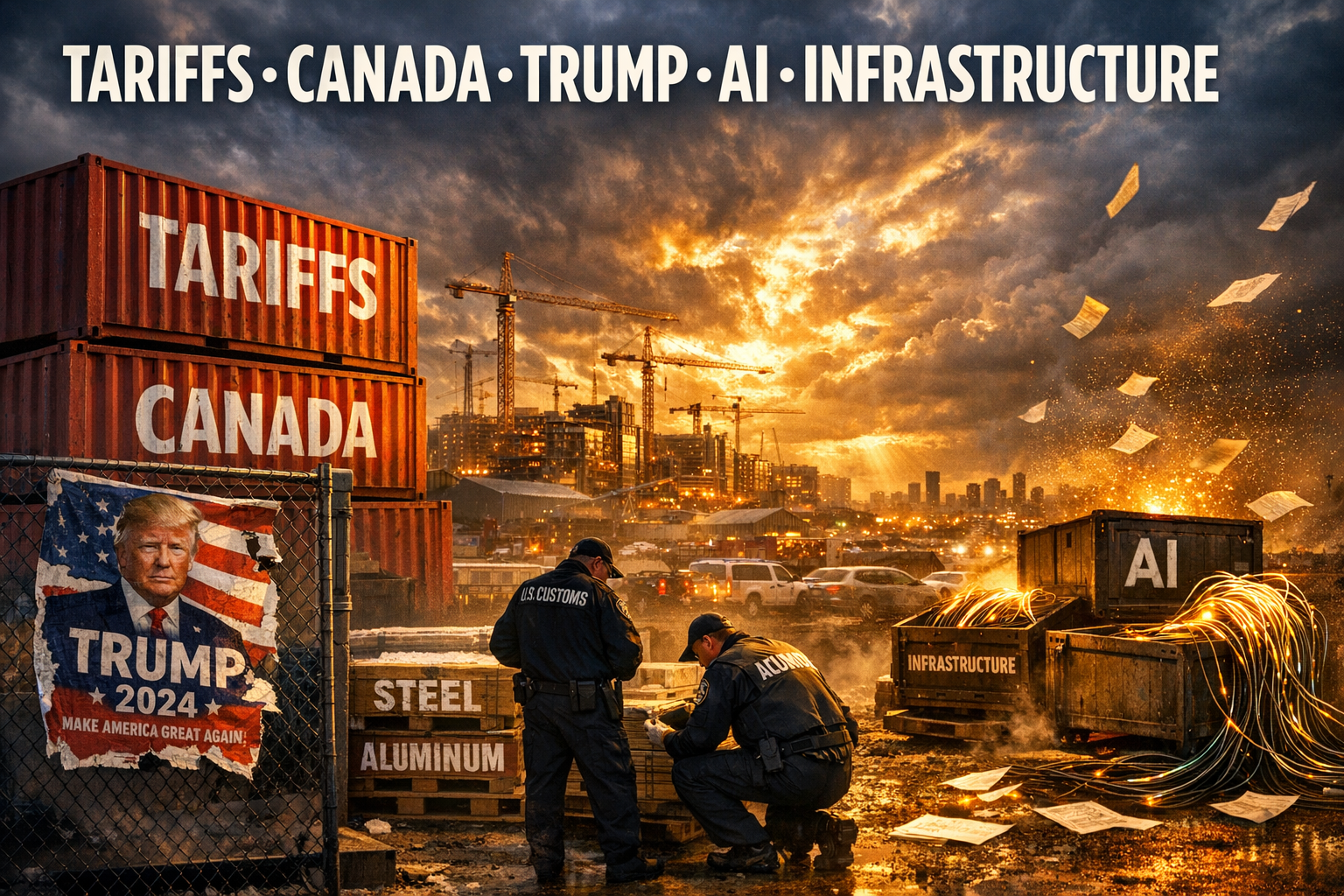
● Canada 100 Percent Tariff Shock, Trump Mega Buy Signal, 2026 AI Infrastructure Gold Rush
2025 Shock Deja Vu? From “100% Tariffs on Canada” to Trump’s Largest-Ever Purchase, and the 2026 Investment Targets Jointly Signaled by Musk, Jensen Huang, and Trump (Key Points, News-Style)
This report covers three items:
- The market significance of “Canada declares 100% tariffs” (spillover beyond trade into supply chains, inflation, and FX).
- A decision framework for interpreting “Trump’s largest-ever purchase” as election optics versus policy risk/opportunity.
- The 2026 capital allocation direction where Musk, Jensen Huang, and Trump converge: not a theme, but infrastructure-level positioning.
1) Headline Briefing: What Markets Are Pricing Now
[Trade] “100% tariffs on Canada” → interpreted as a signal of renewed tariff escalation
- When tariffs are framed with extreme figures (e.g., “100%”), markets typically reprice risk premia regardless of implementation probability.
- Given deep integration under USMCA, Canada-related tariff risk can transmit rapidly into U.S. manufacturing input costs, components, and resource pricing.
[Politics/Capital] Trump “largest-ever purchase” → primarily a policy-positioning signal
- Large-scale buying by political or high-profile actors often functions as a forward-looking message about expected outcomes.
- The key distinction is whether the move is short-term election-driven momentum or a medium-to-long-term policy regime signal.
[Tech/Industry] A shared 2026 focus across Musk, Jensen Huang, and Trump → rotation from “AI” to “the industries that run AI”
- If 2024–2025 emphasized AI software and chips, 2026 is more likely to shift profit pools toward physical infrastructure: power, data centers, networks, and defense/space-linked demand.
2) Why “2025 Shock Deja Vu” Is Being Discussed: The Risk Combination Markets Fear
Markets are less sensitive to a single headline than to the following combination:
(1) Tariff risk → potential inflation re-acceleration
- Tariffs function similarly to a tax on imported prices.
- Rising tariff expectations can increase inflation risk pricing, which may delay anticipated rate cuts and pressure equity valuations.
(2) Accelerating supply-chain reconfiguration → margin pressure and CAPEX shifts
- Tariffs alter “where to produce” decisions, driving recurring inventory, logistics, and production relocation costs.
- Near-term costs may rise, while longer-term investment may tilt toward North American manufacturing and infrastructure.
(3) Higher FX and commodity volatility
- Tariff narratives often increase volatility in the Canadian dollar, commodities, freight, and selected industrial inputs.
- The result can be an environment where sector-level winners and losers emerge simultaneously.
3) Canada “100% Tariffs”: Practical Monitoring Points (By Sector)
The key variable is the targeted product category. In the absence of specific items, the market transmission channels are as follows:
1) Autos/Auto Parts
- North American auto supply chains cross borders multiple times; tariffs can sharply increase effective costs.
- Key variables: OEM and supplier margin compression, and the ability to pass costs to consumers.
2) Energy/Resources (Oil, Gas, Minerals)
- Canada has high exposure to energy and resources; tariffs/retaliation can disrupt cost structures and routes.
- With AI-driven data center expansion increasing power and resource demand, the sector can face both risk and opportunity.
3) Agriculture/Food
- Tariffs can transmit into food inflation relatively quickly.
- This can reinforce U.S. inflation narratives and increase rate sensitivity across markets.
4) Technology/Equipment (Indirect impact via sentiment and policy uncertainty)
- Direct tariff linkage may be limited versus the effect of broader policy uncertainty on investment sentiment and corporate planning.
4) Interpreting Trump’s “Largest-Ever Purchase”: High-Conviction Signal or Event-Driven Optics
Avoid binary “bullish/bearish” interpretations. Use the following framework:
Q1. Is the purchase primarily for returns or for signaling?
- In political cycles, large purchases may prioritize messaging (support consolidation, confidence in a policy agenda) over pure return optimization.
- Markets may translate the signal into repricing of policy direction.
Q2. Markets react less to “buying” and more to the implied regime shift
- Trump-linked headlines often trigger reassessment across tariffs, regulation, energy policy, defense/space procurement, and reshoring.
- This can catalyze sector rotation.
Q3. Interaction with rates: pro-growth signals vs tariff-driven inflation risk
- Pro-business rhetoric can be supportive, but tariff expansion can raise inflation expectations and pressure rates.
- This mix often produces index-level volatility alongside strength in select sectors.
5) 2026 Direction Shared by Musk, Jensen Huang, and Trump: Physical AI Infrastructure
Common denominator:AI is increasingly treated as national and industrial infrastructure; power, semiconductors, data centers, networks, and security are converging into one capital cycle.
Five likely beneficiary axes (flow-based):
1) Power Infrastructure (Generation, Transmission/Distribution, Electrical Equipment)
- AI data centers consume electricity at industrial scale.
- The binding constraint is frequently power availability and grid capacity, implying sustained power-related CAPEX into 2026.
2) Data Centers (Land, Cooling, Server Racks, Operations)
- Competition is shifting from “how many GPUs to buy” to “where to deploy and how efficiently to operate.”
- Cooling, power contracts, and utilization rates become primary drivers of profitability.
3) Semiconductor Ecosystem (Beyond chips: packaging, HBM, equipment, materials)
- The focus extends to resolving ecosystem bottlenecks, not only GPU volumes.
- Tight supply in HBM and advanced packaging can increase pricing power for constrained segments.
4) Networking/Optical Connectivity
- Training and inference growth increases internal and external data center traffic.
- High-speed switches, optical modules, and cabling can be revalued as core infrastructure.
5) Defense/Space/National-Security AI
- Security priorities can align with reshoring and industrial policy.
- The intersection of space capability, accelerated computing, and defense demand may be a structural driver into 2026.
6) A Critical Point Often Underweighted: Tariffs and AI May Converge
Tariff risk and AI infrastructure can reinforce each other rather than operate independently.
1) Tariffs can reshape where data centers and factories are built
- Higher policy and trade uncertainty increases incentives to relocate supply chains to politically aligned jurisdictions.
- Capital can concentrate where power availability, land, and permitting are favorable.
2) 2026 differentiation may shift from “AI models” to power cost and utilization
- AI economics are materially driven by electricity pricing and asset utilization.
- Power infrastructure and operational excellence can move up the value chain.
3) Markets often price inflation re-acceleration risk more aggressively than rate cuts
- If tariff concerns rise, fear of a disrupted Fed path can dominate.
- Near-term volatility may increase; medium-term relative performance may favor firms with demonstrated pricing power.
7) Investor Checklist: What to Track Now
1) Policy timeline
- Distinguish rhetoric from formal administrative process.
- Prioritize official documents, negotiation status, and exemption/waiver provisions.
2) Inflation data and inflation expectations
- Tariff risk increases the marginal impact of inflation prints on market direction.
- Long-term inflation expectations are a key volatility trigger.
3) Earnings language on margin pressure and CAPEX
- Tariffs and supply-chain shifts appear in cost, inventory, and facility investment disclosures.
- Assess pass-through capability and whether North American investment plans are translating into measurable numbers.
4) 2026 AI infrastructure indicators: PPAs, data center expansion, network bottlenecks
- AI constraints are increasingly supply-side (power, land, equipment), not demand-side.
- Earnings inflections may follow once bottlenecks begin to clear.
8) Keyword Set for Ongoing Monitoring
This cycle is increasingly defined by a single linked set:inflation, policy rates, tariff escalation, supply-chain reconfiguration, AI semiconductors.
Track whether these variables move in the same direction or diverge to accelerate decision-making.
< Summary >
- The Canada “100% tariffs” narrative, independent of implementation, increases risk premia around tariff escalation and can transmit into inflation, FX, and supply-chain repricing.
- Trump’s large-scale purchase is best interpreted as a policy-regime signal that can drive sector rotation rather than a simple risk-on catalyst.
- 2026 positioning may rotate from AI as a theme toward physical AI infrastructure: power, data centers, networking, semiconductor bottlenecks (packaging/HBM), and defense/space-linked demand.
- The key strategic point is potential convergence: tariffs and AI can combine into “build critical AI infrastructure in politically secure jurisdictions,” reshaping the investment map.
[Related Links…]
- https://NextGenInsight.net?s=tariffs
- https://NextGenInsight.net?s=AI
*Source: [ 소수몽키 ]
– 2025 쇼크 데자뷰? 캐나다 관세 100% 선포 / 트럼프의 역대 최대 규모 매수, 강력 신호일까 / 머스크,젠슨황,트럼프가 동시에 찍은 2026 투자처
● KOSPI 5000 Shockwave Pension Pivot Sparks Korea Stock Boom
What Is the Evidence Behind the Claim That Korea Offers “More Opportunity” Than the U.S.? Core Points of the KOSPI 5,000 Debate, Structured as a News-Style Brief
This note covers:
1) A more critical prerequisite than whether KOSPI 5,000 is “possible”: a structural shift in market flows.
2) How the market is re-rated when capital allocation by the National Pension Service (NPS), retail investors, and foreign investors changes direction.
3) Why “do not sell into strength; sell on weakness” is a rule-based system that reduces forecasting, not a psychological slogan.
4) The mechanism through which rising equity prices can widen inequality, and practical policy ideas to mitigate it (credit + trust structures + a national growth fund).
5) The underlying drivers of the Korea discount and the conditions for its potential narrowing.
1) Key takeaway: “KOSPI 5,000? The challenges begin during the climb”
The central message:
KOSPI 5,000 may be attainable.
However, the larger risk is that the process of rising equity prices can widen wealth gaps and weaken innovation and productivity.
Equity appreciation does not automatically imply improved national welfare.
As prices rise, the gap between market participants and non-participants can expand materially.
2) The “Korea over U.S.” opportunity framework (rates, valuation, flows)
2-1. If rate cuts are gradual rather than abrupt, emerging markets can outperform mega-cap tech
The argument is straightforward:
When rates fall sharply, scale leadership (e.g., U.S. mega-cap tech) tends to dominate.
When cuts are gradual, liquidity allocation becomes more selective; historically, this regime has often favored emerging markets.
2-2. Why Korea may be advantaged within emerging markets: “discounted valuation”
Korea is framed as one of the most discounted equity markets.
“Cheap” refers not only to headline multiples (e.g., P/E) but also to structurally depressed valuation due to the Korea discount.
2-3. The primary driver of the index: not earnings, but a structural shift in flows
A core point is the role of flows:
If retail, institutional, and foreign investors simultaneously move into a Korea-overweight regime, index sensitivity changes.
The NPS is positioned as central to this shift.
3) Why the NPS is pivotal: a direct link to the Korea discount
3-1. What global investors cite as the core reason for the Korea discount
A practical observation is presented:
Foreign investors reportedly ask local analysts:
“Why should I buy Korean equities if Koreans and Korea’s pension fund do not?”
This implies that, beyond geopolitical risk, the discount may be materially influenced by domestic capital’s lack of confidence in its own market.
3-2. The significance of “the NPS has not increased domestic equities for a decade”
A key claim:
“The increase in the NPS’s domestic equity valuation reflects price appreciation, not net buying.”
This is used to argue that the portfolio has structurally increased overseas allocation.
3-3. Pension objectives include volatility control, not only returns
The rationale given:
Large pools of capital prioritize reducing uncertainty, not simply maximizing returns.
Higher foreign-asset exposure increases FX risk, global volatility, and other less controllable risks.
By contrast, larger domestic large-cap exposure can allow more influence over governance, payout policy, and other sources of predictability.
This supports the possibility of higher domestic allocation.
4) Warning: equity rallies can damage social outcomes through widening wealth gaps
4-1. Equity ownership disparity is already near “100x”
The cited distributional point:
Upper-wealth cohorts hold equities in the tens of millions of KRW,
while lower cohorts hold amounts closer to the hundreds of thousands of KRW.
Under this structure, equity appreciation concentrates gains among participants, accelerating inequality.
4-2. Lower-income households often cannot invest due to cash-flow constraints
For many low-income households, the propensity to consume is high, or consumption exceeds income, leaving limited investable capacity.
This is framed as a structural constraint rather than a matter of willingness.
5) Policy proposal: provide investable access via credit, trusts, and a national growth fund
5-1. Why leverage is common for housing but structurally limited for equity participation
The policy question raised:
Leverage is widely available for residential asset formation,
but access to capital-market participation is comparatively constrained.
5-2. Proposed model: “National Growth Fund + low-income trust + credit structure”
Proposed design elements:
A fund investing in projects with comparatively stable cash flows (e.g., infrastructure, AI data centers), backed by government support.
Participation allocated with priority to low-income groups rather than high-net-worth investors.
Illustrative mechanics:
Low-income participants establish investment ownership via a trust/loan structure, managing interest costs rather than upfront principal.
Dividends/returns service repayment, with residual ownership ultimately retained as household assets.
6) Practical investing rule: the logic behind “do not sell into strength; sell on weakness”
6-1. Investment decisions are based on the future, not past price moves
On “it has already risen; should I sell?” the response is consistent:
Past performance is not a sell trigger.
If future upside conditions remain, holding is the default.
6-2. Forecasts are frequently wrong; reduce the number of forecasts
A practical rule stated:
Forecast primarily at the point of entry.
After entry, shift from forecasting to rule-based response.
6-3. Why “sell at the shoulder” is impractical
Identifying the “shoulder” requires knowing the peak (“head”), which is rarely feasible in real time.
Hence the rule: do not sell rising assets; exit when the trend breaks (trailing, rules-based selling).
6-4. A common failure mode: accumulating many recommendations without an operating framework
The emphasis is placed on execution and portfolio rules rather than idea intake.
Korean retail behavior is characterized as having abundant buy ideas but weak sell and rebalancing discipline.
7) Realigning capital flows from real estate to equities requires implementable policy
The critique presented:
Policymakers state an intention to reduce real-estate concentration and develop capital markets,
but repeatedly rely on short-term regulation rather than structural reform.
Absent reform, equity gains may recycle back into prime real estate, reinforcing the same concentration pattern.
8) Key points emphasized as under-covered in typical media commentary
1) The Korea discount may be driven less by geopolitics and more by domestic investors and the domestic pension system under-allocating to local equities.
2) The most relevant condition for KOSPI 5,000 may be flow rebalancing including the NPS rather than earnings alone.
3) In a society with uneven participation, equity rallies can function as an inequality accelerator, implying the need for policy design.
4) Expanding low-income participation likely requires institutional structures (leverage/trust/dividend-based mechanisms), not only financial education.
5) For retail investors, the critical edge is not stock selection but sell rules that reduce forecasting and enforce responses.
9) Core market and macro keywords embedded in the narrative
KOSPI outlook, Korean equities, National Pension Service, FX, policy rates
< Summary >
The KOSPI 5,000 debate is less about possibility and more about the conditions under which a re-rating occurs.
A key proposed catalyst is a restoration of flow balance, potentially involving a higher domestic allocation by the NPS alongside changes in retail and foreign positioning.
The opportunity case for Korea is linked to historical patterns in gradual rate-cut cycles favoring emerging markets, combined with discounted valuations.
However, equity appreciation can widen inequality when participation is uneven, indicating a need for institutional policy mechanisms.
For individual investors, the recommended approach emphasizes reducing forecasts and applying rules-based exits when trends break.
[Related…]
How NPS rebalancing may affect the KOSPI
FX stabilization scenarios and 2026 asset-market strategy
*Source: [ 경제 읽어주는 남자(김광석TV) ]
– [풀버전] 미국보다 한국에 기회가 많다. 코스피 5천, 문제는 지금부터 시작이다 ‘코스피 대전환의 조건’ | 경읽남과 토론합시다 | 이광수 대표
● Shutdown Panic, Yen Surge, Frost Fueled Inflation, FOMC Chaos
Minneapolis Shooting → Shutdown Odds Spike; Signs of JPY Surge; Cold-Weather Energy Inflation: This Week’s “Three-Risk Stack” at a Glance
This report covers:1) Why the Minneapolis shooting incident escalated into a “U.S. federal government shutdown” risk (politics–budget mechanics)
2) If a shutdown occurs, where U.S. growth and market volatility are likely to react first (by agency/function)
3) Why a potential “JPY surge trigger” can drain U.S. liquidity (FX and DXY transmission)
4) How U.S. cold weather feeds into natural gas inventories, prices, and inflation (rates/inflation re-acceleration risk)
5) How this week’s FOMC and Big Tech earnings may interact with these variables to amplify equity volatility
1) Headline Summary: Why a “Shooting” Jumped to “Shutdown” Risk
What happened
Footage circulated of a shooting during clashes involving ICE-related enforcement activity and civilians in Minneapolis. Protests reportedly escalated rapidly, including road blockades and disruptions affecting critical infrastructure.
Why the spillover is larger this time
The distribution of video evidence accelerated public attention and narrative formation. Divergence between official statements and witness accounts increases political sensitivity when visual evidence is widely shared.
How a political issue became a budget issue (shutdown linkage)
Democrats gained leverage to adopt a hard line in budget talks by arguing that agencies facing allegations of shooting at civilians should not receive additional funding. This raised the probability of delayed appropriations and elevated shutdown risk.
Market signal (probability betting as a sentiment gauge)
The text cites a Polymarket-implied shutdown probability moving from single digits to the 80% range. Regardless of realized outcomes, such repricing typically increases headline-risk premia and near-term positioning caution.
2) If a Shutdown Hits: Not a “Full Stop,” but a “Cash-Flow Shock”
Why this shutdown could be less disruptive than some prior episodes
If parts of the government (e.g., defense) are already fully funded or expected to pass funding, the dominant risk shifts from comprehensive operational stoppage to partial administrative and payment delays.
Agencies/functions likely to face higher disruption risk (as cited)
HHS, Department of Education, Department of Transportation, Department of Labor, HUD, and the Treasury may experience delays in administration and disbursements.
Investor-relevant mechanism: consumption and liquidity
A prolonged shutdown can delay federal payrolls and transfers, directly constraining household consumption. The macro impact is more consistent with reduced spending velocity than supply-side shutdown effects. Equities typically price higher volatility, while safe-haven demand can increase sensitivity in the dollar index.
3) Why Some Interpret This as a More Adverse Shutdown Setup for Trump
A shifting political frame
Where prior shutdown dynamics often penalized Democrats, the current framing (shooting/human rights/public safety) may increase political costs for Republicans if negotiations extend.
Budget contention concentrated on ICE
The text references a push to increase DHS funding (cited: +4.1% YoY), with enforcement capacity as a central element. With ICE funding becoming a focal point, compromise complexity rises.
Spillover: potential weakening of “Trump trade” narratives
Weekend declines in Bitcoin are cited as a signal. The mechanism described is that market pricing often reflects perceived policy support; reduced confidence in that support can trigger reversals.
4) Japan Variable: Why a JPY Surge Can Tighten Global Liquidity
What was signaled
A Japanese political figure (cited: Takaichi) indicated willingness to take action against “speculative and abnormal moves.”
Why the key is a sudden move in JPY
A sharp JPY appreciation is commonly associated with:
1) intervention signaling (including verbal intervention)
2) USD weakness / risk-off behavior (safe-haven JPY buying)
3) unwind of JPY carry trades (leveraged position reduction)
Why this can reduce U.S. liquidity
During JPY weakness, investors can borrow cheaply in JPY and allocate into USD assets (U.S. equities and credit). If JPY strengthens, carry positions face adverse moves, prompting deleveraging and potential selling of USD assets. This can slow or reverse marginal liquidity flows into U.S. markets.
Political overlay
The text notes lower Japanese political approval and potential early elections. Higher political uncertainty can raise FX volatility premia and intensify JPY-driven cross-asset reactions.
5) U.S. Cold Wave → Low Natural Gas Inventories → Energy-Driven Inflation Risk
Current risk structure
Natural gas inventories are described as among the lowest levels of recent years, while winter demand draws down storage rapidly.
If cold conditions persist
If colder-than-normal weather extends toward late February, inventories could tighten further and prices may become more sensitive. A surge in natural gas prices can translate into higher heating costs and faster pass-through to perceived inflation.
Link to Fed policy
If energy-driven inflation pressures re-emerge, the Fed may have stronger justification to maintain a restrictive stance and avoid accelerating rate cuts. This can raise uncertainty around the rate path and increase valuation sensitivity in equities, particularly growth and mega-cap technology.
6) This Week’s Setup: FOMC + Big Tech Earnings + “Shutdown/JPY/Nat Gas” Resonance
Core events
The text emphasizes that major Big Tech earnings and the Fed rate decision occur on the same day (Wednesday).
Why this can become a high-volatility week
Big Tech earnings drive Nasdaq direction, while the FOMC shapes discount-rate expectations. If the following variables simultaneously dominate headlines:
- shutdown risk (politics/fiscal execution risk)
- JPY moves (global liquidity and DXY sensitivity)
- natural gas (energy inflation re-acceleration risk)
equities may struggle to rally even on strong earnings if rates/liquidity/political risk tighten. Conversely, weaker earnings may be partially offset if the Fed tone is more dovish.
7) Under-Discussed Core Takeaways (Investor Framing)
(1) The shutdown’s practical channel is friction in cash flows
The key investment channel is delayed payrolls, transfers, and administrative execution that impair household spending and corporate cash-flow timing. Hard data may lag, while equities typically reprice expectations earlier.
(2) JPY is not just FX; it is a deleveraging trigger
A rapid JPY appreciation can destabilize carry and hedging structures, particularly in volatile regimes, and can amplify drawdowns in high-beta assets such as the Nasdaq.
(3) Energy inflation often transmits through household perception before CPI prints
Heating costs can affect sentiment and consumption behavior quickly, potentially leading to softer retail and services activity and downward revisions to earnings expectations ahead of official inflation releases.
(4) Bottom line: the key lever this week is liquidity
The Fed stance, JPY-driven carry dynamics, and shutdown-related fiscal execution frictions all affect liquidity conditions and the velocity of money. Earnings alone may be insufficient for positioning.
8) Investor Checklist (Key Monitoring Items This Week)
1) Shutdown: whether ICE funding remains a standalone sticking point or is resolved via a broader package
2) Fed: intensity of commentary on energy-driven inflation re-acceleration risk
3) JPY: whether appreciation is a one-day short-covering move or a regime shift (policy/carry unwind)
4) Natural gas: sensitivity to inventory releases and forecast updates
5) Big Tech: guidance quality and whether forward outlook conflicts with the prevailing rate environment
< Summary >
The spread of video from the Minneapolis shooting and subsequent protest escalation increased political leverage to constrain ICE-related funding, elevating shutdown risk. The primary shutdown transmission is not full economic stoppage but delays in payrolls, transfers, and administration that compress consumption and tighten liquidity. In parallel, signs of a potential JPY surge raise the risk of carry-trade unwinds that can pressure U.S. asset liquidity. Persistent U.S. cold weather amid low natural gas inventories increases the probability of energy-driven inflation pressures, complicating the Fed’s rate-path messaging. With the FOMC and Big Tech earnings coinciding, the interaction of shutdown/JPY/natural gas risks may materially increase near-term equity volatility.
[Related…]
- https://NextGenInsight.net?s=exchange-rate
- https://NextGenInsight.net?s=interest-rates
*Source: [ Jun’s economy lab ]
– 미니애폴리스총격사건이 셧다운 가능성으로, 코너에 몰리는 트럼프