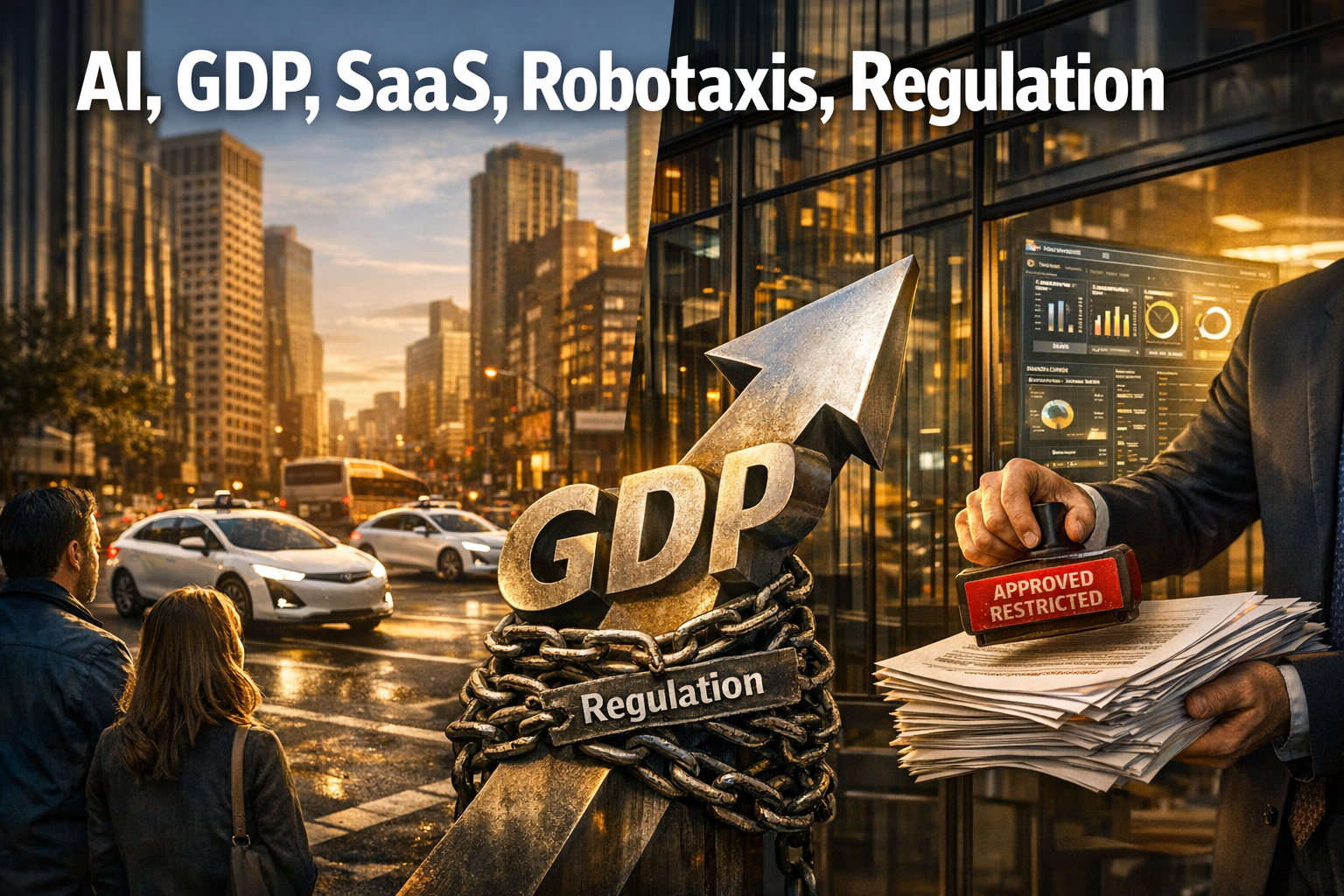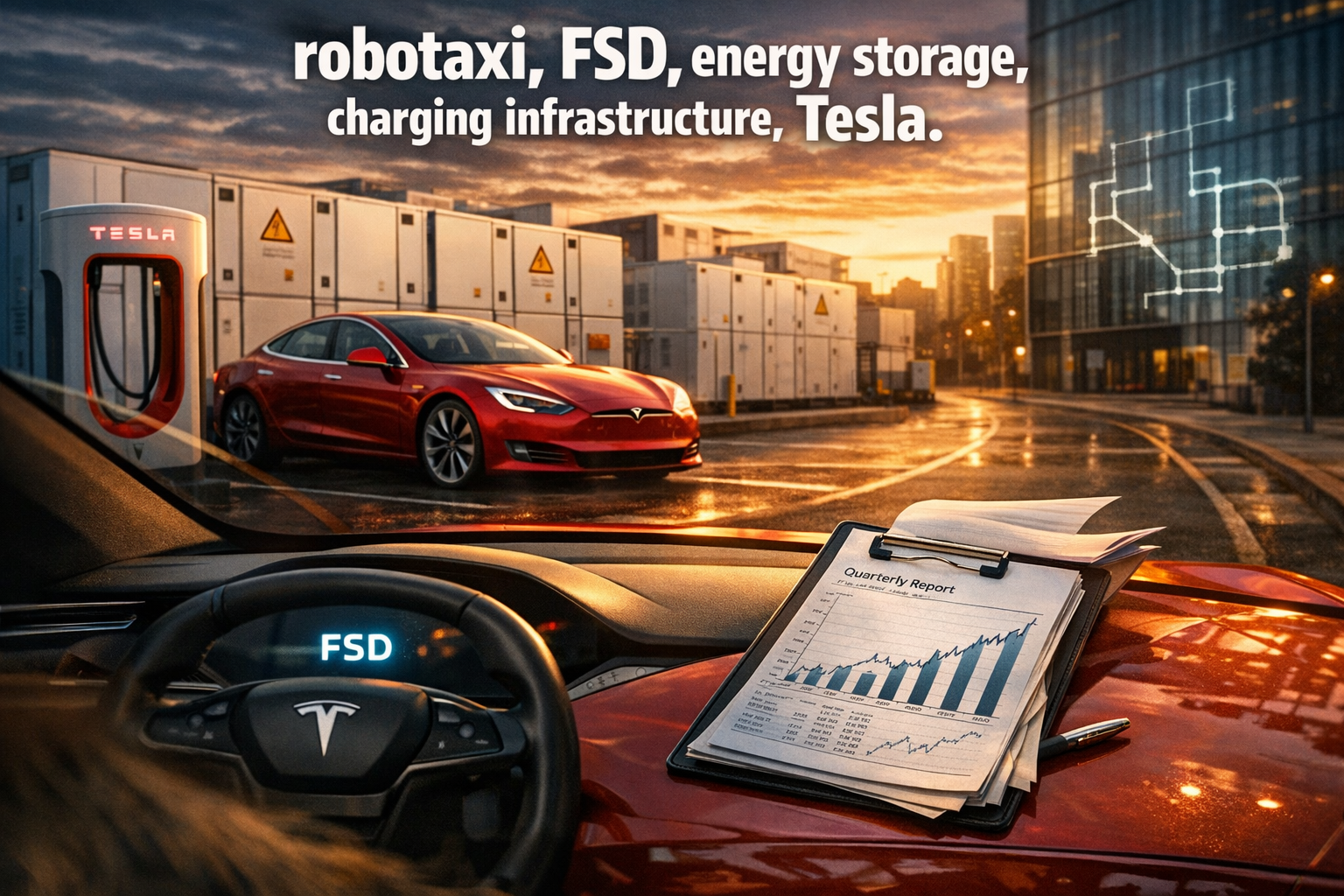
● Delivery Slump, Energy Surge, RoboTaxi Spark
Tesla 2025 Q4 Earnings: Key Focus Areas Beyond the Delivery Shock—Energy, Charging, and Robotaxi Execution
This report covers:
First, why the “growth is over” narrative is only partially correct (decomposed by numbers and business structure).
Second, the implications of a record 14.2 GWh energy storage deployment for earnings quality and free cash flow.
Third, why a Daimler–NextEra–BlackRock joint venture is adopting Tesla charging hardware and the embedded monetization model.
Fourth, the conditions under which “90% robotaxi margins” could be achievable, including key risks.
Fifth, three earnings call Q&A items most likely to drive market reaction, with response scenarios.
1) Earnings Preview: Wall Street’s Tesla View in Two Lines
Wall Street is framing Tesla as: “fewer vehicles sold (slowing growth), profits must be defended (margin preservation).”
As a result, this quarter is more likely to be driven by gross margin, guidance, and management commentary than by revenue or deliveries alone.
1-1) Consensus (Source-Based) Key Metrics
Total revenue: approximately $25.0B (modest year-over-year growth expected).
Gross margin: 17% expected.
EPS: $0.44–$0.45 expected (vs. $0.71 prior year).
Deliveries: 418,227 units (down 16% year-over-year; below ~423,000 consensus).
1-2) The One-Line Driver of Market Reaction
“Despite delivery declines, did Tesla preserve profitability through software, energy, and operating efficiency?”
If the answer is affirmative, equity performance may be driven more by messaging than by headline figures.
2) Limitations of the “Growth Is Over” Frame: Tesla Is Effectively Operating as Multiple Businesses
Bearish sentiment often extrapolates automotive delivery declines to Tesla’s overall growth outlook.
However, Tesla increasingly requires segmentation across (i) automotive hardware, (ii) energy storage and power infrastructure, (iii) software (FSD and subscriptions), and (iv) mobility (robotaxi).
2-1) Why the Record 14.2 GWh Energy Deployment Matters
Energy storage deployment reached a record 14.2 GWh.
The strategic relevance is that energy can exhibit more stable demand characteristics than discretionary durable goods and may improve free cash flow resilience over time.
Grid stability and storage investments can remain comparatively durable during cyclical slowdowns.
2-2) Wedbush (Dan Ives) View: Implications of the “Wartime CEO” Characterization
The “wartime CEO” framing implies prioritization of operational discipline and concentration of resources on core battlegrounds such as AI and robotics, rather than aggressive broad-based expansion.
Accordingly, the earnings call narrative around 2026 strategy may be more market-relevant than the income statement alone.
3) News Item 1: Why the Daimler–NextEra–BlackRock Joint Venture Is Deploying Tesla Charging Hardware
The decision is better understood as a standards and infrastructure dynamic rather than a vehicle-level competitive concession.
3-1) NACS vs. MCS: The Competitive Inflection May Shift Toward Commercial Trucking
NACS standardization is advancing in passenger EVs.
For electric trucks, the critical specification is MCS (Megawatt Charging System).
If Tesla’s commercial charging hardware aligns with MCS requirements, Tesla-manufactured chargers can function as multi-OEM infrastructure rather than proprietary assets.
3-2) Why a Competitor Chooses Tesla: Reliability, Cost/Speed, and Time-to-Deploy
(1) Reliability: logistics economics prioritize uptime.
(2) Cost and speed: scaled manufacturing and supply chain maturity can win on price and lead times.
(3) Time-to-deploy: near-term installability reduces the infrastructure bottleneck for commercial electrification.
3-3) Embedded Monetization: Hardware Margin + Recurring Software/Services + Standards Leverage
The primary value is not limited to charger sales.
As commercial charging networks scale, Tesla can monetize operating software, payments, maintenance, and data services as recurring revenue streams.
This model can produce revenue largely independent of Tesla’s EV market share over time.
4) News Item 2: Snow-Melt Video and Its Relevance to Autonomy
Beyond consumer convenience, sensor visibility maintenance is directly linked to operational reliability for autonomous systems.
4-1) Core Capability: Heat Pump + Integrated Thermal Management to Protect Sensor Availability
EVs lack the abundant waste heat available in internal-combustion vehicles.
Tesla’s thermal architecture can route heat to critical areas (e.g., windshield and camera locations) to mitigate winter-operating risk.
For a 24/7 robotaxi service, sensor uptime in cold conditions becomes an operational KPI.
5) News Item 3: Fremont-Area R&D Infrastructure Expansion Signals Continued Investment in Manufacturing Advantage
Expansion of industrial R&D space capable of prototyping and testing suggests an intent to accelerate the design-to-test-to-production feedback cycle.
5-1) Underappreciated Market Implication
When deliveries soften while manufacturing and R&D capacity expands, it often indicates either:
(1) an approaching product/platform transition, or
(2) confidence in cost and process innovation to rebuild margin.
Any earnings call linkage of this expansion to next-generation platforms, Cybercab, robotics, batteries, or manufacturing process upgrades could be market-relevant.
6) Earnings Call Q&A: Three Questions Most Likely to Drive Market Reaction
6-1) Q1. “Will Tesla shareholders receive priority access if SpaceX conducts an IPO?”
This is an ecosystem valuation question rather than a quarterly performance question.
Response tone can influence whether Tesla is framed as an automotive/AI company or as a central node in a broader Musk-linked asset ecosystem.
Regulatory disclosure and conflict-of-interest constraints make a firm commitment unlikely; a general response is more probable.
6-2) Q2. “When will fully unsupervised FSD be available?”
Markets are likely to focus less on technical capability claims and more on concrete timelines, city-by-city deployment sequencing, and regulatory pathway specifics.
A specific target (e.g., first half of 2026) could support expectations; vague timing may reinforce credibility fatigue.
6-3) Q3. “What is the primary bottleneck to robotaxi scaling: technology, regulation, or production?”
The constraint type materially affects valuation framework.
A technology bottleneck increases uncertainty; a regulatory/administrative bottleneck can be interpreted as time-bound execution risk.
For a vehicle without steering wheel or pedals, regulatory exemptions and compliance pathways are likely to be decisive gating items.
7) Europe and China: Structural Shifts Across Legacy ICE Strongholds
7-1) Europe: The Significance of EVs Overtaking Gasoline Sales
Reports of EVs surpassing gasoline sales in Europe are less about a single period’s mix shift and more about an inflection in supply chains, policy alignment, and consumer preferences.
Post-inflection, transition dynamics can accelerate via infrastructure build-out and adjacent markets (used vehicles, insurance, financing).
7-2) China: Porsche Sales Decline and the Redefinition of “Premium”
A sharp multi-year decline in Porsche sales and reported retail footprint stress suggests more than macro pressure.
The premium benchmark is shifting from engines and brand heritage toward software and user experience, with direct implications for OEM margin structures.
8) Insurance Is Reacting First: Premium Discounts for FSD Users (Lemonade Case)
Insurance premium discounts for FSD users indicate a potential shift from marketing claims to risk pricing based on observed loss data.
8-1) Why This Can Matter for Equity Valuation
Insurance converts risk into explicit pricing.
If improved driver-assistance performance correlates with lower claim frequency and lower premiums, total cost of ownership can decline structurally for consumers.
This dynamic can support demand durability during macro slowdowns.
9) The “90% Robotaxi Margin” Claim: Potentially Feasible, but Requires Tight Preconditions
9-1) Core Claim: Tesla Robotaxi Pricing Undercuts Alternatives
Illustrative comparison for a 5.4-mile trip in San Francisco:
Waymo: $26.98 vs. Uber (including tip): ~ $23.23 vs. Tesla: ~ $11.62.
The implication is that pricing could be materially lower even with safety personnel in-vehicle.
9-2) Conditions Required for a 90% Margin Construct
If operating cost is ~ $0.20 per mile, then a 5.4-mile trip costs ~$1.08.
At ~$11.62 revenue, gross margin would appear exceptionally high.
However, this requires that key cost components remain controlled at that level, including depreciation, maintenance, charging, insurance, accident/claims, remote operations, cleaning, repositioning, idle time, and peak-demand balancing.
9-3) The Central Variable: Utilization Dominates Unit Economics
Robotaxi economics are driven by utilization (hours and miles in service) as much as headline take rate.
Practical constraints include regulatory approvals by city, service area expansion, night and adverse-weather operations, customer support, and incident response capacity.
10) Key Points Frequently Underemphasized
1) Commercial (MCS) charging hardware can evolve into an infrastructure revenue stream that is less dependent on Tesla’s EV share.
2) Energy is not only a defensive earnings buffer; it can become a structurally supportive free-cash-flow engine across cycles.
3) Robotaxi outcomes depend not only on autonomy performance but also on operational KPIs (utilization, empty miles, incident handling, regulatory throughput).
4) Insurance discounts mark a transition from demonstration to market-based pricing mechanisms for autonomy-related risk.
5) Fremont-area R&D expansion is consistent with patterns seen ahead of platform/process transitions and scale manufacturing upgrades.
11) Earnings Call Checklist (Investor Monitoring)
Energy: extent to which record deployments translate into revenue and margin contribution.
Margin: ability to defend gross margin amid ASP pressure and incentives.
FSD: adoption rate, subscription conversion, and specificity of unsupervised timeline.
Robotaxi: city expansion plan, regulatory roadmap, and indications on Cybercab production timing.
Charging: discussion of fee-based software and services economics in an MCS-oriented commercial network.
< Summary >
Tesla’s 2025 Q4 earnings are challenged by delivery declines, but record energy deployments, commercial charging infrastructure expansion (MCS), and robotaxi/unsupervised FSD roadmaps may be more consequential drivers than headline deliveries.
The primary monitoring focus is whether Tesla can defend free cash flow through energy while establishing credible pathways to re-rate valuation around AI, autonomy, and robotics execution.
[Related Posts…]
- Five Signals That Robotaxi Commercialization Is Reshaping the Market
- Why Regulatory Bottlenecks Are Central to Unsupervised FSD Deployment
*Source: [ 오늘의 테슬라 뉴스 ]
– 월가 “성장은 끝났다!” 테슬라 어닝 반전? 댄 아이브스 에너지 신기록 예상과 로보택시와 90% 마진의 진실은?
● KOSPI 4900, AI Chip Supercycle FOMO, Samsung SK Hynix Surge, Bubble Crash Triggers, April July Sell Signal
2026 Semiconductor and AI Supercycle: Conditions Under Which “It Is Not Too Late” Holds (Samsung Electronics, SK hynix, Post-KOSPI 4,900 Strategy)
This report consolidates four points:1) The investment case for KOSPI surpassing 4,900 as earnings-driven rather than purely speculative, alongside the key risk: a narrow, concentrated rally structure.
2) Why Samsung Electronics and SK hynix sit at the core of the supercycle, and a checklist for when to become more defensive (April, July).
3) A reframing of AI-bubble downside catalysts using recurring inflection signals observed in drawdowns (credit, “non-recoverable investment” narratives, and downstream earnings), rather than headline-level commentary.
4) A practical execution framework for retail investors: ETFs, diversification, and sell/trim rules.
1) Market Briefing: One-Sentence Summary
Key point: The rally is narrow and led by a small set of names, but earnings visibility is unusually strong; the peak risk may be signaled by the pace of upward earnings revisions.
Korea’s equity market is being driven primarily by Samsung Electronics, SK hynix, and a limited number of large-cap names. This resembles prior “crowded” phases, but differs in that cash-flow and earnings visibility are materially stronger.
Consensus expectations for 2026 are indicative:
- Samsung Electronics operating profit: ~133 trillion
- SK hynix operating profit: ~110 trillion
- Combined: described as approaching roughly half of total covered-market operating profit
This implies the KOSPI is effectively leveraged to the earnings trajectory of these two names.
2) Defining the Cycle: “AI Infrastructure Build-Out = Picks-and-Shovels (Semiconductors)”
The prevailing framework is that AI adoption requires enabling infrastructure, with semiconductors as the critical “picks-and-shovels” segment (memory, packaging, equipment, power, substrates, and materials).
The rally reflects a phase where the speed of AI infrastructure deployment is exceeding supply response (capacity additions, yield ramp, process transitions). As a result, price action is supported by fundamental earnings, particularly in memory and the AI server supply chain.
This cycle increasingly appears as a structural theme in which AI infrastructure spending is less sensitive to broader macro slowdown concerns than prior tech capex cycles.
3) Is a Narrow, Leader-Driven Market “Healthy”?
The structure is not inherently robust, but concentration alone is insufficient to conclude an imminent reversal.
Key observations:1) The U.S. market also experienced extended periods led by a small group of mega-caps before broader participation improved.
2) Korea may follow a similar path: leaders advance first, with policy, flows, and sector rotation arriving later.
Primary vulnerability: index downside is amplified because both upside momentum and downside risk are concentrated in the same leaders. If leader earnings weaken or the AI ROI narrative deteriorates, the index drawdown can be disproportionate.
4) Supercycle Duration: Interpreting “Approximately Seven Months Remaining”
A referenced historical observation: Samsung Electronics’ longest consecutive period of 3-month relative outperformance versus the KOSPI was ~15–16 months; the current phase is described as ~7 months in progress.
This is not a deterministic timing tool, but supports the view that supercycles can persist near the top for extended periods. Late-cycle participation often increases during the plateau phase prior to a reversal.
5) (Core Execution) Sell Timing for Samsung Electronics and SK hynix: Focus on the Speed of EPS Revisions, Not PER
1) In semiconductors, earnings forecasts (EPS) often lag price.
Prices typically move first; analyst consensus tends to rise after reported results.
2) A falling PER can be a risk signal rather than a value signal.
If price begins to weaken while EPS is still being revised upward, the stock may screen as “cheap” on PER, which can coincide with distribution near cycle peaks.
3) Key checkpoints: April and July (post-quarterly earnings).
If annual operating-profit forecasts accelerate sharply (e.g., revisions stepping to 150 trillion, 160 trillion, 170 trillion), the risk is not strong results per se, but overheated revision momentum, which may warrant de-risking.
6) How Retail Investors Should Read Capacity Expansion Headlines
Capacity additions can be supportive or destabilizing depending on cycle phase.
Constructive phase
When demand growth materially exceeds supply growth; capacity additions do not prevent tightness and pricing support.
Caution phase
1) Expansion headlines persist, but the equity response diminishes.
2) Downstream large-cap tech earnings begin to soften.
3) A “capex cannot be recovered within a reasonable period” narrative gains traction across major media and research channels.
A cited reference point: annual capex by five large tech firms at ~800–900 trillion, with ~75% tied to AI. In risk-on markets this is interpreted as conviction; in risk-off regimes it can pivot into a “non-recoverable investment” overhang.
7) Reframing the “Four-Year” Semiconductor Peak Pattern: Inventory + Investment + Narrative Cycles
Rather than treating periodicity as a fixed rule, cycle peaks often emerge when three forces overlap:
1) Inventory cycle
Supply-chain inventories expand and contract in multi-year rhythms.
2) Investment (capacity) cycle
Fabs take time to build; once ramped, supply can arrive in large increments, creating the typical sequence: tightness → expansion → supply growth → pricing pressure.
3) Narrative cycle
Transformational narratives recur (smartphones, data centers, post-pandemic digitization, AI). When the narrative shifts, valuation anchors can shift with it.
8) Sectors That Co-Move With Semiconductors: A Three-Lens Framework (Supply Chain + Downstream + Capital Flows)
1) Supply chain (deliveries, orders, single-item supply contracts)
Monitor official filings and disclosures for contract awards and capacity-related announcements. In supply-chain equities, contract disclosures often precede earnings realization more reliably than thematic headlines.
2) Downstream (large-cap tech earnings)
If AI server, cloud, and platform earnings momentum weakens or guidance points to capex moderation, semiconductor valuation can compress rapidly.
3) Capital flows (allocation shifts)
When cash-like alternatives are viewed as unattractive, incremental flows into equities can lead to a market pattern of repeated “sharp pullback followed by quick buying,” rather than a single crash.
Macro variables to monitor alongside this framework: rates, the dollar, and FX. FX can materially affect both foreign flows and earnings expectations, amplifying volatility in semiconductor-led rallies.
9) AI Bubble Risk: Practical Early-Warning Signals
Market breaks tend to be driven less by abstract “bubble” claims and more by credit stress and ROI breakdown narratives.
Signal 1: Credit indicators (e.g., CDS)
Movements in credit spreads (illustratively, CDS premia for major corporate issuers) can function as institutional early-warning signals. Credit deterioration often transmits faster than modest earnings softness.
Signal 2: Decisive narrative inflection in major media
Historically, late-cycle breaks have been accelerated by widely adopted narratives centered on liquidity constraints and unsustainable spending. For AI, a dominant “capex is not recoverable” framing would be a material risk catalyst.
Signal 3: Downstream earnings deterioration
If large-cap tech firms signal capex restraint through results or guidance, semiconductor equities can inflect lower even if near-term supply remains tight.
10) Retail Execution Strategy: Direct Leaders vs Index/ETF Exposure
A pragmatic approach emphasizes aligning exposure with risk tolerance and execution capacity.
Strategy A) Direct exposure to leaders (Samsung Electronics / SK hynix)
- Advantage: higher beta to the upcycle
- Risk: larger drawdowns on earnings or flow shocks (SK hynix typically higher beta)
- Monitor: post-April and post-July earnings revision velocity for overheating
Strategy B) Semiconductor ETFs / KOSPI 200 / MSCI Korea-linked ETFs
- Advantage: reduced single-name risk; participation in broader policy/flow-driven expansion
- Use case: more consistent holding profile when rotating between leaders is operationally difficult
Strategy C) Supply-chain names (materials, components, power, substrates, cooling): disclosure-driven only
Avoid entry based solely on thematic headlines; prioritize positions supported by contract awards, orders, and capacity-related disclosures.
11) Key Points Often Underemphasized in General Media
1) The market’s core variable is not PER, but the speed of EPS upgrades.
Because consensus often lags, accelerating upgrades can be closer to a peak condition than a start signal.
2) A narrow rally can represent an early structure, not necessarily an end-stage signal.
Policy, flows, and breadth expansion frequently occur later. Overreliance on “many laggards imply an imminent top” can miss subsequent diffusion phases.
3) AI downside risk is more likely to originate in credit and ROI narratives than in technical debates.
The key question for markets is whether invested capital can be recovered on acceptable timelines.
4) A “single crash” is less likely than repeated fast corrections and rebounds when sidelined liquidity is high.
Without explicit cash allocation and staged profit-taking rules, behavioral risk increases materially.
< Summary >
KOSPI surpassing 4,900 reflects a concentrated leader-driven rally, but one supported by unusually strong earnings visibility for Samsung Electronics and SK hynix. The principal risk is that semiconductors are consensus-lagged: PER may appear to improve even as price action weakens, and the more actionable signal may be overheating in the speed of upward earnings revisions, particularly after April and July results.
AI-bubble risk is more plausibly triggered by credit signals (e.g., CDS), downstream earnings and capex moderation, and the rapid spread of a “non-recoverable investment” narrative. For retail investors, if direct leader exposure is operationally difficult, diversified index and sector ETFs (KOSPI 200, semiconductors, broad Korea exposure) provide a more resilient implementation path.
[Related Articles…]
- 2026 Semiconductor Supercycle: A Checklist Integrating Capacity, Demand, and Pricing
https://NextGenInsight.net?s=semiconductor - The Decisive Mechanism by Which Dollar and FX Moves Affect KOSPI and Foreign Flows
https://NextGenInsight.net?s=exchange-rate
*Source: [ Jun’s economy lab ]
– 4년 만에 돌아온 슈퍼사이클 아직 기회는 있습니다(ft.조윤남 대표 1부)