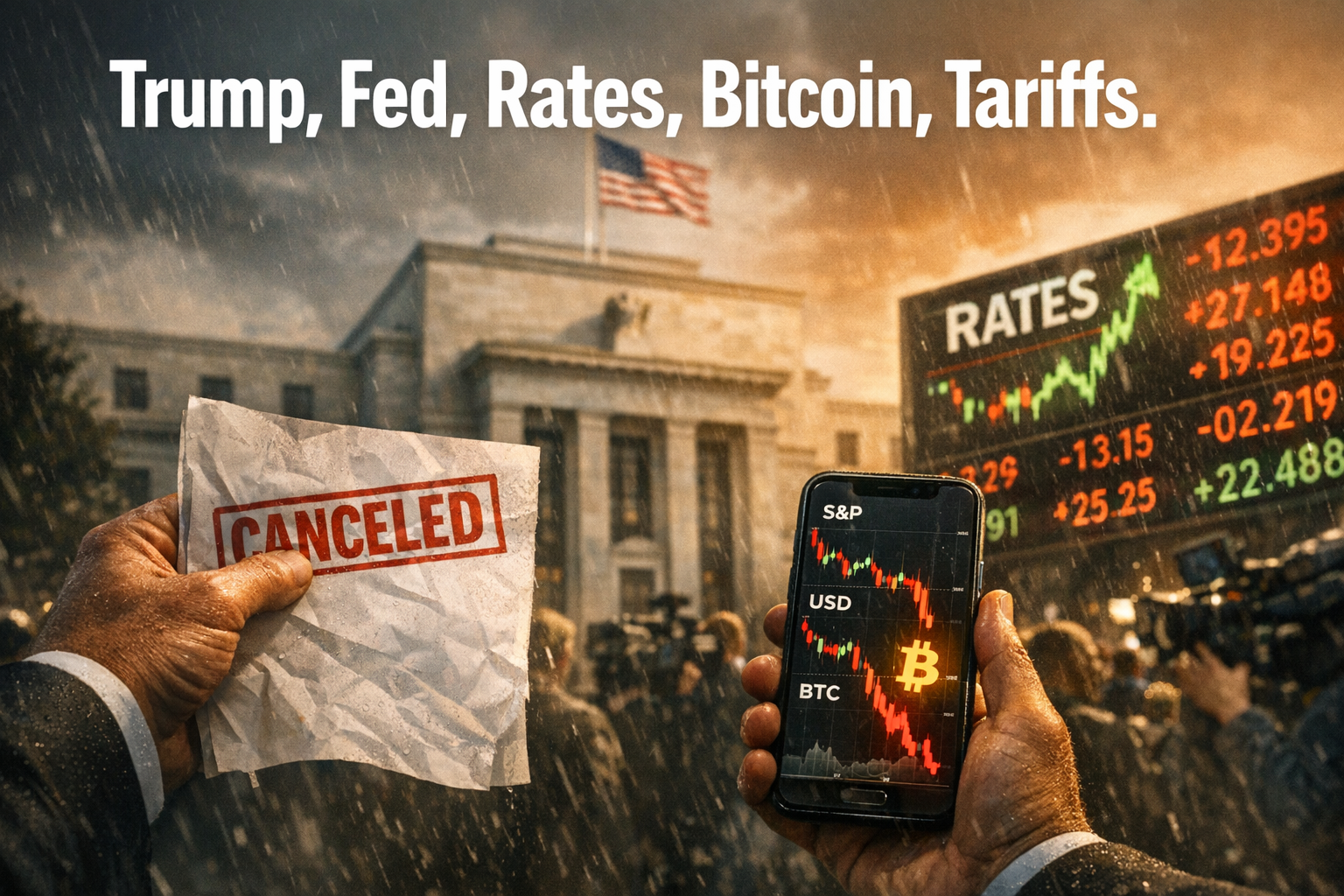
● Trump Speech Chaos Sparks Fed Shock Wave
The Real Meaning Behind the Sudden Cancellation/Delay of Trump’s “White House Remarks”: Markets React More to “Timing” Than to “Content”
This note covers four items.
① Why the schedule disruption (10:30 p.m. -> 1:00 a.m.) is a more adverse market signal
② How the prospective Fed Chair lineup (Rick Rieder, Kevin Hassett, Kevin Warsh) could alter the expected rate path
③ Asset-market implications if a scenario of “neutral rate recalibration -> larger rate cuts -> (conditional) quantitative easing” gains traction (U.S. equities, Treasuries, USD, Bitcoin)
④ How “reciprocal tariffs” and a “U.S. investment special act” could ultimately translate into pressure points for Korea
1) News Brief: The “Cancellation/Delay” Itself Is a Policy Signal
The core development is straightforward.
Trump’s scheduled White House remarks were set for 10:30 p.m., then abruptly canceled and moved to 1:00 a.m.
Markets do not evaluate only prepared text.
Positioning remarks immediately ahead of the FOMC decision release (4:00 a.m.) and the Powell press conference (4:30 a.m.) is unlikely to be incidental.
2) Why “Right Before the FOMC”: The Pressure Framework
The intended framing typically follows this sequence.
“Rate cuts are needed” -> “The Fed is disconnected from politics/real conditions” -> “Therefore the next Chair should be replaced”
Accordingly, a later time slot may not indicate a weaker message.
It may reflect an attempt to introduce a variable immediately before Powell’s press conference.
3) Prospective Fed Chair Dynamics: Why Markets Favor the Rick Rieder Narrative
A recurring emphasis is that betting markets (e.g., Polymarket) show increasing positioning toward Rick Rieder.
Rieder is associated with BlackRock’s global fixed-income leadership and is often interpreted as market-friendly, liquidity-supportive, and relatively constructive on digital assets.
3-1) Core Mechanism: Neutral-Rate Recalibration Comes First
The central logic is as follows.
To justify materially lower policy rates, the perceived neutral rate (r-star) must be revised downward first.
If the neutral rate is assumed to be high,
the Fed’s internal counterargument strengthens: current policy is sufficiently accommodative, and further cuts could raise overheating/inflation risk.
A more accommodative political push typically seeks to establish the sequence:
lower neutral-rate assumptions -> expanded room for cuts -> higher expectations for easier financial conditions/liquidity.
3-2) Fixed-Income Perspective: Rate Cuts Alone May Not Pull Long Yields Lower
From a bond investor’s perspective, lowering the policy rate is not sufficient.
If credibility erodes, long-end yields can rise even as short rates fall.
A more bond-supportive scenario would require markets to price in additional liquidity backstops beyond rate cuts.
4) Quantitative Easing (QE): Unlikely in the Near Term, but Expectations Move Prices
The argument is that QE is difficult to justify with policy rates in the 3% range.
This is directionally consistent with standard policy constraints.
However, markets often move on expectations before implementation.
The objective may be less about immediate QE and more about establishing optionality:
the perception that a policy regime shift could ultimately make such tools plausible.
As those expectations build, U.S. Treasury yields, the USD, and growth-equity valuations can reprice.
5) Stablecoins and Bitcoin: Not a Theme Trade, but a Treasury-Demand Channel
A practical linkage is emphasized.
Stablecoin structures can translate into sustained demand for short-dated U.S. Treasuries (T-bills).
This matters in an environment of large fiscal deficits and heavy Treasury issuance.
If private-sector stablecoin issuers increasingly absorb T-bills,
the impact can transmit through rates, liquidity conditions, and USD flows.
5-1) Bitcoin as a “Strategic Asset” Narrative
The discussion connects prior remarks in which Rieder referenced Bitcoin as an alternative store-of-value analogous to gold.
The key market mechanism is not whether the Fed buys Bitcoin,
but whether a credible policy-imagination set emerges that increases risk appetite.
6) Reciprocal Tariffs, Korea, and a “U.S. Investment Special Act”: Likely Pressure Points
The combination of reciprocal tariffs, Korea, and a U.S. investment-focused legislative push implies a consistent bargaining structure.
“Use tariffs to apply pressure” -> “Extract investment/factory/jobs commitments” -> “Package as political wins”
For Korea, the key variable may be less the headline tariff rate and more the scale and speed of U.S.-directed investment commitments.
This is particularly relevant for semiconductors, batteries, autos, and AI infrastructure, which directly intersect with U.S. supply-chain priorities.
7) Asset-Market Transmission (Summary): What Moves First as Rate-Cut Expectations Rise
Typical sequencing is as follows.
1) U.S. Treasury yield moves (especially the 2-year) -> repricing of the expected Fed path
2) DXY / USDKRW -> global capital flows and risk appetite
3) U.S. equities (Nasdaq-led) -> sensitivity to discount-rate expectations
4) Bitcoin and other risk assets -> amplified response if liquidity expectations overheat
The key driver is less the exact wording of remarks and more whether personnel/framing meaningfully shifts expectations for the Fed path.
8) Key Point Often Underweighted: Repricing of the Policy-Uncertainty Premium
The core issue is not headline-driven rhetoric, but a potential increase in the policy-uncertainty premium.
If remarks are canceled, rescheduled to 1:00 a.m., and official communications appear inconsistent,
market participants may interpret this less as content risk and more as governance/decision-process risk.
When that risk rises, the first areas to destabilize tend to be:
① long-end yields (credibility premium) ② the USD (safe-haven demand) ③ emerging markets (capital-flow volatility).
As a result, even if assets rally on “rate-cut expectations,”
a higher VIX alongside USD strength can characterize an unstable advance.
9) Core Macro SEO Keywords (5)
U.S. rate cuts
Inflation
USDKRW exchange rate
Recession
Quantitative easing
< Summary >
The cancellation/delay of Trump’s White House remarks is a stronger signal about timing risk than about message content.
Positioning remarks immediately ahead of the FOMC can be interpreted as pressure on the Fed and as reinforcement of a “next Chair” narrative.
If Rick Rieder gains credibility as a contender, markets may front-run a sequence of neutral-rate recalibration -> expanded rate-cut expectations.
Stablecoins/Bitcoin are less a standalone theme and more a function of T-bill demand and liquidity expectations.
For Korea, the central variable may shift from reciprocal tariff headlines to pressure for larger and faster U.S.-bound investment commitments.
[Related Posts…]
- How Changes in Fed Policy Affect Markets: Key Watchpoints for Rates, the USD, and Equities
- Reciprocal Tariff Risk Returns: Implications for Korea’s Exports, FX, and Corporate Investment Strategy
*Source: [ 경제 읽어주는 남자(김광석TV) ]
– [LIVE] ※10시30분 연설 돌연 취소됨※ [즉시분석]
● Rate Cuts Dangle, High Rates Bite
1) January FOMC (2025.01.29) Key Takeaways: Not “Rate Cuts,” but “How Long Rates Stay Restrictive” Is Driving Markets
This report consolidates:1) Monetary policy signals implied by wording changes in the FOMC statement
2) How Chair Powell managed rate-cut expectations in the press conference (and where markets are most sensitive)
3) Implications of the US inflation/labor/rate path for USD, FX, and equities
4) Key checkpoints for Korea-focused investors (KOSPI, KRW, bonds)
5) A separate summary of the most material conclusion that is underemphasized in other coverage
1) News Briefing: One Line Markets Should Take from the January 2025 FOMC
The message was less “cuts are imminent” and more “even if cuts begin, the pace will be gradual and conditional.”
The core of this meeting was communication around the duration of restrictive policy (high for longer) rather than the direction of rates. The Chair pushed back market expectations of a rapid Fed pivot, emphasizing further data confirmation.
2) Statement: Key Wording That Signals Policy Bias
2-1. Inflation Tone: Acknowledging Progress Without Declaring Victory
The Fed typically calibrates inflation language across three dimensions:1) Whether disinflation is “in progress”
2) Whether confidence is sufficient that inflation is returning to 2%
3) How strongly re-acceleration risks are emphasized
The signal was: inflation is moderating, but conditions are not yet sufficient for complacency. If inflation expectations re-accelerate, the Fed can pivot communication quickly.
2-2. Labor/Growth Language: “Rebalancing,” Not “Deterioration”
A key adverse scenario for the Fed is a labor-market breakdown before inflation is contained. When the statement starts describing labor conditions as “weak,” it can function as an easing signal. This meeting instead indicated labor conditions moving from overheating toward normalization.
2-3. Rates: “How Long to Hold” Over “When to Cut”
While markets focus on the timing of the first cut, the Fed continues to emphasize keeping policy “sufficiently restrictive for sufficiently long.” The implication is that cuts may occur, but an accelerated easing cycle is unlikely absent clear data support.
3) Powell Press Conference: Managing Forward-Looking Expectations
3-1. Core Messaging Structure: “Not Yet”
The Chair’s framework:“Progress is visible” → “more confidence is needed” → “policy depends on the data.”
The data set typically centers on:1) Sustained deceleration in CPI/PCE trends
2) Stabilization in wage growth
3) No re-ignition of demand overheating
3-2. Financial Conditions Constraint: Equity Strength Can Delay Cuts
A concurrent rise in equities, tighter credit spreads, and lower long-end yields constitutes easing financial conditions. If conditions ease too quickly, inflation risks can increase, incentivizing the Fed to temper guidance or delay easing. This matters most for US growth equities (e.g., Nasdaq) through valuation sensitivity to discount rates.
4) Global Macro: Three Core Scenarios for 1H 2025
4-1. Base Case: “Gradual Cuts + Moderate Growth”
If inflation trends lower and the labor market avoids abrupt weakening, the Fed can ease gradually. Risk assets may remain supported, with market leadership skewing toward earnings and cash-flow durability rather than multiple expansion.
4-2. Upside Inflation Risk: “Re-acceleration → Cuts Delayed”
If energy, housing, or services inflation re-firm, or wages re-accelerate, easing may be postponed. This typically supports USD strength and increases pressure on EM FX, including KRW. For Korea-focused investors, FX volatility becomes a primary risk channel.
4-3. Downside Growth Risk: “Labor Shock → Rapid Easing or Liquidity Response”
A sharp labor-market downturn could force faster easing. However, this is not unambiguously positive for equities if recession risk undermines earnings.
5) Korea (KOSPI, KRW, Bonds): Actionable Investor Checklist
5-1. FX: A Longer US Hold Is Negative for KRW
A prolonged restrictive stance tends to extend USD strength. Given Korea’s sensitivity to trade dynamics and foreign flows, FX moves can amplify KOSPI volatility.
5-2. Bonds: Long-End Behavior Matters More Than the Front End
Even without near-term policy cuts, markets reprice first through long-end yields. Stable long yields can support growth-equity valuation; a renewed rise in long yields typically compresses multiples.
5-3. Equities: “AI/Semiconductors Are Structural, but Pricing Is Rate- and USD-Sensitive”
AI infrastructure (data centers, power, GPUs) is a structural growth theme, but near-term pricing remains sensitive to rates and the dollar. Post-FOMC, rate/FX direction often dominates the equity reaction over technology fundamentals.
6) AI Trend: The Material Macro Link to the AI Industry
6-1. Higher Rates Shift AI from “Narrative-Led” to “Cash-Flow-Led”
In low-rate regimes, funding can follow growth narratives. In higher-rate regimes, AI companies are increasingly required to demonstrate:1) Monetization and revenue conversion
2) Lower inference costs
3) Customer lock-in via data and workflow integration
6-2. 2025 Focus: Operating Efficiency Over Model Performance
The next constraint set is not only model capability but also infrastructure bottlenecks: power, cooling, server utilization, and networking. This links AI capex cycles to macro conditions and financing costs.
7) Underemphasized Conclusion: The Fed’s Primary Objective Is to Prevent Premature Easing in Markets
The key variable is not whether cuts occur, but how strongly the Fed constrains market-driven easing.
If markets price aggressive cuts too early → financial conditions ease → inflation risk rises → the Fed may slow the expected easing path or shift rhetoric more hawkishly. Market-implied easing can become self-defeating.
For interpreting FOMC outcomes, the post-meeting reaction in the following typically matters more than the statement itself:1) Long-end US yields
2) US Dollar Index (DXY)
3) Equity style rotation (growth vs. value)
8) Data Watch: What Could Reprice Cut Expectations
Any of the following could force markets to reduce easing expectations:1) Re-acceleration in services inflation
2) Rebound in wage growth
3) Overheating in employment data versus consensus
4) Rising inflation expectations
Conversely, these would support easing expectations:1) Sustained deceleration in core inflation trend
2) Gradual labor-market cooling (not a sharp deterioration)
3) Evidence of slowing consumption confirming demand is not overheating
< Summary >
The January 2025 FOMC was principally about the duration of restrictive rates rather than the initiation of cuts. Powell acknowledged disinflation progress while signaling that easing would not be rushed and remains data-dependent. The more markets ease financial conditions in advance, the higher the probability the Fed slows the pace of cuts or adopts a more hawkish tone. Korea-focused investors should monitor FX, long-end yields, and foreign flow dynamics as key drivers of KOSPI volatility. Under higher rates, the AI theme is shifting from model-centric competition toward cash-flow discipline and infrastructure operating efficiency.
[Related]
- Key Post-FOMC Market Focus Points: https://NextGenInsight.net?s=FOMC
- What Korea Investors Should Track During FX Volatility: https://NextGenInsight.net?s=FX
*Source: [ Maeil Business Newspaper ]
– [LIVE] 1월 FOMC 성명서 해설 l 파월 기자회견