● Delivery Miss, Profit Shock, Robot Empire
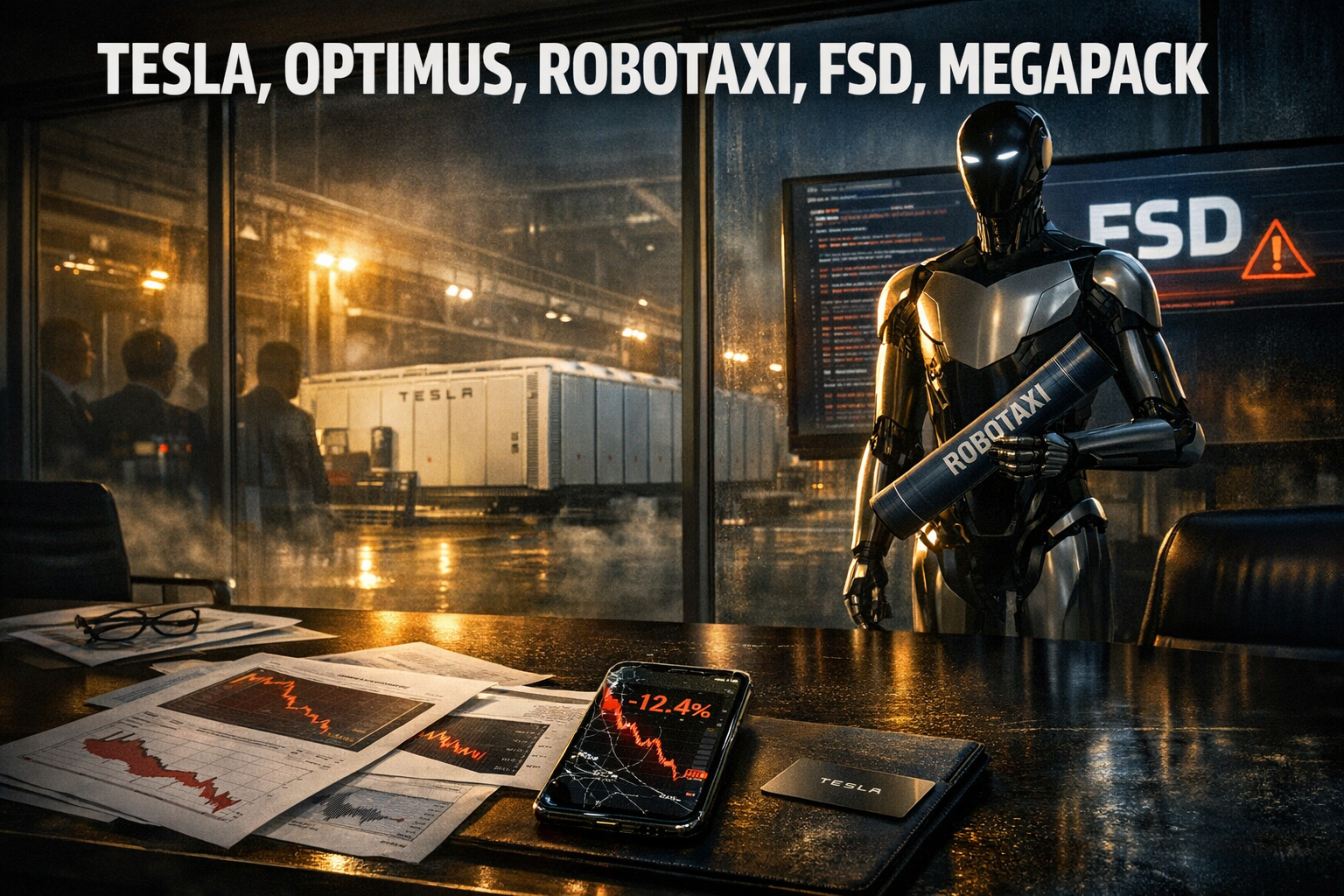
Key Takeaways from Tesla Q4 Earnings: Why Profits Rose Despite a Delivery Miss, the Strategic Intent Behind Discontinuing Model S/X, and the Roadmap Toward a 1M-Unit “Optimus” Scale
This report highlights five material points:
1) Structural drivers behind revenue, margin, and EPS outperformance despite weaker deliveries
2) Tesla’s formal shift away from the “automaker” frame (Physical AI company) and the implications of the 2026 production-line plan
3) Why discontinuing Model S/X is less about cost-cutting and more a signal toward Optimus mass production
4) How 1.1 million FSD subscribers and 14.2 GWh of energy storage deployments create a high-margin cash-generation model
5) Why the $2.0B xAI investment can reshape both long-term cash flows and competitive positioning
1) Headline Summary (News-Style)
- Tesla 2025 Q4: Deliveries below expectations, while revenue exceeded consensus
- EPS exceeded market expectations (0.45 USD) per stated figures, indicating an earnings beat
- Core dynamic: Energy (Megapack) and software (FSD subscriptions) offset slower automotive revenue
- Gross margin recovered to the low-20% range (stated: 20.1%), indicating improved profitability resilience
- From 2026, capacity expansion emphasis shifts away from scaling Model 3/Y and toward Cybercab, Semi, Optimus, Megapack, 4680, lithium refining, and AI/energy/robotics infrastructure
2) Q4 Results in Numbers: Transition Toward “Lower Volume, Higher Profit Mix”
1) Revenue mix quality improved
- Delivery shortfalls typically pressure both revenue and earnings; in this quarter, business mix was the differentiator.
- Automotive revenue weakness was mitigated by growth in energy and services, supporting consolidated revenue.
- Average selling price (ASP) stability and a higher share of value-added revenue contributed.
2) Interpreting the gross margin rebound
- Gross margin reportedly increased to 20.1%.
- Margin expansion occurred despite higher R&D (next-generation chips and AI), lower deliveries, and reduced regulatory credit contribution, implying stronger manufacturing efficiency and energy/services mix.
- Profitability appears less reliant on non-core, external factors and more driven by operating structure.
3) Cash flow and investment capacity
- Sustained operating cash flow supports simultaneous capex execution and AI compute investment.
- The investment posture indicates prioritization of AI/energy/robotics platform expansion rather than growth driven solely by higher vehicle unit sales.
3) Two Engines Behind the Surprise: FSD Subscriptions + Energy Storage
Engine A: 1.1 million FSD subscribers (stated)
- Subscription revenue is recurring rather than transactional.
- Software revenue scales with limited incremental cost, strengthening operating leverage.
- The model increasingly resembles a subscription layer integrated into the vehicle base.
Engine B: 14.2 GWh energy storage deployments (stated)
- Reported as +81% year-over-year (stated), supported by demand linked to AI data-center expansion.
- As the EV cycle moderates, energy storage is positioned not only as a growth vector but as a profitability lever.
Conclusion: Profit center shifting from “auto margin” toward “AI + energy margin”
- The key variable this quarter is mix rather than deliveries.
- Subscription and energy contributions reduce sensitivity to macro-driven demand swings typical of manufacturing.
4) Implications of the 2026 Production-Line Strategy: Scaling Physical AI, Not Model 3/Y
Tesla effectively reframed its identity as:
“Hardware automaker” → “Physical AI company operating in the real world”
Items included in the 2026 expansion plan (stated)
- Cybercab
- Tesla Semi
- Optimus (humanoid robot)
- Megapack (energy storage)
- 4680 batteries
- Lithium refining capacity
This indicates a shift from a unit-sales growth narrative to a platform and infrastructure scaling approach, supported by aggressive vertical integration and industrial capex.
5) Optimus: Gen 3 Disclosure + 1M Units/Year Target
Optimus Gen 3 (stated: Q1 disclosure)
- Positioned as the first design explicitly intended for mass production rather than incremental demonstration.
Target: 1 million units per year (stated)
- This target implies readiness across manufacturing, quality systems, component supply, and service infrastructure.
- The scale ambition signals potential industrial reallocation rather than a purely R&D initiative.
Critical linkage: Discontinuation of Model S/X
- Model S/X discontinuation in 2026 Q2 (stated).
- Framed as less about premium lineup rationalization and more as capacity reallocation.
- If manufacturing lines are repurposed toward Optimus, the decision represents strategic redeployment of industrial capacity rather than a narrow cost-reduction measure.
6) Robotaxi: H1 Geographic Expansion + Unsupervised Testing in Austin
Operating status (stated)
- Unsupervised testing in Austin, reportedly advancing to operations without a chase vehicle.
- Approximate fleet reference: ~500 units across San Francisco and Austin.
H1 target cities (stated)
- Dallas, Houston
- Phoenix
- Miami, Orlando, Tampa
- Las Vegas
Robotaxi is positioned as a platform opportunity integrating subscriptions, platform fees, and insurance-linked monetization.
7) Batteries and Supply Chain: 4680 Dry Electrode + U.S.-Made LFP to Reduce Geopolitical Risk
4680 batteries (stated)
- Dry-electrode production for both cathode and anode in Austin was formally stated.
- Deliveries of Model Y with 4680 cells were stated as initiated.
- Dry-electrode manufacturing is positioned as a cost and throughput lever with high signaling value.
U.S. LFP production (stated: 2026 start)
- Reduces reliance on China-centric LFP supply.
- Addresses tariff exposure, U.S.-China trade friction, and supply-chain volatility, supporting cost stability.
This aligns with broader reshoring dynamics and policy-driven supply-chain reconfiguration.
8) AI Compute and Chips: Cortex 2 + AI5 (50x Target) + Semiconductor Manufacturing Mention
Cortex 2 (stated)
- Target to double AI compute capability at the Texas site by 1H 2026.
AI5 chip (stated: 50x vs AI4, 2027)
- Broad upgrades across compute, memory, and data throughput were stated.
- AI6 mass production timing was stated for 2028.
Semiconductors identified as the primary bottleneck (stated)
- Mentioned intent to address chip constraints potentially via an in-house semiconductor fabrication initiative (“Terra”).
- If pursued, this would extend vertical integration from design into manufacturing to mitigate supply risk and accelerate scaling.
9) Virtual Power Plant (VPP): Scaling Energy Network Effects
Key disclosures (stated)
- More than 89,000 VPP events in 2025
- More than 1 million Powerwalls globally operating as a coordinated virtual plant
- Aggregate electricity bill savings exceeding $1.0B (stated)
The monetization pathway extends beyond hardware sales toward grid-balancing network operations, with potential to evolve into an energy platform model subject to market design and regulation.
10) xAI Investment: $2.0B and Strategic Rationale
Disclosure (stated)
- On January 16, 2026, Tesla agreed to invest $2.0B in xAI Series 2 preferred shares.
Strategic interpretation
- Tesla supplies deployed hardware endpoints (vehicles, robots, energy devices); xAI strengthens conversational and agentic intelligence.
- A framework agreement indicates a formal integration pathway for xAI models into Tesla products.
- The objective appears aligned with increasing service ARPU and retention through AI-enabled subscriptions, fees, and insurance-linked offerings rather than relying solely on vehicle ASP expansion.
11) Under-Discussed High-Impact Points
1) Core earnings narrative is shifting from deliveries to reduced macro sensitivity
Automotive demand is highly exposed to rates, credit conditions, and consumer purchasing power. Expanding software subscriptions and energy storage diversifies revenue sensitivity.
2) Model S/X discontinuation signals manufacturing capacity reallocation toward AI production
De-emphasizing a symbolic premium line suggests prioritization of robotics, robotaxi, and energy where scale economics may be more favorable.
3) Competitive differentiation centers on scaling capability: mass production + vertical integration + cash generation
Demonstrations are not equivalent to industrial-scale output. Control of batteries, refining, compute, and chips is positioned to improve speed, cost, and supply independence.
4) Robotaxi economics may be driven more by scale and insurance/finance integration than by technology alone
Higher FSD utilization tied to insurance incentives can strengthen ecosystem lock-in.
5) The xAI investment links directly to long-duration monetization
If agentic AI is embedded into vehicles and robots, monetization may shift toward subscriptions and services rather than purely hardware pricing.
12) Macro Context
- Regardless of the rate path, manufacturing remains capital-intensive and demand-volatile; Tesla is diversifying via subscription economics and energy infrastructure.
- As tariff and geopolitical risks rise, domestic battery/refining/semiconductor initiatives may increase strategic value.
- AI data-center growth intensifies grid constraints, supporting demand for storage and VPP-type solutions.
- Overall positioning trends toward a multi-platform company combining AI silicon, energy infrastructure, and robotics rather than a single-sector EV manufacturer.
< Summary >
Tesla Q4 outperformed on profitability despite a delivery shortfall, driven by FSD subscriptions (1.1M) and energy storage deployments (14.2 GWh) supporting revenue mix and margin. From 2026, capacity expansion priorities shift from Model 3/Y scaling toward Cybercab, Semi, Optimus, Megapack, 4680, and lithium refining, reinforcing a Physical AI framing. Model S/X discontinuation is positioned as capacity redeployment toward Optimus-scale manufacturing. Combined with robotaxi expansion, VPP scaling, and supply-chain localization (U.S. LFP production), the long-term model increasingly emphasizes subscriptions and platform-style monetization.
[Related Articles…]
- https://NextGenInsight.net?s=robotaxi
- https://NextGenInsight.net?s=battery
*Source: [ 오늘의 테슬라 뉴스 ]
– 어닝 서프라이즈! 모델 S·X 전격 단종과 연 100만대 로봇 제국 건설, 월가를 경악시킨 테슬라 Q4 실적 발표?
● Tesla Ditches Cars, 20B CapEx Bet on AI Robotaxis, Humanoids, Energy Empire
Tesla Earnings Call: Repositioning from an “Automaker” to AI, Robotics, and Energy Infrastructure (What the USD 20B CapEx Signals)
This discussion is not primarily about whether quarterly results were strong or weak.
The key issue is what Tesla intends to build with approximately USD 20 billion (about KRW 28 trillion) in capital expenditures, and how this investment forms a single strategic line connecting FSD monetization, a robotaxi (Cybercab) network, mass production of the Optimus humanoid robot, in-house AI chips (AI5/AI6), and solar + energy storage to address data-center power demand.
Below is a news-style, itemized summary, followed by the most material points often omitted by mainstream coverage.
1) Message More Important Than the Numbers: “The Profit Center Is Already Shifting”
Key takeaway
Despite concerns about slowing EV sales, the call emphasized an ongoing shift in the profit mix from vehicle sales toward software and services.
Points to monitor
- Commentary around margins above 20%: beyond any single-quarter metric, this suggests management intends to improve margin quality via FSD and services.
- 1.1 million paid FSD customers: indicates recurring subscription revenue is increasingly material for earnings durability and upside.
- Insurance discounts tied to FSD: positioning FSD subscription cost as potentially offset by lower insurance premiums effectively functions as a pricing lever to accelerate FSD adoption.
2) USD 20B CapEx: Allocation Priorities (Six Facilities + Broad Internalization)
USD 20 billion of CapEx signals more than incremental factory build-out; it reflects a redefinition of Tesla’s business scope.
Investment areas referenced
- Lithium refining facilities / LFP battery-related initiatives
- AI compute (training infrastructure, including “Tera”)
- Optimus manufacturing facilities (humanoid production)
- Cybercab / Semi / Megafactory (energy storage)
- Supply chain internalization (designing and producing components when external supply is constrained)
Rationale for scale and timing
- Tesla frames the binding constraints as chips, power, components, and scalable manufacturing capacity rather than demand.
- The strategy centers on vertical integration to remove bottlenecks and reduce long-run unit costs.
3) Model S/X Production Halt to Convert to an “1M Units/Year Optimus Line”: Economic and Strategic Significance
A notable statement was the plan to halt Model S and Model X production and fully convert the line to Optimus production, targeting annual capacity of 1 million units.
Implications
- Transitioning from a premium vehicle line to a robot line indicates a strategic shift in corporate identity and product emphasis.
- S/X volumes are limited while production lines carry fixed-cost burdens.
- If successful, Optimus offers a fundamentally different profile in ASP, margins, and scalability, making the line conversion strategically significant.
Acknowledged execution risk
- Management indicated that meaningful mass production should not be expected by year-end.
- This implies limited near-term revenue impact, with a 2–3 year build-out timeline for material financial contribution.
4) Structural Business Model Shift: From “Vehicle Sales” to “Mobility Services + Software”
A recurring theme was positioning Tesla less as a manufacturer and more as a mobility-services provider.
Why hardware margin questions were framed as becoming less relevant
- In a robotaxi model, value creation depends less on gross margin at the point of sale and more on utilization and revenue per vehicle-kilometer within a network.
- Hardware increasingly resembles a terminal, while monetization shifts toward FSD, ride/usage fees, and fleet operations.
5) Cybercab: Implications of the “Replace 90% of the Taxi Market” Claim
Tesla presented an aggressive scenario:
- Cybercab volume could exceed the combined production of other models.
- Cybercab could replace 90% of the taxi market.
Why 1–2 passenger utilization was highlighted
- Tesla cited that most taxi trips involve 1–2 passengers, supporting the thesis that a small, purpose-built vehicle can significantly disrupt cost structure.
Regulatory and scaling posture
- References to pending US approvals and improved visibility toward year-end.
- Plans in Austin to remove chase vehicles (safety support cars), indicating progression toward more autonomous operations.
- Management also noted the need to validate accident-prone zones by city, suggesting staged rollouts.
6) Vehicle Sharing “Like Airbnb”: Embedded Network Effects
A key concept was a structure in which customers who purchased FSD could place their vehicles into and out of a shared network.
Why it matters
- Robotaxi scale is often modeled as Tesla-owned fleet expansion; this approach can increase supply without Tesla funding the full vehicle base via CapEx.
- This can materially change cash-flow dynamics and scaling speed.
- It shifts valuation logic from capital-intensive manufacturing toward platform and network economics.
7) AI Chip Roadmap: AI5 (2027), AI6 (2028) and “Chips Are the Bottleneck”
Mentioning AI5/AI6 timing is less a product roadmap and more an indication Tesla is positioning itself as an AI infrastructure company.
Rationale for in-house chips
- Management implied existing suppliers may suffice for the next 3–4 years, but not beyond, due to demand outpacing supply.
- Geopolitical risks (tariffs, export controls) increase the risk of external dependence.
Macro linkage
- As supply-chain fragmentation intensifies, controlling critical components (especially chips) becomes strategically central.
8) Energy (Solar + ESS): Direct Positioning for Data-Center Power Demand Growth
Tesla referenced record profitability trends in energy and stated solar opportunities are underappreciated.
Logic framework
- AI data-center expansion drives rapid power-demand growth.
- If grids cannot keep pace, incremental supply must come from:1) utility-scale ground solar2) extreme alternatives referenced in discussion (e.g., space-based solar)3) energy storage systems (ESS, including Megapack)
Internal demand also increases
- Robotaxi fleet operations
- Optimus manufacturing facilities
- AI training compute (“Tera”)
Power becomes both a core cost and a competitive differentiator.
9) xAI Investment (USD 2B): Less a Related-Party Stake, More an “Operating System” Layer
Tesla disclosed an xAI investment of USD 2 billion.
Potential use cases indicated
- Large-scale Optimus operations and management (fleet-like orchestration)
- Factory build-out and operational efficiency (orchestration)
- Acceleration of technical innovation
Strategic point
- The direction is to unify autonomy, robotics, manufacturing, and energy under a cohesive AI operating layer rather than relying solely on third-party models.
10) Financing and Balance Sheet: USD 44B Cash + Future Cash Flow + Optional Debt
A practical question around elevated CapEx is funding. Tesla referenced:
- cash and investments of approximately USD 44 billion
- future operating cash flow
- debt financing if needed
Market signal
- Management’s willingness to commit to this investment scale implies confidence in future cash generation from FSD, robotaxi, and energy.
- In a higher-rate environment, longer payback periods increase valuation sensitivity and potential volatility.
11) Earnings Call: Headline Summary in 10 Lines
1) Tesla outlines a USD 20B CapEx program, positioning toward future industries at scale
2) 1.1M paid FSD customers; recurring subscription revenue becoming more material
3) Insurance discounts may reduce effective FSD pricing and support adoption
4) Model S/X production halted; line conversion to Optimus with 1M units/year target
5) Austin: removal of chase vehicles; signal toward broader unsupervised operations
6) Cybercab projected to exceed combined output of other models; 90% taxi replacement claim
7) Explicit positioning shift from automaker to mobility services company
8) AI5 (2027) and AI6 (2028) roadmap; chips and compute framed as primary bottlenecks
9) Solar + ESS (Megapack) highlighted against data-center power demand growth
10) USD 2B xAI investment to integrate robots/factories/operations via AI
12) Highest-Impact Points Often Underemphasized
Point A. The core of the USD 20B CapEx is bottleneck removal, not product launches
The focus is not only whether robotaxis or Optimus succeed; Tesla is prioritizing elimination of constraints in chips, power, components, and manufacturing capacity. This aligns with an environment where supply control and resilience are increasingly decisive.
Point B. Driving FSD adoption via insurance economics can reshape the demand curve
FSD price resistance is materially influenced by upfront and perceived monthly cost. If insurance savings reduce perceived cost, subscription conversion can structurally improve, creating a revenue lever less tied to EV demand cycles.
Point C. A vehicle-sharing network reduces Tesla’s capital intensity
If Tesla must own most robotaxi assets, CapEx scales aggressively. Incorporating customer-owned vehicles distributes asset burden externally while preserving platform fees and software revenue, shifting the business model toward platform economics.
Point D. The entire strategy is directly linked to interest rates
Large CapEx programs are highly sensitive to discount rates. Proceeding despite elevated rates implies internal confidence in nearer-term strengthening of cash generation, while also increasing valuation sensitivity to macro rate dynamics.
13) Investor and Operator Checklist (Practical Monitoring Items)
Check 1: Regulatory timeline
Year-end references may reflect aspirational guidance. City-by-city approvals and rollout pace will determine revenue timing.
Check 2: Optimus productivity (demo vs. operational deployment)
Given comments implying ongoing development, the key milestone is measurable cost reduction from real factory deployment.
Check 3: Durability of energy growth
Megapack/ESS benefits from AI-driven power demand but remains project-based and can be volatile quarter-to-quarter.
Check 4: Supply-chain risk and internalization speed
Tariffs, export controls, and geopolitical shifts are both risk and opportunity; faster internalization increases resilience.
Check 5: Macro conditions (inflation/interest rates) and multiple sensitivity
Large CapEx increases sensitivity to discount rates, likely sustaining equity volatility.
< Summary >
Tesla’s USD 20 billion CapEx program frames a transition from optimizing vehicle sales to building an integrated platform spanning autonomous software, robotaxi networks, humanoid robotics, in-house AI chips, and energy infrastructure.
FSD is positioned for accelerated adoption via insurance-linked economics, and Cybercab is framed as a network platform that may include customer-supplied vehicles.
The central strategic emphasis is not announcements, but removal of bottlenecks in chips, power, components, and factory capacity to improve supply-chain resilience and expand long-duration cash-flow potential.
[Related Articles…]
- Why the FSD subscription economy can reshape Tesla’s valuation (https://NextGenInsight.net?s=FSD)
- Robotaxi regulation and monetization: US vs. China vs. Korea (https://NextGenInsight.net?s=robotaxi)
*Source: [ 허니잼의 테슬라와 일론 ]
– [테슬라 어닝] 이처럼 충격적인 어닝콜은 없었습니다. 200억 달러의 공격적 투자 결정!
● Korea Faces Japan Style Lost Decades AI Policy Trap Looms 2026 Pivot or Stagnation
2026: Why Views Diverge on Whether Korea Can Avoid a “Japan-Style Lost 30 Years” — The Pitfalls of State-Led Industrial Policy and the Critical Battleground in the AI Value Chain
This note consolidates four items:1) Why Japan’s national projects (including semiconductors) repeatedly failed, focusing on decision-making structure
2) A checklist of policy/industrial operating patterns that could place Korea on a similar path
3) Why 2026 is a macro inflection point (rates, FX, capital flows, growth) and how these variables connect
4) A key issue often under-discussed: the operating model of policy design and execution
1) News Briefing: Key Points in a “Business/Economics” Format
[Headline]
“Implicit government backstops” eroded industrial competitiveness.
Japan’s state-led semiconductor initiatives underperformed not due to insufficient technology, but because administrative decision-making substituted for market-based selection.
[Issue 1] Primary cause of failure: adverse decision-making structure
Execution requires alignment between “How” (technology/quality) and “What” (product/market fit). Japan over-weighted the “How.”
Initiatives started from consortium incentives and bureaucratic logic rather than customer demand.
Outcome: deliverables optimized for the program rather than products optimized for the market.
[Issue 2] Joint ventures weakened by the expectation of state responsibility
Government-funded consortia can appear to create scale.
However, competing firms rarely operate as a unified entity; internal politics and responsibility avoidance increase.
Decision speed declines; accountability becomes diffuse, reducing learning from failure.
[Issue 3] The most damaging constraint: inability to pivot
State programs typically hard-code targets and deadlines.
When market conditions shift or superior approaches emerge, rapid pivoting is difficult.
In an AI-driven discontinuity, rigidity becomes a material liability.
[Issue 4] Support as life support → proliferation of “zombie” firms
When funding creates dependency rather than innovation, industry-wide dynamism slows.
Short-term employment/survival may be preserved, but medium- to long-term productivity weakens and private investment incentives deteriorate.
2) Why 2026 Is an Inflection Point: AI Transition + Macro Variables (Rates, FX, Capital Flows) Colliding
[Point A] The gap between ~1% national growth and 50–60% AI-sector growth
When overall growth is low but leading AI firms grow substantially faster, sectoral leadership determines the economy’s potential growth path.
If Korea captures critical nodes in the AI value chain, the growth trajectory can improve; failure to do so may accelerate low-growth entrenchment.
[Point B] FX is not only about exports; it is about capital inflows
Persistent KRW weakness may support exporters in the short run.
However, it can also reduce foreign and domestic preference for KRW assets, increasing capital outflow pressure.
Outflows tighten financial conditions, potentially weakening investment, employment, and consumption.
FX therefore links directly to capital-market confidence.
[Point C] Japan is moving toward rate normalization
Japan’s rate normalization reflects, in part, the long-tail effects of prior policy/industrial management.
For Korea, the practical lesson is to analyze why Japan failed to prevent stagnation, with emphasis on industrial-policy structure.
3) To Avoid “Japanification”: Change the Operating Model of Industrial Policy
The central risk is not what is supported, but how support is designed and administered.
[Checklist 1] Risk signal: KPIs centered on deployment counts
KPIs such as “deploy to 20,000 sites” are politically legible but do not ensure productivity gains.
Thinly spread budgets lead to partial optimization (e.g., minimal equipment purchases) rather than transformation of processes, data, and decision systems.
Result: hardware distribution rather than genuine digital transformation.
[Checklist 2] Risk signal: competition shifts from product-market fit to paperwork fit
Firms optimize for government evaluation rather than customer validation.
This increases “documentation-driven” companies and reduces field-level problem-solving capability.
[Checklist 3] Consortia must be designed for market execution, not technology signaling
In AI/semiconductors, execution across customers, data, distribution, and services is decisive.
If consortia optimize for budget capture, the probability of a Galapagos-style trap increases.
[Checklist 4] Roadmaps without flexibility are harmful in AI cycles
AI competitive dynamics can shift within six months.
If programs prioritize annual budget execution rates, the ability to terminate or pivot is constrained.
This reproduces rigidity and degrades return on investment.
4) Key Under-Discussed Point: The Issue Is Not “Smart Government,” but Systems That Make Smart Decisions Structurally Unlikely
The relevant question is not whether exceptional leadership can make state-led approaches succeed.
Systems dependent on individual competence lack repeatability and tend to underperform on average.
The priority is a policy system that:
- incorporates market signals rapidly,
- acknowledges failure quickly, and
- reallocates resources efficiently.
Japan’s weakness was limited pivot capacity in program operations; Korea faces a comparable risk if operating structures remain inflexible.
5) A Korea-Oriented Framework: Designing AI Industrial Policy for 2026–2028 to Reduce Risk
[Solution 1] Shift from “What” to “Who/How”
In the AI value chain, the determinant is not item selection but whether decision rights sit close to the market (customers, field operators, data owners).
Government should focus less on defining “the answer” and more on expanding experimentation and lowering the cost of failure.
[Solution 2] Avoid thin distribution of funds; concentrate support and measure productivity
Broad, shallow subsidies improve near-term visibility but weakly change industrial fundamentals.
Select fewer targets, but bundle data standardization, process innovation, and AI operations talent, and evaluate outcomes via productivity metrics.
[Solution 3] Integrate FX, rates, and capital inflows into industrial strategy
AI industrial policy functions as both technology policy and financial policy.
If KRW asset attractiveness (returns, growth, credibility) deteriorates, capital outflows increase and reduce innovation-investment capacity.
AI competitiveness should be designed in tandem with monetary/financial conditions.
[Solution 4] Anti-zombie mechanisms: define exit conditions upfront
When support becomes maintenance, sector-wide competitiveness declines.
Establish ex-ante rules such as suspension below performance thresholds, restructuring, and facilitation of M&A.
Note: These dynamics interact with supply-chain reconfiguration, inflation, policy-rate cycles, and KRW weakness.
Industrial policy cannot be addressed in isolation; it must be evaluated jointly with monetary policy, capital markets, and productivity strategy.
6) Conclusion: One Core Lesson for Korea from Japan’s Failure
If increased public funding pushes decisions further from market discipline, even strong technology can become a Galapagos outcome.
Because 2026 marks a phase where AI reshapes industrial hierarchy, operating mechanics—more than declared direction—are likely to determine outcomes.
- The core failure in Japan’s state-led industrial policy was not a technology deficit; it was a structure where bureaucracies and consortium incentives dominated decisions rather than market demand.
- National projects tend to be rigid, limiting pivots; support can drift from innovation toward maintenance, increasing zombie-firm risk.
- 2026 is an inflection point as AI transition coincides with FX, rates, and capital-flow pressures, shaping Korea’s growth path.
- Korea’s risk rises unless policy execution prioritizes flexibility, market validation, explicit termination rules, and productivity-based KPIs over deployment counts.
[Related]
- AI Transition Era: Critical Battlegrounds in Korea’s Industrial Strategy (https://NextGenInsight.net?s=AI)
- KRW Weakness and Capital Outflows: How FX Transmits into the Economy (https://NextGenInsight.net?s=FX)
*Source: [ 경제 읽어주는 남자(김광석TV) ]
– 국가 주도 산업 정책의 실패 ‘정부가 책임져 주겠지의 끝’ 일본의 실패에서 한국의 답을 찾다 | 북리뷰 ‘일본의 몰락’ 2편