● AI Hype Ends, Earnings Rule 2026, Quantum Boom Teased
Why the 2026 “Great Technological Upheaval” Really Arrives: AI Is Now Shifting from “Expectation” to “Performance”
This article contains the following.
1) The structural reasons why tech/AI investment in 2026 shifts from “themes” to “performance”
2) The background for quantum computing being mentioned again as the next wave after AI (liquidity/government strategy/technical indicators)
3) How to read quantum computing not as “how many qubits?” but as a ‘money-making technology roadmap’
4) A key point rarely covered in the market: in 2026 only companies that post profits receive a premium
1) [Headline] 2026 Is the “Year of Investment Math for Tech” — Performance and valuation, not news, will decide
core point
The reason returns are lacking despite abundant information is not “lack of information” but an underlying problem of “lack of interpretation.”
The claim is that in 2026 it will no longer be “AI so it goes up” but “does AI produce operating profit?” that becomes the rule of the game.
Why this change amplifies in 2026
AI is already permeating physical industries such as robotics, autonomous driving, and space, expanding beyond a “mega-trend” into a “giga-trend” that alters daily life and industrial structure.
When reaching this stage, the market naturally looks at the income statement rather than technology demos.
Changes from an investment perspective (important)
2024–2025: Competition over “which AI theme to pick”
2026: Competition over “who can prove it with profit margins/cash flow”
Ultimately, valuation (business valuation) returns to the forefront.
2) [Market frame] The 2026 tech market could be both a “liquidity rally” and a “verification rally” at the same time
Premise revealed in the original text
By mentioning a “possible liquidity rally in 2026,” it suggests small caps and new-technology themes (including quantum) could regain momentum.
However, it also warns that “AI-related stocks will not rise indiscriminately; only companies that generate profits will rise.”
Common traps investors fall into here
Many stop at holding mega-caps like NVIDIA/Google/Tesla and conclude “I invested in AI.”
Alpha (excess returns) usually depends on the next questions.
You must ask “why did it already rise (narrative vs performance), where does the current period sit in valuation terms, and how much upside remains?”
Macro keywords that naturally connect here (also important for SEO)
Interest rates, inflation, US stocks, semiconductors, generative AI are key axes forming the 2026 tech investment frame.
3) [Quantum computing part] A realistic answer to “Is quantum computing science fiction?” : promising but still needs “time” and “metrics”
Big picture by market size/growth rate
According to the original text, the quantum computing market is estimated at about 8 trillion KRW in 2022 → about 60 trillion KRW in 2031, implying a compound annual growth rate of 21%.
Based on numbers alone, the conclusion is that the market itself is very attractive.
But the commercialization timeline must be viewed coldly
Research and government investment still account for a large share, and full-fledged B2B expansion may take time.
Conservative forecasts that say “it will take 20–40 years” clash with aggressive forecasts that say “significant progress within 5 years.”
In short, the theme is hot but the timing remains uncertain.
4) [Three key indicators to view quantum computing] Look at real performance, not qubit number marketing
The original text emphasized
“Physical qubit count” can be an easy-to-show metric (marketing), and more essential are “logical qubits” and quality metrics.
Three core indicators investors must know (the language investors should use)
1) Coherence Time: How long the quantum state is maintained (longer is better)
2) Gate Time: The time required for a single operation (shorter is better)
3) Gate Fidelity: Operation accuracy (higher is better)
Commercialization stages (from a TRL perspective)
Quantum communication is close to commercialization, but quantum computers are still at an intermediate stage (roughly TRL 6–7 mentioned); generally, TRL near 9 is considered full commercialization.
This gap explains why many talk about the 2030s for mainstream adoption.
5) [Use cases] Where quantum computing actually makes money: finance, drug discovery, new materials, optimization, and AI itself
Finance
Portfolio optimization, risk analysis, and derivative pricing—areas with heavy combinatorial optimization/probabilistic computation—are cited as representative applications.
Pharmaceuticals/Biotech (Drug Discovery)
Molecular simulation is a computation-heavy domain, and quantum computing could combine with AI (e.g., protein structure prediction) as the next stage.
New Materials
Molecular-level design and exploration are problems that take a long time on classical computers, making quantum a candidate for the next-generation computation engine.
Logistics/Route/Scheduling (Optimization)
Route optimization and combinatorial optimization face walls as problem sizes grow for classical computing.
Relationship with AI (complementary)
Quantum is more likely to complement rather than replace GPUs: classical computing, GPUs, and quantum may each take on roles in a division of labor.
AI can help quantum development, and quantum can assist AI development in a mutually accelerating picture.
6) [Policy/national strategy] Quantum computing is treated as a “strategic technology of nuclear-weapon scale”
Many countries, including the United States, are pushing quantum information science as a strategic technology.
From an investor perspective, this point means that even if the technology is slow, the probability that funding and talent will not dry up is high.
However, policy support does not immediately translate into listed companies’ performance, so it is essential to look at company-specific roadmaps and cash flow.
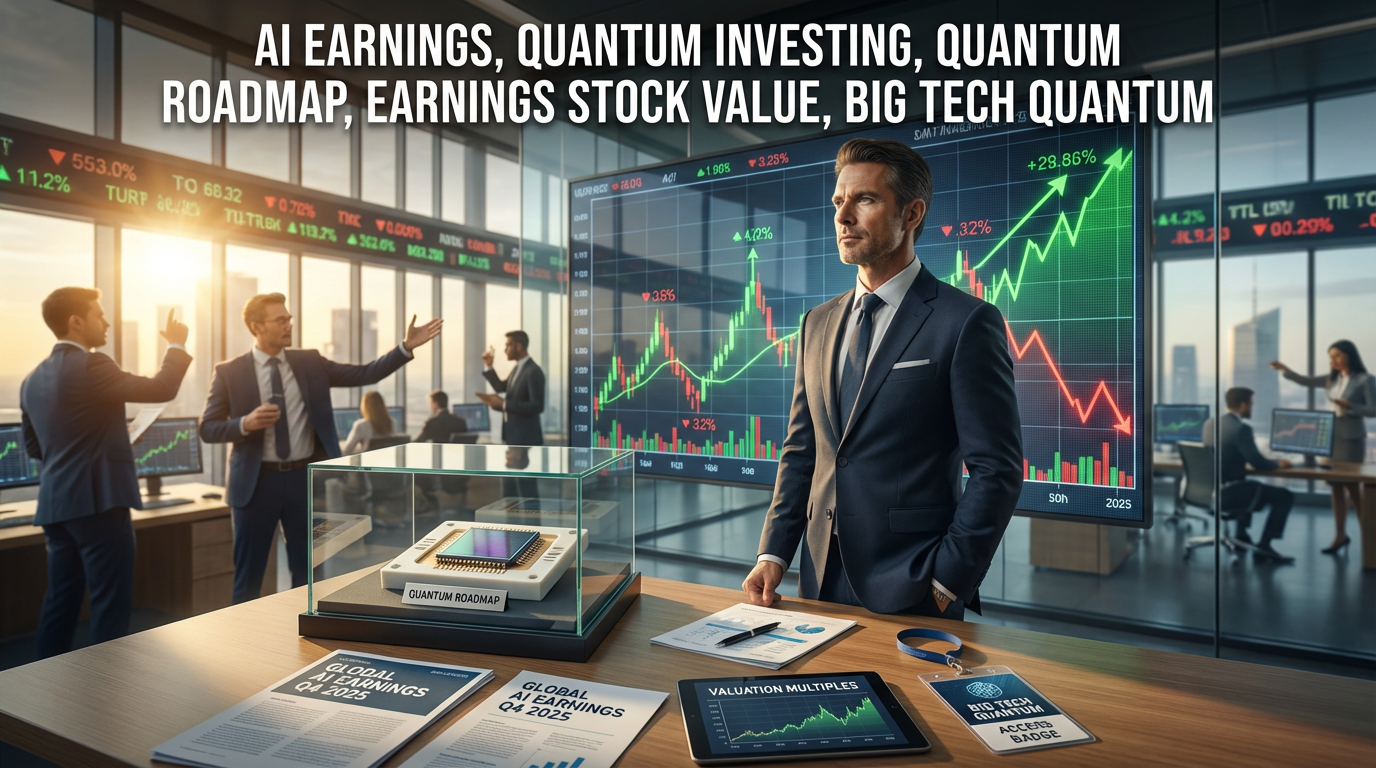
7) [Company/stock frame] Valuation formulas don’t work well for quantum companies → look at the roadmap
core point
Traditional metrics like revenue, EPS, and EBITDA have difficulty cleanly valuing early-stage quantum companies.
Therefore, the focus of investment judgment becomes “technology roadmap presentation → whether it is executed.”
Company group classification (original flow)
They are divided into full-stack (hardware + software + stack), annealing (specialized in certain optimization), and software (control/developer tools), etc.
Retail investors tend to focus on full-stack names that are grouped as leaders.
8) [Representative player check] Grouping IonQ, IBM, and Google together as “quantum” blurs investment judgment
IonQ
Presented as the leader in the ion-trap approach, with “connectivity (all qubits connected)” cited as a strength.
Its acquisition of Oxford Ionics secured control technology (EQC), and the key point noted is that it significantly raised its physical qubit roadmap target for 2028 (1024 → 20,000).
It is also mentioned that logical qubits (e.g., 12) are expected in 2026, and the author insists on watching whether this is delivered.
IBM
Strengths are based on superconducting qubits, history, investment scale, and a solid roadmap.
However, the realistic critique is that “even if the technology is good in a large company, investing solely for quantum is hard because quantum revenue is a small share.”
Strong in technical capability but its roadmap timeline can be uncertain.
From an investment perspective it is summarized as “not a pure-play because quantum is a small portion.”
9) [Risk summary] The real risk for pure quantum companies may be “cash” rather than “technology”
Except for big tech like IBM/Google, many quantum companies face high cash burn risk due to long-term R&D.
If the technology does not progress as expected, it could lead to delisting risk.
Therefore, the conclusion is to avoid “all-in bets” and instead focus on theme learning plus position sizing.
10) [News-style summary] If we extract only the investor conclusions to take from the original text
① 2026 tech investment: “AI” becomes a performance filter rather than just a keyword
Among AI beneficiaries, companies proven by operating profit/cash flow receive a premium.
② Quantum computing: The market is large, but commercialization requires checking stages and metrics
Understanding real metrics like TRL, logical qubits, coherence/gate time/fidelity is essential to filter news noise.
③ Stock selection: There are periods when roadmap execution matters more than financial models
Especially in early-stage technology sectors, “roadmap credibility” acts as a substitute for valuation.
④ Big tech vs pure-play: Even within quantum, investment purposes differ
Google/IBM are “comprehensive stocks that come with a free quantum option,” while IonQ is closer to “a direct bet on quantum.”
11) [The most important point that other YouTube/news outlets rarely cover] 2026 is when “accounting numbers” win over the technology story
Most content ends at “AI/quantum are rising,” but the truly important message from the original text is this.
From 2026, “the technology being amazing” will be outweighed by “has that technology started to show up on the income statement” in determining stock prices.
This matters because even within AI
1) The GPU/cloud layer that already has significant revenue
2) The layer that converts to software-derived margin
3) The layer that is still in R&D (like quantum)
These three receive completely different market multiples.
Ultimately, 2026 rewards not the ability to pick a theme but the ability to dissect a theme and pick layers that have entered the monetization phase.
< Summary >
Tech/AI investment in 2026 shifts from “news consumption” to battles over interpretation of performance and valuation.
AI is expanding into robotics, autonomous driving, space, etc., moving from an expectations rally to a verification rally.
Quantum computing has large market growth potential, but checking TRL, logical qubits, coherence/gate time/fidelity is essential.
For early quantum companies, roadmap execution becomes the core factor in investment judgment rather than traditional financial metrics.
The alpha in 2026 comes from “not lumping AI together but selecting the layer where performance is being delivered.”
[Related articles…]
- How to select companies that generate performance from AI investments
- How to reduce stock risk with a quantum computing roadmap
*Source: [ 월텍남 – 월스트리트 테크남 ]
– 26년 기술의 대격변이 일어나는 이유