● Genie 3 Ignites Physical AI Training Arms Race,Nvidia Omniverse Showdown
The real reason things exploded after Google DeepMind unveiled ‘Genie 3 (GENIE 3)’: It’s not “game generation” but the start of a ‘physical AI training ground’ competition
This article contains exactly four core points.
1) Why Genie 3 is called a “world model” rather than “video generation”
2) What technically changed for real-time interaction (arrow key input)
3) Why this leads beyond games/edutech to robots, autonomous driving, and defense simulation
4) The meaning of a direct confrontation with NVIDIA Omniverse for AI dominance, and investment/industry takeaways
1) News briefing: Why is Genie 3 causing such a stir
1-1. One-line summary
Genie 3 is attracting attention as a world model that creates a “real-time generative virtual world that responds to user actions (WASD/input) while maintaining consistency of the world.”
1-2. Core point functions observed in the original text (public reaction points)
Real-time generation: Each time the arrow keys are pressed, it gives the strong impression that the next scene is synthesized/generated immediately rather than “replaying existing video.”
Continuity (context retention): Even if you look left and then turn right, it feels like the previous state continues rather than a newly created frame (world state maintenance).
Image/photo-based characterization: Real-world inputs like a box photo or a cat photo are reflected as characters/objects in examples.
Mimicking game UI/UX: Scenes where “game-like layers” are included in the output, such as a UI in the lower right of the screen, are getting attention.
1-3. Access conditions (based on the original text)
Even though it has been released to the public, the original text includes constraints such as a high-priced plan (e.g., Ultra $200 mentioned) and US accounts/permissions.
2) What’s the difference between “video generation” and “world model” (Genie 3’s point)
2-1. Why misunderstandings arise toward the video generation (motion video model) side
It looks like the screen keeps changing, so it just appears to be “real-time video generation.”
But the distinction emphasized in the original text is that the system changes its internal state according to user input and remembers that state while predicting the next state.
2-2. The essence of a world model: ‘state-action-next state’
You can roughly understand a world model with this structure.
It internally maintains the current world state,
when user actions (movement/rotation/interaction) come in,
it predicts and updates the next world state.
In other words, it moves beyond “drawing a plausible next frame” toward simulating the world itself.
2-3. Why the ‘physics laws’ mentioned in the original text matter
When scenes like a ball bouncing, falling, or rolling over bumps look “80–90% plausible” even if the physics are not perfect, users have the incentive to already use the virtual environment as a training ground.
This is the point that connects to robots and autonomous driving.
3) Comparison perspective: Odyssey World vs Genie 3 (message implied by the original text)
3-1. Why “quality + context retention” is the battleground
The original text mentions other real-time simulation platforms (e.g., Odyssey World) and judges their overall quality and implementations of horror scenes as somewhat crude.
In contrast, Genie 3 is said to preserve context for a long time and give a strong sense of continuity of entities and the world.
3-2. How this difference connects to “reproducibility” in industry
In content (games/videos) people often forgive flaws if it’s fun.
But for robots, autonomous driving, and industrial simulation, reproducibility that allows repeated experiments is crucial.
If the world keeps resetting or the rules are inconsistent, it’s hard to use as training data.
4) Why games are kept front and center: the fastest packaging toward ‘physical AI’
4-1. DeepMind’s history itself is a “game → real world” route
The trajectory implied by the original text is clear.
From Atari → AlphaGo (Go) → StarCraft, DeepMind has proven “acting AI” through games.
Games have rules, allow repeated experiments, and offer clear performance measurements, making them ideal for AI development.
4-2. The ultimate destination is robots and autonomous driving: drive failure costs close to zero
Failure once in the real world for robots/autonomous driving is extremely costly.
Therefore, the more you can enable infinite trial-and-error in simulation, the more competitive you become.
If world models like Genie 3 function as “training grounds,” they can partially bypass the lack of real-world data.
4-3. From here it becomes an AI dominance fight: a direct confrontation with NVIDIA Omniverse
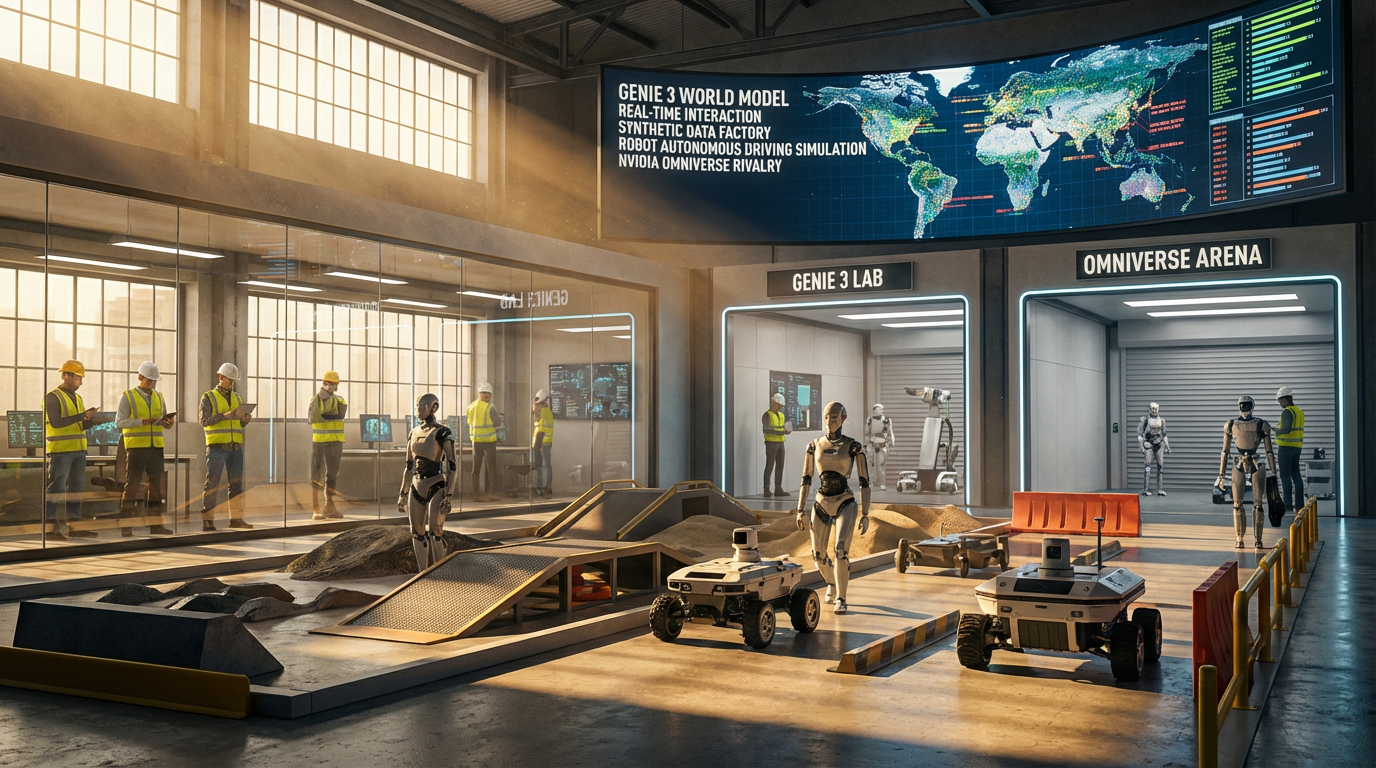
As the original text suggests, this is basically read as competition for dominance of training grounds with Omniverse (the digital twin/robot simulation ecosystem that NVIDIA is pushing).
That means a world model is not just a feature but a platform war.
As this fight grows, cloud infrastructure, GPU supply chains, and developer ecosystems move together.
From this perspective, Genie 3 can be seen not merely as a new technology but as a signal tied to global economic AI infrastructure investment (even amid concerns about interest rates, inflation, and recession, AI CAPEX could remain resilient).
5) (Important) The real core points that other YouTube/news outlets often miss, summarized separately
5-1. More important than “making a game in real time” is ‘ownership of state’
The public reacts to demos like Fortnite/GTA, but what matters industrially is “who defines and maintains the world state.”
The more stably one can maintain state for a long period, the easier it becomes to train agents/robots/autonomous driving policies on top of it.
5-2. A world model is essentially a “synthetic data factory,” and data is the moat
Real-world data is expensive, slow, and heavily regulated.
A world model can freely change specific conditions (weather/road/crowd/obstacle) and generate infinite data, so data production capacity itself becomes competitive advantage.
This can be a longer-term moat even stronger than AI semiconductors or apps.
5-3. For defense/public safety/disaster training, procurement structures may move before technical maturity
As mentioned in the original text, U.S. defense budgets are already funding “simulation-based training.”
The important point here is not that the technology is perfect, but that simulation can substitute for training in real-world areas that are difficult due to risk/cost/ethics.
Thus, world models are likely to become procurement/contract/regulatory news rather than just technology news.
5-4. The trap in saying “LLM era → world model era”: it’s not replacement but “stack expansion”
Although the original text strongly states “not the era of LLMs but the era of world models,” in reality it is more of a combination than a replacement.
Combining dialogue/planning (LLM) + action/environment (world model) lets agents expand from “being good at talking” to “being able to move and execute.”
Therefore, for companies, AI investment (cloud, AI semiconductors, data centers) could enter another expansion phase.
6) Industry impact checklist (practical summary for blog readers)
6-1. Games/Content
Prototyping cost collapse: production pipelines will be restructured if backgrounds/maps/characters can be generated in real time.
UGC explosion: more user-created content where users “create while playing.”
Copyright/style imitation issues: as scenes resembling Fortnite increase, disputes will grow.
6-2. Edutech/Training
Reenactments of historical events and field-experience education become possible, dramatically boosting immersion.
However, “plausible but incorrect reenactments (hallucinations)” are more fatal in education, so verification layers are essential.
6-3. Robots/Autonomous Driving (Physical AI)
If simulation-based learning increases its share, actual testing costs decrease and development accelerates.
The keys are physical accuracy, long-term consistency, and sim-to-real transfer performance.
6-4. Cloud/AI Infrastructure (macroeconomic connection)
Real-time world generation demands large compute.
This tends to lead to GPU demand, data center investment, and competition over power/cooling infrastructure.
This trend can amplify market volatility as it intersects global supply chains, raw materials, energy costs, and interest rate environments.
7) Investment perspective (general): what the market is watching now
This issue will react as a short-term theme for tech stocks, but in the mid-to-long term the bigger question is “who will dominate the physical AI training ground (simulation stack).”
Cloud providers, AI semiconductor companies, simulation platforms, and robot/autonomous driving value chains can simultaneously benefit and compete.
Especially during times of recession worries, AI infrastructure investment often continues strategically, so it is important to view this alongside macro indicators (interest rates, inflation).
< Summary >
Genie 3 is gaining attention as a world model that responds to user actions while maintaining world state, not merely as a video generator.
The core point is real-time interaction and long-term context/continuity, and these traits extend the use case from games to robots, autonomous driving, and defense simulation training grounds.
As the platform war with simulation stacks like NVIDIA Omniverse escalates, cloud, AI semiconductor, and data center investment are likely to move in tandem.
[Related articles…]
A quick summary of Google DeepMind AI update trends
Why ‘physical AI’ matters in robot and autonomous driving investment
*Source: [ 월텍남 – 월스트리트 테크남 ]
– 구글 지니3 출시! 전세계가 난리난 이유가 있네요 ㄷㄷ..