
● China Humanoids Invade Korean Megastores, Data Grab Experiment
Humanoids Entering Your Living Room: Just a Simple Toy or a Massive Economic Experiment?
Those who clicked on this article are likely looking to read the trends beyond the simple news that robots are being sold at supermarkets.
What I am summarizing for you today is not just simple news about a new product launch.
I plan to sharply analyze why Chinese robots costing over 30 million won have hit South Korean hypermarkets right now,
and the true intentions of Chinese tech companies and the data war, which the news merely glossed over as “fascinating.”
From now on, I will spoon-feed you artificial intelligence trends and economic implications that others fail to see.
1. Humanoids on Supermarket Shelves: An On-Site Report
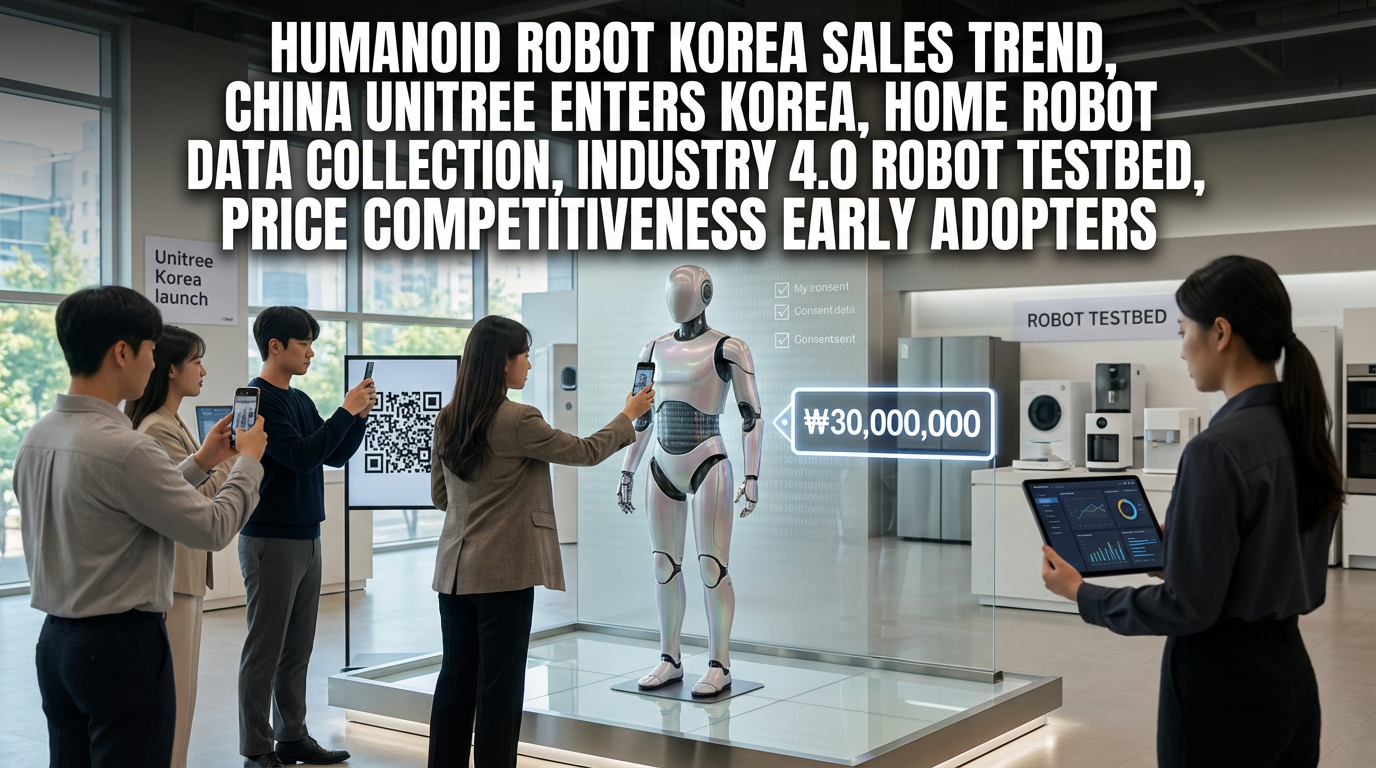
A shocking scene recently unfolded at major distribution channels in Korea, such as E-Mart.
Humanoid robots resembling humans began to be sold right next to groceries and home appliances.
According to KBS reports, it’s not just children who are fascinated; even adults stop in their tracks to stare, showing a hot reaction.
The robots being sold on-site include a total of 14 types, including products from China’s Unitree.
If you say “G1, let’s shake hands!”, it reaches out its hand, dances to K-POP, and even performs martial arts moves.
But there is a cold ‘fact’ we need to look at here.
The robots currently being demonstrated are not yet at the stage of autonomous Artificial Intelligence (AI) that perfectly understands human speech,
but are rather at a level where they are controlled by a human from behind (teleoperation) or perform pre-entered movements.
In other words, we must clearly understand that this is not a robot equipped with ‘Iron Man’s Jarvis’ yet.
2. Price and Marketability: A Hurdle to Mass Adoption or a Toy for Early Adopters?
The most important thing is, of course, the price.
The price of the humanoid robots currently on sale is around 31 million won.
If you add higher-level models capable of slightly more complex high-difficulty movements, the price soars to the 70 million won range.
This is an amount close to or exceeding the annual salary of an average office worker.
Even the E-Mart buyer honestly admitted, “It is difficult to sell a lot right away due to the high price.”
Nevertheless, why did they start selling them?
It is due to the symbolism of letting customers experience future technology first,
and a hidden strategy to lower the psychological barrier of consumers with relatively cheaper models like ‘robot dogs’ or ‘Go robots’ in the multi-million won range.
3. [Deep Dive] The ‘Real Strategy of China’ That the News Doesn’t Tell You
This is the core point of today’s post. Please pay attention.
While the news concluded with simple remarks like “fascinating, expensive,” I see a terrifying strategy by Chinese tech companies here.
Unitree, the Chinese robot manufacturer, entered the Korean market almost simultaneously with opening its first store in China.
This is strong evidence that they view Korea not just as a sales destination, but as a key test-bed.
Why household humanoids specifically?
Unlike factories, homes are ‘unstructured environments’ where toys are scattered on the floor and furniture placement varies.
It is the highest difficulty level, the hardest for robots to adapt to.
Chinese companies are utilizing Korea’s apartment living environment and high technology acceptance
to preemptively secure ‘real-life data’ accumulated as robots bump into things and fall over in actual homes.
Only when this data is accumulated can a robot evolve from a dumb machine into a true AI robot.
Ultimately, the current sales should be interpreted as a prelude to securing data to hold hegemony in the 4th Industrial Revolution, rather than profit generation.
< Summary >
- Sales Status: Sales of Chinese humanoid robots (Unitree G1, etc.) have begun in large domestic supermarkets.
- Technology Level: Flashy movements are possible, but they mainly rely on remote control and pre-entered movements rather than full language understanding.
- Price Barrier: Ranging from a base of 30 million won to a maximum of 70 million won, targeting early adopters and exhibition effects rather than mass adoption.
- Key Takeaway: The entry of Chinese companies into Korea is not for simple sales, but for technology advancement through securing unstructured data within households, which is the real objective.
[Related Posts…]
Humanoid Robot Era, Is Your Job Safe?
Will China’s Unitree Surpass Boston Dynamics?
*Source: KBS News