● US Tech Bubble Bursts, Liquidity Floods into Korea Value Stocks
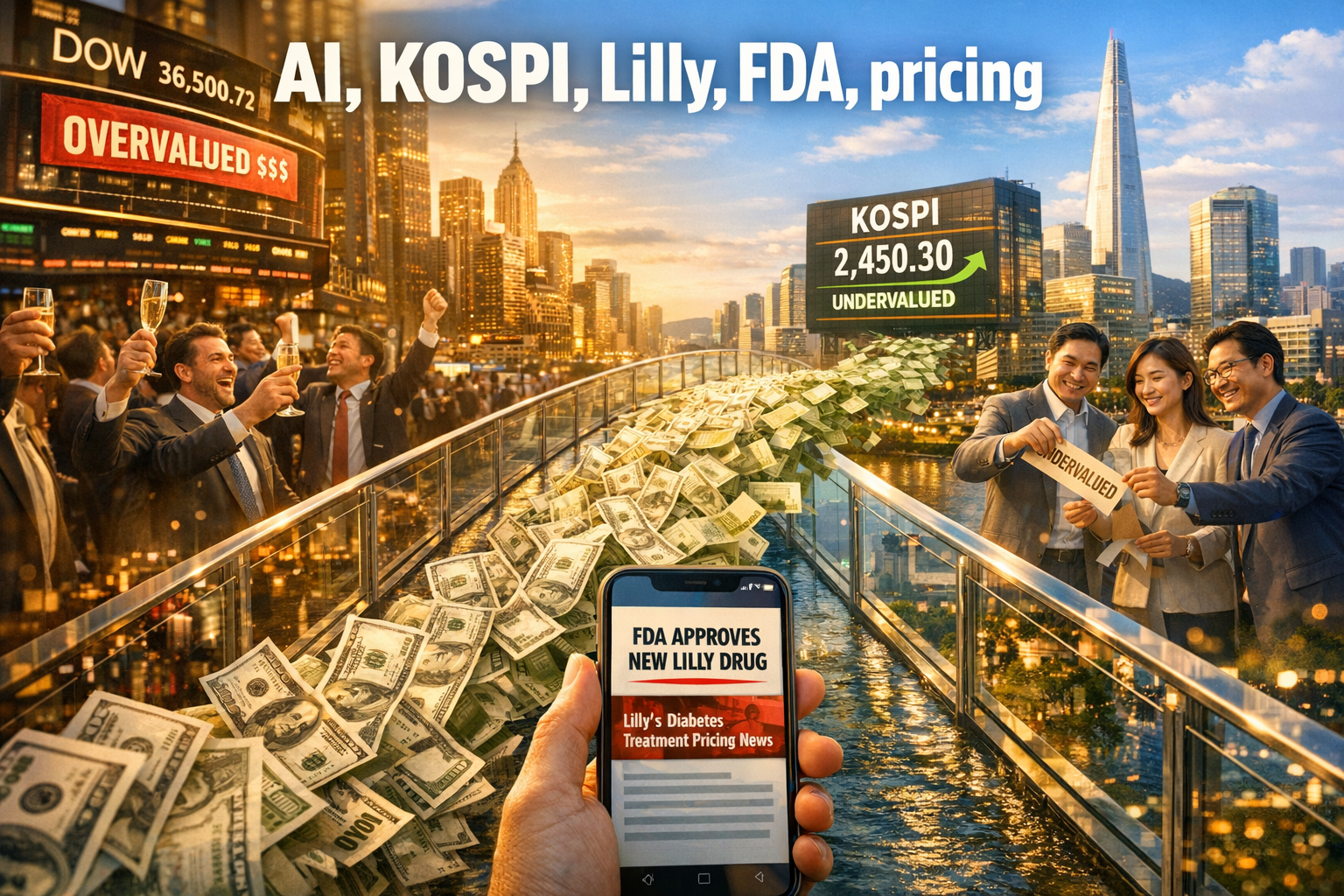
US Overvaluation vs. Korea Undervaluation: Structural Reasons Why Korea Can Be a Primary Beneficiary of a Liquidity-Driven Market
This report addresses four points:1) Why a liquidity-driven market can persist through 2026 (rates, fiscal stance, political calendar)
2) Why capital can rotate from US mega-cap technology into undervalued markets (valuation mechanism)
3) Why “still inexpensive” can remain valid for Korea even after gains (core PBR/PER comparisons)
4) The key driver of returns is not the amount of liquidity, but its destination
1) Market brief: one sentence framing current price action
“Liquidity is increasing, but US equities are expensive; the next marginal destination can be undervalued high-quality markets (including Korea).”
In a liquidity expansion, relative performance is primarily determined by where incremental capital concentrates, not by liquidity alone. The key linkage is elevated US valuation risk versus comparatively lower valuation in Korea.
2) Rationale for liquidity conditions potentially extending through 2026
2-1) Rate cuts: higher probability of more aggressive easing in the US
The baseline assumption is:
- Korea may face constraints on rapid rate cuts due to FX sensitivity, housing dynamics (Seoul), and inflation variables.
- The US may face stronger incentives to support growth and risk assets as political events approach (including the midterm election cycle).
This supports a scenario in which US monetary conditions could skew more accommodative into 2026.
2-2) Fiscal expansion: fiscal policy may reinforce monetary easing
Liquidity conditions should not be viewed through rate policy alone. Pre-election periods often coincide with higher fiscal spending, which can be supportive for risk assets. Markets typically price a “money-in-motion” environment early.
2-3) Indicators of sidelined cash: Reverse Repo and MMF balances
A practical framework referenced:
- Lower Reverse Repo usage can be interpreted as improving risk appetite and reduced parking of cash.
- Elevated MMF balances indicate substantial deployable cash awaiting allocation.
Combined, these signal capacity for incremental flows into risk assets.
3) Core mechanism: liquidity does not automatically concentrate in expensive US equities
3-1) Similar to 2020, with a key difference
The similarity versus 2020–2021 is the direction of policy support. The difference is valuation starting point:
- In 2020, US equities had de-rated materially and were comparatively inexpensive.
- Currently, US equities have appreciated significantly and face higher valuation sensitivity.
As a result, the next liquidity phase may be more selective, favoring undervalued markets/sectors rather than lifting all assets uniformly.
3-2) US mega-cap tech (AI included): “good-news inelasticity, bad-news sensitivity”
A notable feature is that leading AI-linked mega-caps can show higher volatility even without a clear deterioration in AI fundamentals. This is consistent with valuation-driven behavior:
- Positive news: perceived as already priced in
- Negative news: can trigger outsized repricing due to elevated multiples
This can catalyze rotation toward lower-multiple regions and sectors.
4) Why Korea can remain “undervalued” despite index gains: the numerical framing
4-1) Why the relevant peer set is not the US, but Taiwan and Japan
Global allocators may benchmark Korea against structurally similar export-led markets with large manufacturing/technology weights and semiconductor/hardware ecosystems. In this framework, Taiwan and Japan are practical comparators.
4-2) KOSPI valuation: PBR and PER comparison
Key points as presented:
- KOSPI PBR: approximately 1.3–1.4 (at the referenced time)
- Japan PBR: approximately 2.6
- Taiwan PBR: approximately 3.1
PER is also observed to be lower for Korea under this comparison. Therefore:
- “More expensive versus its own past”: possible
- “Expensive versus global peers in similar categories”: less supported
4-3) How higher index levels are derived (high-level mechanics only)
This is a relative-value exercise rather than a point forecast:
- If Korea’s PBR partially converges toward Taiwan/Japan multiples, implied index levels rise.
- If earnings growth materializes into 2026 (e.g., semiconductor recovery), multiple expansion and earnings growth can both contribute to upside.
5) Investor checklist (mechanism-focused)
5-1) Focus on the destination of liquidity, not the aggregate quantity
Even if the US injects liquidity, incremental funds do not necessarily flow into US equities. When valuations are elevated, marginal expected returns compress, encouraging reallocation. Allocation typically targets the intersection of:
- Low valuation (lower multiples)
- Earnings momentum (profit growth)
- FX/policy/flow conditions
5-2) One-line structural case for Korea
Korea is integrated into the AI value chain (semiconductors/infrastructure) while the market’s aggregate multiple remains comparatively low.
6) Under-emphasized point: the allocation process, not the slogan
The central issue is not “Korea cheap vs. expensive,” but the broader search for a substitute container for flows that have concentrated in US large-cap growth.
A staged rotation framework:1) Rotation within the US (concentration in the largest names to broader sector/small-mid diversification)
2) Diversification beyond the US (toward undervalued developed markets or higher-quality emerging exposures)
3) Korea can sit at the intersection of “emerging-market discounting” and “developed-market-grade industrial competitiveness”
Key variables to monitor:
- Pace of US rate cuts and renewed inflation risk
- USD strength / KRW weakness and its impact on foreign flows
- Speed of semiconductor upcycle translating into realized earnings
7) Key terms integrated for indexing and retrieval
This report links global liquidity expansion, policy-rate easing prospects, and valuation (PER/PBR) comparisons to a KOSPI allocation framework. It also connects elevated valuation volatility in US AI-centric mega-cap equities to potential cross-market rotation dynamics.
< Summary >
- Despite expectations of monetary easing and fiscal support, US equity valuations remain elevated, reducing the likelihood that incremental liquidity concentrates solely in US mega-cap technology.
- Lower Reverse Repo usage and elevated MMF balances indicate meaningful sidelined cash that could rotate into risk assets.
- Korea may remain relatively undervalued versus Taiwan and Japan on PBR/PER comparisons, even after recent appreciation.
- Through 2026, the primary driver is likely to be the destination of liquidity rather than liquidity size; Korea can be positioned as a potential beneficiary.
[Related links…]
- KOSPI outlook: conditions under which liquidity-driven markets move index levels
https://NextGenInsight.net?s=KOSPI - Stablecoins: a potential variable influencing global capital flows through 2026
https://NextGenInsight.net?s=stablecoin
*Source: [ 경제 읽어주는 남자(김광석TV) ]
– 미국은 고평가, 한국은 아직 저평가다. 유동성 장세의 진짜 수혜처 : 돈이 한국으로 온다 | 경읽남과 토론합시다 | 나틸리 허 변호사 2편
● AI Bubble Panic, KOSPI Crash 4 Percent, Foreign Dump 6 Trillion, Retail FOMO Buy 8 Trillion
AI Bubble Narrative Resurfaces; KOSPI Down ~4% — The Core Issue Lies Elsewhere
This report covers:1) Why today’s move was not an “industry-specific” event but a broad “index de-risking” session
2) What KRW 6T of foreign selling vs. ~KRW 8T of retail buying implies (including next-day/next-week scenario framing)
3) Why “AI bubble” is an imprecise label: signals of winner/loser differentiation within AI
4) OpenAI valuation and SPV (special purpose vehicle) structures as market stress points
5) Why Alphabet was relatively more resilient and why Broadcom moved in tandem (practical investment implications)
1) One-line market summary: Not “Korea underperformed,” but “global risk-off hit Korea’s semiconductor-heavy index”
KOSPI fell close to 4% intraday/at the close, with KOSDAQ also declining. The simultaneous drop in Samsung Electronics and SK Hynix amplified index-level impact due to their heavy weights.
1-1. What flows indicate about today’s session
Foreign investors recorded net selling exceeding KRW 6T, while retail investors posted net buying around KRW 8T in KOSPI alone. A significant portion of foreign selling concentrated in Samsung Electronics and SK Hynix, indicating pressure on index heavyweights rather than broad-based weakness across all sectors.
1-2. Passive ETFs/futures increased market amplitude
With higher passive ETF penetration, combined with index futures selling, broad “everything down” sessions can form rapidly. Risk reduction via index exposure often precedes sector-specific narratives, mechanically pushing the market lower.
2) The “AI bubble” frame: partly relevant, but incomplete
2-1. Not an “AI-wide collapse,” but a potential internal rotation within AI
The key signal is a transition from a single-factor “AI lifts everything” regime to a phase where winners and losers within AI diverge. This framework aligns with relative resilience in Alphabet versus larger swings in higher-volatility momentum names such as Palantir and IonQ.
2-2. VIX spread dynamics suggest re-positioning rather than simple fear
A widening volatility term-structure/spread is often discussed when investors reduce index beta while reallocating toward perceived higher-survivability exposures. This pattern is consistent with “sell the index, rotate within equities” behavior.
3) Why Alphabet was less affected: profitability visibility despite higher AI costs
Alphabet exceeded consensus on revenue/earnings, and cloud operating margins were stronger than expected. However, increased CAPEX guidance raised concerns about AI-related cost intensity.
3-1. Why the market still assigned relative resilience
Alphabet is viewed as closer to an integrated model across compute infrastructure, data centers/cloud, and monetization (search/ads/services). In a rising AI cost environment, firms with greater external dependence may face more margin pressure, while integrated platforms can command a relative survivability premium.
4) Why Broadcom was linked: the “Google TPU” supply-chain connection
Broadcom was cited as a beneficiary of Alphabet strength due to its role in the TPU ecosystem and related design/partnership exposure. As investor attention broadens beyond a single-supplier AI accelerator narrative, TPU-linked supply chains can emerge as distinct beneficiaries. This is a relevant global AI positioning point for Korea-focused investors.
5) How OpenAI risk transmits to public markets: valuation and SPV-related financing fatigue
5-1. Valuation step-ups can shock risk perception
If OpenAI seeks meaningfully higher valuations (e.g., moving from ~USD 500B discussions toward ~USD 850B levels), investors may interpret it less as fundamental repricing and more as aggressive capital pull-forward, increasing risk premia across AI-linked assets.
5-2. SPV structures can elevate scrutiny, especially approaching IPO conditions
SPV usage can raise concerns that economic burdens may be less transparent at the core entity level. While private markets may tolerate structural complexity, public-market and IPO-adjacent standards typically impose higher disclosure and accounting scrutiny. The key market mechanism is not verification of claims, but that rising doubt alone can increase required returns and volatility.
6) Korea market outlook: rebound potential checklist (3 items)
6-1. Primary variable: whether U.S. tech sells off again overnight
Given Korea’s frequent role as a high-beta risk asset proxy, stabilization or rebound in U.S. tech would support a short-term rebound narrative.
6-2. Secondary variable: semiconductors at an inflection between oversold bounce and continuation
Today’s decline was driven by synchronized drawdowns in heavyweight names, increasing the probability of a technical rebound. However, if foreign selling persists for 2–3 consecutive sessions, retail absorption capacity may weaken.
6-3. Third variable: broad USD strength and the pace of foreign capital flows
The focus is less on idiosyncratic KRW factors and more on generalized USD strength driving FX pressure. If elevated FX levels persist, foreign investors may slow incremental allocations to Korean equities.
7) Key points often missed in mainstream coverage
1) More important than the term “AI bubble” is a shift toward ecosystem ranking within AI
The market is increasingly differentiating by cost absorption capacity and monetization capability.
2) The structural ability to sell the index (futures/passive) matters more than attributing a single “cause”
This is driven by market structure, not solely company-specific fundamentals.
3) OpenAI is less a technology debate and more a financing/valuation/accounting-perception stressor
Financial structure can be a primary volatility catalyst even amid strong technology narratives.
4) “Semiconductors = AI” is an oversimplification
As proprietary ecosystems (e.g., TPU) scale, supply-chain beneficiaries can become multi-polar rather than single-axis.
8) Practical investment framework: focus on cash flow, pricing power, and value-chain integration
With inflation, rates, and FX variables interacting, the relevant screen is not simply “AI vs. non-AI,” but resilience under rising costs: pricing power, integrated value chain, and cash-flow durability. This regime tends to penalize thematic positioning without balance-sheet and monetization support.
< Summary >
- The KOSPI selloff resembled foreign-led index and heavyweight semiconductor de-risking rather than broad sector-specific deterioration.
- The AI “bubble” narrative is better framed as early-stage differentiation between winners and losers within AI.
- Alphabet showed relative resilience due to integration and earnings durability; Broadcom gained attention via TPU-related exposure.
- OpenAI-related concerns center on valuation, funding mechanics, and SPV-driven transparency risk, which can expand risk premia.
- Near-term direction depends on U.S. tech stabilization, persistence of foreign selling in Korean semiconductors, and USD/FX conditions.
[Related Articles…]
- Exchange-rate volatility and its implications for Korean equities: key monitoring points
https://NextGenInsight.net?s=exchange%20rate - Semiconductor cycle and AI data-center capex: updated beneficiary map
https://NextGenInsight.net?s=semiconductors
*Source: [ Jun’s economy lab ]
– AI 버블 논란 / 코스피 반등 가능할까?
● Lillys Oral Obesity Pill Nears FDA Greenlight Price War Looms Novo Vulnerable Lilly Fortified
Why Pricing Pressure Is Separating Winners: Lilly’s Oral Obesity Drug Nears FDA Decision, Drug Price Negotiation, and Supply Chain—Consolidated
This report consolidates three points:
1) Why the FDA timeline for Eli Lilly’s oral obesity therapy is a key equity inflection point
2) How drug price cuts (pricing pressure) are structurally turning the category into a price-competitive market
3) Why Lilly may be more resilient than Novo Nordisk (portfolio diversification, supply capacity, and payer negotiation experience)
1) Key news (2/5 Wall Street AI news summary): “Lilly’s oral obesity therapy launch is approaching”
The core message is straightforward.
Following comments from Lilly’s CFO that the FDA approval schedule is “tracking as planned,” investor attention has shifted back to the approval catalyst.
1-1. Reuters framing: Upward guidance revision signals confidence in the oral obesity program
Reuters emphasized upgraded guidance.
Lilly guided 2026 revenue to $80–83 billion and EPS to $33.5–35.
The implication is that management is embedding expectations of substantial demand following an oral launch into forward financial targets.
1-2. Bloomberg framing: Operational readiness largely complete; remaining variable is regulatory timing
Bloomberg characterized the situation as “launch preparations largely complete, with regulatory review remaining.”
This suggests key uncertainty is shifting away from technology or manufacturing readiness toward approval timing and post-approval commercialization (pricing, coverage, and supply execution).
2) Primary investor concern: pricing pressure has become structurally more significant
To date, the obesity drug market has sustained premium pricing supported by innovation and demand growth.
Negotiating leverage is increasing across Medicare/Medicaid, private insurers (including PBMs), and government channels, making price pressure a structural baseline rather than a cyclical risk.
2-1. Why pricing pressure matters: it changes valuation mechanics, not only margins
Equity valuation for large-cap pharma is often anchored on “growth rate × operating margin × duration.”
Lower pricing can reduce more than near-term profitability:
– lowers expected growth rates
– reduces peak sales assumptions
– compresses premium valuation multiples
2-2. Countervailing effect: lower prices can expand access and increase prescription volumes
While near-term margins can weaken, broader coverage can expand total treated populations over time.
Obesity has a large addressable patient base, and a subset of patients prefers non-injectable options.
The key question is whether unit economics can be offset by scale such that total gross profit expands.
3) Why “Novo vs. Lilly” diverges: differences in business mix (portfolio structure)
Even with similar category exposure, earnings shock absorption differs materially by company structure.
3-1. Novo Nordisk: higher dependence on obesity/diabetes increases earnings sensitivity to price competition
Novo’s growth narrative is centered on obesity and diabetes therapies.
As price competition intensifies, investors may interpret this as a higher risk of broad-based earnings volatility.
3-2. Lilly: oncology/immunology and other high-margin franchises can provide an earnings buffer
Lilly’s obesity franchise is significant, but the company also has additional growth drivers and pipeline assets.
This diversification can reduce the probability that obesity price compression translates into immediate company-wide profit deterioration.
It is also a key factor supporting a premium market capitalization valuation.
4) Why an oral obesity therapy can reshape the market: it expands the demand base
Injectables face persistent adoption friction despite strong efficacy.
Oral therapy can meaningfully broaden the patient funnel by reducing barriers to initiation and persistence.
This can shift competition from share capture to market expansion, at least initially.
4-1. Why established players can benefit: commercialization experience from injectables
Lilly has built operating capability in large-scale manufacturing, distribution, and payer negotiation through its injectable portfolio.
This experience may translate into execution advantages as the oral segment scales.
5) Investor checklist ahead of the FDA catalyst (practical monitoring items)
5-1. FDA timing risk: delays increase near-term volatility
Approval delays primarily disrupt expectation timing, increasing equity volatility.
Conversely, post-approval visibility can support reassessment once commercialization parameters become clearer.
5-2. Policy and coverage: separate short-term headline risk from long-term volume effects
Price cuts are typically negative in headlines, but broader reimbursement can accelerate prescription growth.
Investors should quantify the trade-off between price declines and volume expansion.
Policy direction is a key macro-linked variable influencing adoption pace.
5-3. Supply chain and manufacturing capacity: demand is not monetizable without supply
While Lilly has referenced capacity investment (including Pennsylvania facilities), execution remains the primary risk variable.
Key diligence items include start dates, ramp curves, and the magnitude of incremental capacity.
Manufacturing optimization is increasingly data-driven and automated, making operational efficiency a strategic differentiator.
5-4. Earnings metrics to prioritize: operating margin and volume trends over topline alone
In a pricing-pressure regime, revenue growth can be misleading without unit and margin context.
Core indicators include:
– prescription and shipment volume growth
– operating margin durability
This phase can also coincide with rapid multiple adjustments in U.S. equities, linking outcomes to rate expectations.
6) Key points often underweighted in mainstream coverage
6-1. The contest is not “whether pricing pressure occurs,” but “who can design the pricing environment”
Pricing pressure is frequently treated as an exogenous risk.
In practice, scale players can shape outcomes by integrating pricing, coverage, and supply strategies.
Firms with diversified profit pools and operational leverage can sustain lower prices while accelerating share gains and defending long-term gross profit.
6-2. The main battleground for oral therapies may be persistence and long-term adherence
Orals reduce friction at initiation, but long-term persistence becomes a primary commercial driver.
As real-world evidence accumulates, adherence and durability data can strengthen payer negotiations.
Post-approval differentiation may shift from trial outcomes to real-world utilization and retention metrics.
6-3. The category is increasingly policy-driven
Obesity pharmacotherapy is directly tied to societal and fiscal priorities.
Product-level competition alone is insufficient to assess market trajectory.
Coverage scope, government negotiation dynamics, and budget framing can materially affect the pace and scale of adoption, linking category outcomes to macro policy direction.
< Summary >
Lilly’s oral obesity therapy has entered a catalyst phase as an FDA decision approaches.
The obesity drug market is transitioning toward price competition as pricing pressure intensifies.
Novo’s higher reliance on obesity/diabetes increases sensitivity to category-level price compression.
Lilly’s diversified portfolio (including oncology/immunology) provides comparatively greater resilience to pricing pressure.
Key diligence items include FDA timing, pricing and coverage policy changes, capacity expansion execution, and the combined trajectory of volumes and operating margins.
[Related posts…]
GLP-1 Market Outlook: Competitive Landscape in Obesity Therapies and Beneficiary Sectors
How FDA Timelines Affect Stock Performance: Timing Checklist for Biotech Investing
*Source: [ Maeil Business Newspaper ]
– [LIVE] “가격 압박에도 믿을 구석은 많다” 최종 승자는 릴리? | 길금희 특파원