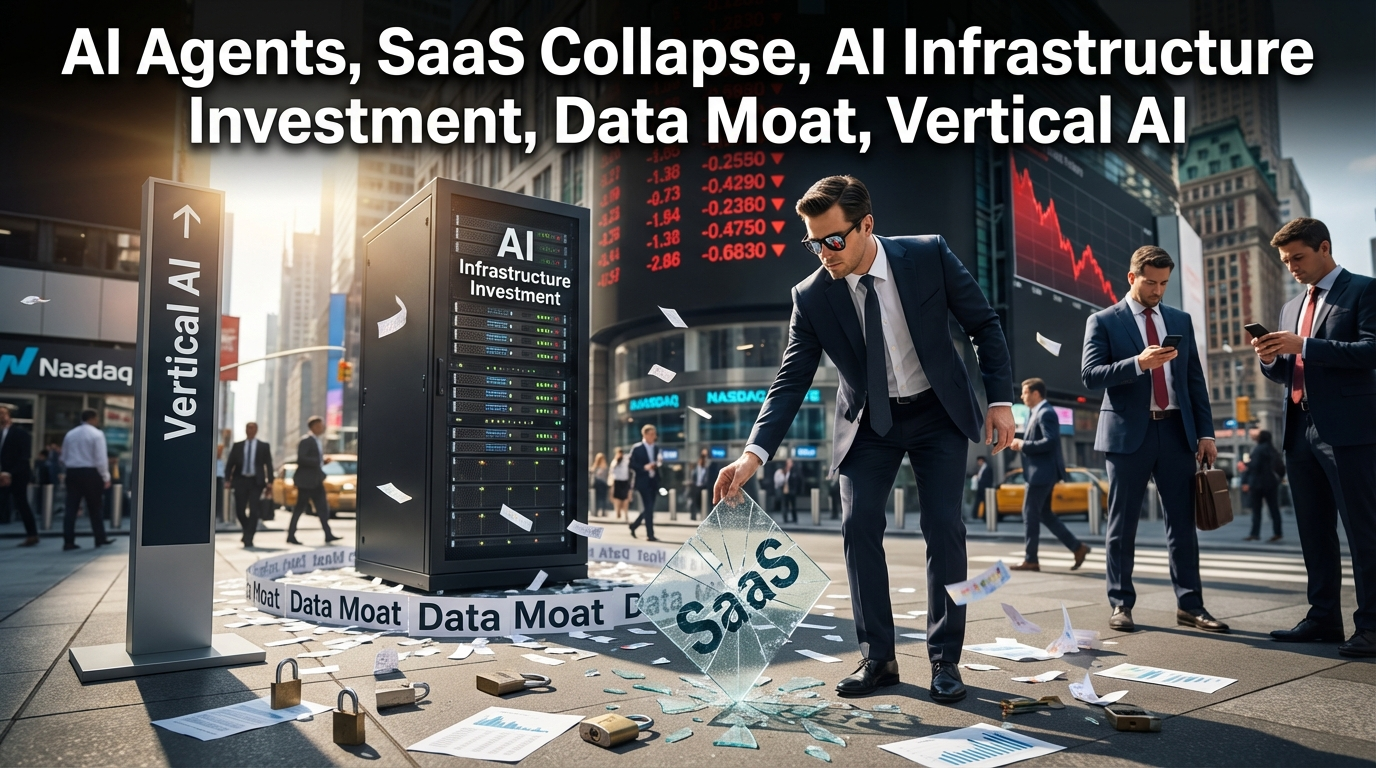
● Nasdaq Panic Selloff, AI Agents Crush SaaS, AI Bubble Fear Ignites GPU Power Surge
The real identity of the Nasdaq “panic sell”: Why the fear “AI will kill SaaS” vs the fear “the AI bubble will burst” erupted at the same time (and the key takeaway investors are missing now)
This piece contains exactly four things.
1) Why this plunge looks like “DeepSeek 2.0,” summarizing the market logic contradictions in one go.
2) Why AI agents (Claude Computer Use, agentic workflows) look like a “software crisis” but at the same time lead to “explosive demand for semiconductors, data centers, and power.” I’ll connect those dots.
3) Which SaaS business-model areas will truly fail / which will actually strengthen—I’ll give selection criteria down to the business-model unit.
4) Finally, I’ll pick out the “really important points (pricing models, data moat, token economics)” that other news and YouTube channels often miss and turn them into an investor checklist.
1) Today’s market: Nasdaq plunge caused by “simultaneous irrational fears”
The core point of the original is this.
The market is currently pricing in two fears “at the same time,” producing a logically inconsistent crash.
(1) Fear A: “AI agents replace SaaS → software revenue collapse”
(2) Fear B: “AI investments do not pay off → AI infrastructure bubble collapse”
But these two cannot easily both be true.
If AI becomes strong enough to truly replace SaaS, the infrastructure that runs that AI (especially GPUs, memory, power, data centers) will be needed even more.
In other words, the assumption that “both software and semiconductors will fail” is likely an overblown fear.
This is the “DeepSeek incident (DeepSeek 2.0)” frame from the original.
Rather than “cheaper models reduce investment,” the logic is that cheaper/better models lead to much greater usage, resulting in higher total investment (cloud, data centers, chips, power) — a demand explosion.
2) AI trend: Agents threaten SaaS but simultaneously drive massive infrastructure demand
Here is the flow appearing in the original, summarized in news form.
AI product update news
– Anthropic’s “Claude Computer Use (computer-manipulating agent)” is a hot topic
– Human-like agents and workflow automation are spreading rapidly
– As a result, fear spreads that “existing SaaS will be entirely replaced”
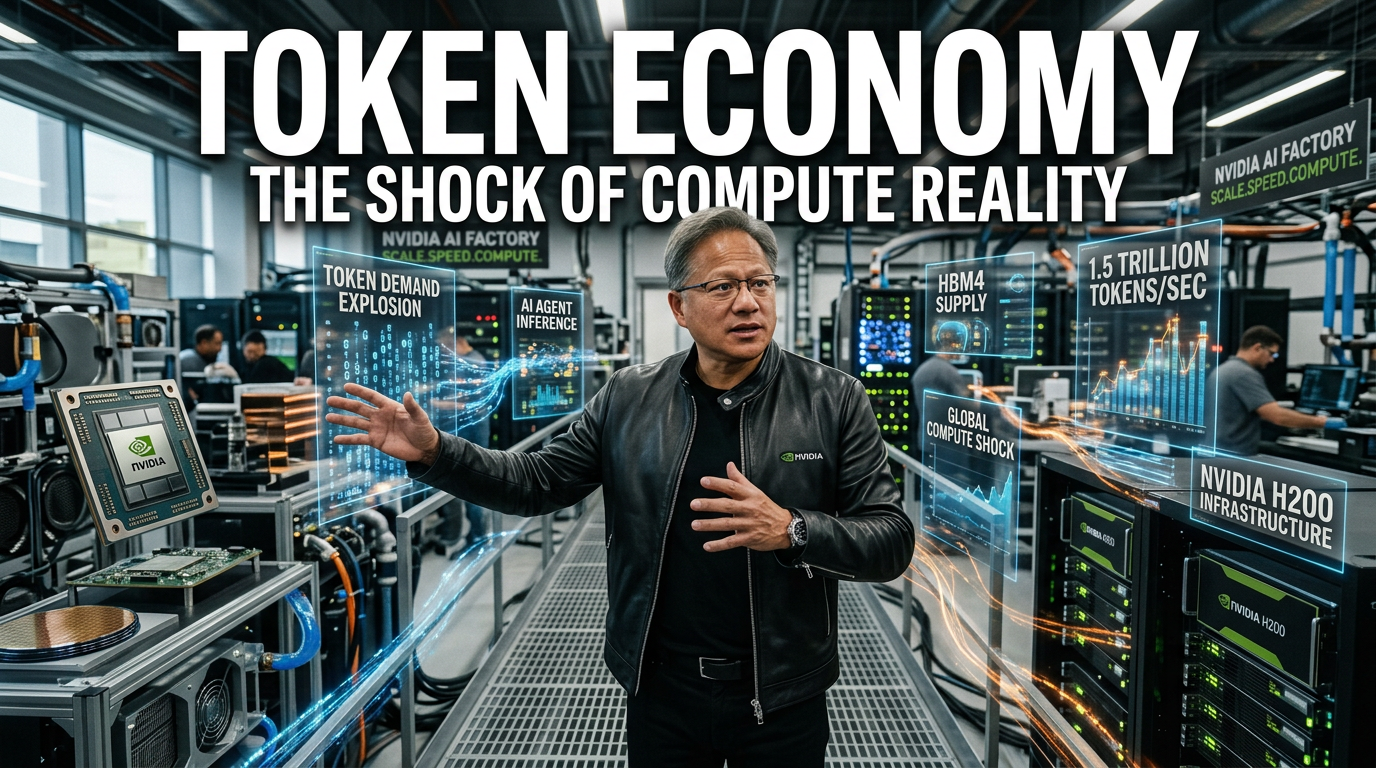
core point: Tokens and compute are on a different level compared to conversational AI
Conversational chatbots end after a few round trips,
but computer-manipulating agents keep capturing screens, recognizing state, clicking, and rechecking — repeating this all day.
So token usage and compute demand structurally grow much larger.
Therefore bottlenecks cascade.
– GPU: compute bottleneck
– HBM/memory: possible surge in demand from agentic workloads
– Servers/data centers: need rack-level expansion
– Power/cooling: ultimately power becomes the final bottleneck
This area directly connects to the hottest macro keyword right now: AI infrastructure investment.
And if big tech is actually raising CAPEX, structural direction is hard to reverse even after short-term corrections.
3) Big tech signals: “supply shortage” comments + CAPEX increases hint at a long-term cycle
The original emphasized the common CEO comments that “demand is insane but there’s no supply.”
To summarize:
– Data centers are scarce
– Power is scarce
– Wafers/packaging/memory (HBM) are scarce
– But AI demand keeps rising
One more important point.
Alphabet reportedly referenced CAPEX around $180 billion for 2026 (per the original), which is much more aggressive than market expectations.
In such an environment, the narrative of “AI investment slowdown” is less realistic than “AI arms race (CAPEX increase).”
This is not merely a technology news item; it links to interest-rate cut expectations, US growth, and inflationary pressure.
Bigger power and capital expenditure can affect cost structures and prices.
4) Is SaaS really dead? The original concludes clearly: “Many SaaS are at risk, but not all are doomed. Irreplaceable software survives.”
The original concludes rather clearly.
Many SaaS are indeed at risk. But not all will collapse, and software that cannot be replaced will survive.
4-1) SaaS most at risk: common traits are per-seat billing and automation of routine tasks
The representative revenue model for traditional SaaS is seat-based billing.
If a company has 100 employees, that’s 100 licenses in revenue.
But when agents are introduced, what happens is:
– The number of people needed can fall (efficiency gains from automation)
– One person can operate multiple agents, increasing throughput per person
Then the equation “seat billing = growth” breaks.
Especially first-layer SaaS that assists repetitive, structured, rule-based tasks (e-signatures, simple workflows, basic meeting tools, etc.) are likely to be absorbed into AI platform features.
4-2) Software that survives: characteristics are data moat, vertical focus, and internalization
The original’s winning model is “vertical AI.”
That means not just a tool but a player that owns domain data and workflows in a specific industry.
– Companies that accumulate proprietary data that genuinely improves AI performance
– Areas where regulation, security, or complex operations prevent general-purpose agents from entering easily
– Situations where customers are deeply embedded in the company’s UI/workflows and face high switching costs
The original mentioned examples like Palantir, Emreobin, Supeuteu, but the core point is companies that are data-centric and become more competitive when AI is added.
5) The most important points other YouTube/news channels don’t cover
Now comes the real practical part.
If you treat this episode only as “AI will kill/AI will save software,” you get half the picture.
The core point is pricing models and token economics.
5-1) SaaS’s real inflection: shifting from per-seat billing to usage/performance billing
In the agent era, the unit of value becomes the amount of work processed, not headcount.
So over time seat-based billing will erode,
and there is a high probability of movement toward:
– API-based billing
– Workflow execution-based billing
– Performance-based billing (cost savings/revenue contribution)
What matters here is that even if the technology is excellent, a company that cannot change its pricing model will see its stock pressured, and conversely a mediocre technology company that moves its pricing model quickly can defend itself.
Many channels focus only on technology demos and miss this point.
5-2) If “AI eats SaaS,” infrastructure companies gain pricing power
Agents use lots of tokens, inference costs rise, and memory and power become bottlenecks.
Then supply constraints in the infrastructure layer (GPUs, HBM, networking, power/cooling, data centers) become pricing power.
So a scenario of prolonged AI supply constraints is plausible, not just an AI bubble collapse.
In that case, markets may re-rate AI semiconductor valuations.
5-3) The “software presumed guilty” phase: what RSI oversold and PSR compression mean
As the original notes, software stocks are near RSI oversold levels,
and PSR (price-to-sales ratio) is historically low.
These phases are usually ones where “once results are confirmed, the rebound can be large.”
But you cannot buy any software stock; only companies that:
– Reduce costs with AI or
– Increase revenue per unit with AI or
– Strengthen a data moat
will see earnings-driven reversals.
6) Investor checklist: a ten-second filter to separate winners from losers in the current phase
When evaluating software, especially SaaS, this view speeds decision-making.
Higher risk side
– Excessive reliance on seat-based billing
– Simple, highly standardized functions (easy to replace with platform features)
– Weak structure for accumulating data inside the company (no learning/improvement)
Survival/growth likely side
– Deep, proprietary domain data (strong in healthcare, defense, manufacturing, finance, etc.)
– Complex workflows that make it hard for general-purpose agents to displace them
– Already shifting to usage-based or performance-based billing or having clear paths to do so
– Customers start using AI features as core productivity rather than optional extras
7) Conclusion: This plunge is more likely a “pricing-model shock during AI transition” than simple AI fear
In summary, view it this way for clarity.
– The spread of AI agents shakes SaaS valuations in the short term (especially seat-billing models).
– But the stronger agents become, the more structural demand grows for infrastructure (semiconductors/memory/power/data centers).
– Therefore it is not “everyone fails together” but “winners and losers are determined by pricing models and data moats.”
< Summary >
The Nasdaq plunge may be a logically overblown reaction combining fears that “AI will kill SaaS” and that “the AI bubble will burst.”
The stronger agents become, the more severe the token, GPU, HBM, data center, and power bottlenecks get, making AI infrastructure investment likely to expand rather than contract.
SaaS is not universally doomed: seat-billing and simple-function SaaS are at risk, while data-moat, vertical, and AI-internalized companies can survive and grow.
The real core point is not the technology demo but the shift from per-seat billing to usage/performance billing.
[Related posts…]
- Summary of AI infrastructure investment expansion and data center power bottlenecks
- The truth about the SaaS collapse theory: features of companies that survive via vertical AI
*Source: [ 월텍남 – 월스트리트 테크남 ]
– “또 속으시면 진짜 안됩니다..”