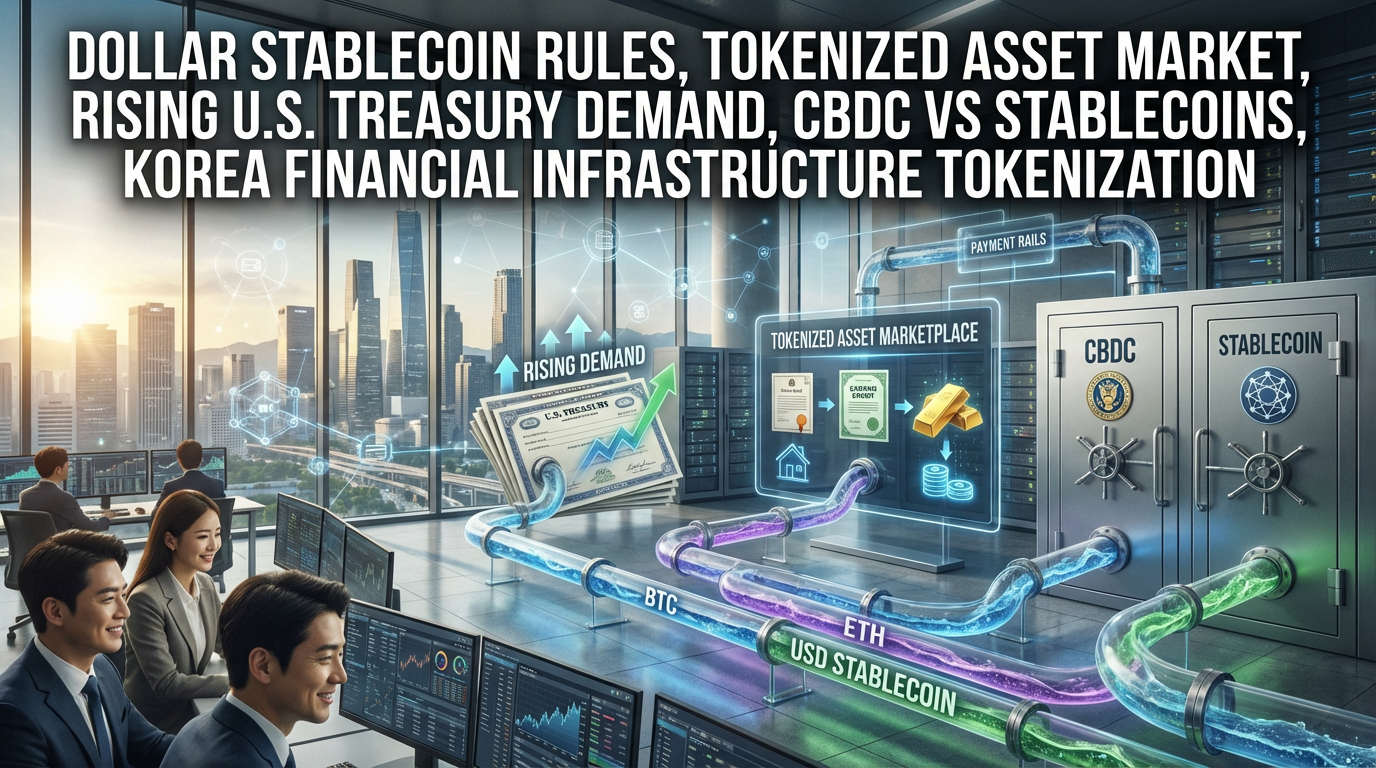
● Bitcoin Ethereum Dollar Stablecoins Power-Shift Watchlist 2026 Crash-Risk Regulation Liquidity Shock US Treasury Backdoor
In a shaky economy, if you properly understand only “Bitcoin, Ethereum, and dollar stablecoins,” you can see where money will flow (including 2026 watch points)
This post includes the following:
1) Why Bitcoin is “the most perfect ledger humanity has built” (understand the structure, not the trade)
2) A 2026 crypto-market shake-up checklist across politics, regulation, and liquidity
3) How dollar stablecoins neutralize central banks, commercial banks, and card networks (the real core point)
4) A “realistic scenario” for Korea to seize East Asian financial leadership—and what happens if it misses
5) The “single most important line” others rarely cover: a structure opens for individuals to support U.S. Treasury demand
1) The core of today’s original text summarized like “news”: what’s happening in crypto now
[Breaking 1] Before Bitcoin is “money,” it is engineered as a ledger the center cannot rewrite
Professor Taemin Oh defines Bitcoin not as an investment product but as “the most perfect ledger humanity has created.”
The essence is a “record system no one can arbitrarily modify,” and the ledger is distributed across nodes (servers) worldwide.
[Breaking 2] Mining is not “digging coins,” but a security competition to protect the ledger
Miners record and validate the ledger and receive newly issued coins plus transaction fees as compensation.
Issuance is capped at 21 million, and as new issuance declines over time, fee share grows.
[Breaking 3] The claim that “Bitcoin 10x-es before it dies” comes from comparing it with gold’s market cap
If Bitcoin partially replaces gold’s role (store of value, collateral asset), its market cap could converge toward gold’s, the argument goes.
From a super-rich perspective, “weightless asset mobility” is a powerful advantage over physical gold or cash.
[Breaking 4] The market focus compresses to three: Bitcoin, Ethereum, and stablecoins
– Bitcoin: By network effects (dominant market cap), it’s close to “the” coin (with the definite article)
– Ethereum: Smart contract/tokenization platform (with the character of a title registry and financial infrastructure)
– Stablecoins (especially dollar): A practical tool that directly encroaches on payments, remittances, and banking functions
[Breaking 5] 2026 was cited as an “unfavorable” year for Bitcoin by cycle
From a four-year cycle view, 2026 is seen as a zone of high volatility/correction risk.
If Bitcoin wobbles hard, altcoins could collapse even harder (up to 90%), the warning adds.
[Breaking 6] Even so, 2026 could become a “year of promise” via U.S. politics, regulation, and tokenization
Repeated catalysts are ① U.S. midterms ② liquidity ③ regulatory clarity (legislation) ④ asset tokenization.
In short, “the cycle is bad, but policy events could be good”—the core interpretation is a tricky market.
2) Structural understanding: why Bitcoin is a “perfect ledger”
2-1. When the center edits the ledger = most financial disasters you see in the news
States/banks/platforms ultimately have an “ultimate ledger administrator.”
If that administrator errs, is corrupt, or is swayed politically, record trust breaks.
2-2. Bitcoin is closer to “transparent yet pseudonymous”
Anyone can view transaction records, but they link to addresses (keys) instead of names.
As the Silk Road example shows, “once it moves, it’s all visible.”
2-3. Why a 51% attack is theoretically possible yet practically hard
To rewrite the ledger, you must secure overwhelming compute/energy dominance over the network.
The original text stresses impracticality with an extreme scenario like “turning off the world’s generators.”
3) Investment checklist (based on the original) — a 2026 volatility playbook
3-1. Approach with “money you won’t need for at least three years”
The original repeatedly advises caution on short-term (one-year) bets and a minimum three-year hold.
In essence, your capital plan must stomach volatility.
3-2. With a 10 million KRW stake: propose Ethereum 50% + Bitcoin 50%
The original mentions that “the bet this year (as of filming) could be Ethereum.”
The logic is that Ethereum could lead in the asset tokenization platform race.
3-3. Five reminders for Bitcoin investing (original gist)
– U.S. midterm election variable
– Liquidity (including rate-cut/easing expectations)
– Major exchange hacks/incidents (negative shock triggers)
– Whale flows (early holder sell/buy patterns)
– Institutionalization of asset tokenization (the gate for institutional inflows)
3-4. On-chain and macro matter more than charts
In a 24/7 market, obsession with short-term charts harms your health, the warning says.
Instead, it mentions structural data like whale movements, old coin activity, and MVRV-type metrics.
4) The most disruptive theme in this original: dollar stablecoins = redesign of the global financial network
4-1. “You may not feel it in Seoul, but it’s already real on factory floors”
A notable point is that the original frames stablecoins not as “future” but as “the present in Korea’s industrial belts.”
The example of foreign workers preferring salaries in Tether (USDT) illustrates a demand-driven story.
4-2. Targets shaken by dollar stablecoins
– Commercial banks: deposit outflows + weakened credit creation
– Card networks (Visa/Mastercard, etc.): potential displacement of the payment layer
– Central banks worldwide: harder fine-tuning of monetary policy (rates/FX/liquidity)
4-3. Replace the “monetary sovereignty” frame with “financial leadership”
The original argues “monetary sovereignty” is vaguely defined and already constrained in a globalized era.
In a stablecoin/tokenization age, the real question is who controls the gateways for payments/remittances/asset trading.
The operative keyword is digital finance.
5) The U.S. (Trump) and dollar stablecoins: not a “political event,” but a U.S. Treasury structure issue
5-1. The most important passage in the original: “Dollar stablecoins reflect U.S. intent”
Because the U.S. faces mounting fiscal pressure, and Treasury interest costs have reportedly overtaken defense spending.
If dollar stablecoins proliferate, as people worldwide use dollar-based assets, the demand base for U.S. Treasuries could broaden as a result—that’s the logic.
This ties directly into global liquidity flows.
5-2. Designing stablecoin issuance conditions to anchor reserves in “short-term U.S. Treasuries”
The original notes a dollar stablecoin bill (guidelines) that restricts reserves to dollars or short-term U.S. Treasuries.
Thus, “stablecoin growth = increased demand for short-term U.S. Treasuries.”
5-3. Chinese government vs. Chinese people: dollar stablecoins can become a tool to crack capital controls
Beijing wants to stem capital outflows, while wealthy Chinese and the diaspora want to move funds out.
The original sees dollar stablecoins weakening the government’s grip amid that tension.
6) CBDC (central bank digital currency) vs. stablecoins: why do people dislike government coins?
6-1. The “allure” of a CBDC = a powerful policy-execution tool
From a Keynesian viewpoint, CBDCs can favor stimulus.
Programmable money enables use restrictions, expiry, and negative rates.
6-2. Yet user choices diverge
If both pay similarly,
– a CBDC may impose negative rates/control, while
– a private stablecoin offers greater freedom,
people are likely to choose the less controlled option.
7) Korea scenarios: “the path to opportunity” vs. “the path to being eaten away like Netflix”
7-1. Opportunity scenario: potential to be a Northeast Asian financial hub (leadership)
The original stresses that dollar stablecoins “move through phones.”
Leveraging Galaxy’s market share, if Korea secures payments/wallet/tokenization infrastructure, it can gain financial leadership in Northeast Asia.
This is a digital-asset infrastructure race, not a simple coin boom.
7-2. Opposite scenario: the moment regulation blocks it, Korean asset tokens trade on foreign apps
The original likens a potential outcome in finance to media being absorbed by YouTube/Netflix.
If domestic IT/platforms are over-restricted from entering finance, Koreans may end up trading Korean stocks/asset tokens on overseas platforms.
7-3. Policy issue: advocate easing separation of banking and commerce for IT firms
The original argues for exceptions that let IT companies drive domestic financial innovation.
It assumes platforms are entering finance faster than banks are evolving into digital firms.
8) A separate list of “the most important content” other news/YouTube underplay
core point 1) The essence of dollar stablecoins is not “payments innovation,” but the privatization of U.S. Treasury demand
Most content stops at “cheap remittances/fast payments.”
But the original’s bigger picture is that reserve rules for stablecoins can link worldwide individual transactions to demand for short-term U.S. Treasuries.
This touches FX, interest rates, global capital flows, and inflation.
core point 2) Korea’s real risk is not “whether to issue a won stablecoin,” but who holds the ‘financial OS’
Issuing a won stablecoin does not automatically expand monetary-policy autonomy—an important point.
Going forward, whoever controls layers like wallets, identity, payments, tokenization venues, and custody will hold “financial leadership.”
core point 3) More important than Bitcoin cycle debates is whether “regulatory clarity → big tech/institutional capital” flips the switch
Even if the cycle is poor, once institutionalized, the nature of capital changes.
When the market shifts from retail/trader-driven to institutions/pensions/corporate treasuries, the quality of volatility can change.
< Summary >
Bitcoin is less “money” than a distributed ledger no one can arbitrarily edit, and mining is the security competition that defends that ledger.
While 2026 is cited as a high-volatility year by cycle, U.S. politics, liquidity, regulatory clarity, and asset tokenization could still open an upside surprise.
Dollar stablecoins go beyond payments innovation to unsettle commercial banks, card networks, and central banks, with the core point being “stablecoin growth = expanding demand for short-term U.S. Treasuries.”
Rather than dwelling on monetary sovereignty, Korea can seize financial leadership by owning wallets/payments/tokenization infrastructure and becoming a Northeast Asian financial hub—or, by over-blocking, cede finance to overseas platforms.
[Related posts…]
Bitcoin: A checklist of “institutional capital” signals more important than price
Stablecoins: How dollar hegemony descends into the payment rails
*Source: [ 지식인사이드 ]
– 흔들리는 경제에도 ‘이것’만 알면 돈 법니다ㅣ지식인초대석 (오태민 교수 풀버전)
● AI Data Center ROI War Shifts to Networks, InfiniBand vs Ethernet, 800G to 1-6T Breakout, Top 5 Winners
The next stage of the AI data center “ROI war” is the network: why it’s taking off now, the InfiniBand vs. Ethernet landscape, the 800G→1.6T roadmap, and a one-shot summary of the TOP 5 stocks
This piece includes all these core points.
First, why as AI investment (capex) grows, “the network over the GPU” becomes more important.
Second, the real core point of the InfiniBand vs. Ethernet (ROCE) dynamic that hyperscalers are pushing.
Third, as 400G→800G→1.6T unfolds, where the money flows across the value chain.
Fourth, a one-page, news-style data center network map from switches/optical transceivers/cables to NICs·DPUs.
Fifth, a reorganization of the “network-related TOP5” from an investment perspective based on the flow mentioned in the original piece.
1) Today’s headline: “AI data center efficiency war, the answer is network upgrades”
With the AI boom driving an explosion in data center investment, the market’s question has become simple:
“Given all this spending, does the ROI actually add up?”
Here’s why the network is rising: the math is straightforward.
Networks account for roughly 10% of total data center build costs,
but improving the network can lift overall system efficiency by more than 30%.
In other words, put in about 10% more money and you can boost performance/throughput by 30%—
which makes this “the most compelling investment” in a rate- and cash-flow-sensitive environment.
(This trend ties into macro variables like AI data center capex, the semiconductor supply chain, U.S. interest rates, inflation, and global recession risks.
Companies need to justify CAPEX, and investors are hunting for “efficiency gains that show up in earnings right away.”)
2) Data center networking: once you know the structure, you can see the money flow
2-1. Scale-up (within the chip/server) vs. scale-out (server↔server/rack↔rack)
Scale-up is “how fast the GPU/CPU can attach inside a single box.”
Scale-out is “when thousands of GPUs train together, how smoothly servers/racks/clusters connect without bottlenecks.”
Today’s AI training mostly runs into bottlenecks at scale-out.
No matter how expensive and fast your GPUs are, if the data highways (the network) clog, the whole system stalls.
The original piece’s analogy fits perfectly.
If GPUs are factory machines, the network is the conveyor belt.
2-2. Six core point components (know these to link the stocks)
1) Switches (Spine/Leaf)
The hub for routing data signals.
As AI clusters grow, switch performance/ports/latency determine profitability.
2) Optical transceivers
Converters between electrical and optical signals.
As speeds move from 400G→800G→1.6T, the importance of “optics” surges.
3) Cables (optical cables/copper cables)
The shift is from copper to optics, but it’s a mixed deployment by segment—not a full replacement.
4) Connectors
Higher bandwidth raises demands on signal integrity/thermals/durability, making connectors higher value-add.
5) NICs (Network Interface Cards)
NICs are evolving beyond basic communication to assist CPUs with security/processing.
6) DPUs (e.g., NVIDIA BlueField)
They offload networking/security/storage tasks to ease CPU bottlenecks.
In short, “the network becomes computing.”
3) Why the network is emerging as the ‘next leader after AI’ right now
3-1. ROI pressure forces network investment
As AI investment scales, management is judged on “efficiency.”
The larger the data center, the more network bottlenecks devour cost/power/time,
so network expansion is now less of an option and more of a necessity.
3-2. Different growth curves: ‘AI networking’ is a separate high-growth track
Based on the original piece,
if the traditional networking market grows 15% annually,
AI-related networking is growing at around 33% annually—much steeper.
This means the market is being redefined by
“AI cluster expansion demand,” not by “traditional IT replacement demand.”
4) InfiniBand vs. Ethernet: the essence of the fight is ‘latency’ and ‘ecosystem’
4-1. InfiniBand (NVIDIA/Mellanox): ultra-low latency + closed + expensive
NVIDIA sells GPUs, but in effect it also sells “the best way to cluster GPUs.”
InfiniBand is the emblem of that connectivity, and its prebuilt ecosystem is the strength.
4-2. Ethernet (open): cheaper, pushed by hyperscalers
Hyperscalers like Meta/Microsoft
prioritize cost and supply chain optionality, so they’ll keep championing open standards.
The core point keyword here is RDMA,
and bringing this to Ethernet is RoCE.
In short,
as the Ethernet camp recreates part of the fast memory-direct communication once unique to InfiniBand,
Ethernet’s competitiveness is rising sharply.
4-3. Conclusion: co-growth is more likely than winner-takes-all
The original view leans this way too.
InfiniBand already has a strong dedicated ecosystem, including NVIDIA’s DPU (BlueField),
while Ethernet wields openness plus massive customers (hyperscalers).
So rather than “who wins,”
the more important question in a growing market is “which segments (switch/optics/cables/NIC/DPU) they capture.”
5) 400G→800G→1.6T: the bandwidth roadmap lifts the entire value chain
We’re in the transition to 800G,
with 1.6T up next.
When bandwidth doubles,
you don’t just swap out switches—optical transceivers, packaging, PCBs, and cables must all be upgraded.
That’s why networking isn’t a “single-stock theme,”
but an expanded theme that moves both upstream and downstream of the semiconductor supply chain.
6) Network-related TOP5 (based on the original piece) — what they make and what to watch
This is not investment advice; it’s a list reorganized by “industry position” based on the original content.
(The warning that many stocks have already rallied hard is also repeated in the original piece.)
6-1. Switch ODM/white box: Celestica
What they do:
They’re close to manufacturing “custom switches/equipment (white boxes)” designed by hyperscalers.
Here’s the point:
As the open Ethernet camp grows, tailored hardware orders from customers can increase.
The risks are clear:
After a big 12-month run, the stock can become more sensitive to misses in results/guidance.
6-2. Ethernet switch leader: Arista Networks
If Ethernet spreads further, this is “the most straightforward beneficiary” as a switch leader.
Three checkpoints:
- How tightly it’s linked to the hyperscaler CAPEX cycle.
- Whether Ethernet stacks maintain their competitiveness in AI workloads.
- How product mix improves through the high-bandwidth (800G/1.6T) transition.
6-3. 800G/1.6T optical transceiver leader: Coherent
For optical transceivers, demand becomes “structurally attached” at 800G and beyond.
Coherent’s vertically integrated strength—from laser components to finished products—is highlighted.
The point is,
the faster the bandwidth upgrade, the more cyclical leverage optical transceiver vendors can see.
But if the stock spikes quickly,
growth expectations may already be priced in, increasing volatility.
6-4. Optical transceiver heavyweight (No. 2 axis): Lumentum Holdings
Grouped with Coherent as a pillar of optical transceivers.
The point is that the market’s strong expectations are already reflected, to the level of making new all-time highs.
What matters here is
“as 800G becomes mainstream, can capacity/yields/margins keep up?”
6-5. (Appears in the original) beneficiaries of the same optics/network cycle: Vertiv or Super Micro Computer
While not “network component” companies,
they’re cited as players tied to data center expansion (racks/power/thermal/server packages).
In other words, when network upgrades occur,
you often need to rebuild parts of the data center,
which can boost demand for power/cooling/racks/server integrators too.
(However, if you want a strictly “network pure play TOP5,” it’s cleaner to slot in representatives from cables/connectors/NICs/DPUs here. Since specific tickers aren’t directly named in the original, this list stays within that scope.)
7) The “truly important point” others miss (my one-line take)
The essence of the network theme isn’t the “InfiniBand vs. Ethernet” fight;
it’s the structural shift where as AI scales, “connectivity (the network) becomes computing.”
In the past, GPUs/CPUs were the stars and the network was supporting cast;
now, as with DPU/NIC advancement, you must handle processing (security/offload/data processing) in the network layer
for overall TCO and throughput to make sense.
So going forward,
beyond switches/optical transceivers,
“NICs, DPUs, offload” could become the epicenter of earnings surprises.
8) Next checklist: metrics you must track for this theme
1) Changes in hyperscaler CAPEX guidance (expansion pace)
2) 800G port penetration and the timing of the 1.6T transition
3) Optical transceiver lead times/ASP changes
4) Deployment trends of Ethernet (RoCE) vs. InfiniBand (by cluster)
5) Power/thermal constraints (they intensify for high-bandwidth network gear)
< Summary >
Networking accounts for a small share of data center costs (~10%) but has a big efficiency impact (30%+), emerging as the ROI solution in the AI era.
AI networking grows much faster than general networking, and the 400G→800G→1.6T transition pulls up the entire value chain across switches, optical transceivers, cables, NICs, and DPUs.
InfiniBand (NVIDIA) vs. Ethernet (hyperscalers) is more likely to co-grow than be winner-takes-all, with the core point being the shift to “connectivity as computing.”
Based on the original piece, the top-stock axes are Celestica (white box), Arista (Ethernet switches), Coherent·Lumentum (optical transceivers), and broader data center infra beneficiaries (Vertiv/SMCI).
[Related posts…]
Network: A concise overview of the core infrastructure that relieves AI data center bottlenecks
Ethernet: How RoCE adoption impacts the switch/optical transceiver market
*Source: [ 월텍남 – 월스트리트 테크남 ]
– 26년 10배 오를 “네트워크”관련 TOP5 종목