● Humanoid Robot Shockwave, Factory First, Home Next, ROI Wars
“From Factory to Home” The Real Reason Humanoid Robots Are Truly Scary: Atlas·Unitree·Figure Summed Up in One Page
Today’s post includes the following.
① Why Hyundai Motor (Boston Dynamics) “New Atlas” targets industrial sites first
② Why Unitree G1 “gets a lot of buzz,” but is still weak for industrial use
③ The key points where Figure flips the market with a household demo (and the points you should be skeptical about)
④ The conclusion: the decisive battleground is not “robot performance,” but cost, mass production, and the operating model (ROI)
⑤ Over the next 2–3 years, where to look—from company/investment/career perspectives—to see where the money flows
1) News Briefing: Reconstructing the original’s main claims into “fact units”
[1-1. Boston Dynamics “New Atlas” under Hyundai Motor — “The motion looks eerie, and that becomes productivity”]
The original’s point is that it’s not about stunts like “backflips,” but that range of motion and agility directly translate into industrial work.
In particular, designs like 360-degree rotating joints (omnidirectional articulation) are framed as a solution to force the robot to fit into “narrow factory/aisle/shelf environments built for humans.”
In other words, it’s the view that building a humanoid robot that fits human spaces could become cheaper than tearing apart and rebuilding the factory.
[1-2. Unitree G1 — “Amazing movement, but industry is a different game”]
Unitree’s strengths are mass awareness and high-impact demos.
However, as the original points out, when judged by industrial-site standards—durability, repeatability/precision, payload, safety certification, and maintenance systems—there is still a gap between “show and production,” is the nuance.
[1-3. Why factories first — fewer variables than homes, and economics show up faster]
Factories have standardized tasks, and routes/lighting/equipment/safety rules are relatively controlled.
Above all, factories are where “cost savings from replacing humans can be calculated the fastest.”
The important keywords here are productivity, labor costs, and ROI (return on investment).
[1-4. Figure — a “VLA/end-to-end autonomy” household-labor demo is shaking the market]
What the original emphasizes is that “manipulation + camera-based perception + end-to-end control” appear together.
And collaboration with NVIDIA (computing modules, software stack, etc.) is mentioned.
This combination creates the classic structure where valuation is assigned not as a simple “robot hardware company,” but as an “AI stack company.”
2) My re-framed conclusion: The essence of humanoid competition is not “motion,” but the “unit-cost curve”
[2-1. The core KPIs for factory robots are not style, but three things]
① Repeatability/accuracy (defect rate/rework rate)
② Uptime (24/7 operation, downtime, maintenance)
③ Total cost (TCO: purchase + operation + repair + safety + integration)
The original’s “you don’t need a show” statement is exactly about this.
Being able to do a backflip can be evidence of “control margin,” but factories ultimately compete on TCO.
[2-2. Why humanoids suddenly became “possible” — the arrival of Physical AI]
The original views the key inflection point as the moment capabilities like “transplanting DeepMind robotics tech” enable robots to judge on their own, avoid obstacles, and use tools.
What industry cares about here is how much the “robot programming cost for specific tasks” has been reduced.
In other words, in the past robots could be cheap but “setup/integration costs” were expensive, and now AI is starting to cut those costs.
[2-3. Why the unit-cost curve is scary — once “mass production” starts, the labor market and inflation structure can change]
The logic in the original goes like this.
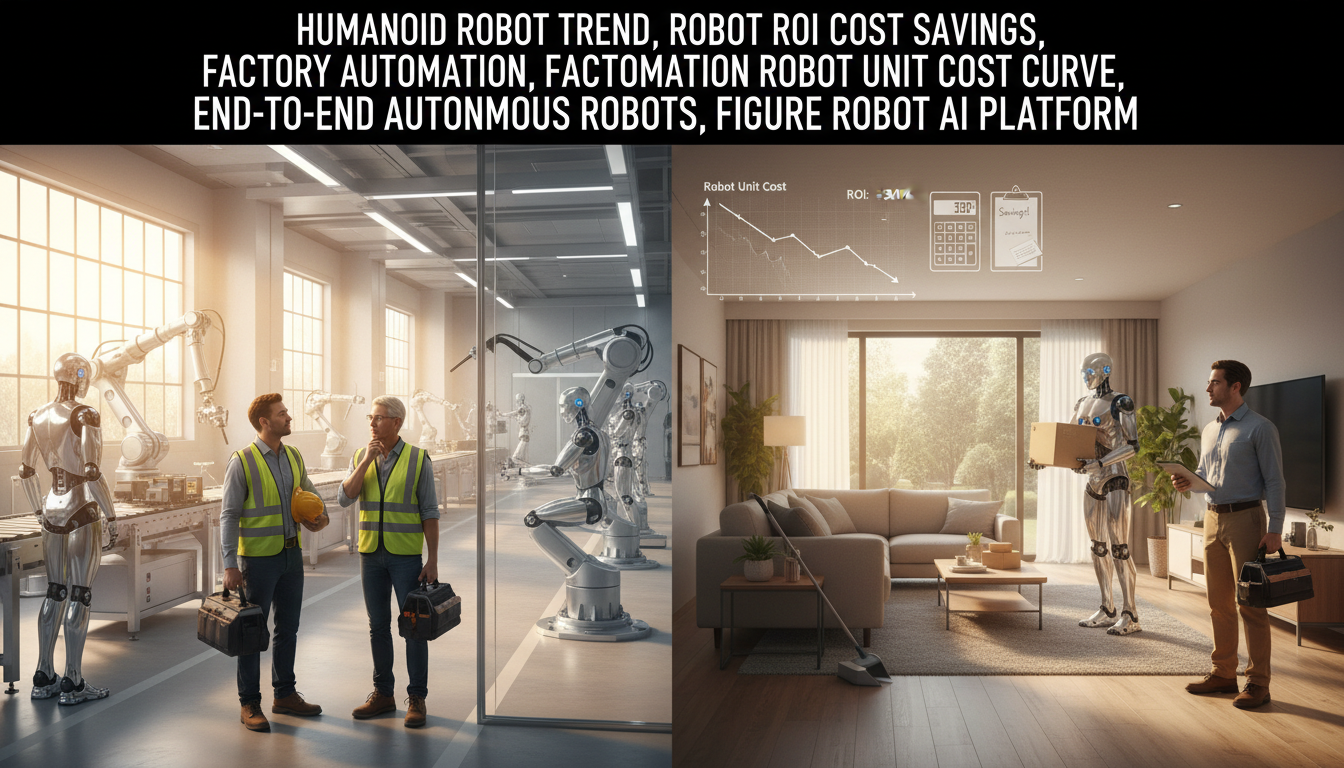
Even if early production costs are high, once unit costs drop via mass production (10,000 units → 50,000 units) and cross a threshold, the robot’s “hourly cost” becomes far lower than human wages.
If this becomes real, it turns from a choice into a survival strategy for companies.
From here, the macroeconomic keywords follow naturally.
Even if a rate-cut cycle arrives, companies have growing incentives to shift CAPEX (capital expenditures) toward “buying robots instead of hiring people.”
Over the long term, this can structurally affect labor supply, wages, and service prices—in other words, the composition of inflation itself could change.
3) Step-by-step roadmap: Factory → service → home, why this order is “almost fixed”
[3-1. Phase 1: Manufacturing/Logistics (Factory & Warehouse)]
The environment is controlled and safety standards are easier to design.
Work also supports “repetition + rules + data accumulation,” so learning efficiency is high.
For companies, ROI calculation is clear. (Labor-cost reduction + productivity gains + reduced absenteeism/turnover risk)
[3-2. Phase 2: Services (hospitals/hotels/big-box retail/building operations)]
There are more variables than factories, but “work processes” still exist.
From here, robots start affecting customer experience and brand, not just acting as simple workers.
So safety, social acceptance, and liability (accidents/damage) become more important.
[3-3. Phase 3: Homes (housework + caregiving)]
Homes are a nightmare of variables.
Lighting/space/object locations/edge cases/kids and pets/fragile items—the “long tail” is simply too long.
The tactile and delicacy issues mentioned in the original ultimately become a comprehensive challenge that includes “safety + reliability + insurance/liability.”
4) What other news/YouTube usually misses that’s “truly important” (separately organized from my perspective)
[Key takeaway 1: Humanoids are not a “robot industry,” but an industry that changes “the labor pricing system”]
Most people fixate on “wow, that motion is insane,” but the essence is the moment hourly cost breaks a threshold.
From that point on, robots don’t remain automation tools for one company—they reset the baseline floor of labor costs across all industries.
This change connects to inflation, wages, consumption, and even welfare-policy debates.
[Key takeaway 2: The battle is not hardware but “data/operations” — robots also become a platform game]
Humanoids are sensor bundles in their arms/legs/hands, and every moment becomes data.
The company that secures “more on-site data + more stable remote operations (teleop) + faster learning loops” will create the gap.
That is, in 1–2 years, “fleet scale (number of deployed robots)” may become the moat more than “robot athletic performance.”
[Key takeaway 3: Why the winner is a robot “fit to human environments,” not a “factory-tailored robot”]
The points mentioned in the original (door height, aisle width, stair spacing) are actually the most important.
One reason industrial automation is slower than expected is not a lack of robots, but that the cost of changing the site is too high.
Humanoids can become the first general-purpose automation form factor that can be deployed “without changing the site.”
[Key takeaway 4: You must be skeptical of “housework robot” demos — but the direction of skepticism matters]
Rather than emotionally arguing about whether it’s fake, it’s more productive to check like this.
① Is it fully autonomous, or partially remote-operated (teleop)?
② Is there disclosure of failure scenes (failure rate)?
③ Have speed (real-time performance) and repeatability (how many times the same performance is reproduced) been verified?
④ Does performance hold under safety conditions (close proximity to people)?
Demos can always be edited to show only “the best moments,” so investment/business decisions should be made with operations metrics at the center.
5) Global macro outlook: The next cycle humanoids could create (the 2026–2030 picture)
[5-1. What to watch in corporate results changes: labor-heavy industries get shaken first]
Manufacturing/logistics/retail/hotels/healthcare support work are areas where “AI + robots” directly hit the cost structure.
The earliest signal visible in earnings is not revenue growth, but operating-margin improvement (margin).
[5-2. Supply-chain reshuffling: reshoring could become possible not through “wages,” but through “automation”]
Production that moved overseas due to wages gains a plausible scenario of coming back because of robots.
This could also expand into cross-country competition in employment policy, tax systems, and regulation.
[5-3. A change in the nature of inflation: structurally suppressed service prices vs short-term cost increases during the transition]
In the long run, labor costs for repetitive services could face downward pressure.
However, during the transition, robot adoption costs, safety-compliance costs, and insurance/liability costs could raise short-term costs.
6) What to watch starting now to see the flow (checklist)
[6-1. Robot companies checklist]
Whether mass-production plans (unit volumes) and unit-cost targets are disclosed
Whether on-site PoC (proof-of-concept) contracts move from “pilot” to “repeat orders”
Whether there is an operations organization for remote operation/safety/maintenance
[6-2. Big tech/semiconductors checklist]
Robots ultimately explode demand for edge computing.
You should look not only at GPUs, but also robot modules/power/sensors/networking together.
[6-3. Personal career checklist]
Demand is likely to grow in manufacturing/logistics operations, safety/regulation, robot adoption consulting, and data operations (MLOps/RobotOps).
On the other hand, simple repetitive work could face pressure from both “AI agents (knowledge)” and “humanoids (physical labor).”
7) One-line conclusion
Atlas’s eerie motion looks like a “show,” but in reality it’s a signal of “generality for inserting robots into a world built for humans,”
and Figure’s demo is less “home robots are coming right away” and more a warning that “end-to-end autonomy + manipulation are approaching a commercialization threshold.”
The real battle is not how many backflips a robot can do, but how far unit costs fall at 10,000 and 50,000 units.
< Summary >
Humanoid robots are likely to spread in the order of factories (clear ROI) → services (processes exist) → homes (variable hell).
Atlas’s strength is athletic capability/joint degrees of freedom that can adapt to human environments, and Unitree’s industrial specs/operations still need to be seen relative to its buzz.
Figure is creating a “robots = AI platform” valuation by demonstrating manipulation + perception + end-to-end autonomy.
In the end, what flips the market is not motion videos but the mass-production unit-cost curve and operational data (on-site fleet).
[Related Posts…]
- Humanoid robot commercialization: 5 signals that change the game of factory automation
- AI infrastructure investment direction read from Palantir·Google·Amazon earnings
*Source: [ 월텍남 – 월스트리트 테크남 ]
– “와..진짜 대단합니다”…이전과는 차원이 다른 아틀라스봇의 “기괴한 동작들”