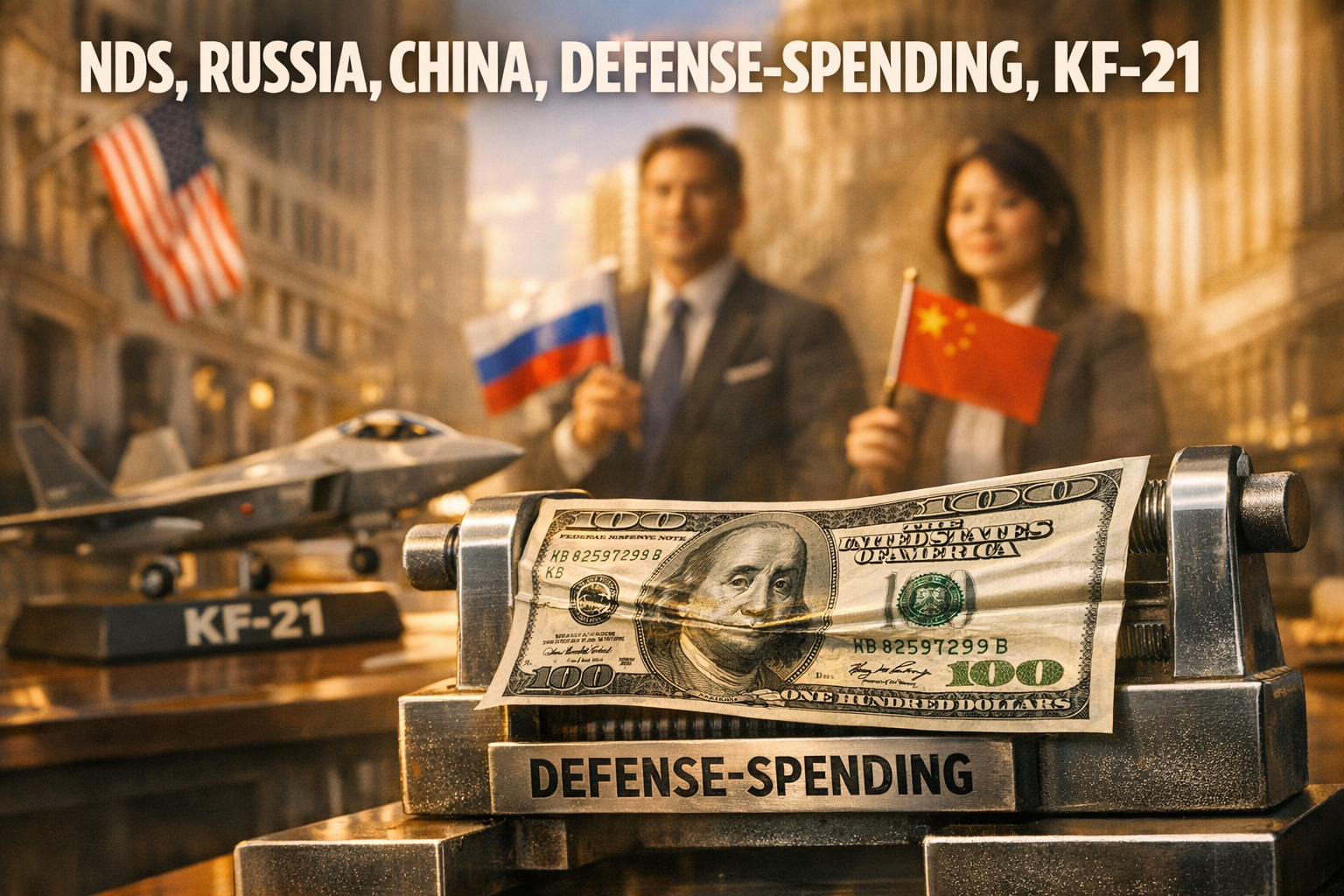
● Pentagon Spins China Menace, Russia Downplayed, Trillion Defense Binge, Bond Yields Spike, NATO Fractures
Why the US NDS Says “Russia Is Manageable, China Is the Real Challenge” — and the Embedded USD, Treasury, and Alliance-Fracture Scenario
This report focuses on four points:
1) Why the US National Defense Strategy (NDS) should be read less as an “external-facing strategy paper” and more as a “domestic taxpayer-justification document.”
2) Why comparing military power via GDP and defense-spending figures can miss operational reality (industrial capacity, defense-industrial structure, and inefficiency).
3) How a move toward USD 1 trillion+ in US defense spending can become intertwined with inflation, Treasury yields, and US federal debt dynamics.
4) Why a NATO “5% of GDP” target may function less as an “unmet pledge” and more as a trigger for European domestic political destabilization.
1) Briefing: “The NDS is not a global intelligence product; it is a political document for US taxpayers”
Key point
The NDS is a public document. Its primary audience is domestic voters and taxpayers, not foreign intelligence services. As a result, “threat perception” should be treated as a packaged message combining military framing with budget and political persuasion.
Why there is an incentive to downplay the Russia threat
If the US openly acknowledges a large technology and production-gap challenge from Russia, a domestic question follows: why has substantial defense spending over the past two decades not produced commensurate outcomes? Reframing Russia as a “manageable” threat and elevating China as the “primary challenger” can reduce accountability pressure while preserving the rationale for higher budgets.
Typical NDS device: using “economic-size comparisons” to minimize Russia
A common method is to compare Russia’s GDP against the aggregate economic size of NATO to imply that Russia is not a peer competitor. This may be effective for public messaging, but it can diverge from the variables that drive battlefield performance (munitions output, sustainment, and adaptation).
2) The operational meaning of “money-based comparisons fail”: GDP is only a proxy for combat power
Why GDP comparisons can mislead
GDP is market-price based. The same capability can have materially different cost structures across countries due to procurement practices, labor costs, regulation, subcontracting, quality systems, and rent-seeking dynamics. These factors can distort the translation of spending into usable force.
Three drivers emphasized in the discussion
1) Industrial capacity
Protracted conflict becomes a production and sustainment problem. The ability to manufacture artillery, missiles, spares, conduct repairs, and maintain logistics at scale and speed becomes decisive.
2) Inefficiency in the defense-industrial structure (high unit cost, long lead times, low volume)
Western procurement can be shaped by shareholder incentives, profit capture, lobbying, and political allocation, creating bottlenecks where budgets rise faster than deployable capability.
3) Non-equivalent “value per dollar”
Identical nominal spending does not yield identical physical capability. Conversion efficiency from budget to delivered systems varies materially across countries.
Investor-oriented framing: prioritize mobilization speed over nominal defense budgets
In peacetime, large budgets can signal strength; in wartime, the critical variable is the speed and effectiveness of industrial conversion to a war-footing. This connects directly to supply-chain security policies, reshoring efforts, and strategic-material controls.
3) Why a USD 1 trillion defense budget is a macro risk factor: yields, USD confidence, and debt dynamics can move together
Current trajectory
The discussion references roughly USD 910 billion around 2026, with the potential for further increases beyond USD 1 trillion.
Why defense-budget expansion becomes a macro issue
Defense spending is recurring, large-scale government demand. With elevated federal debt already in place, higher defense spending implies increased Treasury issuance. This can pressure Treasury yields; persistently high yields increase debt-service costs and further tighten fiscal constraints, reinforcing a negative feedback loop.
Core observation: “The USD is bought because alternatives are limited, but yields stay high due to fiscal unease”
The USD retains reserve-currency advantages and unmatched liquidity. The euro lacks full fiscal integration and a singular safe asset at comparable scale; China’s capital-market openness and trust constraints remain binding. As a result, the USD can remain the default, while fiscal expansion risk is reflected in higher yields.
Inflation linkage
Rearmament cycles can interact with energy, commodities, and manufacturing bottlenecks, increasing inflation risk. Persistent inflation reduces the likelihood of rapid monetary easing, sustaining higher rates and compounding debt-service pressures.
Why reshoring appears in this framework
The implied logic is that long-term USD credibility benefits from a stronger real-economy production base. Reshoring is therefore treated not only as labor policy but as a strategy to restore the physical foundations supporting a reserve-currency system. Implementation timelines, however, are long relative to near-term fiscal and rate stress.
4) NATO at 5% of GDP: less a military commitment than a “welfare–politics” stress test for Europe
Core argument
Raising defense spending to 5% of GDP is not only a question of intent. It can translate into welfare retrenchment, erosion of governing coalitions, leadership turnover, and eventual policy reversal or non-compliance.
Why 5% is structurally destabilizing
Europe faces low growth and fiscal pressure. A rapid defense-spending surge would likely crowd out pensions, healthcare, and education. Governments may attempt to intensify threat narratives to maintain support; if electorates do not accept the framing, political backlash can accelerate.
Most plausible pathway: emergence of “non-compliers”
Short-term alignment may persist for 1–2 years, but durability is uncertain. Over longer horizons, at least some countries may fail to meet targets or shift policy direction. This is relevant for markets because it challenges assumptions of persistent alliance cohesion.
5) Implications for defense exports: opportunity and risk
Opportunity: rearmament increases near-term demand
A sustained increase in defense budgets expands the global defense market. Korean defense exporters may benefit from delivery speed, cost competitiveness, and integrated packages (training, maintenance, ammunition, spares).
Risk: if “Europe at 5%” breaks down, orders may be delayed or repriced
Domestic political resistance can lead to cancellations, reductions, or postponements. Country-level fiscal capacity, election calendars, and coalition stability become key variables for forecasting order stability.
6) Under-addressed but decision-relevant takeaways
Point A: the NDS functions more as budget justification and domestic persuasion than as a pure strategy document
Threat narratives should be treated as framing tools supporting spending decisions, not as neutral intelligence outputs.
Point B: the decisive gap is often industrial endurance (production, maintenance, logistics), not headline technology
As conflicts extend, lead times and volume frequently dominate technical specifications. Structural inefficiency can operate as a hidden capability loss.
Point C: defense-spending expansion tests US rates, fiscal capacity, and USD credibility simultaneously
Defense outlays feed into deficits, deficits into issuance, issuance into yields, and yields into risk pricing and confidence. Bond-market responses are therefore integral to geopolitical risk assessment.
Point D: NATO at 5% is a test of European political-system durability
If domestic politics cannot sustain the trade-offs, strategy cannot be executed. Alliance cohesion can be constrained by fiscal realities and electoral dynamics.
< Summary >
- The NDS should be read as a domestic taxpayer-justification document; its Russia–China framing may reflect political budgeting incentives.
- GDP and nominal defense spending are insufficient for power assessment; industrial capacity and procurement inefficiency are central to real capability.
- A move toward USD 1 trillion+ in US defense spending can tighten the linkage between inflation risk, Treasury yields, and federal debt sustainability, testing USD confidence.
- A NATO 5% of GDP target may be difficult to sustain politically, increasing the probability of partial non-compliance and alliance-policy divergence.
[Related]
- https://NextGenInsight.net?s=treasuries
- https://NextGenInsight.net?s=reshoring
*Source: [ 경제 읽어주는 남자(김광석TV) ]
– 미국 군사전략에 담긴 러시아·중국 위협 구도와 실제 전력 격차. 돈으로 군사력 비교하면 망한다 | 경읽남과 토론합시다 | 진재일 교수 2편
● Temp Permit Loophole, Gangnam Listings Surge-Price Shock or Jeonse Meltdown Risk
Temporary Easing of the Land Transaction Permit Scheme’s “Owner-Occupancy Exception”: Will It Stabilize Gangnam Prices? The Core Issue Is Not “Price,” but “Listings, Jeonse, and Financing Risk.”
This report covers:
1) Why transactions involving occupied (tenant-in-place) homes were effectively blocked under the Land Transaction Permit Scheme (LTPS), and what has been eased
2) Scenario analysis for listings, transaction volume, and prices in the Gangnam area before and after May 9 (deadline)
3) Risks when jeonse-linked purchases (gap-like structures) conflict with owner-occupancy obligations, and the significance of enhanced funds-sourcing plans
4) The primary pressure points on the Gangnam market from rates, liquidity, and policy shifts
5) Key points typically underemphasized in mainstream news and online commentary
1) One-line summary: “A temporary fix has been introduced to unblock LTPS transactions involving tenant-in-place homes.”
With large parts of Seoul under LTPS coverage, homes with existing tenants were effectively untradeable because buyers could not move in immediately to meet occupancy requirements.
The policy change is designed to relieve this bottleneck and encourage listings.
2) Policy details: timeline, eligibility, and permitted actions
2-1. Deadline: May 9
The policy signals a strong expectation that multi-homeowners dispose of certain holdings by May 9.
This creates time-bound pressure for listing supply.
2-2. Why LTPS blocked transactions: “Existing tenants prevent immediate owner-occupancy compliance.”
LTPS is structured around owner-occupancy by end users.
If a tenant is already in residence under a jeonse or lease contract, the buyer cannot move in immediately, which becomes a barrier to permit approval and transaction completion.
2-3. Substance of the easing: “Honor the tenant’s remaining term, then require owner-occupancy.”
For transactions involving a home already occupied by a tenant, the tenant’s contract term is protected.
After contract expiration, the purchaser must satisfy owner-occupancy obligations.
The change primarily targets clearing transactions frozen by existing tenancies rather than opening a channel for new tenant-based investment structures.
2-4. Attempted circumvention via new jeonse: “February 12 is the reference date.”
A potential interpretation is that buyers could insert a new jeonse contract before May 9 and secure an extended protected term.
By setting a fixed reference date (February 12), the policy framework is positioned to limit such newly created, investment-like jeonse structures.
2-5. Enhanced funds-sourcing plan: require disclosure of the deposit repayment source
For tenant-in-place transactions, the principal risk is the buyer’s ability to repay the tenant’s deposit at contract end.
Accordingly, funds-sourcing documentation may require explicit detail on how the deposit will be repaid.
This functions as a screening mechanism against over-leveraged demand.
3) Market impact: prioritize transaction volume, listings, and jeonse conditions over “price direction”
3-1. Transaction volume: potential short-term surge from March to early May
A material increase in completed transactions is plausible as previously blocked deals become executable.
3-2. Listings: time-limited easing may bring out inventory that could not be sold previously
Properties that were difficult to sell due to tenant-in-place constraints and LTPS requirements may come to market.
The temporary easing, combined with the May 9 timing, increases incentives to list through spring.
3-3. Jeonse market: more choice, but higher perceived counterparty risk
Greater listings can increase options across both sales and jeonse.
However, tenant concerns focus on deposit safety and the new owner’s repayment capacity.
This is consistent with requiring deposit repayment details in funds-sourcing plans.
4) Why a simple “up vs. down” price view is insufficient
4-1. Near-term (now to May 9): limited likelihood of large price swings
The dominant driver is structural (permit and compliance constraints), not a classic speculative acceleration cycle.
4-2. Medium-term (after May 9): risk of a listings gap and tighter market conditions
If post-deadline tax burdens or regulatory frictions reduce seller willingness, listings could contract.
Absent substantial new supply, reduced market float can tighten conditions and reduce liquidity.
4-3. Key variables: the combined effect of rates, liquidity, and policy signaling
Gangnam pricing is ultimately determined by the durability of end-demand.
Demand capacity is shaped by mortgage rates, household cash flow, and policy direction.
If inflation re-accelerates, the pace of rate cuts may slow, limiting the intensity of incremental buying pressure.
Key factors to monitor:
Interest rates
Inflation
FX rates
Recession risk
Housing policy
5) Investor-style translation of the announcement
[Breaking-news framing] “Temporary relief for LTPS tenant-in-place transaction blockage.”
The government introduced a temporary measure addressing the practical impossibility of trading tenant-occupied homes in LTPS areas.
Higher transaction volume and more listings are expected through early May.
[Interpretation] “Not a broad opening for gap investment; primarily a mechanism to clear existing tenancy constraints.”
Newly created jeonse-based circumvention is constrained via a fixed reference date (February 12).
The structure preserves existing tenant terms while imposing owner-occupancy after contract expiration.
[Checkpoint] “Stronger verification of deposit repayment capacity.”
Funds-sourcing plans may require a detailed statement of deposit repayment resources.
This aligns tenant protection with leverage restraint.
6) Underemphasized but decision-critical points
6-1. The primary objective is closer to restoring transaction function than directly suppressing prices
The core issue is that “tenant presence = transaction failure” undermines market functionality.
The measure is best interpreted as reopening a blocked channel rather than a direct price-control tool.
6-2. “Listings increase until May 9” is both an opportunity and a risk: a post-deadline supply cliff is possible
Near-term supply may improve due to time pressure.
After the deadline, listings may contract again, reducing choice and market liquidity.
6-3. The main risk transmission channel is the jeonse–sale linkage (deposit and financing), not spot price volatility
In high-demand submarkets, stress typically emerges first in funding channels (credit, deposits, cash flow) rather than immediate price declines.
Requiring deposit repayment plans indicates policy attention to this risk vector.
7) Stakeholder checklists
7-1. End users (primary-home buyers)
From March to May, broader listing availability may improve comparative selection conditions versus momentum-driven buying.
Buyers should align move-in timing (owner-occupancy compliance) with a conservative financing plan, including potential post-May 9 liquidity tightening.
7-2. Tenants
The priority is deposit protection.
Tenants should verify the buyer’s funding basis and the mechanics of deposit repayment (loan execution, equity, refinance feasibility, or permissible debt transfer where applicable).
7-3. Multi-homeowners (sellers)
Simultaneous listing inflows can reduce scarcity premiums.
If selling is intended, execution before the deadline may be critical; failure to sell may increase exposure to renewed tax and policy burdens.
< Summary >
The temporary easing addresses an LTPS bottleneck that effectively prevented transactions of tenant-in-place homes, increasing the probability of higher listings and transaction volume through early May.
The measure is more consistent with restoring market functioning than directly targeting prices; after May 9, a renewed contraction in listings is possible.
The dominant risk is not price volatility but deposit repayment capacity and broader financing conditions, including interest-rate sensitivity.
[Related items…]
Summary of how LTPS easing may affect transaction volume in Gangnam
Scenario analysis for listing flows following the end of capital gains tax surcharge relief
*Source: [ Jun’s economy lab ]
– 토허제 실거주 잠시 풀리면 강남 집값 잡힐까?(ft.윤지영 중개사)
● China Military Rumors Explode, North America Alliance Cracks, K Defense Exports Surge
“Indicators of Stress in China’s Military + Friction in the North America Alliance + Korean Defense Exports” in One Brief
This note covers three items:1) Why rumors such as “Hu Jintao death” and “Zhang Youxia purge” recur in China, and what signals they may send to markets.
2) How the Trump variable may affect Canada–U.S. relations and spill over into energy, defense, and FX.
3) Why demand in Southeast Asia may rise around KF-21, and how spillover benefits could extend across Korea’s industrial base (components, materials, AI).
A separate section summarizes the most decision-relevant risk/opportunity checklist.
1) News Briefing: Separate “Facts” vs. “Interpretation” in the Source
1-1. Domestic Anxiety in Canada + Cooling Canada–U.S. Relations (Trump Variable)
Source claim: Canada–U.S. relations are deteriorating due to Trump-related uncertainty; domestic narratives even mention a hypothetical U.S. invasion.
Interpretation: The invasion narrative is not a base-case scenario; it is better viewed as political exaggeration that often accompanies declining trust among allies. For markets, the actionable issue is policy risk: tariffs, border and energy policy, defense burden-sharing, and supply-chain reconfiguration.
In such regimes, global investors typically price a “policy uncertainty premium.” A synchronized increase in North American trade/energy/defense uncertainty can coincide with USD strength, higher commodity volatility, and accelerated supply-chain diversification, with second-order effects on inflation, rates, and FX.
1-2. China: Rumor Propagation (Zhang Youxia Purge, Hu Jintao Death, Zhu Rongji Death)
Source claim: Rumors suggest Zhang Youxia could sideline Xi Jinping; death rumors circulate regarding Hu Jintao and Zhu Rongji; potential for large-scale unrest.
Interpretation: The market-relevant issue is less the truth of any rumor and more the structural conditions that allow repeated rumor cycles. High information asymmetry and delayed/limited official disclosure regarding senior leadership and the military can amplify unverified narratives across finance and public opinion.
From a market perspective, this tends to raise China’s geopolitical risk premium. Military-related rumors can intersect with Taiwan and South China Sea tensions and transmit into China equities, CNY pricing, and foreign capital flows.
1-3. KF-21 Export Expectations: References to Turkey, Malaysia, Indonesia
Source claim: Turkey is failing; KF-21 could be a major success; Malaysia has taken action; Indonesia missed the timing; KF-21 is superior to China’s J-35.
Interpretation: Stripping rhetoric, the key frame is rising air-force modernization demand among middle powers, with increased preference for favorable price-performance and supply reliability—areas where Korea may be competitive. KF-21 is not only an airframe sale; it is typically bundled with AESA radar, avionics, engines, MRO, weapons integration, and training systems. If executed, this can have meaningful implications for domestic manufacturing, exports, and medium-term industrial competitiveness.
2) Macro/Market Reframing: Why This Connects to Global Macro
2-1. Three Market Channels from China Rumor Cycles
1) Faster de-risking of China exposure by foreign investors
Uncertainty alone can trigger allocation reductions regardless of ultimate verification.
2) Higher CNY volatility with spillovers to Asian FX
CNY moves can transmit via sentiment into KRW, TWD, SGD, and broader regional risk pricing.
3) Re-acceleration of supply-chain diversification (China+1)
Political/military risk provides corporate justification for relocation and multi-sourcing. Beneficiaries often include Southeast Asia, India, Mexico, and—in higher value-added manufacturing—Korea.
2-2. The Practical Variables in Canada–U.S. Friction: Energy, Defense, Trade
Canada is tightly integrated with the U.S. across energy, critical minerals, and defense value chains. If tariffs, regulation, or defense-cost disputes escalate, policy risk can feed into commodity pricing and corporate capex/hiring.
If “domestic preference” procurement rules strengthen in North America, parts and raw-material sourcing may shift and costs may rise, potentially reintroducing inflation pressure. This can affect central-bank reaction functions and global liquidity conditions.
2-3. Why Korean Defense Matters in Macro Terms: Industrial Leverage, Not Just Exports
Defense is not only revenue expansion; it can drive manufacturing upgrading, localization of materials/components/equipment, and integration with AI/software.
Modern warfare is increasingly shaped by drones, satellites, electronic warfare, and data links. Competitive advantage depends not only on platform performance but also on battlefield networking, operating software, lifecycle cost, and delivery timelines—areas where Korea may gain positioning through pricing, packaging, and lead-time credibility.
3) AI Trend Lens: The Core Theme Is the Industrialization of AI-Enabled Warfare
3-1. Where AI Monetizes in Defense (Operational Use Cases)
1) ISR automated analytics
Satellite/drone/radar data volumes exceed human review capacity. AI supports anomaly detection, target classification, and prioritization.
2) Predictive maintenance
For aircraft and naval assets, readiness rates are critical. AI that optimizes replacement timing before failure has direct economic value. Larger MRO scopes increase the need for data-driven maintenance.
3) Simulation and synthetic-data training
With limited real-world combat data, synthetic datasets and simulators are used for model training and tactical validation, linking to GPUs, edge computing, and digital twins.
3-2. Commonly Missed Investor Point in “AI + Defense”
Revenue pools are not confined to platforms (e.g., fighters). Value accrues across the chain:
Sensors -> Communications/Data links -> Analytics AI -> Command and Control (C2) -> Maintenance
Accordingly, platform headlines (e.g., KF-21) can create correlated momentum for radar, avionics, communications, semiconductors, materials, and maintenance software.
4) Most Decision-Relevant Points Often Underemphasized in Media
4-1. China’s “Death/Purge” Rumors as a Market Stress Test, Not a Binary Truth Claim
The repeatable data are: official response patterns (censorship, denial, silence), market reactions (CNY, equities, sovereign rates), and shifts in diplomatic messaging.
Rather than waiting for confirmation events, investors can monitor how strongly markets react to rumor cycles to gauge China risk “capacity” under stress.
4-2. Why North American Alliance Friction Matters: Procurement Rules More Than Kinetics
In allied disputes, rules often change before any military dimension: procurement standards, rules of origin, subsidy conditions, and tariffs. These adjustments can transmit quickly into earnings and supply chains.
This can also reintroduce inflation in a slowing-growth environment, directly affecting central-bank policy paths, global liquidity, and valuation multiples.
4-3. The KF-21 Export Frame: Delivery, Operating System, and Maintenance Data Over Headline Price
Buyer priorities often center on delivery schedules, sustained readiness, MRO simplicity, and training/operating systems more than headline specifications.
Korea’s potential advantage may expand if it can package digital operations and maintenance systems effectively; AI integration could widen performance and lifecycle-cost differentiation.
5) One-Page Checklist (Risk/Opportunity Summary)
[China Risk Checklist]
- During senior military/leadership rumor cycles, do CNY and China equity volatilities widen in tandem?
- Do official signals shift (denial vs. silence vs. intensity of censorship)?
- Do military activity levels rise concurrently around Taiwan/South China Sea?
[North America Policy Risk Checklist]
- Do tariffs/subsidies/rules-of-origin themes translate into concrete legislation or executive action?
- Do procurement conditions change across energy and critical-minerals supply chains?
[Korean Defense Momentum Checklist]
- Beyond single-order headlines, is there evidence of bundled sustainment (MRO), weapons integration, and training systems?
- Are there parallel signals of value-chain contracting in radar, avionics, communications, and maintenance software?
< Summary >
China’s rumor cycles matter less as discrete truths than as a mechanism that increases uncertainty and widens the geopolitical risk premium. Canada–U.S. frictions are more likely to transmit through tariffs, procurement rules, and energy policy, with implications for inflation dynamics and macro pricing. KF-21-related developments can function as industrial leverage events, with potential spillovers from platform exports into radar, avionics, MRO, and AI-enabled operating systems.
[Related Posts…]
- KF-21 export expectations and shifts in the Southeast Asian defense market: https://NextGenInsight.net?s=KF-21
- China military risk, CNY volatility, and implications for global capital flows: https://NextGenInsight.net?s=China
*Source: [ 달란트투자 ]
– “곧 대륙에 끔찍한 일 터진다” 후진타오 사망설 싹다 퍼졌다. 심상치 않은 중국 군부 상황 | 김대영 군사평론가 풀버전