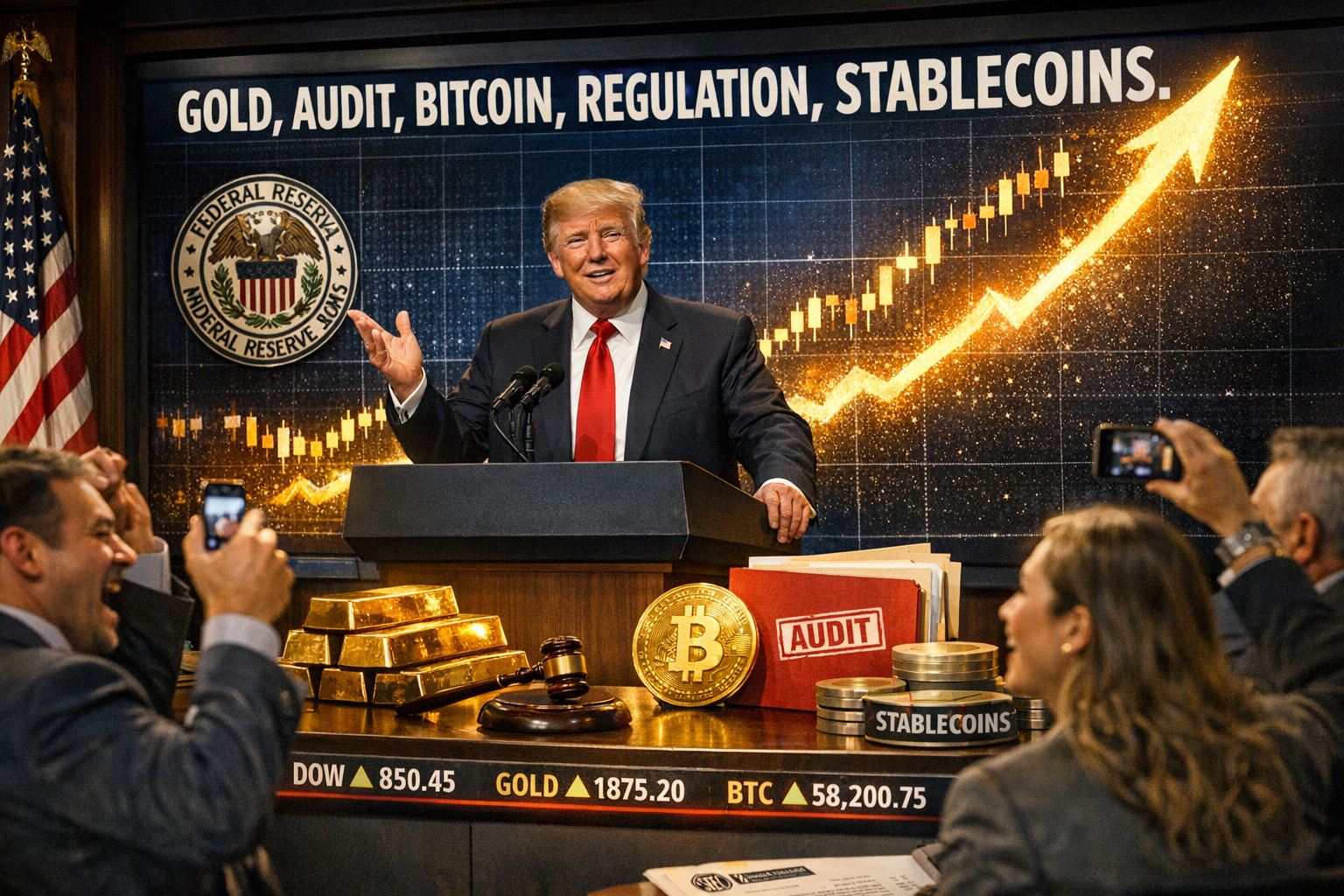
● Fort Knox Audit Shock – Dollar Doubts – Gold Spike – Bitcoin Exit Plan
Why the “Trump Gold Reset” Scenario Is Material: Gold Audit (Fort Knox) → Pressure on Dollar Credibility → Gold Spike/Revaluation → Institutionalizing Bitcoin as the “Exit”
This report consolidates four points:1) Why the US–China rivalry is a structural conflict and unlikely to resolve quickly
2) Why flashpoints are increasingly concentrated around Saudi Arabia (oil) and Taiwan (security)
3) Why a “gold reserves transparency/audit” theme can destabilize both gold and the US dollar
4) What will actually determine passage of key crypto legislation in H1 2026 (Bitcoin Act, Clarity, Genius)
1) News Briefing: The Primary Market Driver (US–China Rivalry Is Structural)
The core premise is that US–China tensions are structural rather than event-driven. The conflict is likely to persist absent a decisive strategic outcome, with continued spillovers into supply chains, commodities, and the international monetary order.
A related framing is that US engagement in the Middle East has often been aligned less with “stability” per se and more with shaping geopolitical risk to support US interests. Oil-price volatility and regional risk cycles can transmit into inflation, rate expectations, and dollar liquidity conditions.
2) Two Core Geopolitical Risk Nodes: Saudi Arabia (Oil) + Taiwan (Force Signaling)
2-1. Saudi Arabia: A Remaining High-Leverage Pressure Point
A key claim is that US leverage in the region has narrowed, increasing the relative importance of Saudi Arabia as a potential focal point.
Saudi Arabia’s positioning has become more complex:
- US dependence on Saudi crude has declined due to shale production.
- Security guarantees may be less binding than in prior cycles.
- Saudi crude export exposure to China has increased.
This creates a balance that may hold but remains sensitive to shocks, increasing the probability of oil-price spikes.
Transmission pathway:Oil volatility → inflation re-acceleration risk → uncertainty in the rate path → risk-off positioning (gold/USD/cash) → higher volatility in risk assets.
2-2. Taiwan: A Persistent Security Overhang
The Taiwan issue is framed as timing-dependent rather than resolvable. Domestic political incentives and credibility signaling can sustain pressure even without immediate escalation.
For investors, Taiwan-related risk can affect semiconductors, maritime logistics, insurance premia, and USD funding conditions, potentially combining growth downside risks with supply-side inflation pressure.
3) Core Mechanics of a “Gold Reset”: Why Audit/Transparency Can Move USD, Gold, and Bitcoin
3-1. Trigger: Escalation to a Public Audit Narrative (Fort Knox)
The central trigger is not the definitive truth of reserves, but the emergence of a credible public push for transparency (legislation, hearings, or formal audits). Markets can react to the audit narrative itself because it introduces uncertainty about the credibility of the existing framework.
3-2. First-Order Reaction (Short Term): Pressure on Dollar Credibility → Potential Gold Spike
If confidence in the dollar framework is challenged, investors may rotate toward established hedges, notably gold. In a risk-off phase, gold can rally while equities and crypto weaken, although mixed reactions (including concurrent USD strength) remain possible depending on broader conditions.
3-3. Second-Order Reaction (Medium Term): Reframing Could Increase Volatility and Challenge Gold’s Long-Term Narrative
After the initial shock, the narrative can shift toward a broader credibility debate: if official gold-reserve claims become a focal point of distrust, gold’s role as an anchor of confidence can be re-litigated. This can create a regime of higher volatility, including the possibility of a reassessment of gold’s medium-term role.
3-4. “Ledger Over Physical”: Revaluation as a Policy Tool
A key argument is that policy outcomes may hinge less on physical inventory and more on accounting, institutional design, and revaluation mechanisms. A large reset of the official gold valuation could, via Treasury–Fed accounting, expand perceived fiscal/monetary room and signal an attempted restructuring of the dollar system. This would likely feed into recession risk debates, USD directionality, and the inflation path.
4) Completing the “Gold Up, Then Bitcoin” Framework: H1 2026 as the Institutionalization Window
The scenario emphasizes H1 2026 as a potential inflection period for US crypto institutionalization, focusing on committee markup and the pathway to floor votes rather than bill introductions.
4-1. Bitcoin Act: Legalizing the Strategic Reserve Narrative
If enacted, the concept of Bitcoin as a strategic asset would gain statutory support. This could accelerate institutional adoption by enabling policy updates across pensions, insurers, and banks.
4-2. Clarity: Defining Asset Classification (Commodity vs. Security)
Market impact is driven primarily by uncertainty reduction. A clearer framework that treats sufficiently decentralized assets as commodities while applying securities standards to more centralized tokens could reduce compliance ambiguity and improve institutional risk acceptance.
4-3. Genius (Stablecoin Framework): The Negotiation Focus (No-Interest vs. Conflict-of-Interest)
Two practical chokepoints:1) Whether stablecoins can pay interest to holders. Allowing interest could compete with bank deposits and face opposition from incumbent banking interests.
2) Conflict-of-interest provisions: whether senior executive-branch officials can maintain crypto-related business interests, and whether the president/vice president would be exempted. This is presented as a primary political legitimacy constraint.
The gating factor is political viability rather than technical architecture. A durable compromise (e.g., enforceable trust structures) could unlock progress; failure to resolve legitimacy concerns could delay passage.
5) Investor Checklist: How to Monitor Gold, USD, and Bitcoin
Use the framework as scenario analysis rather than prediction:1) Whether “gold audit/transparency” expands into legislation, hearings, or repeated official statements
2) Whether events in the Middle East (especially Saudi-linked) increase oil volatility
3) Whether Taiwan-related military/diplomatic events translate into supply-chain disruption
4) Whether H1 2026 markup schedules advance toward floor votes and enactment
5) Whether conflict-of-interest provisions settle into a passable compromise
If these factors align, markets may reprice under a “monetary regime reset” lens rather than a technology-only narrative, requiring simultaneous monitoring of USD dynamics and safe-haven positioning.
6) Key Points Often Underweighted in Mainstream Coverage
1) The audit narrative itself can be more destabilizing than the physical inventory question. The credibility gap can drive outsized volatility before facts are resolved.
2) Gold may function as a short-term hedge, while the longer-term institutional narrative could shift toward digitally verifiable collateral, driven by auditability and verification-cost advantages.
3) The H1 2026 legislative outcome may hinge on political-ethics constraints (conflict-of-interest) more than on market-structure design.
The US–China rivalry is framed as a structural conflict, with Saudi Arabia (oil) and Taiwan (security) as key pressure points. If a gold-reserves transparency/audit theme gains traction, it can challenge dollar credibility and support a short-term surge in gold, followed by elevated volatility as gold’s longer-term role is reassessed. In parallel, the US could advance Bitcoin institutionalization through the Bitcoin Act, Clarity, and Genius in H1 2026; the primary passage variable is a workable compromise on executive-branch conflict-of-interest provisions.
[Related Articles…]
- https://NextGenInsight.net?s=Bitcoin
- https://NextGenInsight.net?s=Gold
*Source: [ 경제 읽어주는 남자(김광석TV) ]
– 트럼프의 금 리셋 전략… 금 신뢰 흔들리면 시장은 어디로? “금값 올려 비트코인으로 간다” | 경읽남과 토론합시다 | 김창익 작가 3편
● Bithumb Crypto Slip-Up, Stablecoin Laundering Surge, Cracks in KYC Travel Rule
The Core Issues Behind the “Bithumb Erroneous Credit” Case, and Why Stablecoin-Based Illicit FX Transfers and Money Laundering Are Expanding
This report focuses on four points:
1) Whether a recipient of Bithumb’s “erroneous credit” faces actual legal liability if they do not return it (civil vs. criminal threshold)
2) How illicit FX transfers and money laundering using stablecoins (USDT/USDC) operate in practice (field-level mechanics)
3) What Travel Rule, KYC, and exchange transfer restrictions can and cannot block (practical loopholes)
4) How these developments connect to macro variables such as KOSPI/KOSDAQ, interest rates, FX, and USD dynamics (investor perspective)
1) News Briefing: Key Issues Raised in the Interview (filmed 2026.02.12)
1-1. The “Bithumb Erroneous Credit” resembles mistaken transfers, but crypto adds complexity
In bank mistaken transfers, the baseline remedy is restitution of unjust enrichment; if the recipient refuses to return the funds or spends them, criminal exposure such as embezzlement may arise.
For virtual assets, prior case law has treated “economic value” less consistently, making mechanical application of the same framework less straightforward in certain areas.
1-2. “Sell immediately at market, buy back lower, then return?”
A practical scenario:
- Sell the erroneously credited BTC immediately
- Rebuy after a price decline
- Return the same quantity and retain the spread
Key disputes typically split into three questions:
1) Must the recipient return the asset in-kind (coin), or return equivalent value (KRW)?
2) Which price reference applies (time of erroneous credit, time of return, or time of sale)?
3) Does the matter remain civil (unjust enrichment) or escalate to criminal liability (e.g., embezzlement/fraud)?
1-3. Moving to offshore exchanges or self-custody materially increases recovery difficulty
Large offshore centralized exchanges increasingly cooperate with warrant execution, but recovery becomes materially harder when funds are moved to:
- Non-cooperative smaller exchanges, or
- Self-custody wallets
Enforcement strength declines sharply outside regulated domestic rails.
2) Stablecoin-Based Illicit FX Transfers (Underground Remittance): Practical Structure
2-1. Definition
Formal remittance is routed through licensed banks and regulated financial networks. Illicit FX transfer schemes use unregistered brokers to bypass these channels, effectively settling cross-border value transfers off-network.
2-2. Why stablecoins (USDT/USDC)
Stablecoins are designed to track USD at approximately 1:1, reducing volatility risk during transfer and settlement. This supports:
- Lower price risk during processing delays
- Higher incentives for opacity and circumvention
- Use as a functional USD substitute in certain contexts
2-3. Operational mechanics: ledger-based settlement without cross-border bank transfers
A common pattern:
- Cash is delivered to a broker overseas
- A domestic counterpart deposits KRW into a local account with benign-looking transfer descriptions
Key point: funds may not physically cross borders via banking rails; settlement can occur via internal ledgers and offsetting, while producing the economic effect of cross-border inflow/outflow.
2-4. Lack of a reporting victim increases enforcement difficulty
Unlike phishing and scams, underground remittance and laundering often involve participants with limited incentive to report. With constrained investigative resources and expanding volume, structural detection difficulty increases.
3) What Travel Rule, KYC, and Exchange Controls Block vs. What Remains Exposed
3-1. Travel Rule function: binding sender/receiver identity to transfers
For transfers above thresholds, the Travel Rule strengthens verification of originator/beneficiary information and related records, increasing the cost of anonymity in stablecoin-based schemes.
3-2. Domestic exchange practice: restricting outbound transfers to DEXs or weak-KYC venues
More domestic exchanges restrict transfers to:
- Decentralized exchanges (DEXs), or
- Venues with insufficient identity controls
This can be an effective point-of-origin constraint.
3-3. Residual gap: once offshore, rules and enforcement become less consistent
If assets move from a domestic exchange to an offshore venue and then onward to other wallets/venues, tracing and recovery become more complex. Outcomes depend on cross-border cooperation and the compliance posture of intermediaries.
4) Mixers and AI-Enabled Tracing: Why “Perfect Crime” Assumptions Have Weakened
4-1. Mixer definition
Mixers pool and redistribute assets to obscure transactional linkages, historically used as a laundering tool.
4-2. Mixer usage increasingly functions as a risk flag
With expanding collaboration between blockchain analytics providers (e.g., Chainalysis-type tools) and authorities, pattern-based detection has improved. Mixer interaction may raise risk scores and trigger enhanced scrutiny, despite providing some obfuscation.
5) Common Crypto Fraud Pattern: ICO/Presale “Guaranteed Listing” Schemes
5-1. Typical structure
- Sell tokens cheaply pre-listing
- Market the token as “confirmed” for listing on a major exchange
- Use projected multi-fold returns to attract capital
5-2. Why it constitutes fraud
The core element is misrepresentation: portraying a non-existent or highly unlikely listing as confirmed increases the likelihood of fraud liability.
5-3. A frequent variant: sending similarly named tokens
In OTC deals, scammers may issue or transfer a different token with a similar name, creating a mismatch analogous to counterfeit delivery fraud in traditional peer-to-peer commerce.
6) Macro Linkages: Why This Matters for KOSPI/KOSDAQ, Rates, and FX
6-1. Stablecoins are scaling into a private USD value-transfer network
As USDT/USDC usage grows, USD-linked value transfer increasingly occurs outside banks. This can heighten FX sensitivity and make USD demand dynamics more granular and continuous.
6-2. Tighter liquidity and higher rates increase incentives for bypass channels
In restrictive rate environments, market participants become more sensitive to cost and timing of compliant remittance and settlement, increasing incentives for circumvention. Stronger regulation can also raise the “premium” (fees) in underground markets, potentially reinforcing their economics.
6-3. Equity-market relevance: financial trust and regulatory risk
Crypto-market developments can affect:
- Valuations of exchanges, fintech, security, and regtech names
- Broader investor sentiment via changes in regulatory intensity and perceived financial-system credibility
7) Key Points Often Underemphasized in Coverage
7-1. The core dispute is settlement basis, not ethics
Primary litigation risk concentrates on:
- In-kind return (coin) vs. value return (KRW)
- Price reference timing
Absent agreement, dispute complexity and legal cost rise materially.
7-2. In stablecoin-based underground remittance, off-chain ledger netting is often the core
Enforcement discussions frequently over-focus on on-chain tracing. In practice, cash handoffs and off-chain ledger offsetting can dominate operational settlement.
7-3. Mixer usage can create identification signals rather than immunity
Mixers may increase obfuscation but can also function as a behavioral marker that elevates investigative and compliance attention.
7-4. “DEXs make enforcement impossible” is incomplete
DEXs cannot be eliminated, but constraining fiat on/off ramps (domestic exchanges, banks, real-name accounts) increases operational cost and reduces expected profitability of illicit flows. Full elimination is unlikely; economic deterrence is feasible.
< Summary >
- The Bithumb erroneous credit issue resembles mistaken transfers but is more complex due to disputes over return form (coin vs. KRW) and price reference timing.
- Stablecoin-based illicit FX transfer and laundering often rely on off-chain ledger settlement; absence of complainants structurally increases detection difficulty.
- Travel Rule, KYC, and domestic exchange transfer limits raise friction, but enforcement gaps persist in offshore and self-custody segments.
- Growth in USD-linked value transfer outside banks interacts with FX and rate conditions and can transmit into equity markets via regulatory risk and financial trust.
[Related Articles…]
- Stablecoin regulatory tightening and its impact on FX and capital flows: https://NextGenInsight.net?s=stablecoin
- Enforcement trends in underground remittance after the Travel Rule: https://NextGenInsight.net?s=underground+remittance
*Source: [ Jun’s economy lab ]
– 전)남부지검 검사가 본 빗썸사태, 스테이블 코인 돈세탁(ft.이영훈 변호사 1부)
● Europe Paralysis, Energy Shock, Korea-Powered Eastern Boom, 2026-27 Supply-Chain Gold Rush
Why Eastern Europe Says It Became “No. 1 Globally Thanks to Korea”: One Structural Issue Europe Cannot Fix + The Background Behind Slovakia’s Strong Appreciation for Korea + Opportunity Sectors for 2026–2027
This report focuses on three points. First, why Europe lost key recovery tools after a series of suboptimal policy choices (depletion of policy levers). Second, why parts of Eastern Europe, including Slovakia, show unusually strong appreciation toward Korean companies (industrial structure, operational culture, employment impact). Third, how these dynamics translate into opportunities and risks for Korean corporates and investors in 2026–2027 (supply-chain realignment and localization).
1) News Brief: Why Europe Remains Challenged and Struggles to Respond
In investor terms, Europe is entering a regime where major policy options (fiscal, monetary, energy, and industrial policy) are simultaneously constrained. As a result, negative shocks are more likely to translate into prolonged economic underperformance.
1-1) The Structure Behind Europe’s Loss of “Recovery Tools”: A Triple Constraint
(1) Structurally Higher Energy Costs Even with short-term price volatility, the cost floor for energy-intensive manufacturing has shifted higher. A higher cost base tends to reduce corporate investment and hiring, while weakening real household income and consumption.
(2) Monetary Policy Dilemma (Inflation vs. Slowdown) With inflation risks not fully resolved, policy rates are harder to cut aggressively. Maintaining restrictive rates, however, can further suppress growth. This extends the period in which central banks cannot prioritize growth support.
(3) Limited Fiscal Space (Widening Cross-Country Dispersion) Debt levels and fiscal rules constrain countercyclical spending, and response capacity differs materially by country. These differences can become self-reinforcing through persistent growth divergence within the EU.
Bottom line: Europe’s repeated vulnerability to downturns reflects weakened shock absorbers across multiple policy channels.
2) News Brief: Why Slovakia Expressed Strong Appreciation Toward Korea
2-1) Three Reasons Eastern Europe Shows Sustained Appreciation for Korean Companies
(1) Factory Attraction Was a Survival Priority in the 1990s–2000s Following the transition period, Slovakia and peer economies experienced industrial gaps and employment shocks. Manufacturing FDI and job creation were central to local economic stabilization.
(2) Korea’s Investment Model Is Often Perceived as Operationally Intensive Korean firms frequently established production lines rapidly, accelerated workforce training, and emphasized productivity-led operations. For host countries, the visible outcomes—jobs, capability building, and process know-how—tend to be salient.
(3) Korea-Linked Clusters Contributed to “Global No. 1” Outcomes in Specific Segments Such statements are typically associated with autos and components, electronics, and batteries—areas where export performance and production scale improved materially. The key mechanism is not attribution to a single country, but the completion of an industrial cluster triggered by anchor investment.
3) The Most Material Point Often Missed: Eastern Europe’s Role Is Being Reframed
A common framing is “Eastern Europe as a low-wage production base.” That framing is shifting.
Eastern Europe’s value proposition is moving from labor cost arbitrage to supply-chain insurance within the EU.
Corporate decision-making is increasingly driven by risk diversification, delivery reliability, and regulatory compliance—not only unit cost. In this context, Eastern Europe functions as a strategic node in supply-chain reconfiguration. Historical cooperation and favorable local reception can lower execution friction for future expansions.
4) 2026–2027 Macro Outlook: Europe/Eastern Europe Checklist
4-1) Europe Macro: Low Growth with Policy Constraints as the Base Case
① Downside growth risk remains Europe’s manufacturing sensitivity can translate into weaker resilience during global slowdowns.
② Even if inflation moderates, the cost structure may remain elevated Energy, wage dynamics, and regulatory costs can persist as structural inputs for corporates.
③ Rate cuts, if/when they occur, are not a comprehensive solution Lower rates can ease financial conditions, but investment decisions will remain heavily influenced by demand outlook and non-financial cost burdens.
4-2) Eastern Europe (Including Slovakia): Rebalancing of the Germany–Central Europe Value Chain
① German industrial weakness transmits quickly High integration with Western European value chains implies rapid spillovers from demand softness.
② Investment attraction remains structurally competitive Single-market access, workforce availability, infrastructure, and established clusters support greenfield and expansion feasibility.
③ Batteries, automotive electronics, and automation: localization becomes a core advantage Regulatory compliance, certification, and skilled labor availability increase the value of established local production footprints.
5) Implications for Korean Corporates/Investors: Opportunities and Risks
5-1) Opportunities: Eastern Europe as a “Production + Compliance + Delivery Reliability” Package
① Beneficiary of supply-chain realignment As intra-European sourcing and production deepen, incumbents with local capacity can gain operating leverage.
② Potential for cluster expansion via technology and process transfer In batteries, electronics, and factory automation, anchor investments often pull in suppliers, reinforcing employment and infrastructure build-out. Positive host-country sentiment can reduce permitting and community-relations friction.
5-2) Risks: Approaching Eastern Europe as a “low-cost assembly base” can be value-destructive
① Wage inflation and labor competition Manufacturing labor scarcity and rising wages can pressure margins for labor-intensive models.
② Policy and regulatory speed EU requirements on ESG, carbon, and supply-chain due diligence can function as market-access conditions rather than discretionary costs.
③ Second-order demand shock from Western Europe Plant utilization ultimately depends on end-market demand; prolonged weakness in Western Europe can reduce throughput and returns on capacity.
6) AI Trend: If Policy Capacity Is Constrained, Corporate Efficiency Becomes the Primary Lever
When macro policy is less effective, operational efficiency and productivity improvements become more material. AI and automation are the highest-impact levers in manufacturing.
6-1) Four High-ROI AI Use Cases for Eastern European Manufacturing Operations
① Vision-based inspection (lower defect rates, reduced rework) Camera systems combined with edge AI can automate quality inspection and reduce cost of quality.
② Predictive maintenance (reduced downtime) Sensor-driven models can forecast failure risk and optimize maintenance timing.
③ Production scheduling optimization (improved delivery reliability) Optimization under demand volatility can stabilize lead times and reduce delivery risk.
④ Energy optimization (particularly material in Europe) Power and gas optimization, including peak management, can translate directly into operating profit improvement.
7) Conclusion
Eastern Europe’s favorable stance toward Korean firms is best viewed as an execution asset for the next cycle, not a sentiment story. As Europe operates under constrained policy capacity, competitive advantage is increasingly determined by supply-chain positioning and AI-enabled productivity. Eastern European manufacturing footprints, supported by long operating histories, can be leveraged within this framework.
< Summary >
Europe faces a triple constraint across energy, monetary policy, and fiscal capacity, increasing vulnerability to downturns and reducing rebound effectiveness. In Slovakia and parts of Eastern Europe, manufacturing FDI was critical during the transition period; Korea’s operationally intensive investment model contributed to durable clusters and measurable export/production gains in select sectors. Eastern Europe’s value is shifting from low wages to supply-chain insurance within the EU; in 2026–2027, supply-chain realignment and AI-driven manufacturing productivity are likely to remain central competitive factors.
[Related]
- Europe Economic Outlook: Key Drivers Across Energy, Rates, and the Manufacturing Cycle
- Supply-Chain Realignment: Global Production Footprint Strategy for Korean Corporates
*Source: [ 달란트투자 ]
– “한국 덕분에 세계 1등” 동유럽이 한국에 감격한 이유|진재일 교수 4부