● NY Fed Bombshell Tariffs Fully Passed Through Americans Pay Hidden Tax Deadweight Loss Surge
[Shocking Report] “They Pay the Tariffs?” The Inconvenient Truth of the US Economy Revealed by the NY Fed
In this post, based on a shocking report released by the Federal Reserve Bank of New York in February 2026, I intend to talk about the illusions of trade policy that we have believed in until now.It includes a fact check on whether the politicians’ confident claim that “the exporting country foots the bill” was true, or if that bill returned directly to our wallets.Going beyond the simple story that prices have risen, I will thoroughly uncover how the economic mechanism of ‘complete passthrough’ operated and why this is effectively an ‘invisible tax.’Especially through the concept of ‘Deadweight Loss,’ which is rarely covered in the news, I have analyzed in depth from my own perspective why this policy gnawed away at the efficiency of the entire economy, so please focus until the end.
1. Fact Check: Who on Earth Paid the Tariff Costs? (The Mechanism of Complete Passthrough)
On February 12, 2026, the report released by the Federal Reserve Bank of New York (New York Fed) is delivering a megaton-level shock.This is because it proved with data who the actual burden bearer of the ‘Trump tariffs,’ which had been the core point of US trade policy for the past few years, really is.Although the political sphere has consistently claimed that “exporting countries like China bear the tariffs and pay money to the US,” the reality pointed to by the data was the exact opposite.
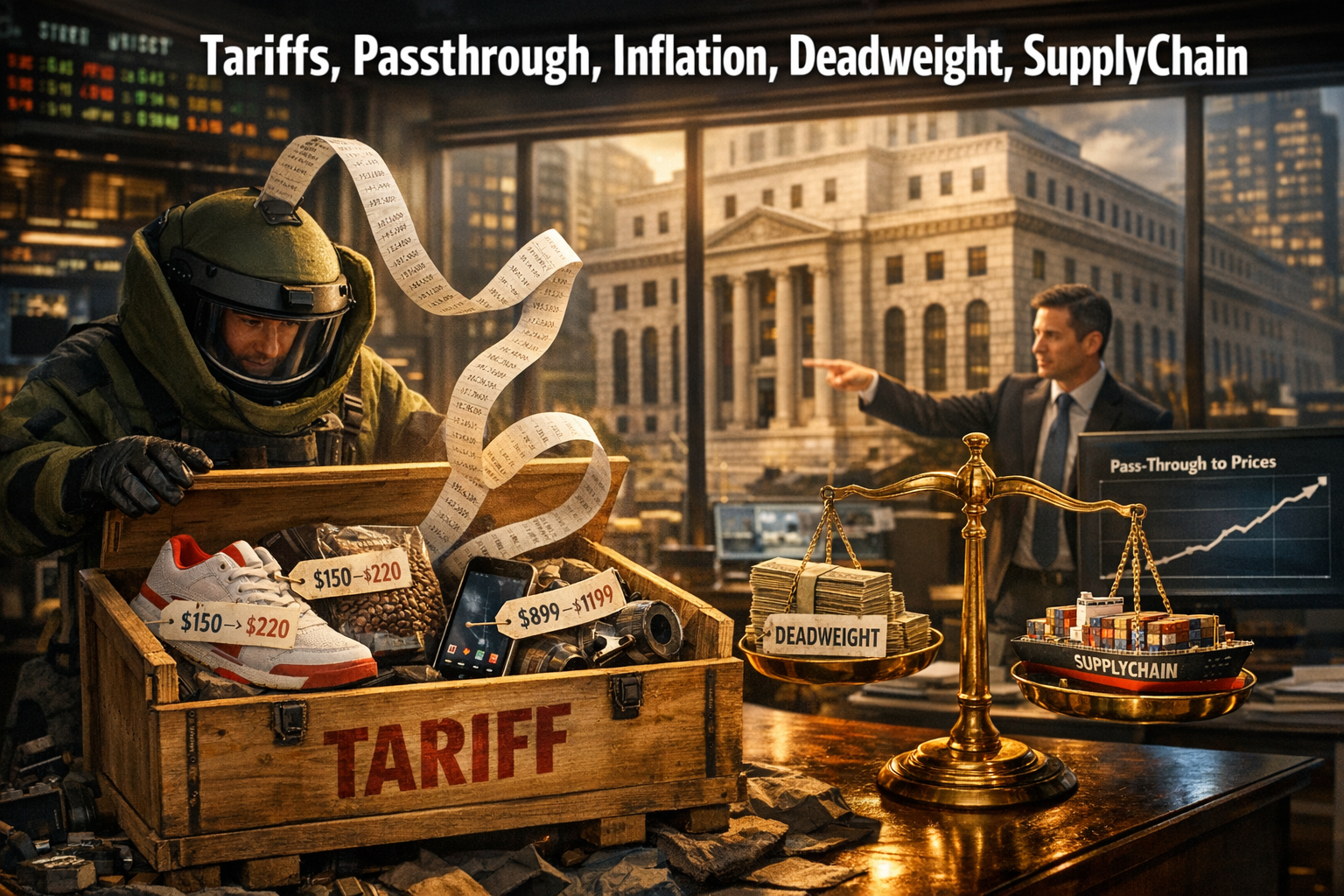
The report analyzed two scenarios that could occur when tariffs are imposed.First, the case where foreign companies lower unit prices for price competitiveness (exporting country burden).Second, the case where foreign companies maintain unit prices and prices rise by the amount of the tariff (importing country burden).Surprisingly, the results appeared to be close to 100% the second scenario, or ‘Scenario B.’Companies exporting to the US, including China, did not lower their export unit prices at all even when tariffs were imposed.Ultimately, the costs increased by the tariff rate were primarily shouldered by importers within the US, and this was reflected directly in final consumer prices through wholesale and retail margins.This is exactly the ‘Complete Passthrough’ phenomenon spoken of in economics, and the cost was entirely the share of US companies and households.
2. The Reality of the ‘Invisible Tax’ That Robbed Your Wallet
The most painful part of this analysis is that tariffs effectively functioned as a ‘Consumption Tax.’When we buy goods at the mart or purchase home appliances, we were unknowingly paying more taxes.Directly, prices of imported consumer goods such as clothing, electronics, and furniture rose exactly in proportion to the tariff rate.
What is scarier is the indirect cost.Production costs for US manufacturers using imported raw materials like steel or aluminum skyrocketed.This triggered price hikes in automobiles, construction materials, etc., and resulted in aggravating overall inflation pressure.Also, an interesting phenomenon called the ‘paradox of reduced competition’ was discovered.As prices of imported goods rose, competing US domestic producers realized, “Oh? We can raise our prices a bit too?” and gained ‘room to raise prices.’Ultimately, tariffs caused the prices of not only imported goods but also domestic substitutes to rise together, dealing a blow of high prices to the overall US economy.
3. Global Supply Chain Restructuring, Was the Loss Greater than the Gain?
The Trump administration’s tariff policy was ostensibly intended to return global supply chains to the US (Reshoring) or move them to friendly nations (Friend-shoring).However, the report points out that the effects of this supply chain restructuring were very limited.Of course, it is true that some factories moved from China to Vietnam or Mexico.However, in this process, logistics costs increased and production efficiency declined, which also became a factor in product price increases.
The goal of reviving US manufacturing was also not achieved.Evidence that tariff barriers significantly increased US manufacturing employment was scarce.Rather, as the competitiveness of US companies weakened due to rising raw material prices, the fact that there were sectors where employment actually shrank suggests a lot.Ultimately, the change in trade policy failed to lead to substantial strengthening of industrial competitiveness and ended up only increasing costs.
4. [In-depth Analysis] ‘Deadweight Loss’ Not Mentioned in the News and Future Costs
While most media focus only on price increases, in my view, the real core point of this report is ‘Deadweight Loss.’This is a concept that shows the extreme of economic inefficiency.Consumers had to reduce consumption due to higher prices, and companies had to choose expensive second-best options instead of optimized global sourcing.In this process, it was proven that the magnitude of economic utility (welfare) lost by consumers and companies was much larger than the tariff revenue gained by the government.
I will reinterpret this by connecting it to my area of expertise, AI Trend.The core point of AI and the 4th Industrial Revolution is high-performance hardware and data centers.These advanced industries rely deeply on global supply chains, and cost increases due to tariffs increase AI infrastructure construction costs.In other words, beyond simple price increases, it can slow down the speed of future technological innovation and result in eating away at the R&D capacity of related companies.Like the economic adage “There is no such thing as a free lunch,” as of 2026, the US is simultaneously holding a bill for high prices and increased innovation costs.
< Summary >
- Complete Passthrough Confirmed: According to the New York Fed report, nearly 100% of tariff costs were borne by US companies and consumers, not the exporting countries.
- Main Culprit of Price Hikes: It acted as a ‘Consumption Tax,’ causing price increases in imported goods as well as domestic substitutes.
- Inefficiency of Supply Chains: Production base relocation resulted in increased logistics costs and reduced efficiency, and the effect of increasing manufacturing employment was minimal.
- Deadweight Loss Occurred: It was proven to be an inefficient policy where the private sector’s loss of economic utility was greater than the government’s tariff revenue.
- Hindering Future Innovation: This cost-increasing structure raises the cost of building advanced technology infrastructure such as AI, raising concerns about weakening long-term competitiveness.
[Related Posts…]The Betrayal of US Tariff Policy and the Correlation with Consumer PricesChanges in the AI Hardware Market Brought by Global Supply Chain Restructuring
*Source: https://www.reuters.com/world/us/ny-fed-report-says-americans-pay-almost-all-trumps-tariffs-2026-02-12/