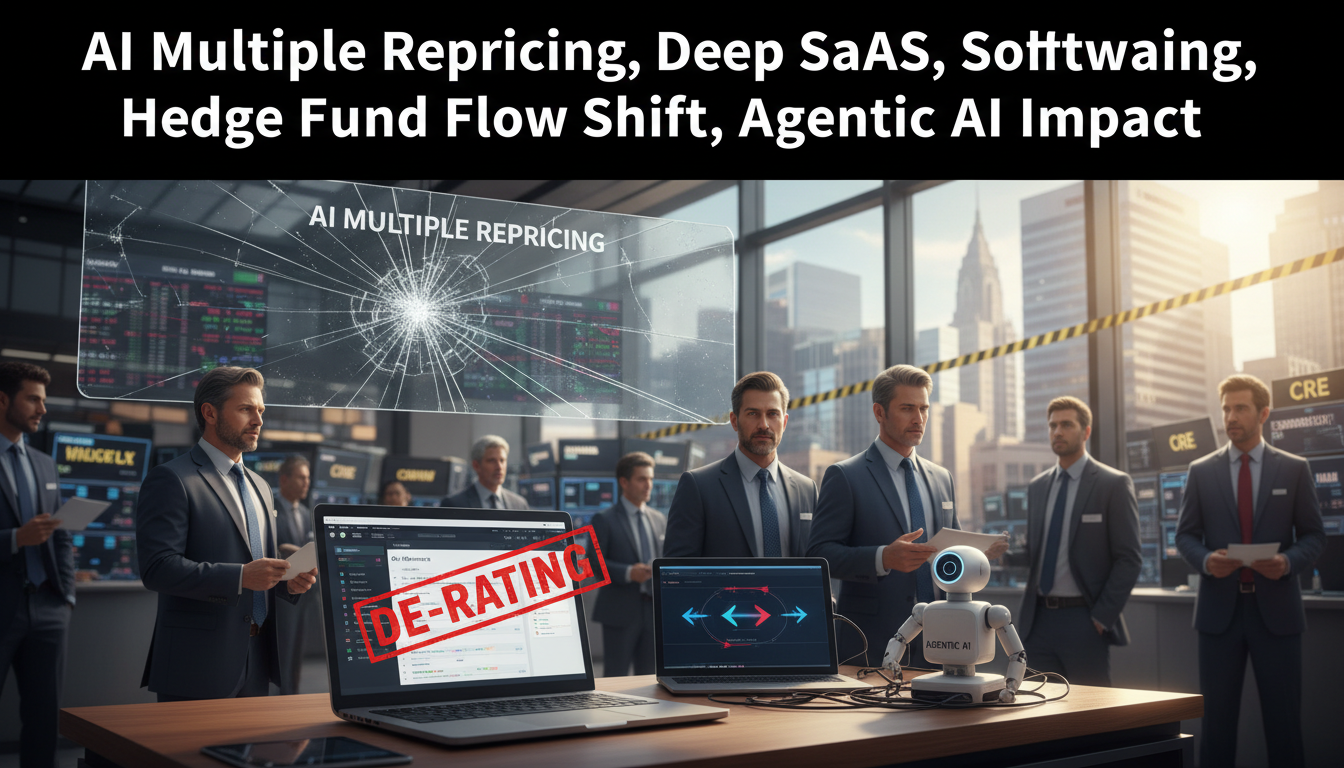
● AI Panic Sparks Marketwide Derating, Software Logistics Real Estate Finance Slammed, Deep SaaS Survivors Emerge
AI fear is spreading beyond the “bubble controversy” into an “industry-wide derating (value markdown)”: why software, logistics, real estate, and finance are getting hit all at once—and where opportunities open up
In today’s post, I organized everything below in one place.
1) Why the AI narrative suddenly flipped from “good news” to “bad news” (focused on market mechanics).
2) The structural reasons behind the chain-reaction selloff across Unity, SaaS, logistics, commercial real estate, and fintech.
3) The “overreaction” in stock prices created by changes in short-selling/hedge-fund positioning.
4) A checklist for separating resilient software (deep SaaS) from shaky SaaS—even in this environment.
5) A separate整理 of the “truly important points (core risks/core opportunities)” that YouTube/news often fails to cover.
1) News briefing: “AI goes from hero to fear” — mood flips fast
Key takeaway
Just a year ago, merely saying “we’re doing AI” could trigger a rerating (value reappraisal). Now it’s the opposite: the moment a story attaches “AI will replace the existing business,” derating often comes first regardless of earnings.
Starting point of the shift in market sentiment
At first it was “Is Big Tech AI CAPEX (capital expenditure) too excessive?”—the AI bubble/overinvestment debate, which was a reasonably rational concern.
But recently, fear has spread into “overgeneralization.”
In other words, whenever a specific AI demo/benchmark appears, the market starts hitting the entire related listed industry as a single bundle.
2) Trigger of the fear: the narrative that “agents can replace SaaS”
Logic presented in the original source
As agent-style AI like Claude released benchmarks showing it can “work continuously for hours without stopping,” the idea grew that maybe existing software—especially coding/office/analytics tools—is no longer necessary.
Why the market reacts especially sensitively (economic mechanism)
When the narrative says the production cost of knowledge work “approaches zero,” the market immediately imagines price collapse (deflation).
Then SaaS valuations get re-rated not by “growth rate” but by “pricing power and lock-in.”
Point
Coding/analytics/document work has fast adoption and fast perceived substitution, so investors tend to derate it first.
3) What actually happened: game engines → chain selloff across game ads/tools
Event flow (based on the original examples)
A demo like “Genie 3” appears, where generative AI can create real-time games.
→ The next day, traditional toolchains like Unity (game engine) plunge.
→ It spreads into “Is everything game-related risky?”
→ Even with strong earnings, anything in the same sector/value chain gets hit together (e.g., game advertising/middleware), creating a chain reaction.
What matters here is the speed of position unwinds, more than “substitutability”
Separate from whether AI can fully replace Unity soon, the market cuts the multiple first as long as the “could be replaced” label sticks.
In this phase, narrative can dominate earnings (earnings reports).
4) Even scarier spillover: logistics, real estate, and finance under a “if it’s AI, everything dies” frame
Logistics: a startup platform triggers a one-day collapse in a large-cap
The original source cites an extreme reaction like “a company that used to sell karaoke machines (a startup) launches a logistics platform, and a major logistics company drops -24% intraday.”
This is less about technical superiority and more a signal that the market is starting to price in a structural breakdown of “distribution/intermediation fee models.”
Commercial real estate: “white-collar substitution” → “office demand collapse”
If AI replaces office workers, the need for offices declines.
Using this logic, commercial real estate/REITs/developers can see broad derating together.
This shock gets amplified because already-elevated rates (high rates) overlap with refinancing risk in commercial real estate.
Fintech/finance: fear of automating “intermediation/underwriting/support”
As AI automates loan underwriting, customer support, and internal reporting, concerns spread that existing fintech differentiation may weaken.
Even in regulated industries, “margin compression” can still happen first.
5) The real supply/demand variable: hedge-fund exposure cuts + surge in software short interest
Core point from the original source
The claim is that hedge funds sharply reduced software exposure (e.g., cutting from 7% to 3%), and software short interest is at an all-time high (higher than during COVID).
Why this matters
In a market like this, “good earnings but the stock still falls” can happen.
The reason is simple.
1) If hedge funds/institutions reduce sector exposure, “sector basket selling” often hits before individual fundamentals.
2) Heavy shorting can create a self-reinforcing momentum phase where declines feed more declines.
3) Therefore, short-term price action is driven more by “positioning/supply-demand” than by the actual pace of technological substitution.
6) The winner type you must never lump together: deep SaaS (mission-critical) vs shallow SaaS
Perspective mentioned in the original source (Palantir example)
Software deeply embedded in access control, security certifications, legacy integrations, and organizational operating systems—such as defense/government/core data—is hard for LLMs to replace quickly.
Even if AI can mimic “features,” the “platform as an operating system” is not easily swapped out.
My blog’s “survivability checklist”
If a company meets 3 or more of the 6 items below, it tends to have relatively better defensiveness even in an “AI fear market.”
1) Does it have high barriers from regulation/security/certification (government, defense, financial core, medical data, etc.)?
2) Is it deeply integrated into the customer’s workflow (is switching cost high)?
3) Does it have data network effects beyond simple functionality (the more it’s used, the more performance/accuracy/ROI improves)?
4) Do customers need the platform because of audit/accountability/traceability, not “AI alone is enough”?
5) When AI is added, is upsell/expansion revenue structurally larger than “cannibalization of existing revenue”?
6) Even if model costs fall, does the company have a cost structure (margin defense) where it benefits?
7) One-line reinterpretation of this phase: “AI is not a tech issue; it’s a multiple revaluation event”
Why moves are this extreme
AI is treated not as a simple new product but as a “general-purpose technology” that can reshape price structures across industries.
So the market recalculates “long-term margins/pricing/competitive intensity” before revenue growth rates, and the result shows up as derating.
Macro variables to view together
In a high-rate regime, future cash flows are discounted more heavily, so long-duration growth stocks (especially software) swing more.
In other words, it’s natural to see AI fear as a combination of the tech factor plus the rate environment amplifying volatility.
8) (Important) Only the “true core points” that news/YouTube tends to miss
Key takeaway 1: “Price pressure” is scarier than “replacement”
Most content fixates on “AI will replace your job/industry,” but from an investing standpoint, what’s more lethal is not full replacement—it’s collapse in pricing power.
Even if SaaS survives, the moment it “can’t charge the old price,” the multiple changes.
Key takeaway 2: This may be a “basket liquidation” market, not a “technology evaluation” market
When even strong earnings get hit, it may be less about the individual company and more about positioning play that reduces sector exposure.
In that case, you must watch flow/positioning as much as company analysis.
Key takeaway 3: AI beneficiaries are not only the companies “building AI”
The real beneficiaries can be “adopter companies (users)” that increase revenue or cut costs with AI and reflect it in results.
Companies are strong when earnings calls show “AI-driven productivity gains → shorter lead times → margin expansion” in actual numbers.
Key takeaway 4: “Agents are cheap” is only half true in enterprise buying
Comparisons like $6–$7 per week are compelling, but enterprises ultimately decide based on TCO (total cost of ownership) including security, auditability, liability, and data governance.
In other words, “cheap AI” does not necessarily mean “cheap operations,” and that gap can persist for quite a while.
Key takeaway 5: Long term, the main game is “organizational redesign,” not “headcount replacement”
If a 10-person job can be done by 2, some companies will fire the remaining 8—but the more formidable competitor is the company that redeploys those 8 into new revenue/new products/new markets and scales faster.
So going forward, the gap may widen not by “whether AI is adopted,” but by “how quickly organizations are redesigned around AI.”
9) Investment/industry checkpoints: what to watch from next quarter for “fear to turn into opportunity”
1) Earnings-call keywords
Check whether AI adoption is just talk or proven through KPIs.
Examples: revenue per employee, throughput per customer, CAC/CS costs, churn, upsell mix, operating margin.
2) Product strategy
Is it merely “adding AI features”?
Or has it been redesigned into an “AI-as-default workflow”?
3) Valuation
If derating becomes excessive, entry prices change completely even at the same growth rate.
Especially while global recession concerns remain, companies with “staying power (cash flow)” are more advantaged.
< Summary >
AI is currently less a technology issue and more an event triggering “industry-wide multiple revaluation.”
As the narrative spreads that agent-style AI can undermine SaaS pricing power, chain derating appears not only in software but also in logistics, commercial real estate, and finance.
In this process, flow factors such as hedge-fund exposure cuts and expanded shorting amplify volatility, and some stocks get hit together even when earnings are strong.
However, “deep SaaS (mission-critical)” with strong regulation/security/integration/accountability structures is hard to replace, and companies that prove cost reduction and revenue expansion with AI in numbers can become opportunities even in a fear market.
[Related posts…]
AI investing: is it a bubble now or a structural opportunity—key watchpoints for 2026
High-rate prolongation scenario: impacts on growth-stock valuations and the asset market
*Source: [ 월텍남 – 월스트리트 테크남 ]
– “진짜 믿기지가 않습니다”