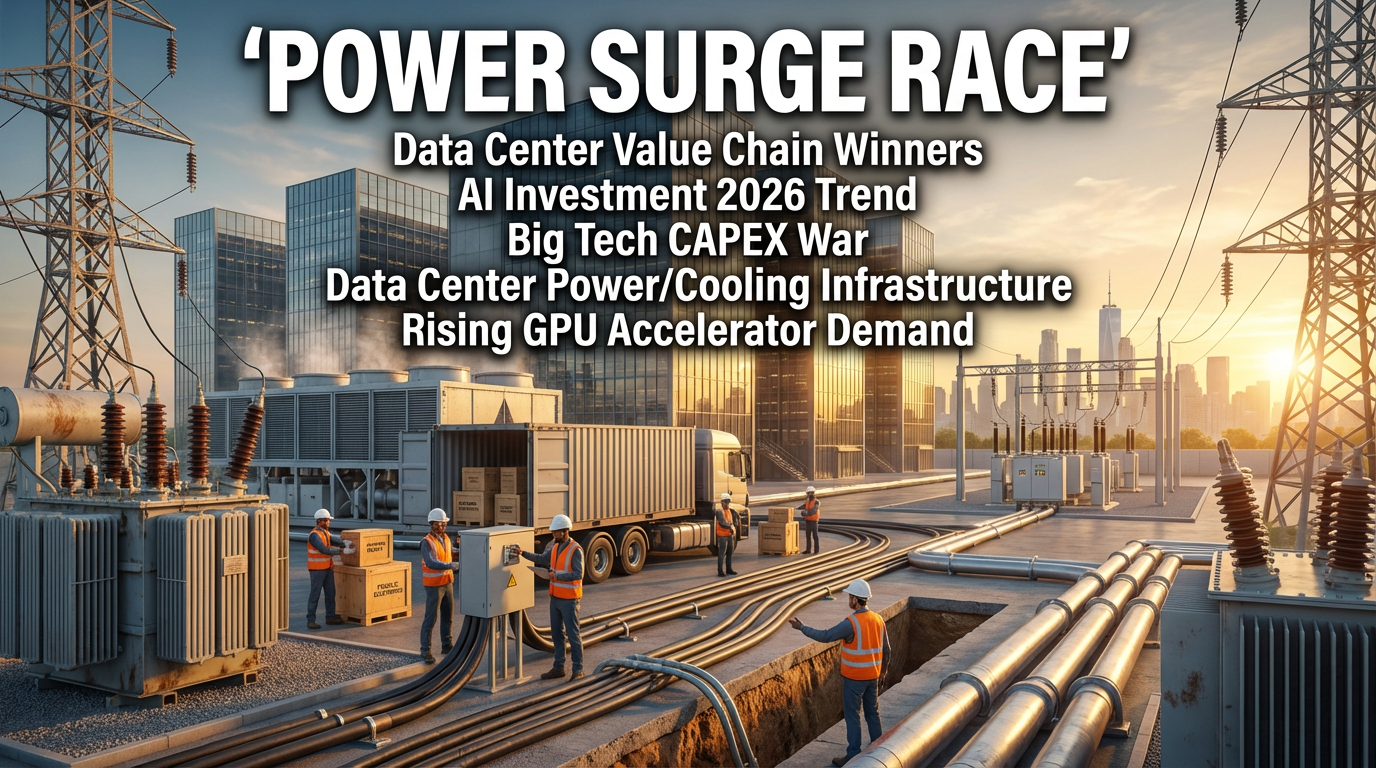
● Big Tech AI Spending Tsunami Triggers Data Center Power Grid War
Where the “KRW 1,000 Trillion” AI Money Pours In 2026: In the Big Tech CAPEX War, the Ultimate Winner Is the Data Center Value Chain
Today’s post contains exactly four things.
First, a value-chain map that organizes “exactly where” Big Tech AI investment money (USD 700–900 billion per year) flows in 2026.
Second, why Amazon, Google, Meta, and Microsoft are “collectively” beating Wall Street expectations, and how this connects to the macro economy (rates, inflation, recession risk).
Third, a logical dissection of the contradiction: “AI investment is exploding, so why are software stocks wobbling?”
Fourth, the core point others rarely cover in news/YouTube: the bottleneck in this war is “power, cooling, and the grid,” so the true long-term beneficiaries are not only GPUs.
1) News Briefing: In 2026, Big Tech AI Investment Hits 1,000 Trillion—The Problem Is Not “Scale,” but “Speed”
Key Takeaway Headlines
Six Big Tech companies are signaling roughly USD 700 billion per year (up to USD 900 billion) in CAPEX in 2026, centered on AI infrastructure and data centers.
Comparable to South Korea’s GDP (roughly KRW 1,700 trillion), meaning “capital spending by just a handful of companies” is approaching the scale of a national economy.
Why this shocked Wall Street
It’s not just that the scale is huge—the scarier part is that the “year-over-year growth rate has steepened again.”
Normally, as CAPEX gets larger, the growth rate slows down—but right now it’s moving in the opposite direction.
This implies one of two things.
1) AI is starting to generate real monetization (ROI).
2) Or it has become a survival game, shifting into “if you don’t do it, you die” mode.
In reality, 1) and 2) are usually happening at the same time.
2) Company-by-Company Points: Don’t Look at “Who Spends Money,” Look at “Where the Money Leaks”
Based on the original flow, I’ll summarize only the points the market focused on—like a news brief.
2-1) Amazon (AMZN): Beats Wall Street Expectations, Short-Term Stock Pressure… But “Infrastructure Dominance” Is at Stake
The investment 규모 is being discussed at around USD 200 billion, far above Wall Street’s expectation (USD 140 billion).
The year-over-year growth rate is also high, which fueled a short-term selling thesis of “isn’t this too excessive?”, and a narrative that the stock actually wobbled right after the announcement.
However, Amazon structurally has two engines that can absorb AI costs: “AWS cash-generation power” and “retail logistics automation.”
In other words, failure would be painful—but success could make it an even bigger “infrastructure landlord of the AI era.”
2-2) Alphabet (Google): Top-Tier Growth Rate, Reality Is Outrunning Analyst Models
Figures like a 97% year-over-year increase symbolize one thing.
“Demand forecasting keeps being wrong.”
This isn’t mere optimism; it stems from a structure where generative AI/agent usage pushes up both service traffic and compute demand at the same time.
Google, in particular, has many “distribution channels”—Search, YouTube, Workspace, Android—so model performance improvements can more easily translate directly into explosive usage growth.
2-3) Microsoft (MSFT): The Speed of “Building Data Centers Directly” Is the Main Watch Point
Messages like adding 1GW of data center capacity within a quarter are interpreted by the market like this:
“Cloud is no longer a software industry; it’s a power, real estate, and equipment industry.”
Also, the OpenAI competitive landscape (Anthropic, Google, etc.) is mentioned as a short-term burden for Microsoft, but Microsoft’s essence isn’t being No.1 in models—it’s “enterprise customer lock-in.”
However, if Microsoft falls behind in the model race, Azure’s premium pricing power could weaken, which is a risk investors need to monitor.
2-4) Meta (META): One of the Few Big Tech Firms “Already Making Money with AI,” So CAPEX Gets Even Bolder
Meta has already been monetizing AI through ad recommendation/targeting optimization, so repeated beats versus expectations occur.
That means Meta’s CAPEX is closer to “scaling” than “hope.”
The important part here is that while Meta expands the ecosystem with an open-source (Llama) strategy, internally it builds ultra-large infrastructure to lower “training/inference unit costs.”
2-5) Apple (AAPL): It’s Not “Not Investing,” It May Also Be “Making It Less Visible”
The original text highlighted Apple’s relative quietness as a point.
Two interpretations coexist.
1) It is genuinely conservative (on-device focus, limited large-scale data center CAPEX).
2) Costs are distributed through supply chain/partners, executed in forms that “don’t look like CAPEX.”
Apple is more likely to frame AI as “device experience” than “cloud competition,” and in that case, money may shift toward other hardware like NPU/memory/packaging rather than GPU rentals.
3) Why the Conclusion Moves Not to “Big Tech Stocks,” but to the “Data Center Value Chain”
The conclusion in the original text is the core point.
Buying Big Tech is one approach, but more direct beneficiaries emerge across the data center value chain overall.
3-1) A Map of Where the 2026 Money Flows (by Value Chain)
① Compute: GPUs/Accelerators, CPUs, Memory
As AI inference fully ramps up, there’s a strong possibility that “inference becomes a bigger market than training.”
Then compute equipment runs longer and more intensively, and replacement cycles speed up.
② Network: Switches/Optical Modules/Interconnects
The phrase that comes up most often in AI infrastructure these days is: “Even if you buy GPUs, if the network is the bottleneck, it’s over.”
As cluster 규모 grows, networking becomes not an option but survival equipment.
③ Power: Transformers/Distribution/UPS/Generation/Grid
Data centers are now “electricity-eating factories.”
If power infrastructure doesn’t expand, you can buy more GPUs and still not run them.
This is highly likely to become the most persistent long-term bottleneck.
④ Cooling: From Air to Liquid to Immersion, Heat Is Cost
As we move toward high-density racks, cooling shifts from being a performance issue to an “operating cost (OPEX) and uptime” issue.
If electricity prices rise (inflation/energy prices), cooling-efficiency companies may be re-rated.
⑤ Data Center Physical Assets: Land/Construction/REITs/Operations
It looks like tech stocks right now, but in reality it is taking on a stronger character of a real estate/infrastructure industry.
⑥ Cloud Upper Layer (Neo-cloud/Platforms/Management Software)
However, this segment is prone to valuation overheating, so you must separate “a good company” from “an expensive stock.”
4) “AI Investment Is Surging, So Why Is Software Shaky?” Solving the Contradiction Reveals the Next Cycle
This is the point the market is most confused about these days.
4-1) Exploding AI CAPEX = Fear for Existing SaaS (Displacement Risk)
If AI agents start eating CRM, customer support, automation, design, and document work, existing SaaS pricing breaks.
So software stocks can get pressured at the same time.
4-2) But the More AI Replaces SaaS, the More Hardware/Infrastructure Is Needed
The truly important logic here is this:
“Software that replaces labor ultimately becomes software that consumes compute.”
In other words, as AI agents grow, GPUs, memory, networks, power, and data centers become more necessary.
4-3) That’s Why Opportunities Appear When the Market Swings Illogically
When fear becomes extreme, there are periods where not only software but even hardware gets hit together.
But if demand doesn’t break, that decline can ultimately become a “re-entry zone into the value chain.”
5) (Important) The “Real Core Point” That Is Relatively Underdiscussed Elsewhere
Core Point 1: The 2026 AI War’s Bottleneck Is Shifting from GPUs to “Power/Grid/Permitting”
GPUs can be increased if you have money, but power expansion and grid interconnection require time and regulation.
As a result, the larger CAPEX becomes, the more likely “power infrastructure companies” will capture the steadiest benefits.
Core Point 2: As CAPEX Grows, the Winner Becomes Not “Model Performance,” but “Unit-Cost Stamina”
AI’s performance race won’t end, but in the long run, the side that wins on electricity prices, cooling, uptime, and operational automation captures the margin.
In other words, tech news looks only at models, but an investment perspective must look at the “cost structure.”
Core Point 3: The Macro Environment (Rates, Inflation) Is the Real Variable That Shakes AI Stocks
Because AI investment is mostly a long payback structure, valuations are sensitive to rate movements.
If recession fears grow, it becomes easy for a “CAPEX overspending” frame to stick in the short term.
Still, rather than the investment itself breaking, the “announce → raise guidance → raise again” pattern is likely to repeat, which is the original text’s view.
Core Point 4: The Fixed Idea That “Cloud = Software Industry” Is Breaking
Now the cloud is taking on the characteristics of a classic capex-heavy industry (infrastructure) more strongly.
So even in a recession phase, “essential infrastructure” can gain defensiveness, while SaaS with ambiguous unit economics can face pressure.
6) The 2026–2030 Scenario: If AI Agents Eat Revenue, the Economic Structure Changes
Forecasts mentioned in the original text like “by 2030, AI agents account for 60% of revenue” may look extreme, but the direction itself is quite persuasive.
Because AI agents don’t just replace a single SaaS product—they begin to replace human time directly.
Once we reach this stage, companies have no choice but to adopt AI to change their cost structures, and as a result, infrastructure investment can jump once more.
If this trend continues, it also creates important changes in global economic 전망.
Productivity gains (deflationary pressure) versus increased demand for power/capital goods (inflationary pressure) can appear simultaneously.
That is, rather than assuming inflation simply fades, it’s more likely we enter a regime where inflation “splits by category.”
< Summary >
The scale of Big Tech’s AI investment in 2026 is USD 700–900 billion per year, on the order of “KRW 1,000 trillion.”
The core point is the pace of growth rather than the scale, signaling that AI is being monetized or that survival competition has intensified.
Investment funds flow more directly into the data center value chain (compute, network, power, cooling, physical infrastructure) than into Big Tech stocks themselves.
The more AI replaces SaaS, the more demand rises for hardware and power infrastructure.
The true bottleneck that is discussed less elsewhere is not GPUs but power/grid/permitting, and the long-term outcome is determined by cost (unit-cost) stamina.
[Related Posts…]
- Latest Summary of AI Investment Trends: Why Data Centers and Power Infrastructure Are the Real Beneficiaries
- Complete Guide to the Data Center Value Chain: Where the Money Flows After GPUs
*Source: [ 월텍남 – 월스트리트 테크남 ]
– 26년 1000조는 “이 곳”으로 몰린다