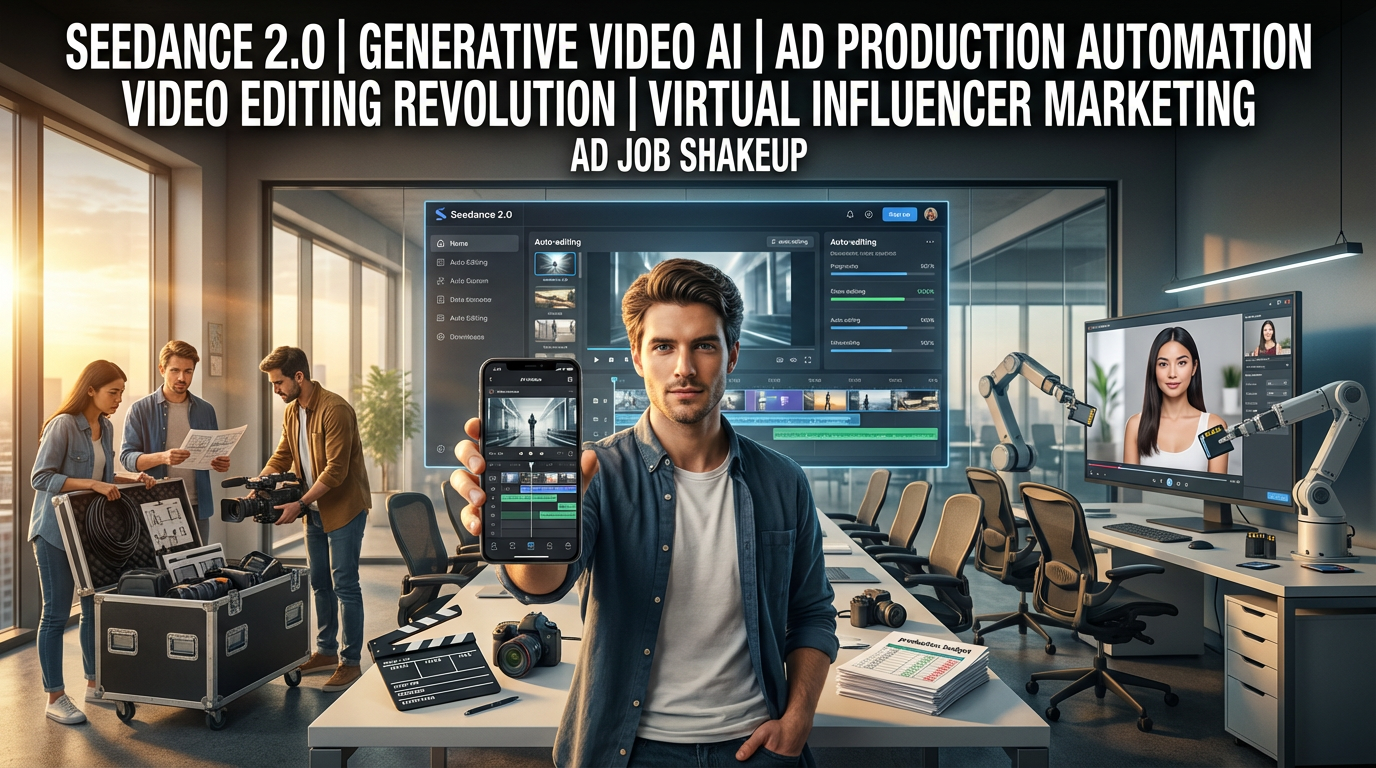
● Seedance 2-0 Sparks Video Quality Revolution Shaking Jobs Ads Content
China’s “Seedance 2.0” Craze Ends Here in One Post: Why the “Video Quality Revolution” Is Shaking Jobs, Advertising, and the Content Industry All at Once + The Truly Important Hidden Points
Generative AI has now moved beyond “making videos from text” into a stage where it implements camera work, editing rhythm, and audio sync using true “cinematic grammar.”
In this post, I’ll organize: ① why people say Seedance 2.0 practically crushes competing models (Kling 3.0, Sora, VEO, etc.) in real-world feel, ② how the advertising/music video/animation industry structure will change, ③ how realistic the “18-minute rumor (Seedance 3.0)” is and how far it can actually go, ④ survival strategies Korean companies/creators should prepare right now, ⑤ and the “most important variable” that other news/YouTube rarely points out.
1) [Breaking-news style summary] What is Seedance 2.0, and why is it causing such an uproar?
Key takeaway in one line: It’s being talked about as a model that makes you feel “video generation AI is no longer creating just a ‘scene,’ but creating ‘direction.’”
The original source emphasizes the following three points.
- Motion quality: People say character/camera movement is far more natural, with “film-like inertia” that feels alive.
- Prompt-following performance: It’s claimed to respond well not only to video prompts (scene instructions) but also to audio prompts (music/sound requirements).
- Audio-visual sync: There’s talk that instrument-playing hand motions, vocal timing, and cut-transition rhythm align with the music at a convincing level.
In the end, the core point is that the felt experience is shifting away from “you can tell it’s AI when you watch it” toward “if you don’t tell me, I’d believe it’s a film/ad.”
2) [Benchmark/comparison points] Why are people talking about a “felt advantage” over Kling 3.0, Sora, and VEO?
If you regroup the comparison axes mentioned in the original source from a “practical use” standpoint, they boil down to five points.
- Naturalness of cut editing (transitions): More than “one scene looks pretty,” what determines perceived quality is how little awkwardness there is when cuts change and how smoothly the flow connects.
- Camera work: If the feel of tracking/pan/tilt/handheld comes through, “photorealism” jumps sharply.
- High-difficulty sequences like action/chases: If physics, blocking, or sense of speed breaks, it’s immediately obvious, and it’s claimed the gap feels large here.
- Audio linkage (music-video style): If cut changes match the beat and the sync in vocal sections holds, it looks like “an edited video.”
- Consistency (character/prop persistence): A feature that maintains style/person consistency based on multiple photos (up to around 9 images mentioned) is critically important in real work.
What matters here isn’t the “spec sheet,” but how much the editing burden felt by practitioners actually drops.
In other words, if the output is good, you do less editing, less retouching, and less reshooting—and that flips the cost structure.
3) [Industry impact] Why does “models might become unnecessary” shake the advertising market?
The sharpest part of the original source is actually this point.
What’s scary about models like Seedance 2.0 isn’t “because the video looks pretty,” but because it removes bottlenecks in ad production.
- Reduced dependence on filming (studio/equipment/crew): If filming decreases, production lead times shorten.
- Changing dependence on models/influencers: As “virtual influencers” become more natural, brands can reduce risk (scandals, scheduling, costs).
- Explosion of A/B testing: With the same product, it becomes possible to generate dozens to hundreds of variations in cuts, copy, and direction, taking performance marketing to the next level.
This change isn’t a simple trend; it’s moving toward changing the ROI equation of the advertising industry itself.
And in the process, companies’ digital transformation will inevitably accelerate as well.
4) [Content/animation industry] If “put in a comic and turn it into an anime” becomes real, who gets shaken first?
The original source mentions a case like “turn a manga like Jujutsu Kaisen into an animation.”
The impact here has two sides.
- If pre-production (storyboards/roughs/tests) is automated, studios will play a different game in “planning speed.”
- If low-budget animation/short-form explodes, it immediately runs into unit-price competition with existing production methods (labor-centric).
However, rather than “full replacement,” it will likely spread first as an assistive tool due to copyright/style/quality-control constraints, and then gradually become the main approach.
5) [Rumor check] The Seedance 3.0 “18 minutes” talk—why is everyone skeptical?
The original source mentions rumors like “not a 15-second limit, but up to 18 minutes,” and references a “narrative memory chain,” while also arguing that drift (collapse of character consistency) will occur due to context limits.
That perspective is quite reasonable.
- The hardest part at long runtimes isn’t image quality, but “identity maintenance”: The first thing to blow up is faces/clothing/props/spaces wobbling across scenes.
- Scene-level generation vs narrative-level generation: The difficulty changes completely depending on whether 18 minutes means “one-shot generation” or “automatically connecting many small chunks.”
- Price-cut rumors: If pricing drops, mass adoption accelerates, but platform regulation/copyright conflicts also grow accordingly.
Personally, I think what matters more than “18 minutes” itself is the moment when usable narrative content of 1–3 minutes can be generated stably.
Once that range is crossed, ads, music videos, and brand films are already more than enough to be overturned.
6) [Macroeconomic viewpoint] Why does this connect directly to jobs/wages/productivity?
This kind of generative video AI isn’t a “new tool”; it’s a technology that changes the content production function itself.
So from a macro perspective, the following flow emerges.
- Productivity surges: The same headcount can produce more concepts faster.
- Unit-price decline: As supply (video content) increases, the “average unit price” is likely to fall.
- Employment reshuffle: Some filming/editing roles shrink, while demand may grow for prompt design, creative direction, brand strategy, and legal/copyright review.
- Strengthening of platform-centered revenue structures: If tools/models/cloud providers control the top of the ecosystem, creators become more “platform-dependent.”
This flow ultimately means that AI investment will hit first in industries where it connects directly not to “R&D,” but to “cost reduction + growth.”
7) [AI trend] A practical checklist of what companies/individuals should do right now
- Brands should shift part of the “shooting budget” to a “generation budget”
Even starting next quarter, you need to lock in test campaigns to get ahead on the learning curve. - Creators should reposition from “production” to “direction/narrative/character”
The better the tools get, the more the difference comes from planning. - Build a legal/copyright check process in advance
Especially for manga-to-anime or live-action-ad-style generations, IP/publicity issues attach immediately. - Data/asset management
For brands, product shots, logos, packaging, and tone-and-manner guides become “assets for model training/reference.” - Diversify overseas platform risk
The higher the dependence on Chinese/U.S. models, the more you’re affected by policy changes (sanctions/export controls/regulation).
This isn’t a short-term fad; in a phase of global economic downturn, companies may adopt it even faster due to cost-efficiency pressure.
8) The “truly important points” other news/YouTube don’t talk about much (only the essentials)
- ① The game-changer is “repeatable productivity,” not “quality”
The model that wins the market is not the one that produces one blockbuster video, but the one that reliably produces 100 pieces in a brand’s tone. - ② As audio-video sync improves, “music video/ad editors” lose time first
The moment editing shrinks, the unit-price structure changes immediately. This is where job impact will be felt the fastest. - ③ Even if “virtual influencers” increase, what determines ad performance is ultimately trust (reviews/evidence/retail data)
The more real the face looks, the more consumers demand “proof.” So commerce data/review design becomes more important. - ④ The 18-minute rumor isn’t what matters; the tipping point is when “1 minute of narrative + product info” stabilizes
From this point, companies start moving budgets in earnest. - ⑤ Platform/national risk grows
The stronger Chinese models become, the more companies need a multi-vendor strategy due to data/policy risk.
9) A “keyword map” from an SEO viewpoint (naturally integrated into the flow)
This issue ultimately connects to how generative AI boosts video/advertising productivity, accelerates corporate digital transformation, stimulates industry-wide AI investment, and, in the long run, ties into global supply chains and platform-dependence risk.
And this cost-reduction pressure is likely to spread faster as concerns about a global economic downturn grow.
< Summary >
Seedance 2.0 is being discussed as a model that delivers a perceived breakthrough by automating not just video generation but “direction” as well—camera work, editing, and audio sync.
This shift reduces production bottlenecks in advertising/music videos/animation, reshaping unit pricing and employment structures, and is likely to push corporate AI investment and digital transformation even faster.
The Seedance 3.0 18-minute rumor may be exaggerated, but the market is already overturned the moment stable 1–3 minute narrative generation is achieved.
The real battleground is not “one-time quality,” but “repeatable productivity” and “copyright/policy risk response.”
[Related posts…]
- How Generative AI Reshapes the Content Business: Rebuilding Advertising and Commerce Revenue Models
- Accelerating Digital Transformation: Cost-Structure Innovation Built First by AI-Adopting Companies
*Source: [ 월텍남 – 월스트리트 테크남 ]
– 이제 일자리 “전멸”입니다..선넘은 AI 시댄스2.0 출현 ㄷㄷ..