● AI Crushes B2B SaaS, Last-Mile Moats Win
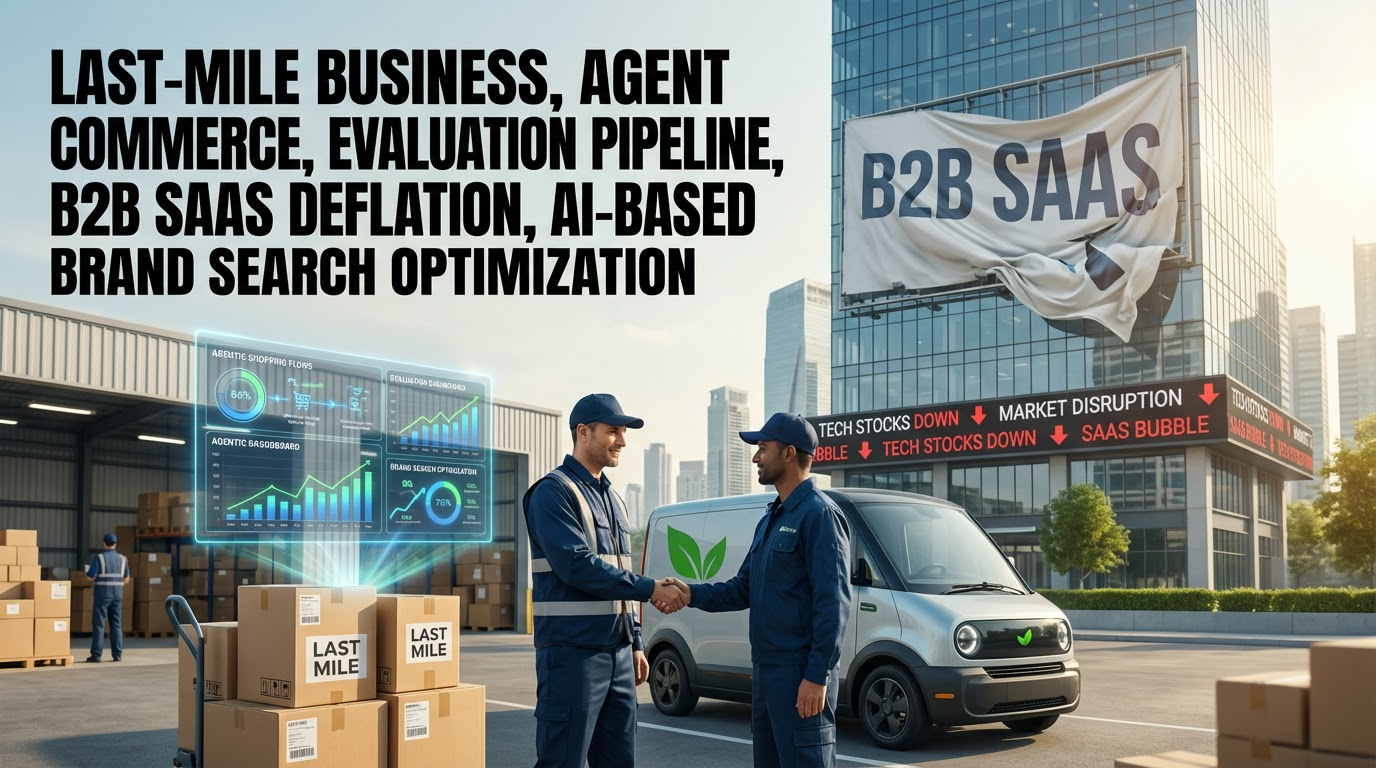
Will B2B SaaS Really “Disappear”? A 2026 Perspective on CEO Noh Jung-seok’s Claim: “The Only Business Opportunity = The Last Mile”
Today’s content can be summarized in one line.
“Because of AI, the B2B SaaS formula collapses, and the only business opportunities left belong to teams that own the ‘last mile’ (on-the-ground operations + data + experimentation pipeline).”
This article specifically bundles the following points.
1) The structural reasons subscription-based B2B SaaS increasingly converges toward “zero price”
2) The era of “invoked brands”: why AI search optimization and agentic commerce change the revenue formula
3) What the “last mile” actually is that remains until the very end even if AI does everything (data/process/organization/experimentation)
4) A map of promising business opportunities from this year to 2026: not what to build, but “which pipeline to monopolize”
5) A core point others rarely articulate: what “only companies where the CEO does hands-on work get stronger” really means
1) News Briefing: What “The B2B SaaS Formula Doesn’t Work Anymore Because of AI” Means
The “B2B SaaS formula” CEO Noh Jung-seok referred to follows this pattern.
Problem definition → package features into software → monthly subscription billing → customer lock-in → expansion (scale).
But the reason this formula gets shaken once AI enters is simple.
Because “features” are no longer scarce.
In the past, implementing features (engineering capability) itself was a barrier to entry,
but now customers also use AI to build a “rough 80%” solution themselves.
Then SaaS unit prices and margins keep dropping, and the product gets treated like a “component,” not a product.
The key takeaway here is that this is not a short-term trend like an economic slowdown or an investment pullback,
but structural deflation (software price decline) created by AI diffusion.
As this intersects with what the tech industry calls the productivity revolution, it changes corporate cost structures themselves.
2) “Only Invoked Brands Survive”: Rule Changes in AI Search and Commerce
There is one underlying premise in the original content.
Now it is not “impressions” but “invocation” that dominates the purchase journey.
The old funnel looked like this.
Ad impression → click → landing page → cart → payment.
But when AI agents shop on behalf of users in agentic commerce, the flow changes.
User question (skin/type/preferences/budget/situation) → AI shortlists candidates → recommends/compares/executes purchase.
In other words, from a brand’s perspective, relying only on Meta/Google performance ad optimization becomes increasingly disadvantageous.
Because AI will invoke more often the brands that possess “recommendable evidence (data/reviews/ingredients/wear results/return rates/customer context).”
This trend is likely to strengthen through 2026.
Because search market restructuring, declining ad efficiency, and reduced consumer comparison costs will happen simultaneously.
3) The B.Factory Case Shows the Essence: A Shift from “Product Selling” to “Service Business”
The changes CEO Noh Jung-seok described in Ameli (color cosmetics) and Keep (skincare) are not simply “adding AI.”
They sell color cosmetics, but in essence they are moving toward selling a service called “context and style.”
Here, AI’s role can be summarized into three parts.
First, collect customer preferences/situations through dialogue (consultation bot/consulting UX).
Second, boost conversion via simulation/recommendation (reduce the hesitation zone before purchase).
Third, as data accumulates through the process, a moat (defensibility) is created.
This is a classic virtuous cycle of “data-service-product,”
and it is closer to a cash-flow stabilizer that resilient brands build even in downturns.
4) If AI Eats Even the Domain, What’s Left? Answer: The “Last Mile”
CEO Noh Jung-seok’s conclusion was this.
“Even the domain gets eaten by frontier models. Only the last mile remains.”
Here, the last mile is not simply logistics like delivery,
but the final integration zone that AI cannot easily do with a single click.
The elements that typically make up the last mile are like these.
– Real operational data (field data mixes structured/unstructured data, and quality is uneven)
– Work processes (friction arises at the junctions connecting people/systems/external partners)
– Accountability and risk (real-world issues like refunds, quality, regulation, CS, production, inventory)
– Organizational judgment (the sense to decide what to discard and what to keep)
That is why people say the approach “sell the last mile as SaaS” does not work well.
Because each company’s last mile is different, it fits poorly as a standardized product,
and it often turns into consulting or falls into a customization swamp.
5) (Key Takeaway) RLVR, and Why an “Evaluation Pipeline” Becomes the Monopoly Right
One of the sharpest sections in the original content is the RLVR (reward-based learning/verifiability) discussion.
Many people only watch “how far model performance will go,” but
CEO Noh Jung-seok sees “the place that can create reward signals is the real opportunity.”
Summarized, it is this.
– In domains where it is easy to verify right/wrong (coding, math), AI takes over quickly.
– In contrast, in domains where verification is difficult, you still have to attach “experimentation.”
– Therefore, the evaluation pipeline that connects bits (models) ↔ atoms (experiments/manufacturing/field operations) becomes the moat.
The example structure like “cloud lab + robotic experimentation + candidate material validation” is
not just software, but a way to complete RLVR by attaching real-world experimental capability.
This perspective is extremely important in AI trends.
In the generative AI era, something often more powerful than “data” is
an experimentation system (feedback loop) that continuously generates data.
6) What “Only People Who Don’t Need a Job Get a Job” Means for the Reshaping of Employment
This line is provocative, but the point is clear.
Thanks to AI, individual productivity explodes, and the number of people who have less reason to “cling” to an organization increases.
Then what kind of people do companies hire?
– People who set goals and push through to the end without being told (willpower/obsession)
– People who can decompose work and recompose it with automation/outsourcing/AI (systems thinking)
These types become more important.
In other words, rather than job-specific skills, an “entrepreneurial attitude” determines job stability,
and this also aligns with the trend of many companies overemphasizing “ownership” in hiring.
7) What “Companies Where the CEO Does Hands-On Work Get Stronger” Really Means
This sentence is not simply “the CEO should suffer.”
The core point is that the communication cost structure has changed.
The cost of coordinating with people (meetings/alignment/persuasion/handoffs) is still expensive.
Meanwhile, the cost of communicating with AI (prompts/agents/automation) keeps getting cheaper.
So if the CEO personally enters the process and confirms that
80% of the work is “transaction processing/moving/organizing,”
and then wipes out that 80% with automation, the company’s body changes.
The remaining 20% becomes the “real value,” and that becomes the last mile.
Companies that can do this protect cash flow while capturing the gains of the productivity revolution,
whereas companies that repeat only the old way (hire more people, buy more tools) only grow their costs.
8) So What Is the “Only Business Opportunity”? (Opportunity Map for 2026)
Reconstructing the original content from a business-opportunity perspective reveals four tracks.
Track A. Invocation-Optimized Brands (Consumer AI Commerce)
Brands that structure “evidence data” so AI can recommend/invoke them will win.
– Revenue is created more by consultation/recommendation/simulation/review data than by the product itself
– Redesigning customer experience (CX) becomes SEO itself (because search becomes conversation)
– The more you reduce dependence on performance ads, the easier it is to defend margins
Track B. Last-Mile Operations Automation (Full Self Management)
Bundle each company’s unique processes into agents to build a “semi-autonomous company.”
– If it is hard to sell as SaaS, a model combining “operations outsourcing + automation” for a specific industry/size is more realistic
– Once finance/inventory/CS/content/marketing reporting are connected in a DB, decision speed changes
Track C. Evaluation Pipeline Monopoly (Evaluation Moat)
A business that creates “right/wrong” in the real world so AI can repeatedly learn/improve.
– A company with feedback loops including manufacturing/experimentation/inspection/quality management/regulatory response
– This is closer to an infrastructure business than a simple app (therefore more defensible)
Track D. “Artist-Type” High-Value Goods (The Opposite Side of a World Where Price Goes to Zero)
As software becomes commoditized, differentiation through emotion/taste/brand/experience becomes premium.
– Like “why Dyson is expensive,” you sell interpretation and experience, not function
– Ultimately, brand and product philosophy may become more important in the AI era
9) The “Most Important Content” Most Other YouTube/News Doesn’t Highlight (Separate Summary)
1) The core point behind B2B SaaS collapsing is not “AI builds features,” but “customers redefine the problem”
In the past, customers demanded “give me this feature,” and SaaS productized it.
Now customers recompose workflows with AI, so “feature-unit purchasing” itself decreases.
When the market definition changes, existing SaaS can lose its “reason to buy” even if the features are good.
2) The moat is not data but the “loop that produces data”
Everyone talks about collecting data.
But the real thing is an “experiment-validation-reward” pipeline that runs automatically.
If you have this loop, learning speed accumulates even during downturns, and you eventually shake off competitors.
3) “The CEO does hands-on work” is not a leadership story, but a story that the cost function has changed
People-management costs stay the same, but AI execution costs drop.
This is closer to a warning that only companies that restructure their organization to match this change will survive.
4) “Take the last mile” ultimately means an “operational invasion” strategy, not M&A or ads
If you can do the final 20% that others cannot do cheaper and faster, the market changes.
This is a battle of execution/on-the-ground understanding/process design, not technology.
10) Execution Checklist: What Should You Look At Right Now
If you are a business owner/leader
– Break down what the “transactional 80%” is in your company’s work within 2 weeks
– Check not where data accumulates, but whether there is a loop where data is “generated”
– Build an “evidence package (structured information)” that AI search/agents would want to recommend
If you are preparing to start a business
– Do not start by thinking “SaaS monthly subscription”; start by designing a structure that takes full responsibility for a specific last mile
– Can you monopolize the verification (evaluation) pipeline? If not, change direction quickly
– What ultimately remains is “will + execution,” so run directly enough to explain your 3-year scenario in words
< Summary >
With AI diffusion, the feature-packaging + subscription-billing formula of B2B SaaS is weakening alongside falling prices.
Going forward, opportunities will concentrate on teams that possess the “last mile,” the final integration zone AI cannot do, and the “evaluation pipeline” that creates reward signals.
Commerce will be dominated not by impressions but by invocation, and CX redesign aligned with AI search optimization and agentic commerce will determine brand survival.
Ultimately, the strongest companies will be those where the CEO automates processes through hands-on work and builds a data-generation loop.
[Related Posts…]
- AI Search Optimization: The Marketing Formula Shifts to “Invoked Brands”
- SaaS Deflation Begins: The Real Reason the Subscription Business Is Shaking
*Source: [ 티타임즈TV ]
– “B2B SaaS는 없어진다. 유일한 사업기회는?” (노정석 비팩토리 대표)