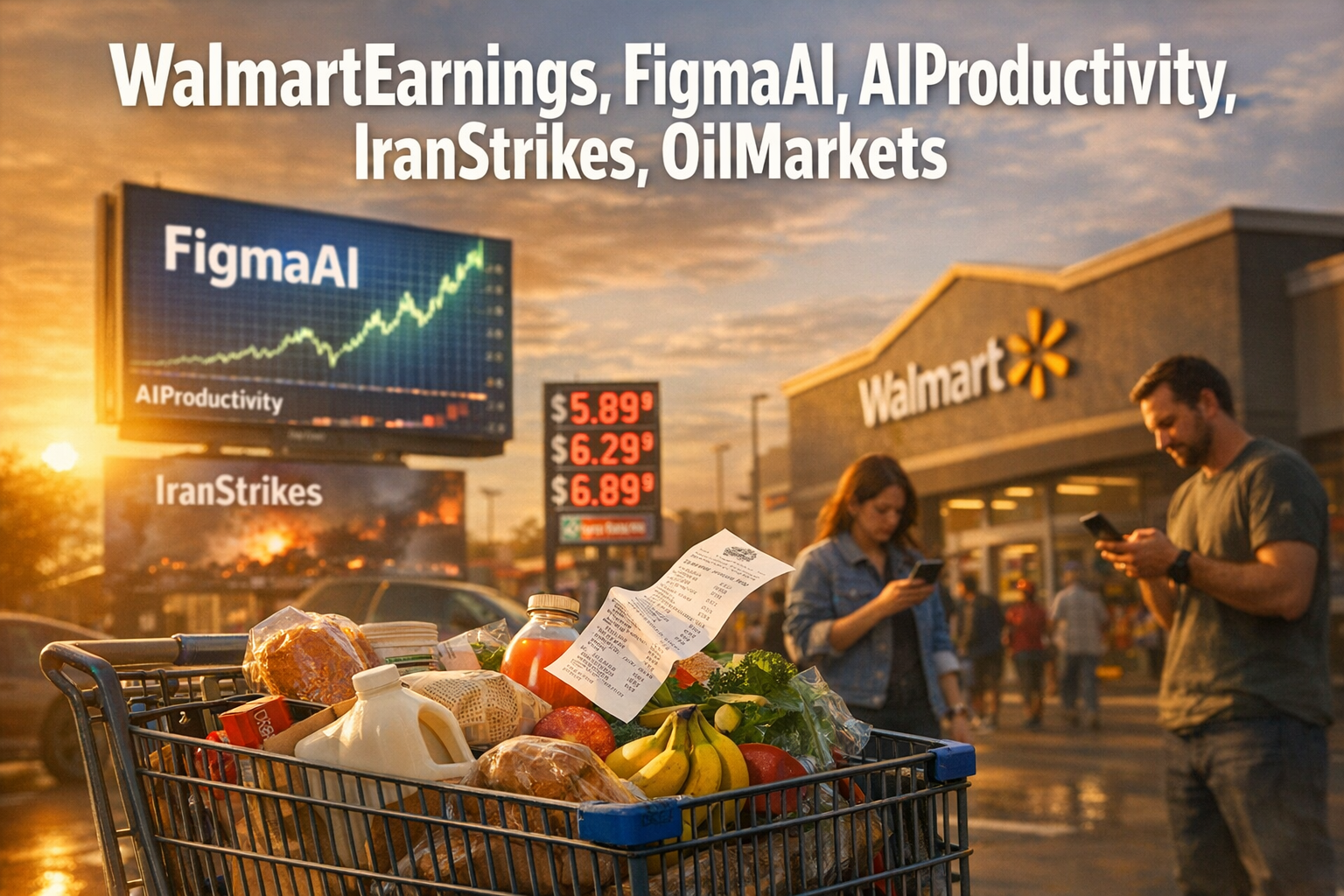
● Walmart Beats, Figma Soars, Iran Strike Rumor Sparks Oil Shock
Consolidated Brief: Why Walmart Results Look “Strong but Concerning,” the AI Signal Behind Figma’s Surge, and the Market Implications of “Saturday Iran Strike Readiness”
This report focuses on three items:1) Why Walmart’s earnings strength may reflect “trading down” rather than a broad-based U.S. consumer recovery2) Why Figma’s surge suggests a re-rating of “AI-driven design productivity,” not merely an earnings beat3) How reports of “attack readiness by Saturday” could transmit through oil, defense, and risk assetsA final section summarizes the hard data (transaction/receipt-like signals) vs. soft data (survey-based indicators) divergence.
1) U.S. market tone into the close: “Data are strong, but risk appetite is heavy”
The Dow, Nasdaq, and S&P 500 traded lower in tandem. Weakness in parts of semiconductors/software weighed on indices, while geopolitical risk constrained sentiment.
Key tension:Macro indicators (employment/manufacturing) remain firm, while retail-level signals (Walmart commentary) point to consumer fatigue.
This mix tends to suppress both rate-cut optimism and confidence in earnings-led growth, leaving valuation support less clear and volatility elevated.
2) Main story #1: The downside nuance behind Walmart’s “beat”
2-1. Headline figures were strong
Walmart reported revenue of $190.6B and EPS of $0.74, both above consensus. On the surface, this supports the view that U.S. consumption remains resilient.
2-2. The market focus shifted to guidance and mix
The primary driver of pre-market weakness was conservative full-year guidance. Walmart’s role as a broad consumer proxy increases the weight of forward commentary.
Management highlighted:
- Increased traffic from households with income above $100,000
- The shift appears structural rather than temporary
Interpretation risk:If outperformance reflects higher-income consumers “trading down” into value channels due to persistent price pressure, the earnings signal is less consistent with a broad demand rebound.
2-3. Margin is the key warning signal
Walmart indicated demand shifting away from discretionary categories (e.g., appliances/apparel) toward grocery/essentials.
Core implication:Essentials can support revenue but typically carry lower margins.
This raises the possibility of industry-wide margin compression across consumer-exposed sectors if the mix shift persists.
In an environment of prolonged inflation pressure:
- Households may remain in a “maintenance” spending mode
- The path to rate cuts becomes less straightforward
- Markets may reprice recession probabilities incrementally
3) Main story #2: Figma’s surge and the AI productivity re-rating
Figma rallied sharply on strong results and a meaningful beat, standing out even as broader software traded unevenly.
Key takeaway:Figma functions as both a design tool and a collaboration/workflow platform. With AI features embedded, it can move closer to the center of enterprise productivity spending.
Current spending preference:Enterprise AI budgets increasingly reward tools integrated into daily workflows (design, documentation, coding, sales, customer support) where productivity gains can be measured operationally. Figma’s move is consistent with that re-pricing dynamic.
4) Main story #3: Market transmission from “Saturday Iran strike readiness” reporting
A report indicating the U.S. had completed preparations for a potential strike by Saturday contributed to risk sensitivity. References to aircraft repositioning, aerial refueling assets, and potential carrier deployment shifted the headline from generalized tension to a time-specific scenario.
4-1. First-order market reactions: oil, defense, energy
Typical initial moves concentrate in:1) Crude oil (Brent/WTI)2) Defense3) Energy/refining
Recent market behavior has often expressed geopolitical risk through sector rotation rather than broad equity liquidation, although this pattern is conditional on escalation intensity and duration.
4-2. Three items to monitor next week
1) Oil: “spike and hold” vs. “spike and retrace”
Persistence would complicate the inflation path.
2) U.S. Treasury yields
In a standard risk-off move, yields decline; however, oil-driven inflation risk may limit declines, increasing cross-asset ambiguity.
3) Relative weakness in consumer/retail equities
Determines whether Walmart’s message is isolated or becomes a broader earnings-season theme.
5) One-page “news-style” core summary
[Retail/Consumer]
- Walmart: earnings beat; guidance conservative.
- Higher-income customer traffic increase suggests potential trading down.
- Discretionary softness and essentials concentration imply margin pressure.
[Macro Indicators]
- Initial jobless claims below expectations (labor market firm).
- Philadelphia Fed manufacturing index strong (expansion signal).
- Visible temperature gap between macro prints and retail-frontline signals.
[AI/Tech]
- Figma: sharp rally on results; consistent with re-rating of AI productivity tools.
- Some semiconductors/tech showed profit-taking and higher volatility.
[Geopolitics]
- “Saturday strike readiness” reporting increased risk premium sensitivity across oil/defense and broader risk assets.
6) Key point: Hard data vs. soft data divergence
6-1. The core conflict
Survey/model-driven macro indicators remain hot, while transaction-like frontline retail signals are cooling.
- Survey indices (soft data) can react quickly to sentiment and expectations.
- Retail results/guidance are closer to realized demand and pricing/mix (harder signal).
Historically, when the two diverge, markets often converge toward real-economy confirmation, typically with a lag.
6-2. The structural issue: seasonal adjustment instability
Frequent revisions and month-to-month reversals are increasingly consistent with post-pandemic disruptions to seasonality, reducing the reliability of legacy seasonal-adjustment frameworks.
A recurring pattern becomes more likely:
- Hot release triggers higher yields / “no cuts” repricing
- Subsequent months show deceleration in realized activity and spending
This increases timing risk for cross-asset positioning.
7) Investor checklist (next 1–3 weeks)
1) Margin guidance across consumer-facing companies
Confirm whether Walmart’s mix/margin message is spreading across retail and consumer staples/discretionary.
2) Speed of oil pass-through into inflation expectations and realized prints
A sustained oil move complicates policy expectations.
3) AI theme breadth: shift from “models” to “tools/workflows”
Additional Figma-like outcomes would imply broader monetization outside core compute and model providers.
< Summary >
- Walmart results beat, but the dominant message points to trading down and margin pressure, not a clean consumer recovery.
- Macro indicators remain firm while retail-frontline signals soften, complicating the policy and valuation backdrop.
- Figma’s surge aligns with a re-rating of AI-enabled productivity tools integrated into workflows.
- “Saturday Iran strike readiness” reporting is a near-term volatility catalyst for oil, defense, rates, and risk assets.
- The primary market tension is soft data vs. hard data; directionality is more likely to be resolved by realized activity and spending signals.
[Related Links…]
- https://NextGenInsight.net?s=Walmart
- https://NextGenInsight.net?s=Figma
*Source: [ Maeil Business Newspaper ]
– 피그마, 강력실적&컨센서스에 급등ㅣ美, 토요일까지 이란 공격 준비 완료ㅣ영업정지 피한 쿠팡, 7% 상승ㅣ홍키자의 매일뉴욕