● FCC Greenlights Tesla UWB, Robotaxi Unmanned-Cost Collapse
Tesla Wireless Charging: FCC Approval as a Catalyst for Fully Unmanned Robotaxi Operations (Reducing the Final Human Cost to Zero)
This report focuses on four points:
1) Why FCC-approved UWB determines the viability of wireless charging
2) Why Tesla can drive operating cost toward “near-zero” while Waymo still relies on people (with quantitative framing)
3) How Tesla addresses wireless charging constraints (efficiency, heat, alignment) through a system-level approach
4) How 8 billion miles of FSD data may interact with potential 2026 federal regulatory standardization
1) Key Development: What “FCC Approval of Tesla Wireless Charging” Signifies
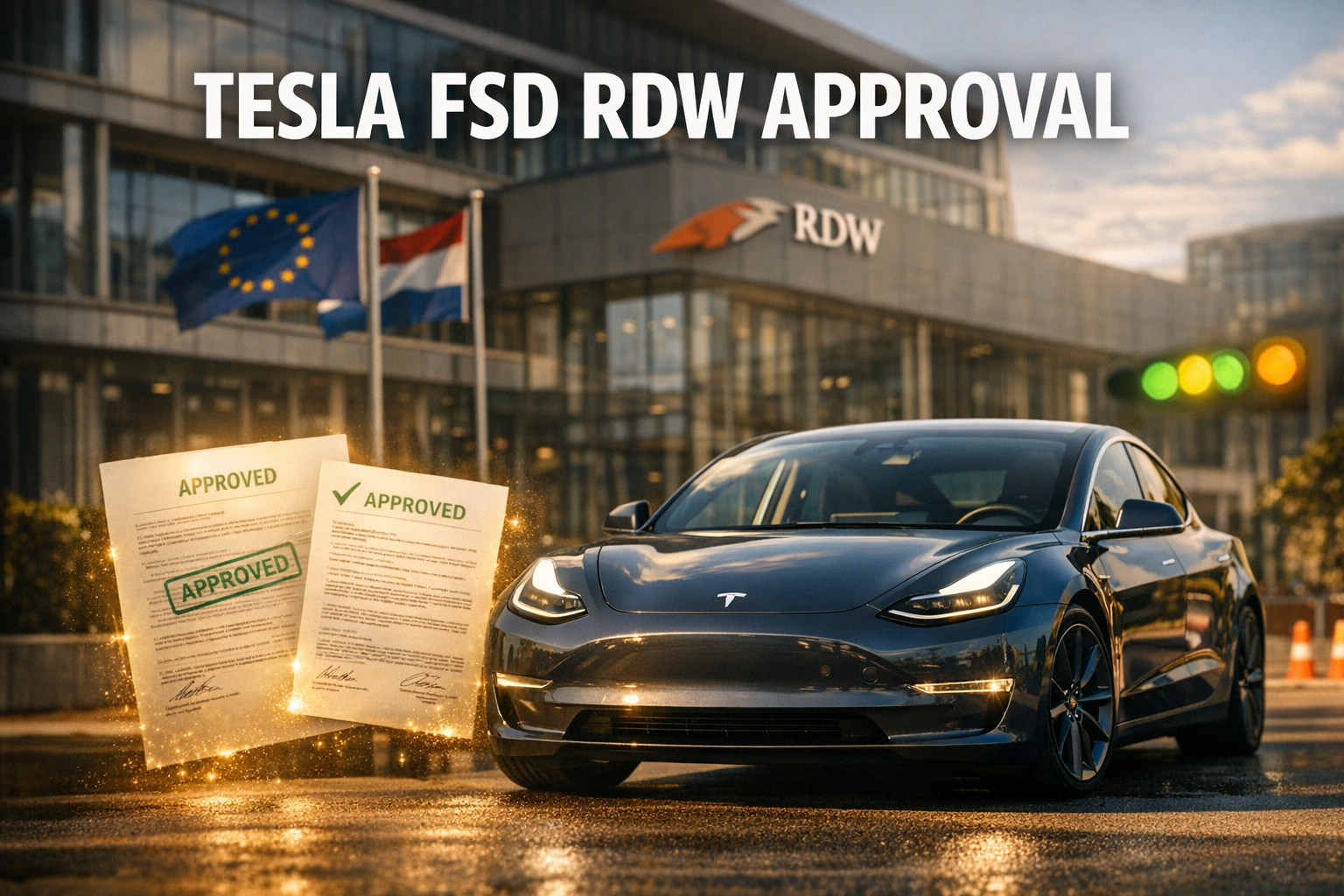
The U.S. Federal Communications Commission (FCC) approval of ultra-wideband (UWB) technology intended for the Tesla Cybercab wireless charging pad is less about convenience and more about enabling the final requirement for human-free robotaxi operations.
Robotaxi scalability is constrained not only by autonomous driving capability, but by on-site operational labor (cable handling, precision positioning, sensor cleaning, basic inspection). Tesla’s approach targets structural removal of these recurring labor inputs.
2) Why Wireless Charging Is the Last Gate to Robotaxi Monetization
2-1. The Primary Cost Driver: On-Site Operating Labor
Robotaxi economics are determined by operating cost structure, not only driving automation performance. If a vehicle requires charging 1.5–2 times per day, even a simple “plug/unplug” process can force 24/7 staffing (three shifts). This converts an ostensibly autonomous service into labor-dependent operations.
2-2. Waymo vs. Tesla: Divergent Unit Economics Despite Similar Autonomy Objectives
Waymo reportedly maintains significant human-based operations such as cable connection and sensor cleaning. As fleet size grows, labor, facilities, and idle time scale with it, pushing per-mile operating cost higher and potentially above $1/mile.
Tesla’s targeted model is a closed autonomous loop: self-positioning → self-charging → self-dispatch. If achieved, this materially lowers cost per mile and strengthens price competitiveness. The strategic focus is operating automation, scale effects, and structural cost reduction.
3) Wireless Charging Constraints: Tesla’s Objective Is Industrial Infrastructure, Not Consumer Convenience
3-1. Implications of a 90% Efficiency Target
Consumer wireless charging often operates at ~60–70% efficiency, resulting in slower charging and higher heat. A 90%+ target implies performance closer to wired charging and frames wireless charging as industrial-grade infrastructure rather than a convenience feature.
3-2. The Core Bottleneck: Alignment, Not Charging Speed
Power loss and heat rise sharply when pad-to-vehicle coil alignment deviates. Reliable, repeatable centimeter-level alignment is difficult to achieve manually and becomes a prerequisite for robotaxi-grade wireless charging.
3-3. Why FCC-Approved UWB Matters: Centimeter-Level Control Beyond GPS/Bluetooth
UWB enables more precise ranging and synchronization between vehicle and pad, supporting real-time guidance to the position that maximizes charging efficiency. In this context, FCC approval is best interpreted as progress toward automated alignment and reduced regulatory friction for commercialization.
4) Quantifying “Wireless Loss vs. Labor Cost”: Why Accepting a 10% Loss Can Be Rational
Using the stated assumptions:
- Wireless charging loss: 10%
- Charging event: 50 kWh
- Lost energy: 5 kWh
- Electricity price: 300 KRW/kWh
- Loss cost per event: ~1,500 KRW
If human labor is required for cable handling, costs extend beyond the task itself to include staffing coverage, shift management, waiting time, and operational risk. The trade-off becomes higher variable electricity cost in exchange for removing labor-driven fixed costs and complexity. This can materially change long-run margins and improve unit economics as scale increases.
5) 8 Billion Miles of FSD Data and the Potential Link to Regulatory Standardization
Tesla’s emphasis on 8 billion cumulative FSD miles is primarily relevant as safety evidence for regulators. When autonomous driving rules differ by state, expansion slows and compliance costs increase. If a federal framework emerges in 2026 (e.g., a unified national standard), data-rich operators may have a structural advantage in regulatory acceptance and faster deployment.
Sequence: cumulative mileage → safety validation → regulatory harmonization → fleet expansion. Data functions as a barrier to entry alongside technology.
6) Supplemental Topic: “Coffee Shops at Superchargers” as an Operations-Led Concept
A concept involving small coffee shops at Supercharger sites with humanoid robotics for payment and service can be evaluated as an operational model rather than marketing. In many retail formats, labor can represent 30–40% of operating cost. Partial automation could enable monetization of charging locations and convert infrastructure from a cost center into a revenue center.
7) Political/Operational Risk Signal: Boycott Motions and the Infrastructure Paradox
A city council resolution to restrict contracts or investments related to Musk-associated entities indicates that certain technologies are becoming embedded as critical infrastructure. If emergency response systems rely on satellite connectivity as a fallback during outages, adoption may persist despite political controversy when alternatives are limited. This supports the view that parts of the Tesla/SpaceX ecosystem are evolving toward infrastructure status.
8) Under-Emphasized Core Takeaways
8-1. Wireless Charging as a Mechanism to Eliminate On-Site Labor
The primary purpose is not convenience; it is removal of labor, operational complexity, and downtime. Driving automation removes driving labor; wireless charging plus precision alignment removes on-site operational labor. Both are required for fully unmanned operations.
8-2. Competitive Advantage Lies in Fleet Operations Systems, Not Charging Efficiency Alone
While efficiency matters, greater differentiation may come from fleet optimization: where and when vehicles charge, how much they charge, and how rapidly they return to service. Wireless charging must integrate into a fleet operating system to maximize utilization and profitability.
8-3. UWB Approval as a De-Risking Signal
Commercial deployment can be constrained by certification and approvals as much as by technical readiness. FCC approval signals continued progress through regulatory gates toward commercialization.
9) Items to Monitor (Investment and Industry)
1) Cybercab production ramp: output rate determines service expansion velocity.
2) Wireless charging deployment strategy at Superchargers: retrofit and hybridization vs. dedicated sites.
3) Federal regulatory harmonization in 2026: persistent state-level fragmentation increases expansion cost.
4) Competitor progress in unmanned operations: operating automation may matter more than autonomy performance.
5) Macro factors: easing rates can improve risk appetite for growth/tech; supply chain conditions and EV demand remain sensitive to inflation and energy prices.
< Summary >
FCC approval of UWB positions Tesla wireless charging as an operational labor-elimination lever for robotaxis, rather than a convenience feature.
As Waymo retains labor-dependent processes for charging and maintenance, per-mile costs can remain structurally higher; Tesla targets an unmanned operating loop via wireless charging and precision alignment.
The key determinant is alignment automation, and UWB is a practical enabler for centimeter-level positioning.
8 billion miles of FSD data may strengthen regulatory positioning as federal standardization becomes more plausible.
[Related Articles…]
- Robotaxi market outlook and key variables: https://NextGenInsight.net?s=robotaxi
- Wireless charging trends and EV infrastructure shifts: https://NextGenInsight.net?s=wireless%20charging
*Source: [ 오늘의 테슬라 뉴스 ]
– 테슬라 무선 충전 FCC 승인, “웨이모는 사람 쓰는데 테슬라는 0원?” 절대로 따라올 수 없는 ‘운영의 무인화’ 시작되나?
● Tesla Robotaxi Shockwave, FCC Greenlight, Wireless Charging Breakthrough, Dry Battery Range Surge, AI Hiring Blitz
Why Tesla’s “Cybercab Robotaxi” Matters: FCC Approval for Wireless Charging + Potential 30% Range Uplift from Dry-Electrode Batteries + AI Hiring Signal a Converging Execution Path
This report links three developments in a single chain:
1) Confirmation of Cybercab pre-production/production readiness → 2) FCC approval of UWB-enabled wireless charging, addressing charging labor constraints → 3) Dry-electrode battery manufacturing as a potential lever on range and cost.
A final section highlights the most decision-relevant items often underweighted in mainstream coverage (monetization, regulation, and infrastructure lock-in).
1) Cybercab is transitioning from a “vehicle” concept to a city-scale operating asset
Key developments
- A first production-intent Cybercab unit was observed on the manufacturing line at Gigafactory Texas.
- Elon Musk referenced the possibility of consumer sales, expanding the addressable narrative beyond fleet-only deployment.
- A critical enabling component for robotaxi operations, a UWB-based wireless charging system, received Federal Communications Commission (FCC) authorization.
Why this is materialAt small fleet sizes (e.g., ~500 vehicles), manual plug-in charging can function operationally. At scale (1,000 → 10,000+ vehicles), charging becomes a structural bottleneck tied to operating expense (OPEX), safety, complaints/liability, and labor availability. FCC authorization indicates a compliance-cleared pathway to reduce that bottleneck.
2) Why FCC approval of Tesla’s UWB wireless charging matters: a design that reduces regulatory friction
Typical UWB regulatory sensitivities
- UWB is often scrutinized due to interference risk, with tighter constraints on fixed installations.
- Using UWB in fixed charging infrastructure could have created a meaningful approval barrier.
Approval rationale implied by the filing
- Low transmit power with usage limited to alignment/positioning moments.
- Discovery via Bluetooth or similar methods, with charging enabled only when the vehicle is precisely aligned.
- Risk mitigation measures designed to reduce external interference during charging.
ImplicationThis supports an operating model where a robotaxi can autonomously enter a bay, align, charge, and redeploy without human intervention—an essential requirement for unattended fleet operations.
3) With autonomous charging, competitive advantage shifts from “scale” to “operational lock-in”
Operational impact
- Wired charging: higher exposure to staffing needs, traffic flow constraints, safety incidents, complaints, and overnight operational complexity.
- Wireless charging: potential simplification to “park = charge,” structurally lowering OPEX.
Market impact
- Robotaxi competition is likely to be driven less by vehicle production volume and more by utilization rate.
- Wireless charging can reduce idle time and labor inputs, improving utilization and enabling more aggressive pricing under comparable demand conditions.
Key monitoring points
- Service inflation may remain sticky, but robotaxi economics target cost-driven price compression through automation.
- If realized, value capture may continue shifting from one-time vehicle sales to mobility services, with secondary effects on supply chains (components, batteries, grid/charging infrastructure).
4) Battery manufacturing: the core point is process-driven voltage uniformity, not only materials
Research takeaway
- Rapid degradation in high-voltage operation (e.g., above ~4.2V) may be driven less by active material limitations and more by current/voltage non-uniformity introduced during wet-coating electrode processes.
- Wet processes can concentrate overvoltage on subsets of particles (e.g., approaching ~4.8V locally), accelerating damage.
- A proposed direction is dry-electrode processing combined with conductive network enhancements (e.g., carbon nanofibers) to distribute voltage more uniformly and improve high-voltage stability.
Relevance to Tesla
- Tesla has invested for years in dry-electrode approaches associated with 4680-related manufacturing.
- If scaled, dry processing may deliver not only cost reduction but also performance gains. The cited “up to 30% range increase” remains contingent on manufacturability and fleet-grade validation.
Investor/industry implications
- Battery advantage is frequently determined by learning curves and manufacturing cost structure, not laboratory metrics alone.
- Dry-electrode processing can affect CAPEX intensity, throughput time, and energy consumption, potentially enabling performance improvement without a full material system overhaul.
- This shifts competitive pressure from raw-material access to manufacturing process mastery.
5) First-principles cost decomposition: a framework that aligns with 2026 battery economics
Framework
- Reject “historical price anchoring” and decompose the battery pack into raw inputs (metals, carbon, polymers, enclosure components), estimate a commodity-based cost floor, then target assembly and process innovation to approach that floor.
Key point
- The stated long-run objective of sub-$100/kWh pack economics—once considered aspirational when packs were ~ $1,000/kWh—has become increasingly consistent with the direction of industry cost curves into 2026.
Broader significance
- Battery cost declines influence not only EV pricing but also grid storage (ESS) economics and manufacturing cost baselines.
- In a rate-cut or rate-cut-expectation environment, valuation sensitivity typically increases for themes tied to autonomy, robotics, and electrification.
6) FSD “driver incapacitation detection” illustrates the primary adoption frame: safety, insurance, and regulation
Case summary
- A driver lost consciousness during highway driving.
- Tesla FSD detected abnormal conditions, decelerated, activated hazard lights, and executed a controlled stop.
- Emergency response occurred rapidly, avoiding a major accident.
Why it matters
- The adoption inflection for autonomy is driven more by measurable reductions in fatalities and severe injuries than by comfort or convenience.
- Regulators, insurers, and public acceptance are primarily influenced by safety data. Robotaxi expansion will depend on clearing this threshold with credible evidence.
7) European EV sales rank and AI hiring point to “AI-enabled manufacturing platform” positioning
Commercial indicators
- In Europe, Model Y ranked #1 in EV sales, with Model 3 also in the leading tier.
Hiring signal
- Emphasis on redefining how the physical world operates through AI.
- Preference for first-principles problem decomposition and builders who implement solutions in code.
- Python and PyTorch positioned as baseline tooling.
- Factories described as the operating laboratory, implying a closed loop: software drives manufacturing, manufacturing generates data, data improves models, and models improve deployment.
InterpretationThis indicates continued integration of manufacturing, autonomy, and robotics into a unified “physical AI” execution stack where data acquisition, training, production, and field deployment are tightly coupled.
8) Underweighted decision drivers: monetization, regulation, and infrastructure lock-in
(1) The core value is an expandable operating model, not the FCC approval headlineRobotaxi economics depend on city-scale operations. Wireless charging can reduce labor, incidents, complaints, and idle time, allowing operational complexity to decline as fleet size increases rather than rise.
(2) The disruptive angle of dry processing is not only cost; it is performance uplift with the same material baseMost battery narratives focus on materials (nickel, LFP, silicon). If process-driven voltage uniformity enables stable high-voltage operation, performance can improve without relying on scarce inputs, changing the competitive basis.
(3) Speed derives from decision architecture and vertical integrationA first-principles operating model combined with vertical integration is structurally advantaged in complex, multi-domain systems such as autonomy, batteries, and robotics.
(4) The dominant near-term variable may be macro conditions, not engineering milestonesTrade policy, rate expectations, and AI semiconductor cycles can materially impact valuations for hybrid tech/manufacturing platforms. Technical news is best translated into: regulatory clearance + operating model scalability + cost-curve impact.
9) One-line investor framing
Cybercab is increasingly a question of execution readiness rather than launch intent, as regulatory clearance (FCC) + infrastructure enablement (wireless charging) + cost/performance levers (dry-electrode processing) + AI talent acquisition converge to improve the practical deployability of large-scale robotaxi operations.
< Summary >
- A production-intent Cybercab unit was observed, and the possibility of consumer sales was referenced, increasing attention on robotaxi commercialization pathways.
- FCC authorization for UWB-based wireless charging supports a reduction in charging labor bottlenecks.
- Battery research suggests wet-coating process non-uniformity may drive high-voltage degradation; dry processing could enable meaningful range improvement (often cited as up to ~30%), subject to scalable manufacturing validation.
- FSD safety cases reinforce that autonomy adoption is governed primarily by safety, insurance, and regulatory acceptance.
- AI builder hiring and European sales performance align with a strategy centered on “AI + manufacturing” integration across robotaxi and robotics.
[Related links…]
- https://NextGenInsight.net?s=robotaxi
- https://NextGenInsight.net?s=battery
*Source: [ 허니잼의 테슬라와 일론 ]
– [테슬라 특허] 시카고대 충격적 연구 결과, 건식공정 배터리 30% 더 멀리! 사이버캡 무선충전 FCC 승인!
● Trumps Threat Sparks Oil Shock Hormuz Strait Crisis, Inflation Fear Hits Stocks
Why Did Oil Prices React So Sharply to Trump’s “Bad Things Will Happen” Remark: A Comprehensive Guide to US-Iran Risk, the Strait of Hormuz, and the Key Variables Investors Should Track
This report covers three points:
First, it deconstructs how Trump’s wording moved oil prices and why the market reacted the way it did.
Second, it outlines scenario-based transmission channels from a potential US-Iran clash to oil, inflation, rates, and equities (with emphasis on the KOSPI).
Third, it highlights commonly overlooked variables: the limitations of the “the US is an oil producer, so it is fine” argument, and the real choke points and hedges tied to the Strait of Hormuz (energy, refining, freight, and FX).
1) Key News Briefing: Why “Trump Remark → Oil Drops/Rallies” Occurred
(1) Markets price the probability of supply disruption before they price “war”
Even with ample inventories, rising Middle East geopolitical risk adds a probability premium: the market prices the chance that flows could be interrupted. Historical episodes (e.g., Gulf War, oil shocks) followed a similar pattern.
(2) Trump’s first message: “Talks with Iran are going well” → oil sold off
This was interpreted as a lower probability of supply disruption, prompting an early decline in prices.
(3) Second frame: “You will know the result in 10 days” → ambiguity over negotiation vs. a de facto deadline
Fixing a time window increases event risk. Mixed messages such as “talks again in two weeks” raise uncertainty; higher uncertainty tends to lift option premia and can amplify futures volatility.
(4) Key escalation: “Iran cannot have nuclear weapons” + “If they do not agree, bad things will happen”
This combination implies a hard red line and a predetermined endpoint for negotiations, increasing perceived conflict risk and reintroducing a geopolitical premium into oil.
2) Why Oil Has Become a Market Sentiment Barometer
(1) Oil links directly to inflation, which can reprice multiple asset classes
Higher oil feeds into transport costs, manufacturing inputs, and electricity/gas, affecting CPI with a lag. The critical variable is not only CPI prints but central bank reaction functions and the implied rate path.
(2) “Growth slowing + oil rising” revives stagflation risk
Oil is a classic stagflation catalyst: higher prices pressure consumption, firms reduce production and investment, labor markets weaken, and inflation proves sticky.
(3) Technical breakouts can trigger systematic flows
A shift from inventory-driven weakness to geopolitics-driven trend changes can prompt momentum and CTA follow-through, increasing realized volatility.
3) Scenario Framework: How Far Can US-Iran Risk Push Oil?
Scenario A) Rhetorical pressure only; no kinetic conflict (repeated talks/deferrals)
Oil: potential spike followed by retracement.
Key point: if risk premia become crowded, downside can be sharp when the premium unwinds.
Scenario B) Limited strikes (e.g., nuclear facilities) + limited Iranian retaliation
Oil: a move toward the USD 80 area is plausible.
Key point: if prolonged, broader risk-off dynamics can emerge (USD strength, EM weakness).
Scenario C) Worst case: Strait of Hormuz risk becomes operational (closure, attacks, or insurance shock)
Oil: not merely USD 80; a “physical choke point premium” can dominate.
Key point: large export volumes transit this route; Asia (including South Korea, China, Japan) is structurally more exposed.
4) Why Asia Bears More Pain: Hormuz Is About Irreplaceable Time, Not Just Volume
(1) The choke point worsens transport, insurance, and settlement terms simultaneously
Even without a full blockade, war-risk insurance premia can rise materially, increasing delivered costs. The effective shock is not only the crude benchmark but the all-in landed cost.
(2) For South Korea, FX must be monitored alongside oil
Energy importers often face trade balance pressure when oil rises, which can weaken the currency. Currency depreciation then raises import prices and can reinforce inflation via a second-round channel.
5) Why “The US Is an Oil Producer, So It Is Fine” Is Only Half True
(1) The US is a major producer/exporter, but domestic prices remain linked to global benchmarks
Even with high domestic output, global price moves transmit to US gasoline and refining economics; full decoupling is unlikely.
(2) The US has more policy levers: export adjustments, SPR releases, and production incentives
These levers support the view that the US may be relatively less exposed than Asia. However, policy actions can also interact with alliance management and trade frictions, potentially increasing global uncertainty.
6) Investment Checklist: When Refiners/Energy Equities Function as “Portfolio Insurance”
(1) For refiners, the key variable is crack spreads and supply-chain dynamics, not crude prices alone
Even if crude rises, margin outcomes depend on product price pass-through. Speed matters: rapid spikes can erode demand and compress margins.
(2) US-centric production footprints can receive a relative premium under geopolitical risk
When production is concentrated in the US, physical disruption risk is lower while revenue benefits from higher prices can be more direct.
(3) Portfolio framing: prioritize hedging characteristics over directional bets
This is a probability-driven regime; positioning for resilience may be more practical than attempting to time outcomes.
7) Macro Implications: Five Key Variables in Context
Rates: oil-driven inflation can reduce the probability of near-term easing.
Inflation: energy can transmit into transport and then into food and core goods.
FX: moves tend to disadvantage energy importers and increase KRW volatility.
KOSPI: foreign risk-off behavior can raise index volatility; event windows warrant tighter risk control.
Crude: in a geopolitical premium regime, “Hormuz risk/military action” can outweigh inventory data as the primary price driver.
8) The Most Under-Discussed Points
Key 1) Real-economy impact can begin with insurance, freight, and settlement terms before an outright war
Even without total closure, war-risk premia can materially worsen Asia’s import economics. Benchmark charts alone can understate the lived cost shock.
Key 2) China’s key vulnerability is policy flexibility, not only oil prices
Higher oil can constrain stimulus via import-price and FX pressures. A policy constraint can transmit into weaker demand and become an earnings headwind globally.
Key 3) The stronger the narrative that “the US is less affected,” the higher uncertainty can become for allies, especially in Asia
US policy optionality (exports/priorities) can increase volatility for import-dependent economies. Monitor the speed at which geopolitical bargaining turns into financial variables.
9) Practical Indicators to Track Over the Next Two Weeks
1) Whether product spreads (crack spreads) rise alongside Brent/WTI
2) Whether headlines on freight rates and war-risk insurance increase
3) Whether the USD index and USD/KRW strengthen simultaneously (classic risk-off pattern)
4) Whether commentary emerges on SPR and US energy policy
5) Whether US asset-movement coverage shifts from “signaling” tone to “operational” tone
< Summary >
Trump’s “talks are going well” remark initially reduced perceived supply-disruption probability and pressured oil, but the combination of a stated deadline, a nuclear red line, and threats of consequences increased perceived conflict risk and restored a geopolitical premium.
The dominant variable is not the existence of war per se, but the Strait of Hormuz channel that can transmit shocks through supply chains, insurance premia, and freight.
Higher oil can reprice inflation and rate expectations, amplify FX moves, and increase KOSPI volatility; energy/refining exposure may be evaluated primarily as portfolio insurance.
[Related Articles…]
- https://NextGenInsight.net?s=oil-price
- https://NextGenInsight.net?s=exchange-rate
*Source: [ Jun’s economy lab ]
– 이란에게 나쁜 일이 벌어질 것이다, 트럼프 한마디에 급등한 유가