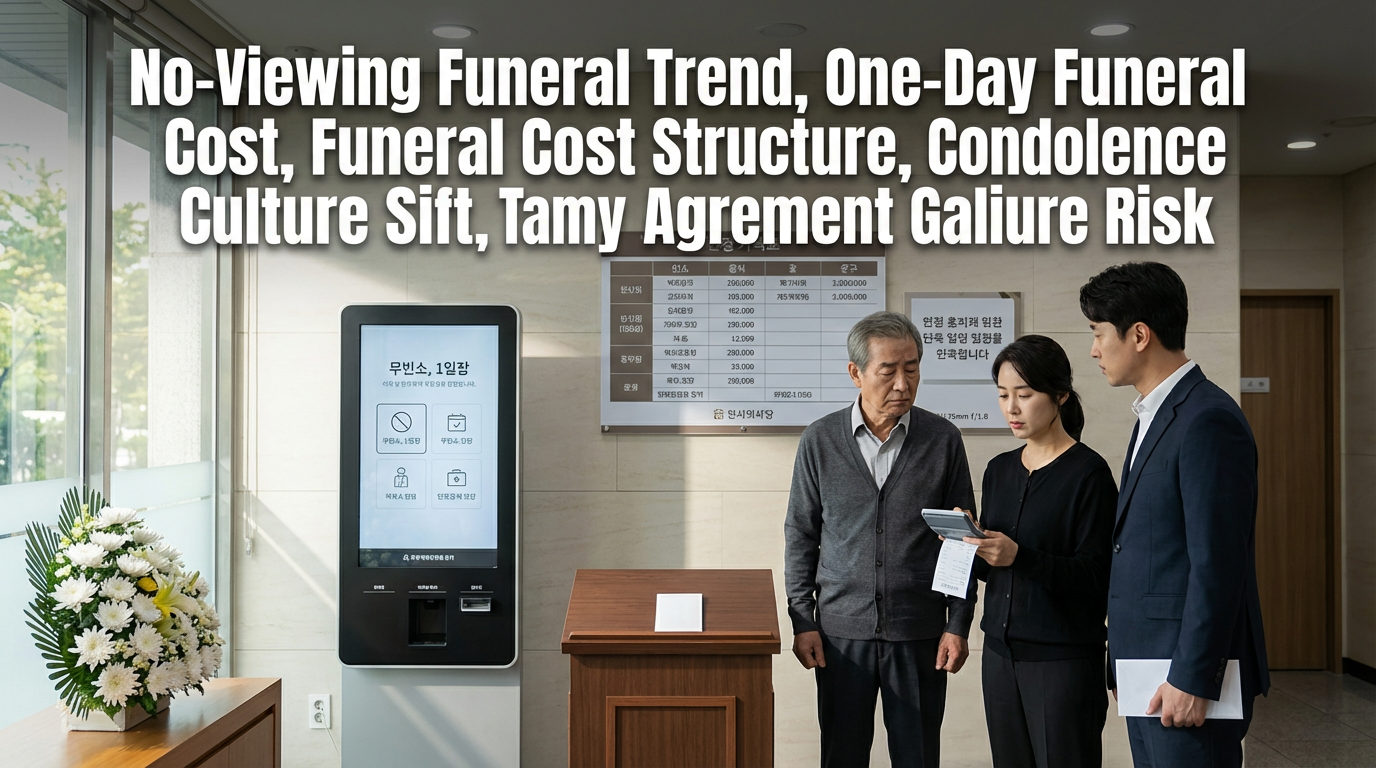
● No-Visit One-Day Funerals Surge-Cost Shock, Social Shift
Parents’ Funeral: The Real Reason “No-Viewing, 1-Day Funerals” Are Surging… and How Your Family’s Life Actually Changes Once You Do It
These days, funeral trends are changing really fast.
This article includes the following key takeaways.
Why no-viewing funerals are becoming popular (post-COVID cultural shifts + one-person households + cost structure).
Why the cost of a 3-day funeral easily exceeds 10 million KRW (in fact, the “casket” is not the main driver; “food / viewing-room operation” is).
The “shocking changes” families experience when choosing no-viewing (benefits / regret points / relationship realignment).
The exact context and real-world steps behind the advice “don’t call 119 first” when death occurs suddenly.
The funeral etiquette mistakes today’s generations make most often (timing of bows, no toasts, condolence money).
And at the end, I’ll also summarize the “single most important point” that other videos/news rarely address.
1) [News Briefing] Deaths Are Increasing, So Why Have Funeral Homes Become “Quiet”?
The core point is not “the number of deaths,” but that “the condolence-visit culture” has declined.
After COVID, a social justification emerged for “it’s okay not to go,” and condolence visits structurally decreased.
In the past, viewing rooms were packed and even reception/serving staff were hard to find, but now visiting has become a choice.
As a result, the traditional funeral operating model built around a 3-day funeral (viewing room + reception) is being shaken.
2) [Trend] Three “Real-World” Factors Driving the Rise of No-Viewing Funerals
2-1. The Cost Structure Is Different: “Funeral Costs Are Driven Not by the Casket, but by Food and the Viewing Room”
A 3-day funeral piles on viewing-room rental fees, reception space, family lodging/standing vigil, and above all, food/alcohol costs.
That’s why, even if you “keep it modest,” there are cases where the total exceeds 10 million KRW.
With no-viewing, there is no condolence reception, so viewing-room operating costs, food costs, and rental fees drop out, structurally lowering the expense.
In the source, a no-viewing package plus facility fees is mentioned as potentially landing in the low 2-million-KRW range (varies by region/facility).
In today’s high-interest-rate environment, this is the point that sharply reduces the perceived burden.
2-2. One-Person Households and Relationship Disconnection Push People Toward “Family-Only Funerals”
Because neighborhood/extended-family networks are no longer as tight as before, the mindset of “I don’t want to burden others, and I don’t want to be burdened” has grown.
As marriage and kinship structures become simpler, the flow naturally shifts from large funerals toward “remembrance centered on the deceased.”
2-3. “Share the Obituary, but Visiting Is Optional” Has Become a Social Norm
In the past, obituary notice and condolence visits were almost a package deal.
Now, even if an obituary is shared, visiting has changed to “if circumstances allow.”
This shift can be seen as a catalyst accelerating the spread of no-viewing funerals.
3) [Key Takeaway] The “Shocking Changes” That Happen to Families When You Do a No-Viewing 1-Day Funeral
3-1. A Funeral Stops Being an “Event” and Becomes a “Decision-Making Project”
From the moment it begins, a funeral is a continuous chain of choices.
Viewing-room size, funeral home location, parking, religious rites, cremation/burial, columbarium/scattering ashes, and so on… you have to keep deciding.
No-viewing reduces the options, which has a strong effect of lowering stress.
Especially for office workers, shortening the schedule also realistically reduces the risk of leave and work disruption.
3-2. When “Handling Visitors” Disappears, Where the Family Spends Its Energy Changes
With a 3-day funeral, families rapidly burn out from responding to visitors, greeting people, and managing meals.
With no-viewing, that energy structurally returns to “organizing the deceased’s affairs and having time to grieve.”
Conversely, for families who expected comfort from a bustling crowd, a sense of emptiness may arise.
3-3. Family Conflict Surfaces “Faster” (An Advantage and a Risk)
As in the case described in the source, some families immediately clash over “I want to receive visitors” vs “let’s keep it quiet with a family-only funeral.”
Because no-viewing is hard to reverse, it’s important to secure stronger agreement within the family before starting.
In this process, relationships can become realigned.
4) [Practical Guide] Whether No-Viewing or 3-Day, the “First Two Hours” Decide Everything
4-1. The Real Meaning of “Don’t Call 119 First”
If someone suddenly collapses and emergency measures like CPR are possible, calling 119 is correct.
However, in an “anticipated end-of-life situation” (hospice, preparing for death at home, etc.) where death is already clearly evident,
even if you call 119, after death is confirmed the process shifts to police procedures, and the funeral must be handled separately.
The source emphasizes the flow “report to 112 first → proceed with procedures.”
The conclusion is this.
Depending on the situation, the priority between 119 and 112 changes, and if death is clear, a police confirmation procedure is required.
4-2. The Very First Thing in Funeral Arrangements: “Cremation Reservation Comes First”
Crematoriums have a fixed daily processing capacity, and especially in the Seoul metropolitan area they can get crowded.
So, whether you’re still consulting or in the middle of transport, once you have the personal information, it’s practically important to secure the cremation reservation first.
If this is delayed, you may end up having to travel to another region (Gyeonggi, Gyeongnam, Ulsan, etc.) for cremation.
4-3. Even No-Viewing Funerals Have “Almost the Same” Procedure; Only Two Things Change
You do not receive condolence visits.
There is no “viewing room space” for the family to stay in (the place for waiting/overnight stays disappears).
Other than that, core procedures such as encoffining, body storage, carrying the bier, and cremation are not very different.
5) [Etiquette/Culture] The Funeral Manners People Are Most Confused About These Days
5-1. Timing and Order of Bows: “The Heart Matters More Than a Single Right Answer”
The source’s key takeaway is this.
More important than the number/order of bows is the core point of “a sincere heart that mourns the deceased.”
Depending on religion, people may observe a moment of silence instead of bowing, and the direction of a chrysanthemum can carry different meanings, but it should not be forced as an absolute rule.
5-2. Avoid Toasting at a Funeral Home
A toast is basically closer in meaning to “celebration,” so it can be improper at a funeral.
5-3. The Obsession That “You Must Not Laugh” Has Become Excessive
Traditionally, funerals were not only places to remain silent, but also places where people gathered to talk about the deceased and maintain relationships.
Of course you should avoid loud commotion, but from a human standpoint, you don’t need to feel guilty about sharing memories through conversation.
5-4. Condolence Money vs Funeral Contribution: In Practice, You Can Treat Them as Essentially the Same
Condolence money is money given with a heart that mourns the deceased.
A funeral contribution is money to help the family bear the cost burden.
In practice, they are widely used interchangeably, and the conclusion is that “using the term funeral contribution is not wrong.”
5-5. The Odd-Number Amount Custom (30k/50k/70k/100k KRW) Is Ultimately a Product of Social Convention
A common explanation is that, in yin-yang and five-elements thinking, for a funeral (yin) you match it with yang (odd numbers),
and in reality, the introduction of 50,000-KRW bills and the avoidance of 90,000 KRW (unlucky nine) combined so that 100,000 KRW became a kind of standard.
6) [Field Note] Why Funeral Directors Often Avoid Saying “Hello”
In a place of mourning, the word “hello” carries a sense of “well-being” that doesn’t fit, and that professional sensibility is strong.
So expressions like “You’ve been through a lot” have become the natural greeting.
And the reason they habitually offer a final goodbye before leaving is that,
on site, they have seen too many people regret not being able to say a final farewell.
7) [Reframed Through an Economic Lens] No-Viewing Funerals Are a Microcosm of “Changing Consumption Patterns”
The spread of no-viewing is not just a fad; it can also be seen as a case where Korea’s consumption structure is shifting from “face-saving spending” to “actual use/real value spending.”
In a high-inflation environment, spending on “meals/reception” is even more burdensome, and funerals are no exception.
Also, as aging accelerates in earnest (more deaths), the social total of funeral costs grows,
while individual households face interest rates, inflation, and housing-cost pressure at the same time, so funeral simplification is likely to accelerate further.
This trend affects not only the funeral industry but also insurance, funeral pre-need plans, healthcare, and digital memorials (online obituaries/online memorial spaces).
For reference, this article also viewed funeral simplification as interlinked with economic keywords such as high inflation, prolonged high interest rates, household debt, recession, and asset-market trends.
8) The “Single Most Important Point” Other YouTube/News Rarely Mention (This Is the Real Key Takeaway)
The core point risk of a no-viewing/1-day funeral is not “money,” but “failure to reach agreement.”
Costs can be calculated with numbers, but within a family, “who to notify / how far to share it / whether to receive visitors” is an emotional issue.
Once you decide on no-viewing, it’s hard to reverse, and the lingering hurt can last long after the funeral ends.
So if you’re considering no-viewing, the three things you must decide before the funeral format are exactly these.
1) Obituary scope: distinguish between people you will “only inform” and people who “may come.”
2) Family priority: whether quiet remembrance comes first, or whether relationship closure comes first.
3) A replacement mechanism for remembrance: if there is no viewing room, whether to create a separate gathering later (49th-day rites, a memorial meal, a columbarium-visit routine, etc.).
If these three are organized, the probability of regret drops sharply with no-viewing,
but if they are not organized, even if you save money, the emotional cost can grow.
< Summary >
The spread of no-viewing 1-day funerals is the result of post-COVID changes in condolence-visit culture, the rise of one-person households, and the burden of funeral costs (especially food and viewing-room operating costs) combining together.
No-viewing reduces cost and physical exhaustion and helps people focus on remembrance centered on the deceased, but if family agreement is misaligned, regret can become large.
In practice, it is important to secure cremation reservations quickly, and the priority between 119 and 112 changes depending on the situation (emergency vs end-of-life preparation).
Funeral etiquette is essentially about mourning rather than formality, and it is enough to know the basics: no toasts, interchangeable terms for condolence money, and the odd-number convention.
[Related Posts…]
- In an Era of High Inflation, the Real Reason Household Spending Structures Are Changing
- A Prolonged High-Interest-Rate Scenario: The Shock Hitting Consumption, Real Estate, and Self-Employed Businesses All at Once
*Source: [ 지식인사이드 ]
– 부모님 장례, 무빈소 1일장 했더니 생기는 충격적인 변화 (김범진 장례지도사)