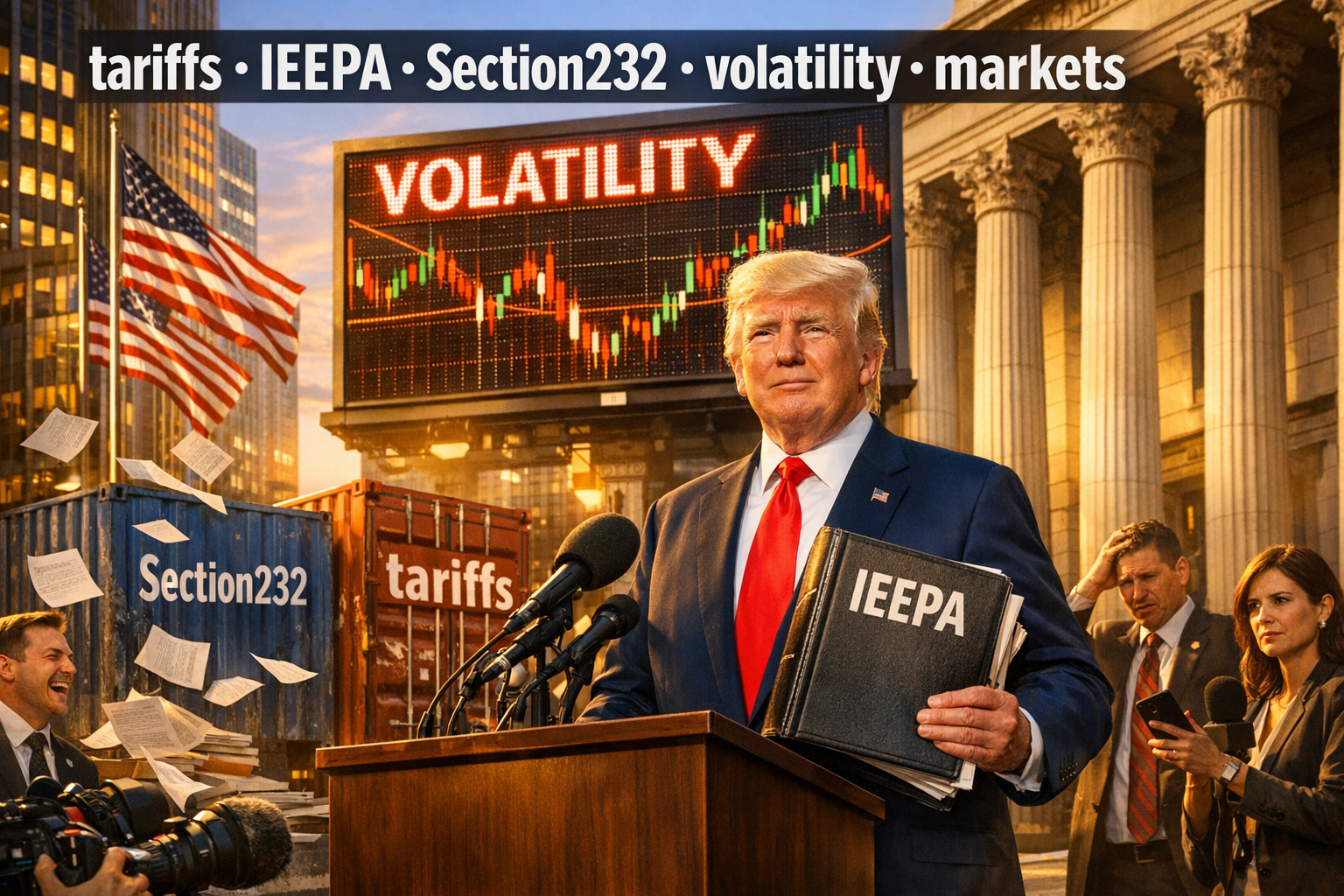
● Supreme Court nukes Trump tariffs, trade chaos spikes, Plan B 232 threat looms
Trump “Reciprocal Tariffs” Ruled Unlawful: Why Global Trade Risks Have Increased (From IEEPA Invalidation to Plan B)
This report consolidates four points:1) The Supreme Court’s core legal rationale for deeming “reciprocal tariffs” unlawful
2) Why countries that agreed to “US investment in exchange for tariff relief” (e.g., Korea, the EU, Japan) face greater complications
3) The administration’s near-term “Plan B” toolkit (e.g., Section 232) and likely spillovers
4) A market-impact sequence (FX, Treasury yields, equities, corporate earnings) presented in a news-style format
1) [Breaking Summary] Supreme Court: Trump Reciprocal Tariffs “Unlawful” — IEEPA Does Not Authorize Tariffs
Key point: The Supreme Court determined that the International Emergency Economic Powers Act (IEEPA) is unlikely to grant the President authority to impose tariffs, materially weakening the legal basis for Trump-style reciprocal tariffs.
Significance: This is not solely the invalidation of a specific tariff measure; it constrains the broader approach of using an “emergency” framework to advance tariff actions.
Political implication: In a Court often described as 6–3 conservative, some conservative-leaning justices were interpreted as aligning with the illegality finding, reinforcing the perception that the decision rested on legal doctrine rather than partisan preference.
2) [Legal Rationale] Why It Was Unlawful: Ambiguous “Emergency” and Tariffs as a Congressional Taxing Power
2-1. The “Trade Deficit = Emergency” Theory Was Legally Weak
The United States has run persistent structural trade deficits for decades. The argument that a specific year (2025) created a sudden “national emergency” sufficient to justify tariffs faced credibility challenges.
2-2. Tariffs Function as a Tax; the Executive Cannot Unilaterally Levy Them
Tariffs have strong tax-like characteristics: they generate revenue and distort prices. The principle that taxation is a legislative (Congressional) power undermined attempts to use IEEPA as a workaround enabling the executive branch to exercise de facto taxing authority.
3) [Rising Global Trade Uncertainty] The Core Issue Is Not “Tariffs Fall,” But “Negotiations Become More Unstable”
3-1. Korea, the EU, Japan: “Investment-for-Tariff-Relief” Deals Become Ambiguous
Because reciprocal tariffs served as negotiating leverage, a central question emerges:“If the tariffs were unlawful, why commit to large-scale investment and supply-chain relocation as the price of relief?”
The resulting uncertainty is driven by:1) Incentives for some partners to seek renegotiation or slow investment execution
2) Practical constraints on reversing commitments if the United States shifts to stronger product-specific tariffs under Plan B
This creates a scenario where tariffs are legally contested but economic pressure persists.
3-2. The US Policy Debate Shifts to Filling Gaps in Revenue and Trade Objectives
Reciprocal tariffs were viewed by some as increasing tariff revenue and, in the short term, reducing the trade deficit. If that mechanism is curtailed, the United States faces renewed pressure toward alternatives:
- Replacement revenue sources
- Increased Treasury issuance
- More aggressive product-level restrictions
This reduces policy predictability for global supply chains.
4) [Trump Plan B] If IEEPA Is Constrained, Shift Toward “Product Tariffs” Such as Trade Expansion Act Section 232
4-1. From Country-by-Country Tariffs to Sector-by-Sector Tariffs
If IEEPA-based country tariffs weaken, the most readily defensible executive option is often Trade Expansion Act Section 232, justified by:“Imports of the relevant product threaten US national security.”
Sectors frequently considered susceptible:
- Semiconductors
- Autos and parts
- Steel and aluminum
- Shipbuilding and critical industrial equipment
For export-oriented economies with concentrated flagship sectors, product tariffs can be comparable in impact to country tariffs, and in some cases more severe.
4-2. Markets Cannot Treat “Tariff Invalidation” as a Pure Positive
A near-term relief rally is plausible, but could be quickly offset by subsequent headlines such as:“Section 232 product-tariff expansion under review.”
Result: elevated equity volatility and ongoing risk repricing. The practical takeaway is not “tariffs are over,” but “the tariff instrument may change.”
5) [Market Watchpoints] Likely Shock Sequence: Treasury Yields, FX, Equities
5-1. Potential Wave of Corporate Refund Litigation
A realistic second-order effect:“If unlawful, refund the tariffs already paid.”A surge in coordinated litigation could force fiscal provisioning for refunds.
5-2. Rising US Fiscal Burden → Greater Issuance Pressure → Higher Treasury Yield Volatility
Refund risk, lost tariff revenue, and policy uncertainty can converge into a fiscal concern. Markets are typically most sensitive to US Treasury yields:Higher expected supply can lift yields and volatility, pressuring valuation-sensitive segments such as growth and technology equities.
5-3. FX and Exporter Earnings Reprice Based on the New Tariff Form
If reciprocal tariffs genuinely weaken, the KRW may see short-term relief. However, a pivot to product tariffs could reintroduce sector-specific risk for industries such as autos/parts, steel, and the semiconductor value chain.
6) [Under-Reported Core Risk] Trade Policy Has Become a Judicial Risk Variable
Common interpretation:“The Supreme Court ruled it unlawful, so tariffs will decline.”
Key issue:1) Trade policy becomes contingent on litigation and injunction risk
Tariffs may now fluctuate with court timelines and rulings, complicating pricing, supply contracts, and investment planning.2) The domestic political rationale for allied investment weakens
“Investing to avoid tariffs” becomes a less defensible narrative, potentially increasing domestic resistance and renegotiation pressure in partner countries.3) Incentive to shift from tariffs to harder instruments
If tariffs become legally constrained, the policy mix may tilt toward security- and technology-linked measures (regulation, export controls), which can be more disruptive for corporates.
7) Korea: Priority Sectors and Monitoring Points
- Autos and parts: High exposure to potential Section 232 actions; North American production footprint and localization pace become critical.
- Semiconductors: Risk may manifest more through equipment/material/technology controls than through tariffs alone; supply-chain reconfiguration should be reassessed.
- Shipbuilding and defense value chains: “National security” framing can increase both bargaining leverage and policy pressure.
- Steel: Renewed tightening is plausible given historical precedent (tariffs/quotas).
The central question is not whether tariffs disappear, but whether they become more sector-targeted and operationally specific.
8) Three Forward Scenarios (Ordered by Practical Likelihood)
Scenario A: Near-term disruption → Plan B strengthens product tariffs (most likely)
- Shift toward Section 232 and similar tools
- Pressure concentrates by sector rather than by country
Scenario B: Congressional legislation to reinforce tariff authority
- Higher political cost, but potential efforts to codify clearer tariff powers
Scenario C: Tariff agenda loses momentum and shifts to other priorities
- Possible depending on political constraints, but less consistent with the core platform
Summary
- The Supreme Court’s view that IEEPA does not authorize tariffs undermines the legal foundation of reciprocal tariffs and increases global trade-policy uncertainty.
- Countries that traded US-bound investment for tariff relief face weakened negotiating rationale, while the United States retains plausible alternatives via product-specific measures such as Section 232.
- Refund litigation risk, fiscal pressure, and higher issuance expectations may increase Treasury yield volatility, with knock-on effects for FX, equities, and corporate earnings.
- The primary structural change is the transformation of trade policy into a judicially contingent risk factor, reducing predictability for cross-border investment and supply-chain planning.
[Related]
- https://NextGenInsight.net?s=tariffs
- https://NextGenInsight.net?s=fx
*Source: [ 경제 읽어주는 남자(김광석TV) ]
– [속보] 트럼프 상호관세 위법 판결…글로벌 무역 불확실성 커져 [즉시분석]