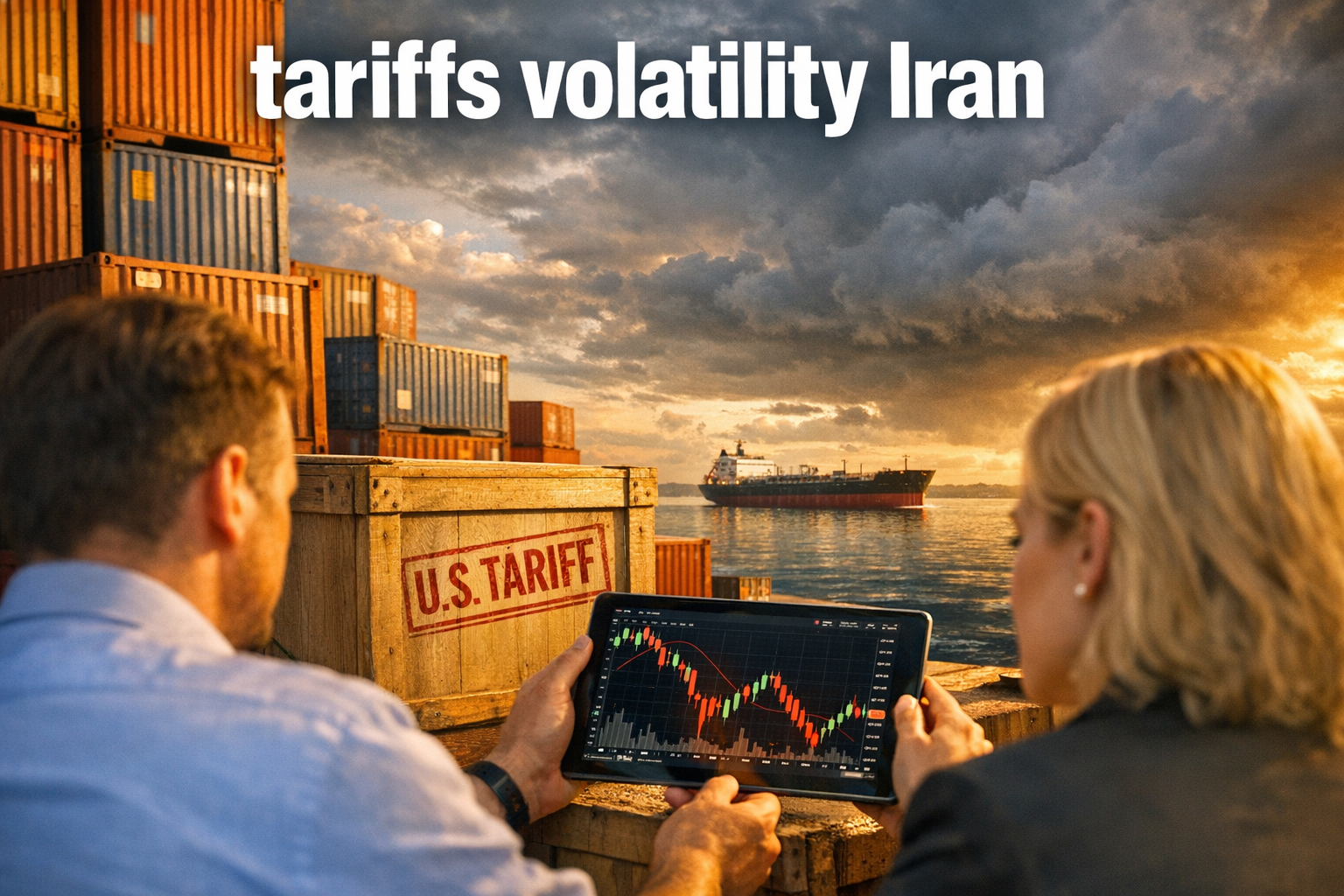
● Tariff Chaos, Iran War Jitters, Wall Street Smart Money Flip
Tariff Uncertainty + Imminent Iran Conflict Risk + Shifts in “Smart Money” Positioning: Three Core Drivers Behind Elevated Market Volatility
This note consolidates three topics.
First, why renewed tariff uncertainty is acting as a volatility catalyst.
Second, how an “imminent Iran-related military escalation” scenario can affect major asset classes (equities/oil/USD/rates).
Third, how institutional and hedge fund buying/selling patterns have recently converged.
A final section isolates the key under-discussed factors (market microstructure, positioning, and second-order effects).
1) Issues Summary (Headline Format)
[Headline]
With tariffs resurfacing, earnings visibility has weakened. Combined with rising Middle East (Iran) escalation risk, markets may re-enter a high-volatility regime.
[Immediate Market Transmission]
Tariffs disrupt corporate margins and the inflation path.
Middle East escalation risk disrupts oil, logistics, and the risk premium.
When both occur simultaneously, risk becomes harder to quantify, increasing the likelihood of de-risking and reduced positioning.
[Current Regime Characteristic]
Not a simple risk-off impulse; concurrent policy risk (tariffs) and geopolitical risk (Iran) can reprice volatility ahead of spot levels.
2) Tariff Uncertainty: Why It Is Re-emerging as a Volatility Driver
2-1. How Tariffs Flow Through to Earnings
When tariff policy becomes uncertain, corporates typically choose among three responses.
① Raise prices (risking demand slowdown)
② Absorb costs (compressing margins)
③ Reconfigure supply chains (higher time and transition costs)
These channels destabilize guidance and can reduce valuation premia linked to earnings certainty.
2-2. Where the Inflation Path Becomes Dislocated
Tariffs can lift import prices.
If the impact propagates through consumer and intermediate goods, core inflation risk increases.
The highest-risk configuration for markets is growth deceleration alongside renewed inflation pressure.
Even absent a sharp increase in recession probability, early signs of inflation re-acceleration can pressure equities.
2-3. Investor Checkpoints (Data and Calendar)
Tariffs are policy-event driven; timing matters.
Markets reprice across stages such as announcement, signaling, negotiation, deferral, and expansion.
In such periods, policy communication can dominate macro data as the primary volatility driver.
3) Iran Escalation Risk: Asset-Class Reactions by Scenario
3-1. Scenario A: Limited Conflict (Short-Duration Event Risk)
Typical market pattern:
Oil spikes → attempts to mean-revert within days
Defense/energy outperform → short-term momentum concentration
Equity indices may gap lower, then refocus on earnings season and rates
3-2. Scenario B: Rising Supply Disruption Risk (Medium-Term Risk)
If shipping, insurance, and maritime logistics deteriorate, costs rise beyond oil alone.
Risk aversion can persist longer.
Companies with resilient cash flows may outperform higher-duration exposures.
3-3. Scenario C: Broader Escalation (Risk Premium Reassessment)
The key variable is not “war fear” per se, but a higher, sustained risk premium that tightens corporate, consumer, and policy reaction functions.
Safe-haven demand typically strengthens.
Equities often see beta reduction (lower overall market exposure) before sector-level differentiation.
4) What “Smart Money” Buys and Sells (Pattern-Based)
This section focuses on recurring institutional portfolio patterns rather than single-name calls.
4-1. Common “Buy” Patterns in High-Uncertainty Regimes
① Energy/commodities value chain: hedging demand can rise with oil volatility
② Defense/security: higher geopolitical risk can strengthen budget and policy support expectations
③ Consumer staples/healthcare: defensives tend to attract flows as growth risk rises
④ Cash-flow durable mega-cap equities: relative valuation support can be stronger in higher-volatility/higher-rate regimes
⑤ Dividend/quality factors: preference shifts from long-duration growth to current earnings and balance-sheet strength
4-2. Common “Sell/Trim” Patterns in High-Uncertainty Regimes
① High-valuation growth: greater sensitivity to discount-rate and risk-premium repricing
② Cyclicals with high leverage: vulnerable to the combination of cost inflation and demand softening
③ Low-margin retail/manufacturing: if pass-through is limited, earnings downside materializes first
4-3. The Key Variable Is Not “What,” but “How”
Institutions rarely deploy risk in a single tranche.
They often hedge volatility via options/futures while adjusting cash equity exposure, or run sector-level long/short structures targeting relative returns.
Surface-level “buying” may represent materially different net risk than it appears.
5) Key Under-Discussed Factors
5-1. Volatility Can Reprice Ahead of Spot
With tariff and escalation risks concurrent, both earnings estimates and the oil/inflation path become unstable.
Markets may reprice volatility before establishing direction.
Indices can appear range-bound while dispersion across sectors and single names increases materially.
5-2. Tariffs Affect Not Only Inflation, but Inventory Strategy (Earnings Distortion Risk)
Elevated tariff uncertainty can drive inventory pull-forward and stockpiling, or alternatively a conservative inventory posture to reduce risk.
These shifts can distort quarterly revenue and margins, increasing earnings-season volatility.
5-3. Geopolitical Risk Requires a Full Cost Stack View (Logistics/Insurance/FX)
Oil is not the sole transmission channel.
Freight, insurance premia, and delivery delays represent additional frictional costs that can pressure importers, manufacturers, and retailers.
Accumulated frictions can reintroduce global supply-chain risk as a market factor.
5-4. AI Exposure Should Be Segmented: Software vs. Infrastructure (CAPEX Linkage)
In higher-uncertainty regimes, AI does not trade as a single factor.
Higher-valuation software/platform exposures can be more sensitive to rates and volatility.
By contrast, data centers, power, semiconductors equipment, cooling, and networking may be supported by the CAPEX cycle.
Key focus: differentiate segments tied to tangible investment from those dominated by duration and multiple risk.
6) Forward Watchlist (Macro/Markets/AI)
① Inflation
If tariffs and oil lift inflation expectations, the rate path may need to reprice.
② Rates
If conviction in near-term easing weakens, growth equities typically reprice first; defensives and cash-flow durability can re-rate relatively.
③ Recession Risk
If geopolitical stress weakens consumption and business sentiment, recession probabilities may be reassessed.
④ USD
Stronger risk aversion can coincide with USD strength, amplifying volatility in emerging markets and commodities.
⑤ Semiconductors
A core pillar of the AI cycle, but simultaneously exposed to tariffs, supply-chain constraints, and policy risk; monitor both earnings and policy developments.
7) One-Line Conclusion: The Risk Is the Interaction, Not the Headline
Tariffs reduce earnings visibility.
Iran-related risk affects oil and the risk premium.
Together, the initial market response is more likely to be higher volatility than a clean directional move.
Priority shifts from prediction to portfolio robustness under wide outcome distributions.
< Summary >
When tariff uncertainty coincides with Iran escalation risk, volatility is more likely to reprice before spot.
Tariffs can increase earnings volatility via margins, inflation transmission, and inventory strategy shifts.
Middle East risk can propagate beyond oil into logistics, insurance, and FX, pressuring broad cost structures.
Large institutional flows often tilt toward defensives, cash-flow durability, energy/defense, and reduce exposure to high-valuation growth.
AI should be analyzed by segment: software/platform duration risk versus infrastructure CAPEX sensitivity.
[Related Links…]
- Tariff Uncertainty Expansion: Implications for Global Equities and Corporate Earnings Visibility
- Iran Risk and Oil Spike Scenarios: Multi-Asset Response Checklist
*Source: [ 소수몽키 ]
– 관세 불확실과 이란 충돌 임박, 증시 고변동 재료될까/월가 초고수들은 무엇을 사고 무엇을 팔았을까
● Policy-Driven Crypto Liquidity Surge, Stablecoin Treasury Blitz, Clarity Bill Shockwave
Bitcoin’s “Breakout Window”: The Core Driver Is Not Price, but the Policy–Liquidity–Regulation Triad
The core takeaways are threefold:
1) In an environment where the Federal Reserve cannot easily deploy QE, stablecoins can function as a de facto new liquidity channel.
2) Asset tokenization is not a “fractional investing” trend; it is linked to payment rails modernization and a structural redesign of securities markets (including 24-hour trading).
3) The passage of the Clarity Act would reclassify crypto from “speculation” to “financial infrastructure,” enabling institutional capital and corporate use cases.
A critical market point: liquidity tends to price in when the market recognizes intent and a credible timeline, not on the effective date itself.
1) News Briefing: Key “Market Restructuring” Statements
(1) “A Kevin Warsh-led Fed = QE is difficult” → stablecoins become a liquidity bypass
The argument is that even if rate cuts are possible after a Fed leadership change, QE would be politically, philosophically, and structurally harder to implement. As a result, liquidity provision may shift from balance-sheet expansion to a structure in which stablecoin issuers invest incoming cash into short-dated U.S. Treasuries (T-bills).
From a U.S. policy perspective, this aligns with fiscal realities: persistent deficits and heavy Treasury issuance increase the need for structural buyers. Stablecoin growth can create durable demand for T-bills, positioning stablecoins as a mechanism that supports Treasury market funding dynamics.
(2) Stablecoins are “money,” not an “asset” → payments infrastructure shift
Stablecoin-based settlement can reduce time, fees, and intermediaries versus legacy rails. This matters for risk assets because the key variable is not only risk appetite but also where dollar liquidity circulates. Stablecoins increase transactional liquidity within crypto markets and, via T-bill purchases, can also transmit effects into the broader financial system.
(3) Asset tokenization = securities-market structure change, not a product gimmick
Tokenization changes trading hours, transaction costs, and liquidity premia by enabling on-chain issuance and transfer of tokenized claims on real-world assets (e.g., real estate, art, IP, bonds). Discussion around 24-hour equity trading in 2027–2028 signals increasing pressure for securities to converge toward tokenized and on-chain infrastructure. This also strengthens the demand rationale for smart-contract platforms.
2) The Clarity Act: More Important Than “It Rises If It Passes”
(1) Core function: ending the SEC vs. CFTC jurisdiction conflict via market-structure design
The Act would define regulatory classification and oversight boundaries (securities vs. commodities), reducing regulatory ambiguity that constrains institutional participation. Frameworks emphasizing “mature” decentralization would likely favor incumbents with stronger decentralization narratives.
(2) Why “markup delays” weakened sentiment
Legislative delays extend regulatory uncertainty, limiting institutional and corporate ability to execute. Expected capital inflows can be deferred, with price reacting to the delay ahead of formal outcomes.
(3) Coinbase’s objection: interest/rewards on stablecoins and tokenization platform economics
Pushback reflects lobbying and business-model conflicts, particularly around whether stablecoins may pay interest or rewards. Banks are sensitive to interest-bearing stablecoins because deposit outflows threaten the traditional net-interest-margin model. This is structurally a contest between the legacy deposit system and on-chain dollar rails.
3) A Practical Framework for the “Bitcoin–Stablecoin Correlation” Question
(1) Bottom line: stablecoins are not a direct price engine; they are liquidity plumbing
Bitcoin’s price drivers are multifactor. Stablecoins primarily alter system-wide leverage capacity, buying power, and turnover by expanding cash-like liquidity within market infrastructure.
(2) Three transmission channels
(a) Trading-liquidity channel: “Stablecoin supply growth = more deployable dry powder”
Rising stablecoin supply increases cash-equivalent balances that can rotate into risk assets. The key variable is risk appetite; in weak sentiment, stablecoins may accumulate without immediate rotation into Bitcoin.
(b) Treasury–rates channel: stablecoin growth = higher T-bill demand = downward pressure on short-end yields
Stablecoin issuer purchases can support short-duration Treasury demand and weigh on short-term yields. However, if inflation expectations or fiscal concerns rise simultaneously, long-end yields can reprice higher, increasing curve steepening and volatility. Bitcoin may benefit on a long-horizon thesis while remaining exposed to interim drawdowns.
(c) Policy–sentiment channel: markets price the signal before implementation
Markets tend to trade expected policy trajectories. For stablecoin and Clarity Act-related catalysts, communications from the executive branch, Treasury, and key Fed figures may trigger repricing before formal enactment.
4) 2026 Investor Checklist (Working-Professional Perspective)
(1) Macro variables to monitor
- Pace of rate cuts: rate cuts are distinct from QE-scale liquidity.
- Long-end yield shocks (Treasury volatility): can destabilize risk assets broadly.
- Dollar liquidity pathways: interactions among the Fed, Treasury issuance, and stablecoin-driven T-bill demand.
(2) Policy variables to monitor
- Stablecoin legislation: effective date and detailed provisions (including interest/rewards).
- Clarity Act jurisdiction design: the SEC/CFTC balance of authority.
- Tokenization scope: prohibition vs. conditional permission determines market size.
(3) Market-structure variables to monitor
- Institutional participation format: expansion beyond ETFs toward on-chain financial products, collateral, and settlement.
- Tokenization adoption: whether secondary-market liquidity and distribution channels emerge.
- Platform beneficiaries: smart-contract rails that capture fees and settlement activity.
5) Under-discussed High-Impact Points
(1) Stablecoin policy is also a Treasury-market demand strategy
Beyond crypto-market benefits, stablecoins can serve as a structural source of demand for short-dated Treasuries, potentially strengthening policy support.
(2) Primary beneficiaries of regulatory clarity may be business models before spot prices
Early winners are likely to be exchanges, custody, settlement, and tokenization platforms that can monetize compliant distribution and fee-based activity.
(3) Timing is shaped by political and personnel calendars, not only enactment dates
Policy momentum often follows election cycles and key appointments (Fed/Treasury). Market timing may be driven by these schedules rather than formal effective dates.
< Summary >
- Stablecoins can function as a new liquidity channel in environments where QE is constrained, partly via structural T-bill demand.
- Asset tokenization implies a shift in securities-market structure, potentially including 24-hour trading and on-chain settlement.
- The Clarity Act would reduce jurisdictional ambiguity and reframe digital assets toward financial infrastructure.
- Stablecoins are best viewed as liquidity plumbing that can increase the probability of liquidity rotation into Bitcoin, rather than a direct price driver.
- The market is more likely to reprice on credible policy intent and timelines than on formal effective dates.
[Related…]
- Bitcoin Outlook: Reframing key checkpoints through rates, liquidity, and policy variables (https://NextGenInsight.net?s=Bitcoin)
- Stablecoin Legislation and Payments Transformation: A new pathway for dollar liquidity (https://NextGenInsight.net?s=Stablecoin)
*Source: [ 경제 읽어주는 남자(김광석TV) ]
– [풀버전 상편] 비트코인 ‘이때’ 폭등합니다. 디지털 자산의 대변혁 | 경읽남과 토론합시다 | 3인토론(김광석×표상록×김동환) 1~3편
● Canada Shifts To Korean Subs, Germany Slips, China Tech Hits Ceiling
Why Canadian Sentiment Is Shifting Toward “Korean Submarines Over German,” and How China’s “Fighter-Class” Technology Constraints Are Reshaping Defense and the Economy
This report covers:
1) The core mechanism by which China’s technological constraints surface simultaneously across defense and industry
2) The underlying drivers of Canada’s reassessment of Korean submarines (and defense suppliers), including politics, economics, and supply chains
3) What “would rank near No. 1 in Europe” implies for export and investment positioning
4) Where German industrial deceleration intersects with Korea’s semiconductor, EV, and hydrogen base to reinforce defense competitiveness
5) The decisive factor often overlooked: production capacity, sustainment, and delivery timelines frequently outweigh platform performance
1) News Briefing: Separate “Stated Claims” From “Implications”
[Keywords] Potential TOP-4 military position, air-power advantage, shifting Canadian sentiment, weakening German industrial competitiveness, Korea’s industrial base in EVs/semiconductors/hydrogen
[Claim 1] “Korea could effectively be within the TOP 4 in military power.”
[Implication] The focus extends beyond nominal force size to operational readiness, sustainment systems, and industrial production capacity as differentiators.
[Claim 2] “Air power is nearly 400x… if moved to Europe, it would be close to No. 1.”
[Implication] While the magnitude may be overstated, the core message is that many European forces face post–Cold War capability gaps and reduced munitions/spares/maintenance infrastructure, whereas Korea emphasizes high-tempo training and readiness, increasing perceived effective combat power.
[Claim 3] “Canadian sentiment is shifting toward Korean submarines; Germany is not what it used to be.”
[Implication] Canada’s evaluation increasingly reflects total cost of ownership (TCO) and program risk, including delivery schedules, pricing, localization, and political risk, rather than platform performance alone.
[Claim 4] “Germany’s industrial champions have weakened; Korea has significant runway in EVs, semiconductors, and hydrogen.”
[Implication] Defense exports increasingly bundle broader industrial ecosystems (components, materials, electronics, batteries, software), not only finished weapons.
2) What “China’s Technology Constraints” Typically Mean (Beyond Defense, Including Industry and AI)
1) Hardware output vs. systems integration gap
For fighters, submarines, missiles, and radars, performance depends less on any single subsystem and more on integrated sensor, communications, C2, and maintenance-data networks. This “system-of-systems” layer depends on semiconductors, communications equipment, software quality assurance, and cybersecurity, which are difficult to compress in time.
2) Advanced manufacturing bottlenecks: engines, materials, processes, and reliability certification
In aerospace and undersea platforms, reliability and verified life-cycle performance often matter more than peak specifications. Low readiness rates can rapidly erode effective capability. Market access and partner confidence frequently hinge on verification, certification, and supply-chain trust.
3) AI deployment economics: data, security, and field integration
In defense AI, outcomes are driven less by demonstration performance than by production-grade deployment, operational data pipelines, security compliance, and sustained MLOps. This converges on supply-chain assurance and certification.
3) Why Canadian Sentiment Moves: Submarines Are a Program, Not a Product
Submarine acquisition is typically a 20–30 year national program.
1) Delivery (lead-time) risk has increased
With prolonged conflicts and rearmament demand, production slots across suppliers are constrained. Schedule slips carry domestic political cost, raising the value of predictable delivery.
2) Sustainment (MRO) and spares supply materially determine combat availability
Submarines require integrated infrastructure: shipyard capacity, spares pipelines, trained personnel, and training systems. Korea’s potential advantage is its manufacturing depth and sustainment build-out experience.
3) Political and alliance risk management
For Canada, procurement decisions directly affect foreign policy and alliance dynamics. Korea may be perceived as a lower political-friction supplier, which can influence award probability.
4) Germany’s Industrial Deceleration vs. Korea’s Industrial Base: Defense Competitiveness Is Industrial Capacity
1) German constraints: energy costs, regulation, labor structure, and supply-chain reconfiguration
Higher industrial costs can translate into pressure on defense program pricing and delivery.
2) Korea’s leverage: semiconductors, EV ecosystems, and hydrogen link directly to defense
Semiconductors underpin radar, communications, electronic warfare, and precision-guided systems. EV supply chains extend into batteries, power electronics, motors, and thermal management. Hydrogen has longer-term relevance for logistics and operational energy autonomy.
3) Macro transmission: exports as ecosystem scaling
Defense export growth can raise industrial utilization and pull through suppliers (components, materials, sustainment). This can support broader ecosystem expansion and investment attractiveness.
Key macro linkages: global supply chains, inflation, interest rates, semiconductors, energy transition
5) The Decisive Factor Often Missed: Production, Sustainment, and Delivery Drive Outcomes
Current market preferences increasingly favor “100 fieldable units” over “one top-spec unit.”
1) Wartime evaluation metrics: stockpiles, munitions, spares, and maintenance workforce
Modern conflict has heightened consumption and sustainment demands; without industrial depth, capability ceilings are reached quickly.
2) National reliability becomes a contract variable
Delivery adherence, contractual execution, spares continuity, and credible technology-transfer commitments are increasingly central. This is effectively national manufacturing and governance credibility.
3) AI trends converge on the same constraint set
Success is determined by deployment, operational continuity, compliance, and secure data pipelines, not proof-of-concept performance.
6) Investor-Oriented Checklist (To Avoid Over-Interpretation)
1) Separate rhetorical magnitudes from underlying structure
Statements such as “400x” depend on metrics and baselines and can mislead. The structural point—European readiness gaps versus Korea’s operational emphasis—remains relevant.
2) Core risks in defense exports: political cycles and technology-transfer terms
Election outcomes, budget changes, and localization requirements can alter margins and timelines.
3) Macro variables: rates, FX, and inflation affect long-duration contracts
Multi-year programs are sensitive to financing costs and cost escalation. Competitive differentiation may increasingly include financing packages (guarantees, loans).
Summary
China’s technology constraints are often most visible not in single-system specifications but in systems integration, reliability, certification, and supply-chain trust.
Canada’s shifting view reflects program execution factors—delivery, sustainment, and political risk—more than platform performance alone.
Germany’s industrial deceleration versus Korea’s semiconductor/EV/hydrogen base links directly to defense competitiveness via production capacity, sustainment, and delivery.
In current defense markets, the decisive advantage is frequently scalable production and operability, not peak performance.
[Related Articles…]
- Defense exports and three structural shifts for Korea’s manufacturing base: https://NextGenInsight.net?s=defense
- Why semiconductor supply-chain reconfiguration is changing global economic outlooks: https://NextGenInsight.net?s=semiconductors
*Source: [ 달란트투자 ]
– “전투기 수준 충격적” 중국 기술 밑천 다 드러났다. 미국이 쳐다도 안 보는 이유 | 김대영 군사평론가 4부