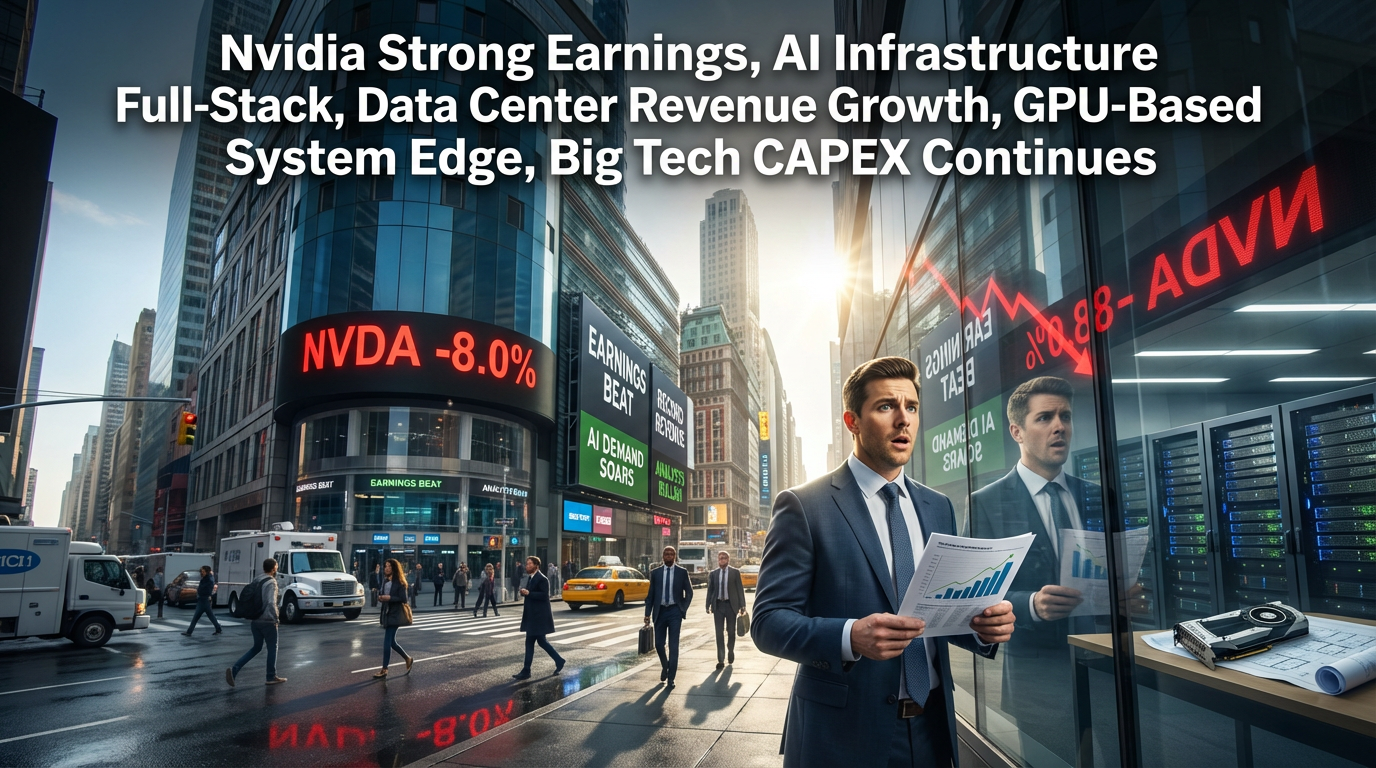
● Insane Nvidia Earnings, Stock Slumps, Wall Street Hikes Targets, Liquidity Crush
NVIDIA “The earnings were insane, so why did the stock drop?”: The real reason Wall Street raised price targets + the core points the market missed
Today’s post includes the following.
1) The point that reinterprets NVIDIA’s earnings numbers in their “real meaning”
2) The structural reason the stock went from +4% to closing at -5% after earnings (options/liquidity/psychology)
3) The core of the logic behind Wall Street raising price targets toward around 300 (not simple optimism)
4) The “infrastructure empire” scenario connecting Blackwell/Rubin/networking/sovereign AI
5) The single most important thing that other news outlets or YouTube rarely say (organized separately)
1) Breaking: NVIDIA earnings are not just “good,” they are ‘to the level of changing the industry structure’
Key takeaway numbers (per the original source)
– Quarterly revenue of $68.1B (beat consensus of $66.0B)
– EPS of $1.62 (beat estimate of $1.52, mentioned as about +90% YoY)
– Data center share nearing 90%
– Data center revenue: around $62.3B for the quarter, with annual scale mentioned at about $200B
The truly scary part from the market’s perspective
– “It’s normal for big companies to see growth slow,” but right now it’s accelerating instead
– Demand since ChatGPT is interpreted as not just “multiple times” (as phrased in the original) but on the order of 13x
2) If earnings are this good, why did the stock fall: organized into 3 layers
Layer A: Options/flow (short-term mechanical selling)
– Interpretation that there were many call option positions above $200, and there was stock held for delta hedging
– If the stock weakens early, call sellers (including market makers) may need less hedging and can sell the underlying stock
– It was likely flow that pressed the price down, “not bad earnings”
Layer B: Liquidity (the “money gate” capping the upside of the overall U.S. market)
– Mention that the TGA (Treasury General Account) balance increased significantly: an effect of draining liquidity from the market
– More Treasury issuance → if cash piles into the Treasury’s account, there is less money flowing into risk assets
– In this zone, no matter how good earnings are, “multiple expansion” doesn’t happen easily
Layer C: Fear of a peak in AI investment (narrative risk)
– The “Cisco dot-com bubble” analogy (a Michael Burry-type narrative) resurfaced
– Big Tech capex is growing too fast, so talk like a 2027 peak thesis is spreading
– In other words, the market has become sensitive not to NVIDIA’s earnings, but to the durability of customers’ spending
3) The “$95.2B purchase commitments” debate: risk, or moat (defense)?
Critique logic (where fear comes from)
– Massive long-term commitments totaling $95.2B across the supply chain such as TSMC wafers and HBM (SK Hynix/Samsung)
– If demand weakens, it could become a burden via fixed costs/inventory/contract obligations
Rebuttal logic (the core basis behind Wall Street raising price targets)
– The key is that right now it’s a market where you can’t sell because you can’t buy enough
– AI chips are supply-bottlenecked, so locking in long-term volume is effectively locking in market dominance
– In a period when HBM prices are surging, long-term contracts can also serve as “insurance” that protects margins
My one-line takeaway
– This commitment is not merely spending; it is closer to an industrial strategy in which NVIDIA fixes the supply chain “to its side.”
4) Why Wall Street raised price targets: re-rating from a “GPU company” to an “AI infrastructure company”
1) The Blackwell platform: the game-changer is not performance but ‘economics’
– Rack-scale product lines like GB300 NVL72 are ramping up in earnest
– If efficiency improves sharply at the same power/cost, customers find it hard to delay upgrading
– This is not simple tech boasting; it strengthens the “must-spend” nature of customer capex
2) Networking revenue: proof of NVIDIA’s full-stack lock-in
– Mention that networking surpassed $11.0B (3.5x YoY)
– Not just selling GPUs, but moving toward designing/packaging the entire data center “as a whole”
– If it captures optical communications/networking too, competition becomes not chip performance but “system competition”
3) Sovereign AI (government/nation-state demand): customer diversification is underway
– A pillar that reduces the concern that the top 5 hyperscalers account for most revenue
– Nation-state AI infrastructure builds, once started, are hard to stop and tend to become long-lasting due to security/sovereignty issues
5) Cash flow says everything: why NVIDIA can ‘grow its own scale even more’
An important passage in the original source
– Mention of quarterly FCF of $34.9B
– Pursuing shareholder returns (buybacks, etc.) and M&A simultaneously
– A strategy of pulling in the ecosystem via Groq acquisition and neo-cloud investments
What it means from an investor’s perspective
– Even in a high-rate/tight-liquidity environment, companies that can “grow with cash” have stronger multiple defense
– At this stage, competitors start falling behind not only in technology but also in “capital strength and speed”
6) NVIDIA’s real weapon: ‘speed’ structurally eliminates competitors
– A roadmap that refreshes the platform on a one-year cadence breaks competitors’ catch-up models
– By the time a competitor catches up to one generation, NVIDIA is shipping/sampling the next generation
– The mention that Rubin has already been sampled to customers pulls market expectations forward by another step
7) The next growth engine: beyond agentic AI to ‘physical AI’
It is small for now
– Autonomous driving/robotics revenue is still a small share (the original mentioned $6.0B in 2025)
But the direction matters
– Build an “agent economy” with data centers (AI factories)
– Then take the next chapter into robotics/autonomous driving (physical AI) as well, creating a dual engine
– This is not short-term earnings; it is the logic of long-term TAM (total addressable market) expansion
8) Valuation check: it looks expensive, but in the numbers it’s also awkwardly ‘cheap’
– It’s true that the market cap is so large that it feels burdensome
– But a scenario is mentioned where the forward P/E could fall into the low 20s
– If EPS growth stays high, it is hard to view it as “overheated” purely from a PEG (valuation vs. growth) perspective
What matters here
– The market right now is a regime where multiples (valuation) are set not by earnings but by rates and liquidity conditions
– So there can be periods where “earnings = stock price” does not connect immediately
9) The three major variables that will determine the multiple (a forward checklist)
1) Big Tech capex durability
– The core point is whether AI infrastructure investment can keep increasing
– This ties directly to the global economic outlook, corporate earnings, and the rate path
2) China export risk
– There is an interpretation that guidance already reflects it conservatively, but policy variables remain
3) In-house chip (ASIC) competition
– The reality is that TPU/Broadcom-based ASICs are a practical threat that can chip away at share
– But if the market expands faster, “share loss = absolute profit decline” may not be a direct link
10) News-style recap (today’s conclusion)
[Earnings] NVIDIA posted “all-time high” results with revenue/EPS beating consensus.
[Stock] The post-earnings surge-then-drop is interpreted as the result of overlapping options flow and the liquidity environment.
[Wall Street] The essence of price target hikes is a re-rating not of GPU sales but of “AI infrastructure full-stack dominance” (compute + network + sovereign AI).
[Risks] The capex peak thesis, China regulation, and ASIC competition limit the upside of the multiple.
[Catalyst] Next roadmap disclosures (Rubin/platform transition) such as at GTC are likely to be the point that reignites expectations.
The ‘single most important content’ that other YouTube/news relatively talk about less
The core point is that the short-term direction key for NVIDIA’s stock is not earnings, but liquidity (especially Treasury cash absorption) and the multiple.
Even if earnings are insanely good, if money is locked up in the market, “good earnings = immediate rise” does not happen easily.
So in this zone, NVIDIA is hard to explain with company analysis (technology/earnings) alone; you need to look at macro too (U.S. rates, liquidity, Treasury issuance) for the puzzle to fit.
If you miss this, you will just keep repeating, “Why isn’t it going up?”
< Summary >
NVIDIA’s earnings reaffirmed all-time highs centered on data centers, and Wall Street is raising price targets because of full-stack AI infrastructure (compute + network + sovereign AI) dominance.
However, in the short term, the stock can be driven heavily by options flow and the U.S. liquidity environment (TGA/Treasury issuance), so it may not move on earnings alone.
Going forward, the core variables are Big Tech capex durability, China export risk, and ASIC competition, and GTC is likely to be the next catalyst.
[Related posts…]
- Next-quarter checkpoints the market is watching after NVIDIA earnings
- Reading the direction of the U.S. stock market through liquidity flows (TGA·Treasury)
*Source: [ 월텍남 – 월스트리트 테크남 ]
– 월가가 목표주가 300으로 상향한 이유