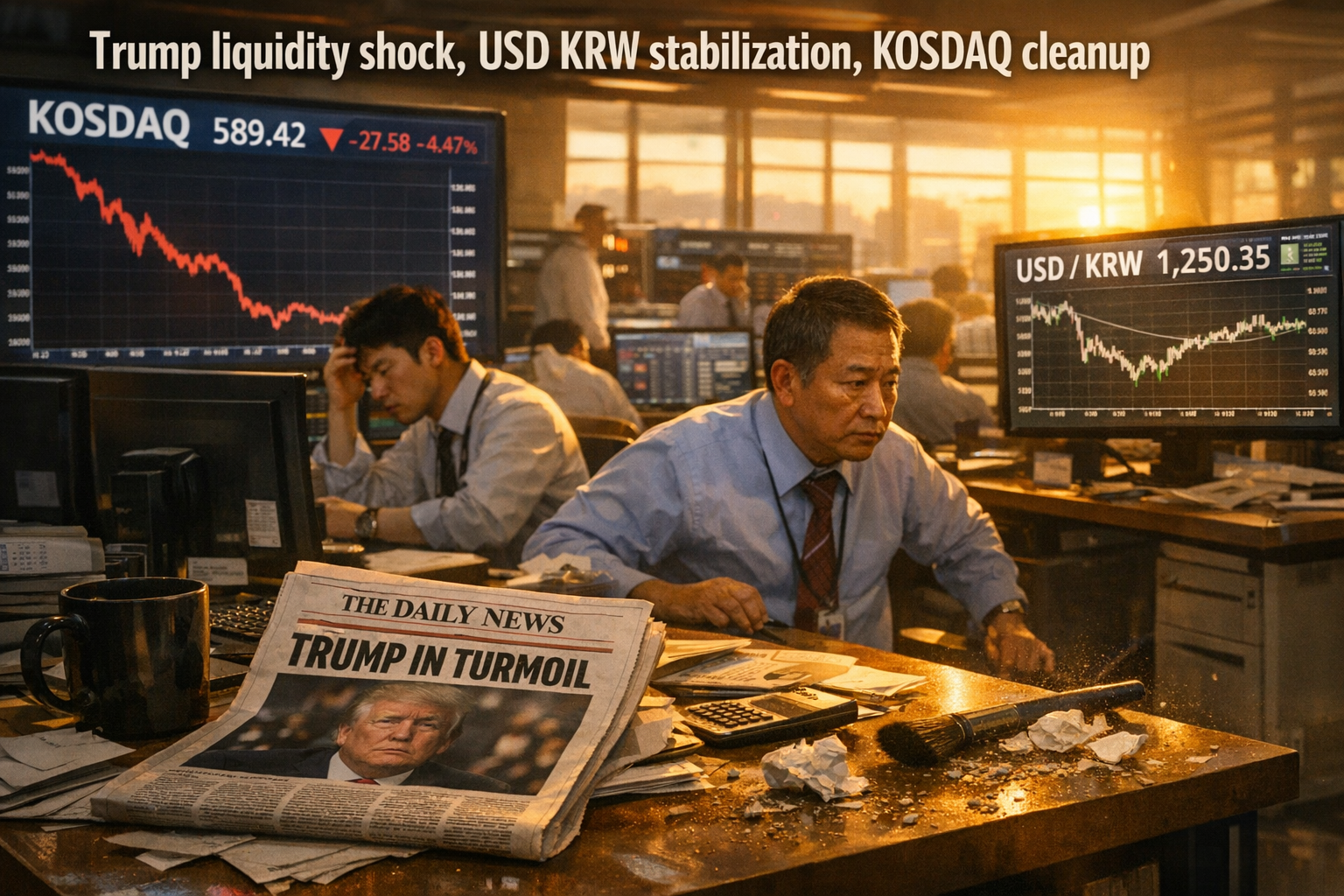
● Trump Liquidity Shock Triggers 2026 Market Shakeup, Dollar Slide Fuels Korea Surge, KOSDAQ Purge Looms
“A Correction Does Not Come ‘Now,’ It Comes ‘Then’?” The Real 2026 Market Triggers: Trump, Liquidity, FX, and KOSDAQ Cleanup
This report focuses on the following points.
1) The AI bubble debate is shifting from “collapse vs. no collapse” to identifying the “trigger” for a correction.
2) The dominant 2026 market variables are likely to be Trump’s midterm-election strategy and pressure on the Federal Reserve (rate cuts and liquidity).
3) For Korean equities, USD/KRW stabilization and/or depreciation of the dollar may be a more important switch for capital inflows than the KOSPI outlook itself.
4) For KOSDAQ, market cleanup (low-quality listings and unfair practices) is a prerequisite before policy support can be effective.
5) A less-discussed scenario: US liquidity expansion may not primarily lift US assets; it could instead accelerate capital leakage into ex-US (XUS) markets.
1) News Briefing: Key Market Messages From the Discussion (Part 3)
1-1. AI bubble collapse? The debate is about “conditions,” not “timing”
The discussion began with “when will the AI bubble collapse,” but did not converge on a simple bearish vs. bullish conclusion.
The central framing was: a correction is likely at some point, but the trigger may be political events (midterms) and shifts in policy/liquidity rather than an AI-specific catalyst.
In other words, system-wide liquidity and risk events are viewed as higher-order drivers than the AI theme itself.
1-2. The largest variable: Trump’s incentive to support markets ahead of the midterms
A recurring point was that the administration may seek to manage market sentiment ahead of the midterm elections.
Trump may continue to pursue visible “reversal actions,” and the market could front-run signals of rate-cut pressure or liquidity support.
This was positioned as a primary through-line for 2026 asset markets.
1-3. The post-midterm period may be higher risk: increased unpredictability
A key caution was that Trump should not be treated as a conventional policy actor.
The view expressed was that unpredictable actions could expand, and market volatility may exceed standard scenario ranges.
In summary: pre-midterm conditions may favor pro-market support, while post-midterm conditions may carry higher risk of volatility and event-driven dislocation.
2) Global Macro View for 2026: Liquidity Can Be Both Supportive and Destabilizing
2-1. The first objective: inflation stabilization to justify rate cuts
For the Federal Reserve to cut rates, a credible inflation downtrend in US CPI/PCE is required.
Accordingly, Trump may attempt to shape conditions that mechanically reduce inflation pressures.
Potential channels discussed included de-escalation of geopolitical tensions to stabilize oil prices and increased inflows of low-cost consumer goods from China (including tariff/import-structure adjustments).
If successful, the market may price a stronger liquidity expansion narrative.
2-2. “If liquidity expands, do US assets rise the most?” Capital may rotate to ex-US (XUS)
A key point was a reversal of the typical assumption that US liquidity primarily lifts US equities.
Signs of rotation into ex-US markets were noted, and rising Trump-related risk could reinforce incentives to seek returns outside the US.
Liquidity may therefore be supportive for global risk assets, while the primary beneficiaries may not be US markets.
3) Korea Equities (KOSPI and KOSDAQ): FX as the “Capital Inflow Switch”
3-1. USD/KRW in 2026: a cap on upside and downside stabilization as a sentiment inflection
The discussion emphasized FX as Korea’s most important variable.
After USD/KRW strength (KRW weakness) in 2025, a 2026 scenario of USD/KRW stabilization and decline (KRW stabilization/strength) could alter institutional and foreign flows.
This is not only a sentiment issue; it reduces FX-loss risk for offshore investors and improves the risk-adjusted case for increasing Korea exposure.
3-2. Korea’s advantage: a dense AI value chain after the US and China
Korea was framed as having a relatively complete AI value chain (semiconductors, equipment, materials, power, infrastructure, and applications).
If global liquidity rotates toward non-US markets, Korea could be a plausible beneficiary.
If combined with a semiconductor cycle upturn and supply-chain restructuring, directional clarity for the KOSPI could improve.
4) The Practical Answer for KOSDAQ: “Trust and Cleanup” Before Policy
4-1. Execution matters more than announcements
A core point was the gap between policy announcements and realized change.
In a high-uncertainty year such as 2026, countries with consistent policy execution may earn a relative premium.
4-2. KOSDAQ requires “removing bad actors,” not index promotion
The most direct message was that KOSDAQ recovery requires market hygiene before stimulus.
Priorities include enforcement against unfair trading, dismantling manipulation schemes, and removing low-quality listings (including micro-priced stocks).
If addressed, KOSDAQ valuation could re-rate because the discount often reflects trust and governance risk rather than growth potential.
5) Key Points Often Missing in Mainstream Coverage
5-1. The AI bubble debate is not the core issue; the core issue is political distortion of liquidity
Much coverage focuses on AI valuation levels.
This discussion emphasized higher-order drivers: corrections may be triggered by the liquidity cycle shaped by Trump’s midterm strategy and pressure on the Federal Reserve.
5-2. Liquidity expansion does not necessarily lift only US assets
Even if policy increases liquidity, capital may not stay domestic.
If Trump-related risk rises, global investors may find it easier to deploy into ex-US (XUS) markets, strengthening reallocation trends.
Under this scenario, Korea could gain attention as an intermediate hub combining manufacturing depth, AI/semiconductor value chains, and a more favorable FX regime.
5-3. For KOSDAQ, “cleanup” is a more durable return driver than “support”
Policy funds and growth vehicles are frequently proposed.
However, without structural cleanup, flows may remain short-term and theme-driven.
Delisting low-quality firms and strengthening enforcement against unfair practices were positioned as the highest-leverage measures to improve long-term market returns through restored credibility.
6) Checklist: How Investors (Stocks/ETFs) Can Frame 2026
Global macro
- Whether the US CPI/PCE disinflation trend is sufficient to support rate-cut justification.
- Whether oil/geopolitical risk becomes a trigger for inflation re-acceleration.
- Whether pre-midterm messaging and policy signals raise risk appetite or increase distrust.
Capital flows (global liquidity)
- Whether US-to-ex-US (XUS) rotation becomes structural.
- Whether a break in USD strength catalyzes rebalancing toward emerging markets/Asia.
Korea equities
- Whether USD/KRW upside pressure fades and the pair stabilizes (a switch for foreign flows).
- Whether earnings-backed strength broadens within the semiconductor/AI value chain.
- Whether enforcement against unfair trading and removal of low-quality listings translates into observable execution.
< Summary >
The primary 2026 correction driver is likely to be the liquidity cycle shaped by Trump’s midterm strategy and pressure on the Federal Reserve, rather than AI valuations alone.
Pre-midterm policy incentives may support markets, while post-midterm political and geopolitical risks may increase volatility.
For Korea, USD/KRW stabilization and decline could be a key switch for institutional and foreign inflows.
For KOSDAQ, credibility restoration through enforcement and removal of low-quality listings should precede policy support.
Even with US liquidity expansion, capital may rotate toward ex-US (XUS) markets; this scenario should remain a central consideration.
[Related Articles…]
https://NextGenInsight.net?s=exchange-rate
https://NextGenInsight.net?s=KOSDAQ
*Source: [ 경제 읽어주는 남자(김광석TV) ]
– ‘이것’ 때문에 조정옵니다. “트럼프, 선 넘을 것” | 경읽남과 토론합시다 | 오종태 대표_3편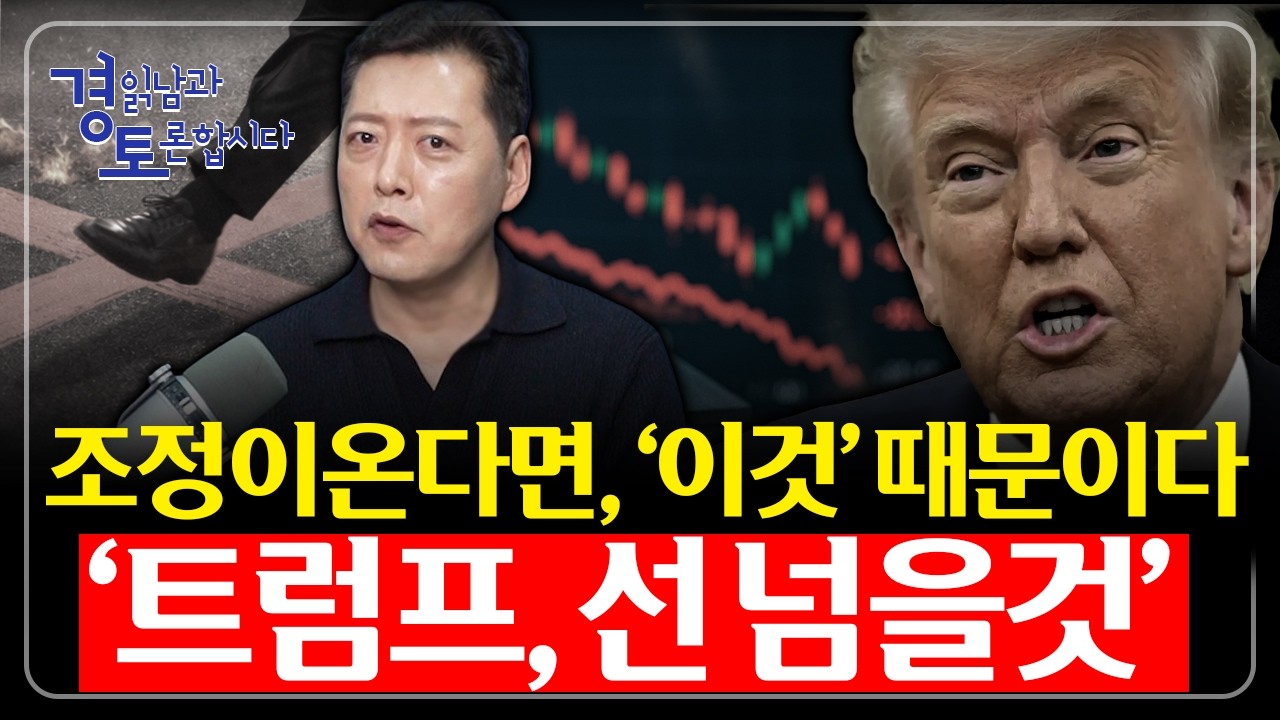
● US-Iran Regime-Change Showdown, Oil Spike, Stocks Shudder, AI Credit Crunch
US-Iran “Regime Change” Phase Shifts Risk Across Oil, Equities, and AI: Five Key Takeaways
This report consolidates five points.
1) The narrative has shifted from “strikes on nuclear facilities” to “leadership removal/regime change.”
2) Market outcomes diverge materially between a “rapid resolution within the weekend” and a “protracted conflict,” with distinct oil and equity scenarios.
3) The transmission mechanism from higher oil prices to inflation and a spike in US long-term yields, and how this pressures AI leaders via valuation and financing costs.
4) A practical risk-hedging checklist for individual investors (cash, energy equities, FX, and staged execution).
5) Why “AI private credit” leverage structures become more vulnerable in this environment.
1) Headline Summary: The Conflict Has Shifted From “Nuclear Negotiations” to “Regime Removal”
The central point is a reframing from “airstrikes on nuclear facilities” to “leadership removal (regime change).”
This matters because strikes on facilities can function as negotiating leverage, whereas a regime-change posture reduces the counterpart’s ability to de-escalate without severe credibility and survival costs, increasing the probability of retaliation, escalation, and a longer duration.
The concurrent appearance of “additional OPEC+ supply” headlines is interpreted as a coordinated response aimed at containing an oil-price spike associated with conflict risk.
2) Markets Price Uncertainty More Than War Itself
Equities can adapt to familiar negatives (e.g., slower growth, earnings resets, regulation). However, low-frequency events that markets have not previously absorbed can trigger abrupt risk premia.
A US-Iran war scenario is treated as a comparatively unfamiliar risk for market pricing. Risk assets such as Bitcoin may react first, with spillover to equities, particularly growth, leveraged exposures, and high-valuation segments.
3) Two Oil Scenarios: Rapid Resolution Is Supportive; Prolongation Is Adverse
3-1) Rapid Resolution (Stabilization Within the Weekend)
If the conflict is contained quickly, oil-price pressure may ease, reducing inflation concerns and supporting stability in US Treasury yields, particularly the long end.
This can prompt renewed repricing of potential Federal Reserve easing, providing relative relief for Nasdaq and AI-linked growth equities.
3-2) Protracted Conflict (Repeated Retaliation/Escalation/Hormuz Risk)
The primary channel is persistent pricing of supply-disruption risk. The Strait of Hormuz is a critical chokepoint; even heightened risk perception can raise insurance, freight, and rerouting costs, tightening effective supply and supporting higher spot prices.
Asia, including South Korea, has high energy-import dependence; higher oil prices can transmit into a cost shock affecting trade balance, manufacturing input costs, inflation, and FX dynamics.
4) The Core Transmission: Oil → Inflation → Rates → Pressure on AI Leaders
The relevant mechanism extends beyond headlines: higher oil can lift inflation expectations, push US long-term yields higher, and raise the cost of capital, compressing AI-related valuations and tightening funding conditions.
4-1) AI Sector Sensitivity: Expansion Ahead of Cash Generation
Many AI companies and projects are not positioned to service interest expense from operating cash flow in the near term; they rely on valuation appreciation, equity raises, and incremental borrowing.
4-2) Costs Are Rising Concurrently: GPU/HBM/Electricity
Rising HBM prices, GPU costs, and electricity/operating expenses can compress margins when pricing power is limited. In a higher-rate backdrop, incremental financing becomes more expensive, tightening the investment ecosystem.
4-3) Private Credit as a Stress Point
A portion of AI funding is linked to private-credit structures that can embed layered leverage, including PIK-style interest capitalization. Small moves in rates can materially reduce resilience in leveraged structures.
A widening in AI-related credit spreads can feed back into public-market valuations and the availability and cost of funding for growth equities.
5) Portfolio Implications: Four Practical Hedges for Individuals
5-1) Increase Cash Allocation
Cash reduces portfolio drawdown risk and preserves optionality for incremental purchases during volatility.
5-2) Maintain AI Leaders, Add Partial Insurance via Energy/Refining Equities
Instead of direct commodity exposure, energy/refining equities, particularly those with higher US domestic production exposure, can function as a hedge.
The logic is directional offset: prolonged conflict → higher oil prices → improved earnings potential for energy sectors, providing diversification against growth-duration risk.
5-3) Use FX/Safe-Haven Characteristics (e.g., JPY)
JPY can serve as a hedge, but correlations can shift; sizing should remain conservative and limited to exposures the investor can monitor and understand.
5-4) Tactical Positioning: “Friday Hedge, Monday Reassess”
Given the probability of weekend developments, a tactical approach is to implement partial hedges into the weekend and recalibrate after markets reopen based on verified information.
6) Forward Triggers: Six Indicators Markets Are Likely to Monitor
1) Scale of Iran retaliation: symbolic versus material damage
2) Damage to US assets (ships/bases/personnel): increases the likelihood of deeper US involvement
3) Strait of Hormuz signals: even verbal escalation can move oil prices
4) Execution risk of additional OPEC+ supply: headline versus realized barrels
5) US long-end yield spike risk (e.g., 10-year): direct pressure on AI/growth valuations
6) Credit-market stress signals: high-yield spreads and private-credit-related headlines
7) Under-Discussed but Material: AI Rally Sensitivity to the Cost of Capital
Coverage often focuses on oil, defense, and gold. A more material variable is the sensitivity of AI funding to rates and credit conditions.
This is not only a geopolitical risk; it can raise the cost of capital, a key driver in the AI cycle debate, tightening both valuation frameworks and financing capacity.
Relevant chain: oil up → inflation expectations up → long-term yields up → credit spreads wider → private-credit leverage under stress → reduced sustainability of AI investment pace.
8) SEO-Aligned Keywords (Embedded in Narrative)
Key market drivers: inflation, US Treasury yields, Federal Reserve easing expectations, oil prices, and Nasdaq volatility.
< Summary >
The US-Iran confrontation is framed as shifting from negotiation leverage to a regime-removal posture, increasing the probability of a longer-duration risk premium.
A rapid resolution could ease oil and rate pressures, supporting Nasdaq and AI-linked growth equities.
A prolonged scenario can lift oil, inflation expectations, and US long-term yields, tightening AI financing conditions (private credit/leverage) and compressing valuations.
Individual investors can consider maintaining core exposure while adding pragmatic hedges via higher cash, partial energy-sector allocation, selective FX, and staged execution.
Markets may react more to uncertainty and deterioration in rates/credit conditions than to conflict headlines alone.
[Related Articles…]
- Oil Price Volatility: Key Investment Checkpoints for the Energy Sector
- How US Long-Term Yield Moves Affect Nasdaq and AI Market Leaders
*Source: [ Jun’s economy lab ]
– 결국 미국과 이란전쟁의 장기전쟁이 시작됐습니다.(ft.유가, 증시 영향)
● Gym Scam Chargeback Shield – Credit Freeze Warfare
Why US Consumers Rarely Call the Police First After a Gym “Exit Scam,” and Two Financial Infrastructure Capabilities Korea Should Adopt Faster
This report focuses on two core points:
1) In the United States, even if a gym operator disappears overnight, the system is designed so consumers typically do not need to pursue recovery themselves (chargebacks).
2) In an era of identity-document fraud and deepfakes, relying on bank-side identity verification is insufficient; controlling credit access by default (credit freeze / credit-lock mechanisms) is becoming essential.
It also highlights under-discussed issues: fees, merchant risk transfer, the gatekeeping power of credit bureaus, and the financial-market impact of AI-enabled fraud.
1) [News Brief] When a Gym “Exit Scam” Occurs: Korea vs. the United States
1-1. Korea Scenario: Victims Must Pursue Recovery Directly
A consumer pays for a 1-year membership by card; the next day the facility is closed and the owner has disappeared.
Typical responses include organizing victim groups, filing police reports, submitting consumer-protection complaints, and contacting media.
As time passes, the probability of recovery typically declines. Even if a civil judgment is obtained, collection may be impractical if the counterparty is insolvent or declares bankruptcy.
1-2. US Scenario: The System Refunds First; the Merchant Must Prove Performance
Consumers often resolve the issue via the card issuer’s app: transaction history -> dispute -> reason (services not provided).
The key difference is refund priority. The issuer commonly provides a provisional credit to the consumer, then recovers funds by debiting or freezing the merchant’s settlement account. If contested, the merchant must substantiate that services were delivered.
1-3. Root Cause: Infrastructure Enforces Behavior via Rules, Not Trust
In a large, high-anonymity market, the system is not built on merchant goodwill. In exchange for card acceptance fees, payment networks (e.g., Visa/Mastercard rails) act as a private adjudication and enforcement layer. Trust is effectively outsourced to rule-based infrastructure.
2) [Core Mechanism] How Chargebacks Reshape Market Behavior
2-1. Chargebacks Function as Consumer Protection and Merchant Discipline
Chargebacks are not merely refunds; they are governance tools within payment networks.
Merchants with elevated chargeback ratios may be classified as higher risk, face higher fees, delayed settlements, reserve requirements, or account termination. The result is behavioral control driven by infrastructure and network rules rather than individual ethics.
2-2. Why US Consumers Open the Card App Before Calling Police
From the consumer perspective, the priority is speed of loss recovery. Criminal proof standards and civil litigation are slow and uncertain; card dispute processes are faster and standardized. Consumer behavior rationally follows the fastest recovery path.
2-3. Implications for Consumption and Economic Activity
Lower perceived risk supports larger prepayments and subscription-style service markets. Network-based dispute absorption can reduce perceived household risk and may contribute to consumer resilience, including during periods of high interest-rate volatility.
3) [Security] The End of “Banks Will Block It”: Equifax and the Credit Freeze
3-1. Korea’s Exposure: Remote Account Opening and Lending via ID Image Fraud
Recurring cases show that forged identity-document images can enable remote account openings and lending.
The key shift is from theft of physical documents to creation of digital replicas using leaked images and data. Deepfake and synthetic media further pressure traditional KYC models.
3-2. The US Experienced a Similar Shock: The 2017 Equifax Breach
A major credit bureau breach exposed sensitive personal data at scale and accelerated the realization that neither government nor banks can fully protect identity. Strong perimeter security is insufficient if the asserted identity is fraudulent.
3-3. The Response: Credit Freeze
A credit freeze locks access to a consumer’s credit file. If lenders cannot pull credit, underwriting workflows often cannot proceed, preventing many forms of new-account fraud.
This approach is operationally inconvenient but provides high-impact loss prevention.
3-4. Korea’s Credit-Blocking Programs Point in the Same Direction
Credit-transaction blocking services are aligned with this model: as remote verification becomes more vulnerable to AI-enabled spoofing, preventive permission control becomes more important than post-incident remediation.
4) [AI Trend] How Deepfakes and Synthetic Fraud Are Changing Financial Infrastructure
4-1. AI Is Also an Engine for Fraud Automation
Even as banks deploy AI for authentication, attackers also use AI. Forged IDs, face synthesis, and voice cloning reduce cost and increase success rates.
4-2. The Competitive Focus Shifts from Authentication Accuracy to Permission Control
Raising authentication accuracy is an arms race without a terminal outcome. Locking critical permissions by default (credit file freeze / credit access blocking) is likely to become a mainstream control layer.
4-3. Investment Angle: Re-rating of Payment Networks and Identity Infrastructure
Rule-based networks that standardize disputes (e.g., chargeback frameworks) and identity-credit control layers (credit reporting, freezing, unlocking) exhibit characteristics of essential infrastructure. As AI fraud scales, the defensive value of established rule-enforcing networks may be reinforced.
5) Under-Discussed Points with High Relevance
5-1. Chargebacks Are Not Free: Costs Are Socialized via the Merchant Ecosystem
Consumer convenience is funded through fees, risk-management overhead, and price pass-through across the market. Individual enforcement costs are effectively converted into system usage costs.
5-2. Rule-Based Infrastructure Can Be Harsher for Small Merchants
When the burden of proof shifts to merchants, smaller operators may be disadvantaged due to weaker documentation, operations, and customer-service capacity.
Recurring prepaid-service failures reflect not only business-model risk but also deficiencies in dispute resolution, settlement controls, and escrow-like safeguards.
5-3. Credit Bureaus’ Gatekeeping Power Is Likely to Increase
Despite breach history, credit freeze mechanisms rely on bureau-controlled infrastructure, underscoring the dependence of economic participation on credit systems.
As AI fraud becomes more sophisticated, the importance of gatekeeping layers (credit pulls, freezes, unfreezes) may rise further.
6) Practical Checklist: Actions Individuals Can Take Now
6-1. For Prepaid or Long-Term Purchases
- Prefer credit cards where possible.
- Cash and bank transfers can provide weaker dispute recovery.
- Retain evidence supporting non-delivery (contracts, receipts, screenshots of notices).
6-2. For Identity and Credit Fraud Defense
- Consider credit-transaction blocking services where available.
- Enable alerts for remote lending/account-opening and credit inquiry monitoring.
- Treat storage of ID images as a breach-assumed risk.
In the United States, consumers often recover losses from prepaid-service failures via chargebacks rather than police reports or litigation. This reflects rule-based financial infrastructure that enforces merchant behavior through network governance.
In the deepfake and forged-ID era, security posture shifts from trusting authentication to controlling permissions: credit freezes and credit-transaction blocking are becoming core preventive measures.
[Related Links…]
- Chargeback: https://NextGenInsight.net?s=chargeback
- Credit: https://NextGenInsight.net?s=credit
*Source: [ Maeil Business Newspaper ]
– 헬스장 사장이 튀어도 미국에서 경찰 안 부르는 이유 (금융 인프라) | 홍키자의 美쿡 | 홍성용 특파원