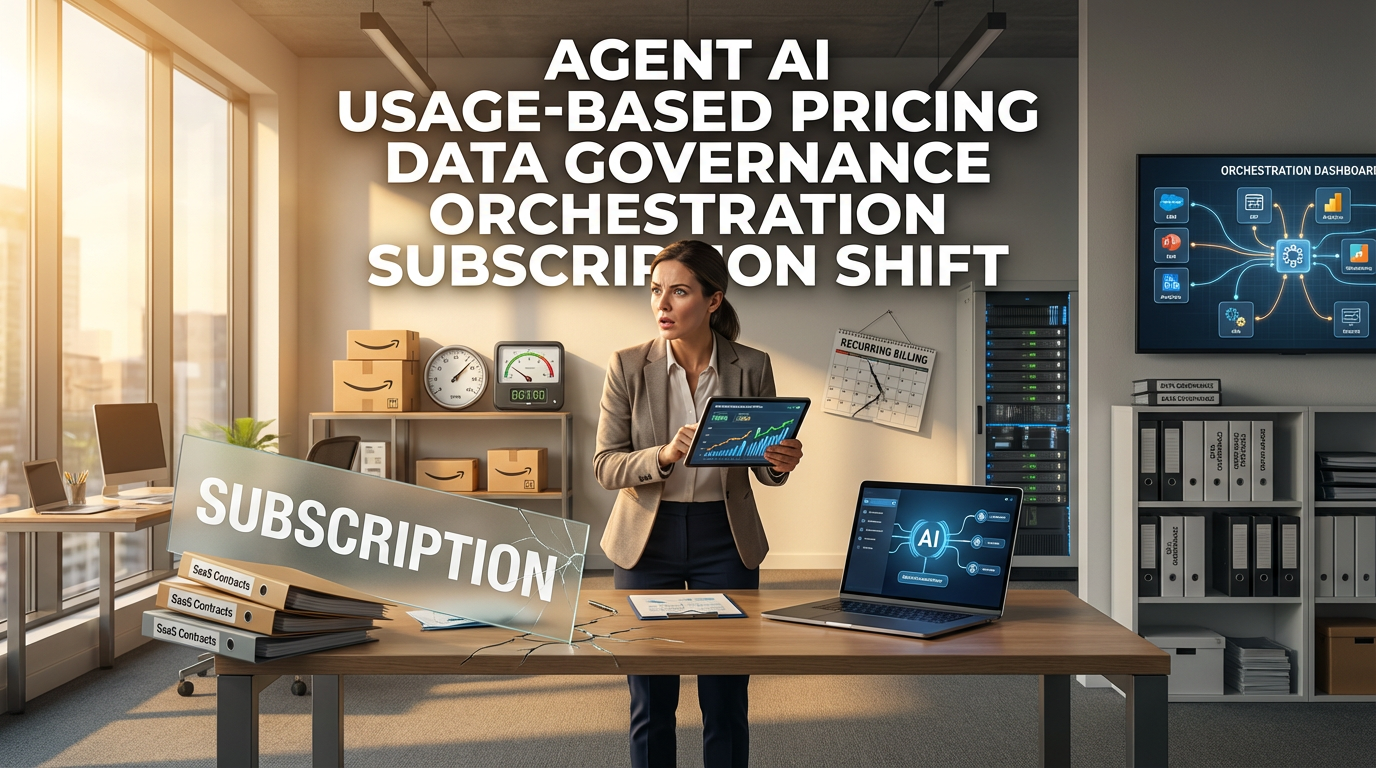
● Agent Shock, SaaS Pricing Meltdown, Winners and Wipeouts
AI Agents Are Shaking Up SaaS: Whether the “SaaSpocalypse” Is a Real Crisis or Hype, and Who Survives
In today’s post, I made sure to include exactly five things.
1) Why a “3.5-year-old LLM” is only now amplifying SaaS fear (the core trigger)
2) The SaaS/software companies whose stock prices swung sharply, and what they were commonly vulnerable to
3) Why “per-seat pricing” can structurally collapse, and what the next pricing model is
4) Companies that will fail vs. companies that will survive: a survival checklist for the agent era
5) The realistic scenarios that will hit Korea first (startups, SI, outsourcing, and the junior ecosystem)
1) News Briefing: Why the “SaaSpocalypse” Broke Out Now
The key takeaway is not “chatbots,” but “agents.”
Earlier LLMs were at the level of “write code when you ask” (vibe coding), and people still handled execution, integration, and verification.
But the recent trend has shifted to agentic AI that “moves around on its own and executes tasks end-to-end.”
Trigger examples that were cited
– “OpenClo (agent)”: performs real tasks like travel booking directly on the web (search → compare → purchase → deliver results)
– “Claude Code”: goes beyond coding to execute step-by-step tasks like fetching/moving/analyzing data
– “Claude Code Security”: a signal that AI can rapidly replace the code review (static analysis) domain as well
The market reaction is closer to “fear of future pricing/moat collapse” than “earnings deterioration.”
In other words, it’s not that revenue collapsed right away; rather, a re-rating came first around “the stability of the subscription model (ARR) might get shaken.”
2) Why Stock Prices Are Shaking Now: It’s Not the Product, but the BM (Pricing) and Moat That Got Attacked
The core of this issue is not simply “AI imitates features.”
When AI agents appear, the SaaS business model itself changes.
(1) Per-seat pricing collapse scenario
B2B SaaS like ERP/CRM/HR typically charges based on “number of employees (number of accounts).”
But if agents do the work, tools that 100 people used can run with “one agent account.”
The moment that happens, the easiest growth formula for SaaS revenue (seat expansion) breaks.
(2) UI/UX value decline scenario
UI matters when humans must click through it themselves.
If agents make systems talk via APIs, “a pretty screen” matters less, and “good API design/permissions/audit logs” matter more.
(3) “Feature moats” weaken, leaving only “data/workflows/standards/switching costs”
The faster AI can implement features, the lower the premium on features themselves.
Instead, the following become the defensive walls.
– A repository where data accumulates (data platform)
– Business standards (processes) and audit/compliance
– Migration costs (switching costs)
– Network effects (industry-standard files/formats/collaboration inertia)
3) “Who’s Nervous”: Four Types of SaaS That Are Vulnerable in the Agent Era
Based on the original conversation, the practical risk categories can be summarized into the four types below.
① “Simple automation/integration SaaS” with low development difficulty
Functions that are basically “just connect APIs and you’re done,” or tools people used because it was “too annoying,” get eaten by agents immediately.
Examples: simple alerts, simple workflows, simple data transfers/report generation
② Services that sell processed data that anyone can access
If the data is public (news, disclosures, structured information, etc.), AI can copy it much more easily.
Conversely, proprietary/closed data has strong defensibility.
③ Products without industry standards or strong reputation
Products with low replacement cost invite “should we just build it with AI?”
On the other hand, things like PowerPoint/Excel are not a coding problem; they’re “standards,” so they don’t change easily.
④ Products with no migration friction
If canceling causes big losses, customers keep using it; but if data/automation sequences/integrations are simple, switching is easy.
Types like the Mailchimp case—“features are simple, but you can’t quit because of operations/integrations/history”—can actually gain defensibility.
4) On the Flip Side, Who Survives or Gets Bigger: “SaaS That Agents Need”
This is the truly important point from here on.
AI doesn’t eliminate SaaS; it changes SaaS’s role.
(1) Orchestration layer: flow managers like ServiceNow
Even if people decrease, “workflows” remain.
It’s just that agents coordinate what people used to coordinate, and the companies that establish coordination/tickets/approvals/audit systems can become even more important.
(2) Data infrastructure layer: storage, permissions, and governance become the moat
The smarter agents become, the more competitiveness depends on “which data they can access.”
So data platforms, data warehouses, security/access control, and audit logs may see even stronger demand.
(3) SaaS grounded in specific industries/regulation/proprietary data
In areas like pharma, legal, and tax—where data sharing is difficult and regulation is strong—“just replace it with AI” is slower than people think.
That’s because “data + compliance + accountability” gets sold as a package.
(4) Spending shifts from “apps (applications)” to “infrastructure”
This is one of the conclusions that appears in the original discussion.
If companies used to spend on apps, now spending shifts to foundational layers like cloud computing, databases, APIs, and developer tools.
From a global economic outlook perspective, this can be interpreted as a long-term trend in IT spend moving from “subscription apps → usage-based infrastructure.”
5) Pricing Models After “Per-Seat Pricing”: The Next BM Reforms Like This
This is the point the original discussion said “will be solved.”
So what does it change to?
① Usage-based pricing
Instead of seats, you charge based on work processed/call volume/API traffic/number of automation runs.
② Outcome-based
Examples: charging by results such as “number of lead conversions,” “amount of cost savings,” or “number of security vulnerabilities detected.”
③ Agent pricing (agent/task-based)
The pricing unit becomes how many agents run inside the company and how many tasks they execute.
This is especially likely to materialize quickly in domains that map cleanly to “tickets/tasks,” such as CRM/ITSM/security.
④ Bundling/platformization (marketplace take rate)
As plugin ecosystems grow, SaaS can generate revenue less from selling features and more from “platform fees/distribution.”
6) The Shock That Will Hit Korea First: Startups, SI, and the Junior Ecosystem Hurt More
(1) “Junior products (MVP SaaS)” become the hardest
If you can build MVPs quickly, that means barriers to entry have dropped, making early SaaS pricing/differentiation even harder.
There are already real cases like “canceling a document-signing SaaS and building it in-house.”
(2) The SI/outsourcing market shifts faster toward “consulting + AI operations”
The labor-arbitrage model (especially simple projects) gets hit head-on by AI.
Korea also has a large SI ecosystem around Gasan/Guro, and the “headcount input = revenue” model will inevitably face pressure.
(3) SI that survives looks like “continuous coding”
A Korean startup example mentioned in the original discussion is a hint.
Sales/consultants talk with customers and use AI to show a 90% prototype immediately,
while engineers refine it behind the scenes into secure, optimized, operable code.
In other words, SI moves from “selling development labor” to selling “problem definition + prototyping + validation.”
(4) Junior talent issue: it’s not “opportunity,” the “entry gate” narrows
When productivity rises, in the short term it becomes “let’s do more work,”
but if market demand hits limits, it can shift to “let fewer people do it.”
In that case, the first hit is junior hiring/junior tasks.
7) Is This Fear a Bubble? The “Real Metrics” to Check
The conclusion in the original discussion was clear.
Right now, financial metrics have not shown an outright “blow-up.”
Still, the market is sensitive because trust in ARR—one of the core pillars of SaaS valuation—has started to wobble.
Four metrics to watch going forward
1) Whether NRR (net revenue retention) declines: including slowing upsell/cross-sell
2) Whether price cuts/large discounts increase
3) Whether seat counts shrink (account reductions) vs. a shift to usage-based pricing
4) Whether “we’ll add AI and charge more” works, or whether unit price pressure comes instead
8) The “Most Important Point” That Other News/YouTube Talk About Less
The essence of this change is not “software gets replaced,” but “the criteria for purchase decisions change.”
Until now, B2B SaaS was sold like this.
– “If you use our tool, you won’t need to hire one more person.”
But in the agent era, customers start calculating like this.
– “Isn’t a developer’s one hour + model usage fees cheaper than this SaaS subscription?”
That is, the competitor is no longer “another SaaS,” but a combination of the customer’s internal development + AI usage (model cost).
From that moment on, the market shifts away from feature comparisons and gets reshaped into a battle over
TCO (total cost of ownership), operational/update burden, accountability (security/outages/audits), and data governance.
If you miss this point, it’s easy to fall into the illusion of “we’ll add AI features and charge more.”
In reality, the structure moves the other way: “the more features become commoditized, the more unit price pressure arrives.”
9) One-Line Conclusion: SaaS Won’t Die, but “App Companies” Will Die and Only “Infrastructure/Orchestration/Data Companies” Will Remain
AI agents don’t eliminate software; rather,
they shift the center of software from “UI that humans use” to “APIs + data + governance that agents use.”
In that process, scenes where growth-stock valuations wobble (especially U.S. tech stocks) are likely to repeat.
For a while, short-term volatility will be high, and companies will push pricing transitions and platform strategies at the same time.
< Summary >
As agentic AI (OpenClo, Claude Code, security review) emerges, SaaS is seeing its “per-seat pricing” and “moat” shake before its features do.
Vulnerable SaaS includes simple automation, public-data services, products lacking standards, and products with low switching costs.
Survivors are orchestration (coordination), data infrastructure, and regulation/proprietary-data-based businesses, while pricing shifts toward usage-, outcome-, and agent-based models.
Korea will see earlier pressure on MVP startups, SI/outsourcing, and the junior ecosystem, but “consulting + AI operations” SI becomes an opportunity.
[Related Posts…]
- Work Automation Transformed by AI Agents: A New Standard for Enterprise Productivity
- The Inflection Point of the SaaS Subscription Model: Why Usage-Based Pricing Becomes the Mainstream
*Source: [ 티타임즈TV ]
– AI 타고 날아갈 줄 알았던 SaaS 회사들의 좌절, 누가누가 떨고있나?