● Trump Demands Iran Regime Change, Middle East War Spiral, Oil Shock, Inflation Surge, Dollar Whiplash, AI Chip Supply Crunch
Trump Publicly Calls for “Overthrow of the Iranian Regime”: Full-Scale Middle East Escalation Scenarios and Implications for Oil, Inflation, FX, Semiconductor Supply Chains, and AI Infrastructure
This note focuses on five core elements.
1) Policy signals embedded in Trump’s statement (war rationale, objectives, red lines), parsed at the sentence level
2) What Iran’s parliamentary response implies for a potential breakdown of the nuclear-negotiation framework
3) Escalation pathways by target set (US bases in the region, maritime routes, energy infrastructure), presented as scenarios
4) Global macro transmission: oil spike → inflation re-acceleration → rates / USD / KRW volatility
5) Second-order shocks to “AI data centers, semiconductors, and power/cooling infrastructure costs,” often undercovered
1) Key “War-Framework” Sentences: Six Policy Signals
The language is rhetorically forceful, but it also specifies operational and political objectives.
1) Objective definition: Launch of large-scale combat operations framed as eliminating an “imminent threat” from the Iranian regime.
2) Regime characterization: Iran labeled as the “world’s leading state sponsor of terrorism,” reinforcing a legitimacy framework for international audiences.
3) Red line: Repeated insistence that Iran must “never” possess nuclear weapons, anchoring the casus belli to the nuclear issue.
4) Means: References to “devastating” missile industry capabilities and “destroying” naval assets suggest a sustained campaign rather than a one-off strike.
5) Internal fracture inducement: Direct messaging to the IRGC/military/police offering amnesty for compliance and lethal consequences otherwise, consistent with psychological operations.
6) Regime-change signal: A direct call to “take back” the government is consistent with a regime-change posture.
2) Iran’s Parliamentary Messaging: Key Implications
The response indicates three main points.
1) “If Europe/Russia/China fill the international vacuum, nuclear capability can be maintained”
→ Signals reliance on external backstops to reduce isolation and sustain strategic programs.
2) “Otherwise, an independent nuclear path will force Trump to come to his senses”
→ Indicates preference for strengthening nuclear leverage rather than returning to negotiations.
3) “No obligation to maintain the existing position”
→ Builds justification to exit prior commitments, weakening the freeze/verification framework.
3) US Military Sites Referenced as Having Been Attacked: By Country
The following is organized for readability and reflects the referenced description; damage and attribution require independent verification.
Bahrain
– Al Jufayr base
– US Fifth Fleet headquarters
Qatar
– Al Udeid Air Base
Kuwait
– Camp Arifjan
– Ali Al Salem Air Base
– Mubarak Air Base
United Arab Emirates (UAE)
– Al Dhafra Air Base
– Jebel Ali Port
– Fujairah Air Base
Saudi Arabia
– Prince Sultan Air Base (Riyadh)
– Tabuk base
– Khamis Mushait base
– Bases in the western Jeddah area (multiple sites implied)
Jordan
– Muwaffaq Salti Air Base
Iraq
– Erbil base
4) Escalation Scenarios: Which Targets Move Markets First?
Scenario A: Maritime routes / Strait of Hormuz risk escalation
– Immediate risk premium on crude and LNG flows, increasing oil-price volatility.
– Higher oil prices can re-ignite global inflation pressures.
– Re-accelerating inflation can delay expectations for policy easing, particularly in the US.
Scenario B: Cross-retaliation cycle involving US bases
– Repeated near-term clashes typically strengthen safe-haven demand and support USD strength.
– A stronger USD can amplify USD/KRW volatility, raising import-price pressure and corporate cost burdens.
Scenario C: Energy facilities / refining and export infrastructure attacks
– Beyond crude, refinery and logistics bottlenecks can push product prices (diesel/jet fuel) higher and faster.
– Higher air/sea freight rates can lift broad manufacturing costs and transmit into consumer prices.
5) Global Macro Outlook: The Transmission Chain Markets Price Most Aggressively
Market stress tends to intensify when the shock propagates through the following sequence.
Step 1: Higher oil prices → energy-driven inflation impulse
Step 2: Higher inflation expectations → repricing of the policy path (rate cuts delayed / long-end yields potentially higher)
Step 3: Greater USD/FX volatility → pressure on EM flows and equity valuation multiples
The key risk is a synchronized move in oil, inflation, rates, and FX.
6) AI Trends: Why War Risk Can Reprice AI Infrastructure Costs
Elevated Middle East risk can raise indirect costs for the AI ecosystem via energy and logistics channels.
1) Data-center electricity and fuel-cost pressure
– Higher oil and gas prices can lift generation costs and lead to repricing of power contracts.
– AI data centers are power-intensive and therefore cost-sensitive.
2) Cooling and operating expense inflation
– Rising power prices increase cooling costs, creating a path to higher AI service unit costs (e.g., cloud GPU pricing).
3) Semiconductor and hardware supply-chain risk premium
– Higher maritime insurance and logistics costs can increase lead-time and cost volatility for high-value equipment and components (servers, networking, power systems).
– AI servers have complex BOMs; a single bottleneck can delay full-system delivery.
4) Defense, cyber, and surveillance AI demand may increase
– Escalation tends to raise demand for ISR, drones, electronic warfare, cybersecurity, and satellite analytics.
– “Higher AI infrastructure costs” and “higher defense-adjacent AI demand” can occur simultaneously.
7) Why Explicit Regime-Change Language Typically Increases Market Stress
Relative to a limited strike narrative, explicit regime-change signaling tends to increase duration risk and the embedded risk premium.
1) Short conflict duration becomes less likely
– A regime-change frame pushes the counterpart toward a survival response, reducing the probability of rapid negotiation.
2) Energy and maritime risk can become structural
– The risk premium may persist rather than fade after an isolated event.
3) Diplomacy can shift toward bloc-based dynamics
– References to roles for Russia/China/Europe point to deeper fragmentation, increasing supply-chain costs and trade uncertainty.
8) Monitoring Checklist
1) Hormuz shipping volumes and marine insurance pricing
2) Additional attacks on US bases in the region (indicator of escalation intent)
3) Speed of pass-through from crude to refined products and freight rates
4) Whether US rate-cut expectations reprice (track long-end yields alongside the USD)
5) Signs of cost pass-through in cloud/GPU rental pricing and data-center power contracts
< Summary >
Trump’s statement anchors justification to a “no nuclear weapon” red line while signaling a sustained campaign against missile and naval capabilities and implying regime change.
Iran’s parliamentary response increases the probability of a shift away from negotiation-based constraints, raising the escalation risk premium.
Macro impact transmission is most likely to run through oil → inflation → rates → FX, increasing volatility.
AI exposure is primarily through higher power/cooling and logistics costs, while defense and cyber-related AI demand may rise concurrently.
[Related Links…]
- How Rising Oil-Price Volatility Transmits to Korean Equities and Inflation
- Five Items for Retail Investors to Monitor During Sharp USD/KRW Swings
*Source: [ 허니잼의 테슬라와 일론 ]
– [주요속보] 트럼프가 이란에 전쟁 선포! “정권 타도하라” 직접 촉구한 전체 한국어 더빙 영상 / 이란의 반응 및 현재 상황 정리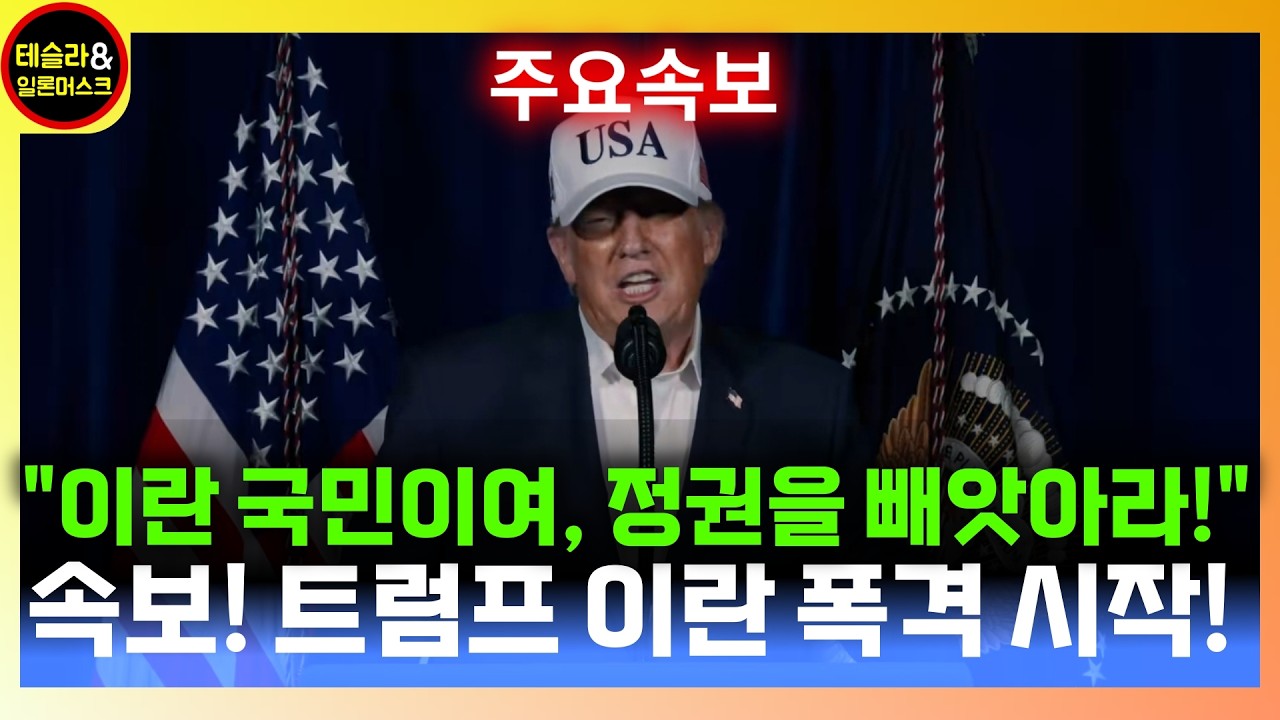
● Hormuz Shutdown Shockwave, Oil Spike Dollar Surge AI Supply Crunch
Why the Strait of Hormuz Blockade Risk Has Become Material After Iran’s Missile Strikes: Potential Spillovers to Oil, FX, and AI Supply Chains
This report focuses on five points:1) Why “blockade-like effects” can occur without a formal closure of the Strait of Hormuz
2) Iran’s “Phase 1–Phase 2–Phase 3” escalation framework and why the probability of negotiation has declined sharply
3) Operational and logistics realities that can disadvantage the U.S. the longer a conflict persists
4) Why China is a key swing factor (oil dependency, Belt and Road exposure, economic retaliation options)
5) Where markets (oil, inflation, rates, equities) and AI/semiconductor supply chains may destabilize simultaneously
1) Situation Brief: Key Developments (News Format)
1-1. Iran Expanded Missile Operations to a Broader Set of Targets
Available indicators suggest Iran broadened its strike scope beyond Israel to include U.S.-linked positions and regional nodes.
References have included Kuwait, Qatar (U.S. 5th Fleet-related), Bahrain, and Abu Dhabi.
A central implication: direct hits on U.S. bases would sharply reduce room for negotiation and indicate a shift toward sustained escalation.
1-2. Why U.S. Carrier Deployment Was Split Into “Offense” and “Defense”
Carrier posture has been observed as unusually segmented between strike capacity (Iran targeting) and defensive coverage (Israel protection).
This implies planning for Iranian missile retaliation and increases the probability of a prolonged exchange rather than a rapid resolution.
2) Reframing the “Phase 1–Phase 2–Phase 3” Escalation Path for Investors
2-1. Phase 1: Retaliation Limited to Israel Preserves Some Negotiating Space
Given the established Israel–Iran conflict channel, retaliation contained to Israel could remain a more manageable confrontation.
Markets could exhibit a spike-and-normalization pattern in oil under this scenario.
2-2. Phase 2: Strikes on U.S. Bases Represent a Structural Regime Shift
Direct attacks on U.S. assets increase U.S. constraints due to credibility, deterrence, and alliance signaling.
The conflict becomes more identity- and legitimacy-driven, raising risk premia across assets.
2-3. Phase 3: The Strait of Hormuz Risk Is Less About “Formal Closure” and More About “Commercial Non-Operability”
Even without an official blockade declaration, a live missile environment can sharply increase war-risk premiums, insurance costs, and crew/asset risk.
Shipping operators may voluntarily suspend transit, producing blockade-equivalent effects via private-sector risk avoidance.
3) Why the Strait of Hormuz Is Structurally High Impact (Numbers, Bottlenecks, Sentiment)
3-1. The Chokepoint Is Inherently Fragile
The strait is approximately 34 km wide; practical transit lanes are narrower due to separation schemes and speed constraints.
In a disorderly exit or congestion event, minor incidents can cascade into system-wide disruption.
3-2. High Share of Global Energy Flows
Approximately 25% of global crude oil shipments and around 20% of global gas consumption flows pass through the strait.
This creates a direct transmission channel into global inflation via energy pricing.
4) Why a Longer Conflict Can Become Disadvantageous for the U.S. (Core Points)
4-1. Large Footprint of U.S.-Linked Sites Requires Broad Defensive Coverage
U.S.-related positions across the region are within Iran’s strike envelope.
Attack vectors can be distributed, while defense must be comprehensive, driving cumulative cost and operational burden.
4-2. Munitions and Logistics Pressure Increases Over Time
Sustained operations can raise resupply stress on roughly a one-week horizon.
A longer conflict increases requirements for additional carrier presence, air defense repositioning, and broader resource allocation.
4-3. Political Incentives Favor Rapid, Decisive Outcomes
If an intervention becomes protracted with ambiguous outcomes, it may be interpreted as weakening deterrence against strategic competitors.
This can create incentives to escalate for faster resolution, increasing the tail risk of broader conflict.
5) Why China Is the Key Variable: Energy Exposure, Belt and Road Linkages, Economic Retaliation
5-1. China Has High Reliance on Hormuz-Linked Oil
Illustrative dependence levels: South Korea ~12%, China ~38%.
Even with strategic reserves, prolonged disruption can pressure industrial activity and broader macro stability.
5-2. Intersection With Belt and Road Energy Architecture
One objective is securing Iranian energy supply routes, including overland alternatives.
A sustained conflict can disrupt China’s energy-security design assumptions.
5-3. Economic Levers Are More Plausible Than Direct Military Involvement
Direct military entry carries high cost and complexity; economic instruments are more actionable.
Key risk scenario: export controls or supply ограничения on critical inputs (e.g., rare earths) that disrupt manufacturing value chains in South Korea, Japan, and Taiwan.
6) Market Impact Checklist: Oil Spike → Inflation → Rates → Equity Volatility
6-1. Oil Transmits First Into Inflation
Hormuz risk can quickly reprice crude expectations and raise transport and input costs, reinforcing global inflation pressure.
This can constrain central banks’ ability to cut rates and revive tightening concerns in asset pricing.
6-2. Stagflation Risk Premium Can Re-Emerge
Historical oil-shock episodes are often used to frame extreme tail risk.
While structures differ today, markets typically price worst-case narratives early when uncertainty rises.
6-3. FX and USD Dynamics Must Be Monitored Concurrently
War risk, oil, and rate expectations can cause rapid USD regime shifts and higher volatility in emerging-market FX.
For South Korea, imported inflation and margin pressure can amplify local equity volatility.
7) AI and Next-Generation Industry Transmission Channels
7-1. Energy Costs Are a Material Input for Data Centers and AI Infrastructure
AI is electricity-intensive; higher power prices increase operating costs and can tighten criteria for new capacity investment.
Oil-driven energy repricing can affect LNG and electricity expectations, creating regional divergence in AI infrastructure momentum.
7-2. Supply-Chain Stress in Asia Can Spill Into Semiconductors
If China deploys economic pressure tools, bottlenecks can emerge across semiconductors, EVs, robotics, and batteries via parts and materials constraints.
Supply-chain stability becomes a valuation premium/discount factor rather than a company-specific issue.
7-3. Defense, Cybersecurity, and Satellite Communications May See Structurally Higher Demand
Prolonged conflict tends to sustain budgets for drones, ISR, satellite, cyber defense, and resilient communications.
AI-related spending frequently accelerates first in defense and intelligence domains, supporting medium-term demand visibility.
8) Under-Discussed but Material Points
8-1. The Critical Mechanism Is Insurance and Voluntary Shipping Suspension, Not a Formal Blockade
The market shock often arrives before any official declaration.
Missile-risk headlines can drive insurance spikes, operator withdrawals, and rapid throughput contraction.
8-2. Even if the U.S. Seeks a Quick End, Structural Conditions Favor Protraction
Defense must be regional and persistent; resupply and air-defense requirements accumulate.
Short-term expectations for rapid de-escalation may be inconsistent with operational constraints.
8-3. China Is an Interested Party, Not a Neutral Mediator
China’s industrial output and energy access are directly exposed.
As the conflict extends, markets may assign higher probability to economic pressure actions that alter risk pricing globally.
9) Monitoring Indicators for Investors (Operational Checklist)
- Spot and intraday volatility in crude benchmarks (WTI/Brent)
- Tanker freight rates and war-risk premium/insurance headlines
- U.S. Treasury yields (especially front-end) and inflation expectations (breakevens)
- DXY and KRW/USD volatility
- Official Chinese announcements on export controls or strategic materials restrictions (e.g., rare earths)
< Summary >
If Iran’s missile activity broadens regionally, the probability of negotiation declines and the conflict risk premium rises.
For the Strait of Hormuz, “commercial non-operability” can replicate blockade effects, lifting crude prices and global inflation pressure.
Higher oil prices can alter the rates path and raise equity volatility; in tail scenarios, stagflation concerns can be repriced.
China is structurally exposed via energy dependence and is more likely to act through economic tools than military engagement.
AI is exposed through energy costs and supply-chain fragility, while defense/cyber/satellite communications may see more durable demand.
[Related Articles…]
- https://NextGenInsight.net?s=Hormuz
- https://NextGenInsight.net?s=rare%20earths
*Source: [ Jun’s economy lab ]
– 중동에 미사일 날리는 이란, 호르무즈 해협 봉쇄 가능성
● War-Panic, Hormuz-Chokepoint, OPEC-Surprise-Boost
Iran–Israel–U.S. Escalation + Strait of Hormuz Risk + Potential OPEC+ Output Increase: Three Variables That Define the Market
The primary market concern is not the presence of conflict headlines, but whether crude oil supply chains could be disrupted.
This report focuses on three variables:
1) Signals of formal U.S. military involvement and shifts in allied/neutral-country positioning
2) The transmission path from a “de facto blockade” of the Strait of Hormuz to oil prices, inflation, and interest rates
3) A potential OPEC+ surprise move (higher output) and the market’s paradoxical interpretation of that signal
A final section highlights key points often underemphasized in mainstream coverage.
1) Breaking Brief: “Official U.S. Announcement” → The Nature of the Conflict Has Changed
The core message is that President Trump, via an official announcement, has initiated military operations inside Iran.
The operation is characterized as coordinated with Israel.
This matters because market-perceived risk shifts from an “Israel–Iran conflict” to a scenario involving potential broader war risk with U.S. participation.
2) Country Reactions: Which Actors Are Moving Toward “Legitimacy” Rather Than “De-escalation”
2-1) Criticism/Condemnation (Sovereignty and Condemnation of Attack Framework)
China and Brazil are summarized as emphasizing “Iranian sovereignty” and issuing condemnatory statements.
This stance can raise the diplomatic and institutional costs for the U.S.-Israel bloc in UN and broader diplomatic channels.
2-2) Support for the U.S. (Nuclear Deterrence and Anti-Oppression Framework)
Canada and Australia are summarized as supporting the U.S. using a rationale centered on preventing Iranian nuclear capability and supporting citizens against oppression.
The key point is the potential shift from rhetoric to operational measures such as sanctions, asset freezes, and financial-network pressure.
2-3) Europe (UK–France–Germany): “Initial Caution → Condemnation of Iran’s Regional Attacks”
The UK, France, and Germany are described as initially cautious, then shifting tone after Iranian retaliation (moves to strike U.S. bases in the region).
Europe appears to avoid fully endorsing “pre-emptive strike legitimacy” while drawing a firm line against “regional escalation.”
If this framing consolidates, markets may interpret stronger Iranian retaliation as increasing Iran’s diplomatic disadvantage.
3) Iran’s Retaliation Targets: The Dispersion of U.S. Bases Is the Core Risk
Key sites referenced include Qatar (Al Udeid Air Base), Bahrain (U.S. Fifth Fleet), Kuwait, and the UAE (including Dubai).
This configuration implies that risk is not isolated to one location; it can trigger a region-wide rise in insurance costs, shipping expenses, and risk premia simultaneously.
As a result, geopolitical stress transmits beyond oil into inflation, rates, and equity valuation.
4) Leadership Death Rumors: The Market-Relevant Variable Is the “Regime Vacuum Risk Premium”
The Iranian foreign minister stated that both the Supreme Leader and the president remain alive, while Israeli reporting suggests a high probability of death.
For investors, the relevant issue is not the rumor itself but the increased probability of leadership vacuum and internal power struggle, which can incentivize more aggressive decision-making to consolidate internal cohesion.
Observed moves such as a sharp rise in prediction-market probabilities can be treated as a signal of whether a scenario is being priced, rather than confirmation of its truth.
5) Immediate Market Reaction: Crypto Often Functions as a Weekend Risk Barometer
Bitcoin reportedly fell sharply immediately after strikes, then partially recovered.
With equity markets closed on weekends, crypto can act as a short-term risk-on/risk-off gauge.
This does not imply crypto is a safe haven in war; it is closer to a 24/7 stress test for risk assets.
6) Interpreting a Potential OPEC+ Surprise: Output Discussions May Be “Insurance,” Not a Bearish Oil Signal
OPEC+ may discuss a larger-than-planned output increase at its March 1 meeting.
On the surface, the objective is to increase supply and stabilize prices.
Key considerations for markets:
1) Output-increase messaging can imply OPEC+ is internally assigning a higher probability to supply disruption risk.
2) Even if output rises, a Hormuz disruption could constrain physical transport, limiting the effectiveness of additional production.
Therefore, “output increase discussions” can be interpreted not as a clear bearish oil catalyst, but as a sign that markets are beginning to price tail-risk scenarios.
7) Strait of Hormuz: More Dangerous Than a Formal Blockade Is “Voluntary Waiting” (De Facto Blockage)
Two stages are highlighted:
(1) The passage is formally open, but shipowners are voluntarily delaying due to risk, creating congestion.
(2) Reports indicate the IRGC is transmitting “no passage” messages via radio communications.
7-1) Why “Voluntary Waiting” Can Be More Disruptive
Regardless of legal blockade status, if insurers raise premiums, carriers postpone sailings, and port congestion builds, a supply shock is already occurring in the spot market.
In such cases, oil prices rise due to logistics bottlenecks rather than headline risk alone.
7-2) Oil → Inflation → Rates → Equity Valuation: The Transmission Mechanism
Higher oil prices lift transportation and input costs, which then pass through to consumer inflation.
If inflation proves sticky, central banks face constraints in easing policy.
Sustained higher rates compress multiples, particularly for growth and technology equities.
This is a primary channel through which stagflation concerns can re-emerge.
8) Five Underemphasized Points
8-1) Hormuz Risk Can Transmit Beyond Oil Into “Dollar Liquidity”
Rising Middle East risk can strengthen safe-haven demand for the U.S. dollar.
Dollar strength increases pressure on emerging-market capital flows and external funding costs.
In larger shocks, the issue can expand from “oil” to the “global dollar cycle.”
8-2) OPEC+ Output Messaging Is Often Political Communication
With limited spare capacity concentrated in a small number of producers, output discussions can function as a market-calming communication tool.
If realized volumes and timing fall short of expectations, the market can reprice higher on disappointment.
8-3) Markets Price Insurance, Freight, and Settlement Delays Before Military Developments
Media focuses on missiles and statements, but corporate earnings are often impacted first by marine insurance premia, freight rates, settlement lead times, and inventory days.
This can pressure margins across energy, airlines, shipping, and chemicals in upcoming quarters.
8-4) Crypto Selloff-and-Rebound May Reflect Deleveraging Rather Than “War Sensitivity”
Weekend crypto volatility can be driven by faster liquidation of leveraged positions.
A rebound should not be treated as risk resolution; it is more consistent with continued preference for cash/dollars and elevated volatility.
8-5) Second-Order Effects on AI/Semiconductors: Energy Is a Core Data-Center Cost Input
A key premise of the AI buildout is power availability, and power costs are linked to fuel prices.
Rising oil and gas prices increase data-center operating costs and power tariffs.
Over time, this can influence data-center CAPEX decisions and indirectly pressure the AI infrastructure value chain.
9) Decisive Triggers to Monitor (Investor Checklist)
1) Strait of Hormuz transit: formal blockade declaration vs resolution of voluntary waiting
2) Marine insurance and freight indicators: abrupt spikes often precede broader real-economy impacts more than oil futures do
3) OPEC+ meeting outcome: verify volumes, timing, and country-level quotas—not statements
4) Additional strikes on regional U.S. bases: a key threshold for escalation
5) Inflation expectation shifts: confirm whether oil price gains are feeding into expected inflation
< Summary >
Signals of formal U.S. involvement shift the conflict profile from a regional confrontation toward broader war risk.
The central variable is the Strait of Hormuz; even without a formal blockade, voluntary vessel delays can create an early supply shock.
OPEC+ output-increase discussions may function less as a bearish oil signal and more as insurance messaging against potential disruptions.
A sharp rise in oil prices can tighten the inflation-and-rates channel, compress equity valuation multiples, and revive stagflation risk.
The AI theme is not insulated: energy costs affect data-center unit economics and can indirectly influence AI infrastructure investment decisions.
[Related Posts…]
- How Strait of Hormuz Risk Transmits to Global Financial Markets
- Oil Price Scenarios and Investment Strategy Under Potential OPEC+ Output Increases
*Source: [ Maeil Business Newspaper ]
– [속보] 이란, 호르무즈 해협 봉쇄. 오펙플러스가 보인 놀라운 움직임 I 홍장원의 불앤베어