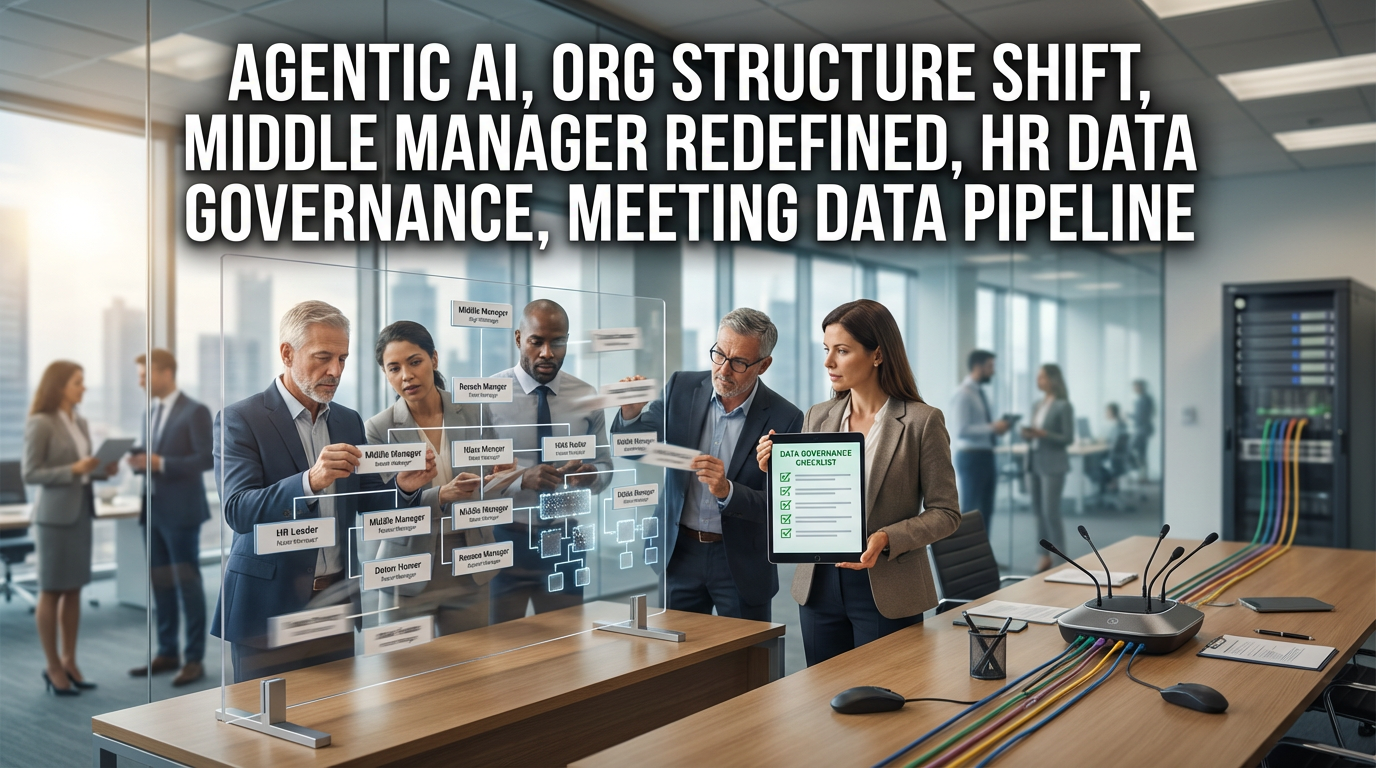
● Agentic AI Upends Org Charts, Middle Managers Wiped Out, HR Pay Systems Shaken
Agentic AI Overhauls the “Org Chart” from the Ground Up: Why Middle Managers, HR, and Performance/Compensation Systems Get Shaken All at Once
In today’s piece, I’ll make sure you walk away with exactly three things.
1) Why the “pyramid organization” structurally collapses as agentic AI becomes mainstream
2) Under what conditions the middle-management layer—the first to be hit—actually survives
3) How HR must redesign evaluation, compensation, records, and meeting operations so that “AI transformation” becomes performance, not cost
And at the end, I’ll separately extract and summarize only the “truly important points” that other news outlets or YouTube channels rarely highlight (the collapse of information asymmetry, the power shift driven by record-keeping methods, and the integration of calendar–meeting–performance data).
1) News Briefing: “Middle managers who can’t create new value are the most at risk”
Key takeaway (summary)
As agentic AI spreads, an outstanding CEO can place AI agents directly under them and execute work at the scale of several hundred people.
The biggest shock hits the “middle-management layer that cannot create new value.”
If the human:AI ratio is 9:1 today, it could be reshaped to 5:5 within three years, and later to 1:9—“and companies like that are already appearing in Silicon Valley.”
Why this is a warning at the level of “organizational design”
This isn’t merely “people get replaced by AI,” but rather that the function of management itself gets absorbed into software.
Then the first thing to shake on the org chart is not the “individual contributor,” but the middle layer that existed through information relaying, approvals, and coordination.
2) The real reason organizational structure changes when agentic AI arrives: the “secret of the pyramid” breaks
There is one point Professor Hwang Seong-hyeon made that was especially sharp when explaining organizational structure.
Behind authority and responsibility in a pyramid organization, there was effectively “information asymmetry”.
(1) The mechanism that kept the pyramid intact
Leaders at the top do not share 100% of information with those below.
They share about 70%, and that gap became the basis for authority, control, and evaluation.
If there are seven layers, the frontline ends up moving in “local optimization” while holding only 5% of the full picture.
(2) But the CEO gives AI “100% + 120%”
Information that used to be shared only 70% with people is shared as much as possible with AI agents.
To maximize outcomes, that is naturally what you do.
At that moment, the information asymmetry that supported the organization’s power structure collapses.
(3) Result: flattening is forced by “technology,” not “culture”
In the past, “flat organizations” failed because of culture/institutions, but now technology makes the middle layer less necessary.
This is the next stage after what we used to call digital transformation, and from a company’s perspective the temptation is enormous from a productivity standpoint.
3) The moment the “management limit (rule of 7)” breaks: middle-manager work gets absorbed into software
In traditional organizational theory, the span of control a manager can properly handle is usually 5–9 people, with an average of 7.
Because 1:1 meetings, tracking work, giving feedback, and evaluating become physically impossible.
But AI has no such constraint.
If it has data, it can simultaneously observe patterns across 100 people, detect deviations, and identify risks.
Important conclusion
When “layers created because managers lacked time” are replaced by technology, the middle-manager role rapidly shrinks or is redefined.
4) What HR must change first: not “evaluation,” but the “recording method”
This is where many companies get it wrong.
They try to start with things like “introducing an AI evaluation system,” but in reality if there is no data, AI has nothing to do.
(1) The structural waste of year-end evaluations
After the year ends, the entire company spends two months compiling performance summaries (self-reviews).
Because it is memory-based, distortions occur, political narratives get mixed in, and time is spent organizing an irreversible past.
The company cares about “next year’s performance,” but feedback ends at explaining the past.
(2) The feedback AI enables is not “a score,” but “behavior correction”
“You’re a 70” only makes people feel bad and doesn’t improve skill.
“You repeatedly make mistakes in the Pythagorean theorem section, so let’s change your approach to this problem type like this” creates growth.
AI can do this continuously.
(3) Therefore HR’s top priority is “a way of working where work data remains”
Work logs, decision rationales, output versions, collaboration contribution, and meeting action items must be automatically captured.
Only when this accumulates can AI analyze performance/contribution/collaboration networks and connect them to compensation and placement.
From a macroeconomic perspective, this point is
a phase where “invisible transaction costs (coordination/reporting/approvals)” inside the enterprise sharply decline due to AI.
In the end, bigger than labor-cost savings is that decision speed and capital efficiency improve, and corporate competitiveness widens dramatically.
5) Changes that happen first in Silicon Valley: “Meetings become the HR data pipeline”
This example felt the most real.
(1) Meeting operations change like this
Calendar invite → meeting participation (even in the same room, everyone joins on their own laptop) → speaker diarization via speech recognition → automatic transcript storage
Immediately after the meeting ends, automatic generation of Summary, Action Items, Owner, and Due date
Automatic scheduling of the next meeting + advance reminders + automatic attachment of related document links
(2) The “nudge” is done by AI, not people
If a colleague says, “Did you prepare that?” feelings can get hurt.
But an AI reminder is relatively less likely to be received as an attack.
(3) Meeting analysis becomes “leadership feedback”
Speaking share, speaking speed, aggressiveness, bias, gender-stereotyped expressions, charisma, and more are turned into reports.
If this accumulates every time, it becomes far more actionable coaching than abstract year-end evaluations.
The key point here
Meeting data is “work data” and at the same time “management data.”
In other words, the fastest route for AI to replace management functions is the linkage of “calendar–meetings–documents–performance.”
6) Do all middle managers die? No. “Value-creating” ones become even more important
The issue is not the “middle manager title,” but when middle-manager work is fixed around relaying/approvals/compilation.
(1) Risky middle-manager types
People who hold information and distribute it
People who exist through compiling/reviewing/approving reports
People who increase meetings and spend time only on coordination
(2) Middle-manager types who survive (and whose salaries rise)
People who accurately do “problem definition” on the ground
People who redesign processes using AI agents (not making work smaller, but making it bigger)
People who translate team goals into “measurable metrics” and change work so that data remains
People who handle human leadership such as conflict, negotiation, decision-making, and ethics
Ultimately, middle managers shift from “manager” to the character of a product owner + organizational designer + AI operator.
7) Will Korean companies be slower? “Industry,” more than “culture,” determines the speed
As Professor Hwang also noted, not every industry in the U.S. moves like Silicon Valley.
(1) Fast industries
Tech, software, content, parts of finance (data/document-based)
→ agentic AI can replace processes immediately
(2) Slow industries
Primary industries, manufacturing/industries with a large on-site component
→ because physical execution remains, the speed is relatively slower
However, the moment physical AI/robotics rises (the moment on-site work becomes datafied), the pace will accelerate sharply.
8) Only the “most important content” that people rarely talk about elsewhere, summarized separately
1) The core of how AI changes organizations is not “automation,” but “the collapse of information asymmetry”
The pyramid was also a structure for controlling people, and its core tool was information asymmetry.
But the moment the CEO shares 100% of information with AI, the reason for the middle layer weakens.
2) HR’s decisive battleground is not an “evaluation tool,” but “record infrastructure (a way work remains)”
Even if you introduce AI evaluation, if data is weak you end up with nothing but “plausible automated bias.”
Conversely, if record infrastructure is established, compensation, placement, and development naturally follow.
3) Meetings/calendars effectively become the “management OS”
If who decided what, who owns what, and by when it must be done are automatically structured,
a large portion of management moves from human memory/emotion to systems.
4) Middle-manager risk starts not with “layoffs,” but with a “role vacuum”
It’s not that you get cut suddenly; rather, as AI takes reporting/coordination/feedback,
the most dangerous moment is when what you should do to create value becomes empty.
5) This change is not a micro issue, but a “productivity shock” that changes the company’s cost structure
This is not just an HR trend; it could become a structure where AI-internalized companies are less exposed to costs even during future downturns.
Ultimately, it may also create gaps in corporate value and investment decisions (especially in global markets).
9) Practical Checklist: What our company/team should check right now
[From the CEO/executive perspective]
First set data governance for “what information to give AI agents, and how far.”
Document and lock in the definition of “new value creation” to demand from middle managers (problem definition/decision-making/design/external negotiation).
[From the HR perspective]
Redesign the year-end evaluation process by breaking it into “continuous feedback + real-time records.”
Connect meeting/calendar/document/project tools to build a “performance data pipeline.”
As AI intervenes more, embed a fairness/bias/explainability frame into the system.
[From the middle-manager perspective]
Coldly break down whether my work is relaying/approvals/compilation, or problem definition/decision-making/performance design, and assess the proportions.
The person who first changes the team’s work into “work that leaves records” survives first.
[From the individual contributor perspective]
Don’t leave only outputs; leave “why you did it that way (decision logs).”
Build the habit of working in a form that enables collaboration with agents (clear goals/constraints/definitions/data locations).
< Summary >
Agentic AI goes beyond simple automation and weakens pyramid structures by breaking information asymmetry within organizations.
The biggest shock hits the middle-management layer centered on relaying/approvals/coordination, while problem-definition/design/decision-making managers increase in value.
HR’s core task is not introducing AI evaluation, but building work record infrastructure and a continuous feedback system.
When meetings/calendars/documents are connected, management functions move into systems and the speed of performance/compensation/placement increases.
This change reshapes corporate productivity and cost structures, and is likely to create large gaps in future competitiveness.
[Related Posts…]
- Organizational Restructuring Driven by AI Transformation: The Meaning of “Management” Changes Before Individual Contributors
- The Era of Productivity Gaps: Why AI-Internalized Companies Are More Resilient to Business Cycles
*Source: [ 티타임즈TV ]
– “새로운 가치 창출 못하는 중간관리자층 가장 위험하다” (황성현 교수)