● Hormuz Shock, Oil-100, Korea Markets Rattled
Strait of Hormuz Risk, $100 Oil, and Spillover to Korean Assets: 24-Hour Briefing (News-Style + Key Takeaways)
This report consolidates:1) The current phase of the US/Israel–Iran conflict as it shifts toward a leadership vacuum
2) Why oil prices can surge even without a “full closure” of the Strait of Hormuz (shipping disruption mechanics)
3) Why OPEC+ output headlines may not calm markets (limits to effective spare capacity)
4) The transmission pathway from a $100 oil scenario to global inflation, rates, FX, and equities
5) Under-discussed vulnerabilities specific to Korea and an investor checklist
1) Breaking timeline: from “military conflict” to “leadership vacuum” and escalation risk
The key development over the past 24 hours is the opening of a power-transition phase within Iran. Markets tend to react more to uncertainty over decision-making authority than to the existence of conflict itself.
-
Joint military operations begin
The US and Israel initiated joint operations, followed by continued reciprocal strikes. -
Death of Iran’s Supreme Leader (as asserted in the source)
The source states that Ali Khamenei and multiple senior military/political figures were killed. Such events often shift the nature of retaliation rather than end hostilities. -
Three-member transitional committee
A structure described as: President (portrayed as relatively moderate/reform-oriented) + Head of the Judiciary (hardline) + Cleric (hardline). With two hardliners, policy direction is likely to skew more hawkish. -
Successor selection mechanism
The next Supreme Leader is to be selected by the 88-member Assembly of Experts, with timing unclear. Indeterminate timing is a key driver of risk premia.
2) Escalation vector: spillover to the UAE and Oman as the core variable
This matters because the conflict can rapidly transmit from military developments to shipping lanes, insurance markets, and logistics.
-
Strike on the UAE (US-aligned, hosts US bases)
Markets may interpret this as increased risk to bases and critical infrastructure. -
Strike on Oman (perceived neutral actor)
Expanding to a neutral jurisdiction can reduce perceived “safe corridors,” prompting more conservative routing decisions and accelerating suspensions, reroutes, and insurance cost increases.
3) Strait of Hormuz: why oil can spike without a formal “full closure”
The critical issue for investors is not whether a complete blockade is feasible, but whether partial attacks or closure warnings can raise transit costs enough to reduce throughput.
-
Reports of tanker attacks
The source cites named tanker incidents and describes warnings against passage and rerouting. -
Shipping companies pausing operations (e.g., Maersk)
This reflects economic optimization: war-risk insurance, security costs, crew safety, and port risk can make suspension cheaper than continued operations. -
Conclusion: “effective blockade” dynamics
Persistent threats (missiles, drones, mines) can lead markets to price conditions as if a blockade exists, regardless of formal declarations.
4) The $100 oil scenario: focus on transmission, not the headline price
The source references media and research commentary suggesting $100/bbl risk, including a potential supply disruption of ~5 million barrels/day (~5% of global supply).
-
Why a -5% supply shock can produce a +20% price move
Short-term oil demand is relatively inelastic; small supply disruptions can drive outsized price responses. -
War-risk premium overlay
Beyond realized outages, expectations of further disruption can be embedded in futures and options pricing.
Markets typically reprice inflation first. Higher energy costs raise logistics, manufacturing, aviation, and chemicals costs, feeding into consumer inflation. This can then alter the rate path (delayed cuts and/or higher long-end yields).
5) Why OPEC+ output headlines may not be a durable stabilizer
The source notes a faster-than-expected agreement for sizable production increases, while emphasizing limited effective ability to deliver incremental barrels.
-
Execution constraints
Well productivity, facilities, transport, and crude quality constraints can limit immediate deliverability. -
Hormuz is a transport constraint, not only a supply constraint
Even if production rises, restricted passage or sharply higher insurance costs can dilute the stabilizing impact on physical markets.
6) US political variables: concurrent “hawkish signaling” and “dialogue optionality”
The source describes US messaging that combines severe retaliation warnings with reports of potential openness to talks with Iran’s next leadership.
-
Market interpretation
Hawkish rhetoric tends to increase near-term volatility; dialogue optionality can reduce risk premia. When both appear simultaneously, volatility may rise without clear direction. -
Domestic constraints in the US
If war-powers and authorization disputes intensify, uncertainty around operational scope and duration may increase.
7) Asset-market signals: interpreting Bitcoin resilience alongside Saudi equity weakness
The source notes Bitcoin recovering relative to pre-conflict levels, while the Saudi main index fell ~2.18% (Aramco relatively resilient versus broader weakness).
-
Implication of Bitcoin rebound
Could reflect expectations of limited duration, or simply rapid risk-on/risk-off rotations typical of high-volatility regimes. -
Saudi equity as a reference point for Korea
Saudi indices can be partially cushioned by energy-heavy constituents. If the index still declines meaningfully, markets with lower energy weightings may experience stronger index-level pressure.
8) Under-discussed core point: five areas where Korea is disproportionately exposed
Korea is structurally sensitive to Hormuz-linked shocks.
-
1) Trade balance deterioration pressure, transmitting into KRW depreciation risk
Higher energy import prices can weaken the trade balance and increase FX pressure. -
2) Manufacturing margin compression (notably transport, chemicals, materials)
Oil is a direct cost input; sectors with slower pass-through tend to see earlier earnings pressure. -
3) Re-acceleration of inflation pressure, weakening rate-cut expectations
A renewed global inflation impulse can constrain domestic policy flexibility. -
4) Higher freight, insurance, and logistics costs directly weaken export competitiveness
As an export-intensive economy, Korea is exposed not only to oil prices but also to shipping costs, delivery schedules, and contract terms. -
5) Short-term outperformance may be confined to defense and select energy-linked names while the index remains pressured
Broad indices can be dominated by weakness across multiple sectors rather than strength in a small subset.
9) Investor checklist (next 72 hours)
-
Hormuz transit volumes and rerouting behavior
Real shipping data matters more than closure declarations. -
War-risk insurance premia and freight rates
These may move ahead of spot oil. -
OPEC+ physical exports and inventory changes, not announcements
Headline pledges may not translate into near-term barrels. -
Substance of US–Iran dialogue: channels, envoys, and conditions
Stated willingness is easier than operational agreement on terms. -
KRW/USD and long-end yields moving together
Rising inflation risk can lead long-duration rates to react first.
10) One-line conclusion: markets are pricing “shipping-lane risk,” not just “war risk”
Even without a complete closure, tanker attacks, rerouting, and surging insurance costs can create effective-blockade conditions. This can jointly shock oil, inflation expectations, rates, and FX. Korea’s dependence on energy imports and its export-led structure can accelerate transmission into domestic assets.
Summary
The US/Israel–Iran conflict has shifted toward heightened uncertainty as Iran enters a leadership-transition phase. The Strait of Hormuz does not require formal closure to create effective-blockade pricing via attacks, rerouting, and insurance spikes. A supply disruption scenario (e.g., ~5 million barrels/day) plus a war-risk premium could push oil toward $100/bbl. OPEC+ output agreements may have limited stabilizing power due to deliverability constraints and transport risk. Korea is exposed through the trade balance, KRW, logistics costs, manufacturing margins, and the rate-expectations channel.
[Related Links…]
- https://NextGenInsight.net?s=Hormuz
- https://NextGenInsight.net?s=Oil
*Source: [ 내일은 투자왕 – 김단테 ]
– 호르무즈 해협 봉쇄로 유가 100달러?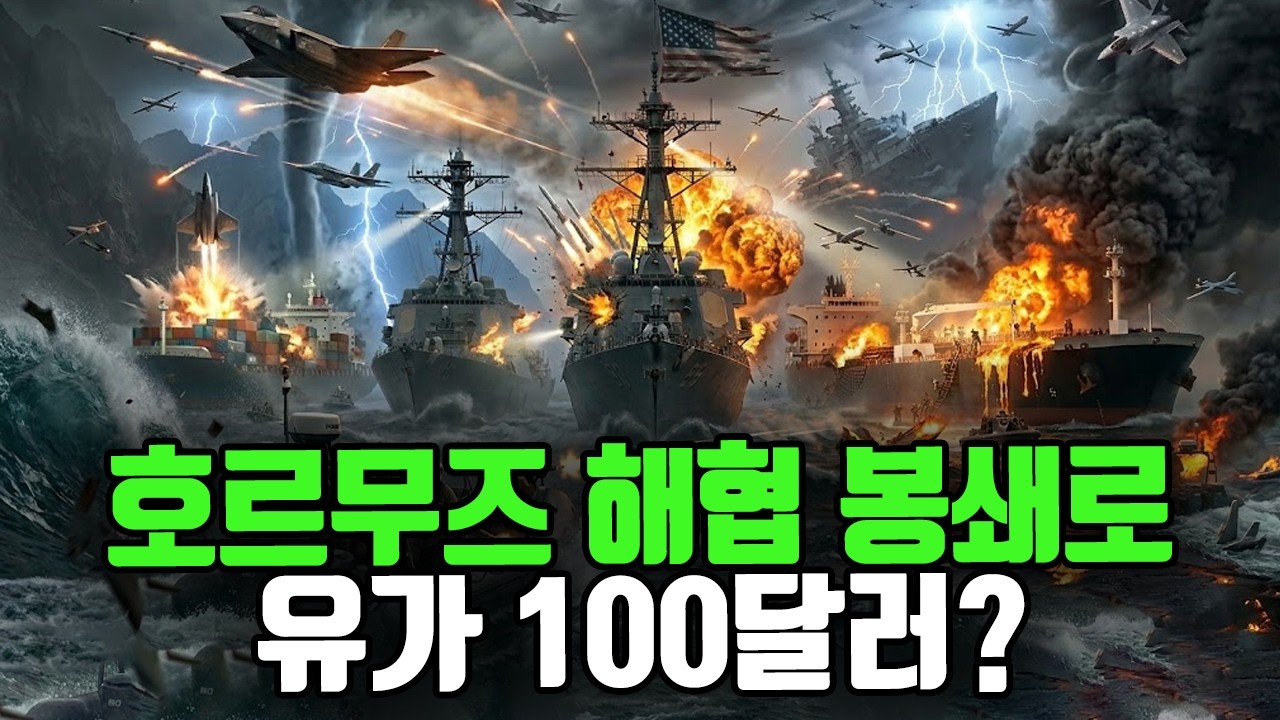
● Prague Clock Tour Exposes Europes Local Retail Edge, Koreas Distribution Trap, AI Experience Pivot Under Energy Shock
Core Signal Behind the Prague “Astronomical Clock Tour”: Implications of Europe’s SME Ecosystem for Korea’s Economy
This text nominally excludes “economics,” but contains economically material signals throughout. Key focus areas:1) European retail structure inferred from the Prague Old Town Square (Astronomical Clock) setting
2) What the CES/MWC travel route implies about global industry and demand
3) Structural risks and opportunities in Korea’s brand and distribution ecosystem
4) How Korean companies should redesign export–domestic demand–distribution to remain competitive
1) Field Briefing: What the Video Functionally Indicates (News-Style Summary)
1-1. Prague Old Town Square & Astronomical Clock: A retail-structure case study, not a tourism clip
The setting is Prague’s Old Town Square and the Astronomical Clock. The economically relevant point is how the city preserves and monetizes commercial districts. Around a high-footfall landmark, the franchise share appears low, while independent bakeries, cafes, and restaurants maintain distinct positioning.
1-2. Travel itinerary: CES/MWC plus a stop in Vienna for an OPEC-related meeting
The speaker cites CES and MWC as the reason for being in Europe and mentions stopping in Vienna due to an OPEC-related meeting. This implies a deliberate pairing of (i) technology exhibitions (demand/industrial direction) with (ii) energy/raw materials (supply/cost). It signals that macro risk (e.g., recession probability) and AI/telecom/device trends are moving simultaneously.
1-3. Plan change: intended to visit Slovakia (near Ukraine), pivoted to analysis due to Middle East conflict
The speaker planned to travel toward a Ukraine-adjacent area but shifted immediately toward analysis content as Middle East risk intensified. From a market perspective, this indicates a regime where geopolitics re-enters the pricing of energy, logistics, insurance, and investor risk appetite.
2) Three Structural Features Observed in Prague’s European Retail Ecosystem
2-1. Low franchise penetration implies differences in regulation, rent mechanics, and branding culture
The observation that “Europe has few franchises” is economically interpretable. Typical drivers include:
- Historic district preservation rules (signage/interior/business-type constraints)
- Rent and retail formation mechanisms that reduce the attractiveness of large-chain expansion
- Local-brand preference, reinforced by tourism demand for “distinctiveness”
This suggests urban design can raise survival probabilities for local operators.
2-2. Tourism demand is monetized through differentiation, not standardization
In landmark districts, travelers often pay for “place-specific” experiences rather than standardized offerings. Local cafes and bakeries become part of the experience, reinforcing brand equity and sustaining pricing power. As AI accelerates product commoditization, narrative and experience design increasingly determine willingness to pay.
2-3. “The disappearance of neighborhood bakeries”: economic meaning
The claim that Korea has become franchise-dominant and that independent brand success is difficult points to structural issues in distribution and brand protection (IP, recipes, packaging, channel power). As options narrow and channel power concentrates, long-run price-setting power may shift further toward a small set of intermediaries.
3) Korea’s Manufacturing/Brand Dilemma: Exports Work, Domestic Distribution Constrains Scale
3-1. “Exports are secured, but attempts to enter big-box distribution are avoided”: interpretation
Food manufacturers described as exporting while not pursuing large domestic retail channels may be behaving rationally. Domestic big-box distribution can involve:
- High entry costs (promotions, supply terms, returns, trade marketing)
- Rapid emergence of substitutes/imitations after early success
- Risk of manufacturers being reduced to quasi-contract production rather than building brand equity
3-2. “Large firms copy immediately”: the core issue is channel power, not imitation per se
The key variable is not who copies, but who controls distribution, shelf access, and marketing leverage. If a channel-dominant player can win post-imitation, the original brand’s growth path is structurally constrained. This implies barriers beyond product capability.
3-3. Practical direction: redesign domestic go-to-market via “bypass” strategies
Three viable approaches under this structure:
- D2C (owned commerce/subscription/community) to secure customer data first
- Build brand abroad first, then re-enter domestically with premium positioning
- Engineer offerings that are harder to copy (service bundling, experience bundling, fandom/content integration)
AI functions less as automation and more as an engine for preference sensing and rapid product/content experimentation.
4) Integrating the CES/MWC Context: The Market Is Shifting from “Hardware” to “Experience + AI”
4-1. What MWC represents: not telecom, but an AI infrastructure contest
MWC has become a contest over networks, devices, and cloud connectivity required to run AI at the edge. As this intensifies, manufacturing and retail shift toward “data + personalization + immediacy.” For independent stores to remain differentiated, AI must lift both operating efficiency and customer experience.
4-2. Why an OPEC-related stop matters: tech valuations remain constrained by energy and input costs
As AI and data-center investment accelerates, power demand becomes a key constraint. Alongside financial variables (e.g., rate expectations), energy pricing and supply stability increasingly affect corporate valuation and margin structure. “AI growth” narratives can be undermined by electricity, transport, and raw-material cost shocks.
5) Key Issues Extracted (Top 6)
1) The Prague clip functions as a case study in European local-brand retail ecosystems.
2) CES/MWC signals industry direction; the OPEC-related stop highlights energy-driven cost/supply variables.
3) Geopolitical risk (Middle East/Eastern Europe) alters risk premia and cost structures.
4) Korea scales exports effectively but faces structural barriers to scaling local brands through domestic distribution.
5) The “copy” problem is primarily about channel power and control of distribution.
6) Practical strategies prioritize D2C, overseas-first brand building, and experience-integrated product design over direct confrontation with large domestic channels.
6) Undercovered but Material Point
6-1. “Few franchises” is evidence that cities can manufacture brand ecosystems
The critical point is not “European aesthetic,” but that city design can raise the survivability of local brands. When local operators persist around landmarks, they become part of the tourism product, generating employment and tax revenue. Urban competitiveness can be assessed via the density of local brands, not only via physical development.
6-2. Korea’s core constraint is not franchise prevalence but the cost of scaling pathways
The central issue is the cost structure of scaling:
- acquiring customer data
- driving repeat purchase
- protecting brand assets
- expanding without dependence on dominant channels
If this pathway is too expensive or blocked, “export-first” becomes economically rational. This may explain why firms export to the US/Europe while avoiding domestic large-scale retail.
6-3. AI-era conclusion: as copying becomes cheaper, brands become operating systems
With AI enabling rapid replication of recipes, design, and marketing copy, product-level defensibility weakens. Brand defensibility shifts to systems such as:
- customer community
- subscription/membership
- personalized recommendations
- supply chain and manufacturing lead times
- offline experience (space and narrative)
European local shops benefit from an ecosystem where the city effectively supports these system-level advantages.
The Prague Astronomical Clock tour reads as travel content but reveals signals about Europe’s local retail ecosystem and the weaknesses of Korea’s distribution structure. The CES/MWC/OPEC itinerary suggests technology demand trends must be evaluated alongside energy and cost variables. Korean manufacturing brands may find exports easier than domestic scale due to channel economics; viable responses include D2C, overseas-first growth, and experience-plus-AI operating systems.
[Related Links…]
- https://NextGenInsight.net?s=MWC
- https://NextGenInsight.net?s=OPEC
*Source: [ 경제 읽어주는 남자(김광석TV) ]
– 그냥… (feat. 체코 프라하)
● Shipping Freeze Sparks Oil Surge After Khamenei Death, Hormuz Panic Hits Markets
The Real Reason Oil Prices Remain Elevated After Khamenei’s Death: A Signal More Alarming Than “Hormuz Closure” Is “Shipping Stops First”
This report covers:
1) Why Khamenei’s death is being interpreted as an increase in uncertainty rather than “risk removal”
2) Why the primary trigger for an oil spike is not a formal “closure announcement,” but carriers’ voluntary avoidance
3) How failure to contain oil prices can transmit simultaneously to inflation, rates, and equities under the Trump administration
4) Iran’s internal constraints that make Hormuz difficult to close, and the power-vacuum risk that can still make it difficult to keep open
5) Why OPEC+ supply increases may provide limited support beyond sentiment stabilization
1) News Briefing: Market-Relevant Takeaways
1-1. Event Summary
Iranian Supreme Leader Ali Khamenei’s death has been confirmed via local broadcasting and diplomatic channels. Iran indicated the possibility of selecting a new Supreme Leader within 1–2 days.
While the political event could be viewed as removing a major risk factor, market pricing has moved in the opposite direction.
1-2. Oil (Brent) Reaction
Brent rose sharply in off-hours trading to around USD 80/bbl (reported at approximately +10% day-over-day).
The key driver is not a single headline, but the risk premium associated with a potential disruption of the physical supply chain being priced in ahead of confirmation.
1-3. Strait of Hormuz: What Appears Before “Closure”
After signals that the Islamic Revolutionary Guard Corps (IRGC) could restrict vessel transits, major shipping companies shifted into avoidance mode regardless of whether an official closure is declared.
Market interpretation of announcements such as suspension, rerouting, or booking halts is increasingly focused on the disappearance of willing transit capacity rather than a formal blockade decision.
2) Why the Trump Administration Has Strong Incentives to Pursue Lower Oil Prices
2-1. Gasoline as a High-Salience Inflation Metric
In the United States, gasoline prices are a primary barometer for consumer sentiment.
Targets such as “USD 2 per gallon” function less as campaign rhetoric and more as part of a broader effort to anchor inflation expectations.
2-2. Energy as a Direct CPI Shock and Cost Pass-Through Channel
Higher crude prices affect not only energy CPI components but also propagate through logistics, aviation, chemicals, and packaging via cost pass-through.
If inflation re-accelerates, markets may reprice the expected path of Federal Reserve rate cuts, increasing equity volatility.
Transmission chain:
Higher oil prices → inflation re-acceleration → greater uncertainty on the rate path → higher U.S. equity volatility (including Nasdaq)
3) Strait of Hormuz: Focus on “Can It Be Kept Open?” Not Only “Can It Be Closed?”
3-1. Why Iran Faces High Self-Harm Risk From a Full Closure
A closure would also block Iran’s own crude exports, reducing hard-currency inflows and worsening fiscal conditions.
Key domestic constraints cited:
Export volumes sharply reduced since U.S. sanctions (materially below prior levels)
Reliance on discounted sales to China
Fiscal pressure from subsidies and inefficiencies in the state sector
Inflation reported in the 40–50% range (with estimates cited up to ~60%)
Rising cost-of-living pressures previously associated with protests and subsequent hardline crackdowns
Under these conditions, a new leadership team may face significant constraints in adopting measures that further impair the domestic economy.
3-2. Why Markets Remain Concerned: Power-Vacuum Risk
The central issue is whether rational decision-making holds during a transition period.
If succession is not orderly, or if a new leadership seeks legitimacy via escalation, markets may assign higher weight to tail-risk outcomes.
In addition, ambiguity around a clear negotiating counterpart increases volatility, particularly if organizations such as the IRGC act independently.
3-3. An Important Asymmetry: China as the Largest Exposure
Hormuz dependency cited: China 38%, India 15%, South Korea 12%, Japan 11%.
Disruption would therefore impose substantial costs on China.
Given China’s role as a key buyer of Iranian crude (including via discounts), Iran’s willingness to materially damage Chinese interests is a critical variable.
4) OPEC+ Supply Increase: Why It May Not Reassure Markets
4-1. The Headline Increase as a Stabilization Signal
OPEC+ was described as announcing an output increase of 206,000 bpd versus a prior 137,000 bpd.
Politically, this can be interpreted as signaling cooperation toward price stability.
4-2. Markets Prioritize “Route Capacity” Over “Supply Volumes”
If Hormuz risk rises, incremental production may not translate into delivered supply due to transport, insurance, and routing constraints.
As a result, the impact of OPEC+ supply headlines may be limited, functioning primarily as a sentiment buffer.
5) Investor Checklist: Key Indicators to Monitor
5-1. Three Data Points That Can Precede Any “Closure Announcement”
1) Operating-resumption notices from major carriers (container and tanker)
2) The pace of increases in marine insurance costs and war-risk premia
3) Tightening signals in the physical market (spot spreads)
5-2. U.S. Policy Set: Options to Contain Oil Price Pressure
Even with a preference for lower oil prices, escalating Middle East uncertainty can constrain policy choices.
Potential measures:
Diplomatic efforts to de-escalate
Discussion of short-term buffers such as the Strategic Petroleum Reserve (SPR)
Enhanced maritime security coordination with allies
A stronger policy mix in these areas can reduce perceived probabilities of a worst-case disruption.
5-3. Why the Impact Is Direct for South Korean Investors
South Korea is among the countries with meaningful Hormuz exposure (cited at 12%).
Higher oil prices increase domestic inflation pressure and can affect the expected rate path.
Concurrent moves in FX volatility and import prices can destabilize corporate earnings estimates.
6) Five Underemphasized Points With High Market Relevance
1) The initial shock from Hormuz risk is more likely to originate from voluntary suspension by commercial shipping than from a military closure.
2) Closing Hormuz would also restrict Iran’s own exports, creating a structural self-harm constraint.
3) Markets may fear power-vacuum miscalculation or independent action more than an intentional, fully planned blockade.
4) China’s high Hormuz dependency implies Iran’s decision-making is constrained by transactional ties with China, not only anti-U.S. rhetoric.
5) OPEC+ increases address supply volumes, while current pricing is more sensitive to route viability and insurance-based risk premia.
< Summary >
Khamenei’s death is being priced less as risk removal and more as elevated uncertainty due to potential leadership vacuum, increasing oil-market volatility.
For the Strait of Hormuz, price action can be driven more by preemptive avoidance by shipping companies than by a formal closure announcement.
Higher oil prices can reintroduce inflation pressure, complicate the expected rate trajectory, and increase U.S. equity volatility.
Iran faces strong economic and fiscal constraints against a full closure, but transition-period miscalculation and independent-actor risks can keep markets unsettled.
OPEC+ supply increases may provide sentiment support, but effects can be limited if maritime route risk dominates.
[Related Posts…]
- Key Variables to Monitor During a Global Oil Price Spike
- How Strait of Hormuz Risk Transmits to Global Inflation and Financial Markets
*Source: [ Maeil Business Newspaper ]
– [홍장원의 불앤베어] 하메네이 사망에도 불안한 유가. 호르무즈 해협 동결가능성은