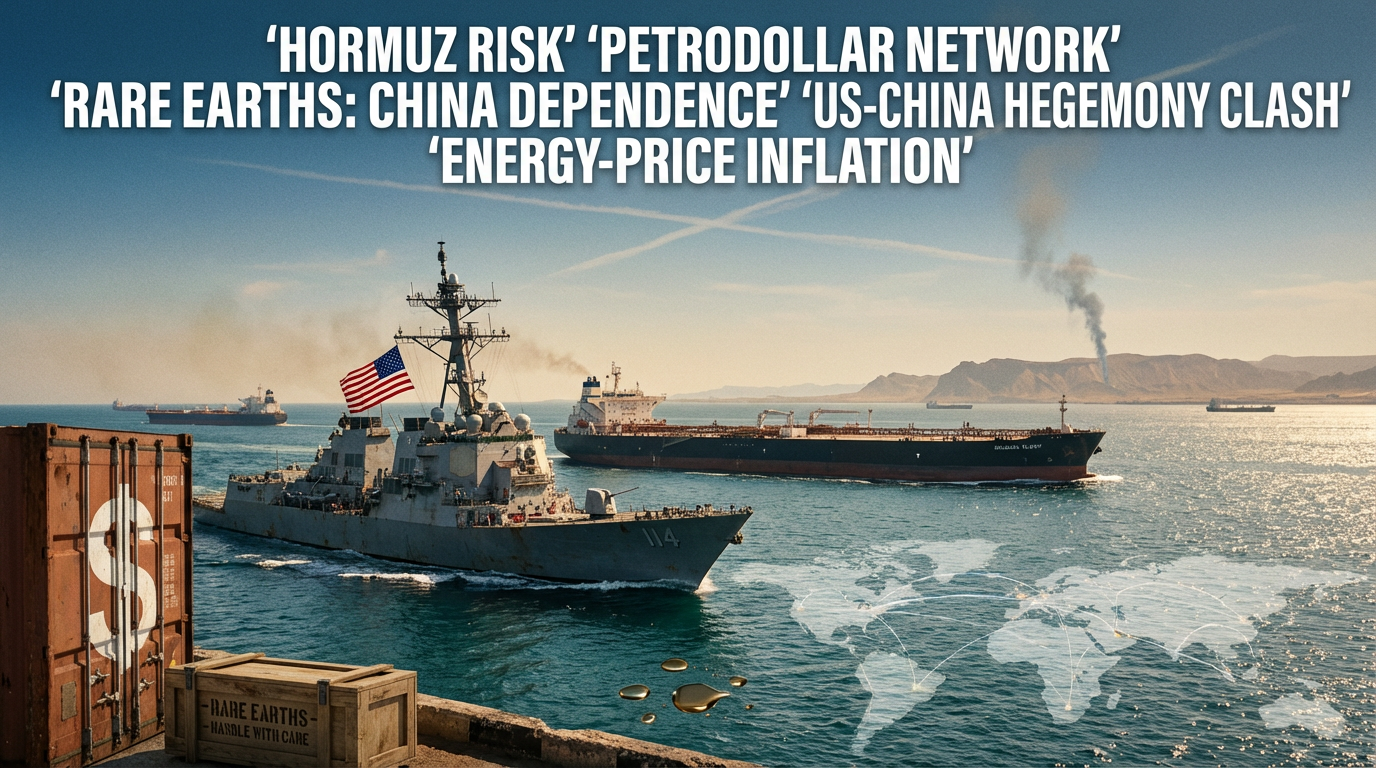
● US Strikes Iran, Oil Shock, Dollar Grip, Supply Chain Squeeze
What the U.S. ‘Iran Airstrike’ Is Really Targeting Is Something Else: A 2026 Global Economic Scenario Read Through Three Wars—Resources, Currency, and Supply Chains
Today’s post includes the following.
First, it interprets the “U.S.–Iran clash” not as a headline, but as a chessboard of U.S.–China hegemonic competition.
Second, it ties oil, rare earths, and lithium together at once and lays out the structure that shakes energy prices and inflation.
Third, it connects—on a single page—all the way to the often-overlooked point of “currency (dollar) war” and the restructuring of the global supply chain.
Fourth, from an investment and corporate practitioner’s perspective, it provides a checklist of “where the risks are and where the opportunities are going forward.”
1) News Briefing: Not “One Strike in the Middle East,” but One Piece of an Anti-China Net
The original text views the U.S. airstrike not as a simple regional conflict, but as a “first move” the United States threw at China.
The key takeaway is three wars.
- Resource war: bundling oil (crude prices), critical minerals (rare earths), and battery materials (lithium) to shake China’s manufacturing and export engine
- Currency war: maintaining the influence of the dollar payment network and the petrodollar (i.e., defending dollar hegemony)
- Supply chain war: strengthening control over chokepoints of logistics and energy routes linking the Middle East, Europe, and Asia
In short, within this frame, Iran appears not so much as the “target,” but as a pressure point that tightens China’s air supply (energy, raw materials, and logistics).
2) The “Triple Hit (Oil–Rare Earths–Lithium)” Structure the Original Text Describes
The original text ties events from the past one to two months into a “series.”
That is, it argues this is not one-off news, but a sequence with an intended design.
2-1. First hit: Venezuela (Oil) = A Lever to Control Crude Prices
The core point is “the United States wants to control oil prices.”
Oil prices ultimately connect directly to inflation, and inflation shakes interest rates, the economy, and even politics (elections).
The original text argues that through Venezuela, the United States gains a crude supply buffer while also striking China’s overseas resource investments (especially Latin America infrastructure/resource linkages).
2-2. Second hit: Greenland (Rare Earths) = Weakening China’s “Materials Leverage” + A Military Foothold
Rare earths are the “vitamins of industry” used in semiconductors, batteries, defense, and deep tech.
What the original text emphasizes is two things.
- Securing mining rights/control over rare earths → weakening China’s materials leverage
- A strategic foothold from a space/defense perspective → not just a resource issue, but a package where security and industry are combined
This section matters because as AI semiconductors and data-center power infrastructure grow, bottlenecks in materials and components are likely to reemerge.
2-3. Third hit: Iran (Lithium + Middle East Energy Chokepoints) = Shaking China’s Energy Safety Valve
The original text sees Iran as a “bridgehead of China’s Middle East strategy.”
In particular, Iran connects not only to energy but also to lithium (a battery material) in a context tied to China’s manufacturing competitiveness.
In other words, for China to keep pushing “EV and battery internalization,” it needs stable raw materials and logistics—and this move shakes that axis.
3) The Currency-War Section: An Attempt to Re-Anchor Dollar Hegemony via “Resource Settlement”
This is the part where the original text makes its strongest claim.
America’s power comes less from aircraft carriers or fighter jets than from the dollar settlement system.
So if resource (especially crude oil) trade is made to run in dollars, dollar demand is sustained, and the United States gains more room to roll its fiscal deficits and debt.
From this perspective, the more movements grow to “settle energy in a currency other than the dollar” (BRICS, expanded yuan settlement, etc.), the more likely the United States is to deploy stronger pressure tools.
And stablecoins may also be interpreted as a tool to expand “digital dollar demand,” which is the underlying concern.
4) The Market’s Immediate #1 Check: Hormuz Strait Risk (But a “Long-Term Blockade” Is a Variable)
The original text cites a Hormuz Strait blockade as the biggest risk, while viewing the likelihood of a long-term blockade as limited.
The logic is as follows.
- If leadership collapse/strike damage is large, long-term and organized blockade capability weakens
- Because the side that could suffer the most from a blockade may be China, China might instead pressure for it to be “kept open”
However, this is based on “rational calculation,” and wars can shift abruptly when emotion, retaliation, or miscalculation enters.
So from a corporate/investor standpoint, Hormuz must remain under watch as a trigger for short-term spikes and swings (oil, shipping, insurance premiums).
5) (Blog Perspective) Five Ripple Effects This Issue Throws Into the Global Economic Outlook
5-1. Oil Returns as the “Core Variable” of Prices
In recent years, even as markets watched rates and growth, what ultimately shook CPI was energy.
When oil rises, transport and input costs transmit through the economy, and inflation becomes sticky.
Then rate cuts get delayed, and risk-asset valuations come under pressure.
5-2. China Manufacturing’s Cost/Logistics Stress Reemerges
When China’s energy import sources and logistics routes wobble, manufacturing costs and export competitiveness take a hit.
In particular, “finding detours” costs both time and money.
5-3. The “Securitization” of Critical Minerals Accelerates
Resources like rare earths, lithium, and nickel become national-security-grade assets, not just commodities.
This 흐름 ultimately pushes the global supply chain further toward bloc formation (U.S.-centered vs. China-centered).
5-4. The Essence of the Dollar Strength/Weakness Debate Is “Maintaining the Settlement Network”
Even if the dollar looks weak at certain moments in the short term, once energy and commodity settlement is fixed in dollars, dollar demand is structurally sustained.
Ultimately, the point to watch is not the exchange-rate level itself, but whether the “settlement structure changes.”
5-5. The AI Trend: War Makes AI Adoption Faster
As the original text mentions Palantir-like systems (simulation/information fusion/target identification), modern warfare is data warfare.
This does not end in the military; it spreads into the private sector.
That is, companies will adopt AI more aggressively for supply-chain risk management, price forecasting, and demand/inventory optimization.
6) The “Truly Important Points” Other News/YouTube Often Miss (My Perspective Summary)
- The key takeaway is not “war,” but “pricing power.”
Whoever holds pricing power over oil, minerals, and logistics changes the inflation and rate path.
War news is noise; pricing power is the signal. - Containing China is not only “China’s problem”; it is a problem where procurement/export conditions change for Korean companies.
If materials, components, and energy procurement become bloc-based, Korea’s business terms become “which bloc’s standards and settlement network it follows.” - Stablecoins are not a “crypto issue,” but a war to expand digital payment networks.
Regulation, banks, payment infrastructure, and cross-border remittances move as one bundle.
Ultimately, the more dollar-based digital cash (or quasi-cash) spreads, the more dollar demand can be extended in another form. - AI makes war “more precise,” and the paradox is that it makes market volatility happen “more frequently.”
In the past, big wars were rare; now precision strikes, sanctions, cyber actions, and financial constraints come more densely and more often.
Corporate risk management must now shift from a quarterly cadence to an always-on system.
7) Practical Checklist: Indicators Individuals/Companies Must Watch Right Now
- Oil: more important than a short-term spike is whether “highs persist” (a signal of inflation reignition)
- Shipping rates/war insurance premiums: rising logistics costs transmit directly into import prices
- Rare earth and lithium prices: determine unit costs for batteries, automotive electronics, and AI server components
- Dollar index and KRW/USD exchange rate: when settlement-currency stress grows, emerging-market currencies shake first
- China PMI and export data: check whether the energy/logistics shock is transmitting into the real economy
< Summary >
From the original text’s perspective, the U.S. airstrike on Iran is not a “Middle East local war,” but a resources–currency–supply-chain war within U.S.–China hegemonic competition.
If you bundle Venezuela (oil)–Greenland (rare earths)–Iran (lithium/Middle East chokepoints) into one set, it becomes a structure that pressures China’s energy, manufacturing, and logistics all at once.
The market’s core risk is the Hormuz Strait and oil, and oil could once again shake inflation and the interest-rate path.
At the same time, maintaining the dollar settlement network (petrodollar/digital settlement expansion) may be the underlying objective of this 흐름.
AI is likely to spread faster not only in the military but also in supply-chain risk management and price forecasting.
[Related Posts…]
- Inflation Reignition Signals: Variables That Could Change the Direction of 2026 Interest Rates
- Global Supply Chain Reshoring 2.0: Survival Strategies for Korean Companies After China Risk
*Source: [ 월텍남 – 월스트리트 테크남 ]
– 이란이 아니라 “000”을 잡는게 목표입니다.