
● Tesla Doubles AI6 Chip Order, High Stakes Samsung Showdown Ahead
Tesla AI6 Order Expansion (“Up to 2x”): Final Negotiations With Samsung This Week — One Strategic Thread Linking FSD, Robotaxi, and Optimus
This report addresses four points:1) Why Tesla is requesting additional Samsung Foundry capacity, summarized with numeric references.
2) How a “No Taiwan” risk-avoidance posture reshapes supply chains and capex cycles.
3) Dojo vs. AI6: where Tesla’s AI infrastructure center of gravity is shifting.
4) Why FSD v14 can improve yet appear more inconsistent, interpreted through neural-network architecture changes.
1) News Summary: “Senior Tesla Procurement Executive Visit” + Additional AI6 Volume Request
The core development is not merely maintaining Tesla’s next-generation AI chip (AI6) foundry agreement with Samsung, but negotiating a meaningful increase in committed volume this week.
1-1. Contract Structure (Numeric Summary)
- Current contracted volume: 16,000 wafers/month (unit referenced as wafers)
- Incremental request: +24,000 wafers/month
- Potential combined volume: 40,000 wafers/month
- Term: 8 years (through 2033)
- Previously cited total value: USD 15.6 billion (approximately KRW 22.8 trillion equivalent as referenced)
- Market view: total contract size could increase further if incremental volume is finalized
1-2. Why the Market Focuses on This
Foundry volume signals downstream production intent. An increase would be consistent with prioritizing mass deployment across robotaxi, Optimus, and AI data-center capacity.
2) Why Samsung: Supply-Chain Reset Driven by “No China / No Taiwan”
A central theme is Taiwan concentration risk. As geopolitical risk rises, manufacturers with large-scale deployment plans increasingly favor physical diversification of advanced-node supply.
2-1. Meaning of Texas Taylor: Time-to-Response and Risk, Not Only Cost
Selecting Samsung’s Taylor, Texas facility is framed as more than “Made in USA”:
- Proximity to Tesla’s US footprint
- Shorter operational response lead times during disruptions
- Lower exposure to cross-border trade and political variability
2-2. Capex Cycle: Potential Alignment With Tesla’s Investment Priorities
Tesla capex is referenced as expanding to USD 20 billion this year, described as roughly double the prior-year average. If AI6 order expansion is confirmed, it would be consistent with AI infrastructure (including semiconductors) moving to a top capex priority, even under broader macro uncertainty.
3) From Dojo to AI6: Structural Change in Tesla’s AI Strategy
The narrative implies Tesla may be shifting emphasis from Dojo-centric development to AI6 cluster-based infrastructure. The critical issue is not peak chip performance in isolation, but system-level optimization across training, inference, and embedded deployment.
3-1. AI6 Rationale (Referenced Metrics)
- Samsung 2nm vs. 3nm: power efficiency +25%
- Performance +12%
Power efficiency is directly tied to data-center operating cost and to vehicle/robot runtime and thermal constraints.
3-2. Link to Optimus: Battery Runtime as Product Economics
For humanoid robots, runtime materially affects commercial viability. A 20–30% efficiency gain can extend operating time under the same battery envelope while reducing thermal and mechanical design constraints.
4) Communications Layer: Scenario for Samsung 5G Modem Supply
Samsung System LSI is described as completing development of a Tesla-specific 5G modem, with potential supply in the first half of the year. This matters because robotaxi operations require more than on-vehicle autonomy; they depend on update, fleet management, and data backhaul.
4-1. Practical Implications of 5G for Robotaxi Operations
Rather than focusing on headline latency figures, operational value would depend on:
- Larger and more frequent map/model updates
- Higher fleet data throughput to shorten learning cycles
- More consistent remote assistance and incident-response workflows
A 5G modem functions as an enabling component for autonomy as a service business.
5) FSD v14.2.2.5: Improvements vs. Regressions Through a “Unified Neural Network” Lens
The reported pattern is consistent with a platform transition period.
5-1. Positive Changes (Examples)
- Slows down after recognizing school zones
- Slows down after detecting deer at night
- Perceived improvements in vision-based object detection
5-2. Negative Changes (Examples)
- Turn signals contradict navigation intent in some cases
- Automated parking attempts non-viable maneuvers near snowbanks or carts
5-3. Interpretation: Why “Better Yet Stranger” Can Occur
During a transition from separated modules (e.g., map interpretation vs. driving policy) toward a large unified network, high-level hazard recognition can improve rapidly while procedural behaviors (e.g., signaling conventions, parking heuristics) can temporarily destabilize.
6) Street View: Bank of America Reiterates a Buy Rating
Bank of America is referenced as issuing a Buy rating with a USD 460 price target. The core thesis centers on the cost structure and scalability of a camera-based approach.
6-1. Economics of a Camera-Only Stack
Beyond technical philosophy, the key distinction is unit economics. At robotaxi scale, lower per-vehicle sensor cost can improve margin structure relative to higher-cost sensor suites.
6-2. Data Scale as a Competitive Input (Referenced Figures)
- Cumulative FSD miles: 6 million (2021) to 4.25 billion (2025)
- An additional 1 billion miles added within 50 days in 2026 (as stated)
Higher data accumulation supports faster iteration and reliability improvement, subject to data quality and training effectiveness.
7) “Tesla AGI” Claim: Signaling vs. Vertical Integration
Tesla is described as asserting it could become an AGI company, including potential humanoid embodiments. The operational implication is a focus on large-scale physical-world data collection via vehicles and robots.
7-1. Practical Meaning: Physical-World Data as a Differentiator
Compared with primarily text/image domains, vehicle and robot platforms can generate continuous real-world interaction data at scale.
7-2. Constraint Set: Chips, Power, and Supply Chain
Execution depends on semiconductor availability, power efficiency, and resilient supply chains. This increases the relevance of AI6 capacity commitments.
8) Key Points Often Underemphasized
8-1. AI6 Expansion Signals Priority Lock-In, Not Only Chip Specs
Long-term capacity lock-in would be consistent with making robotaxi, Optimus, and AI training infrastructure difficult to reverse, independent of short-term auto demand variables.
8-2. “No Taiwan” as Operational Insurance in an AI Update Economy
Foundry disruption risk is not limited to hardware supply; it can interrupt model update cadence and service competitiveness. Diversification functions as an insurance premium against that risk.
8-3. Samsung’s Upside: Reference Value Beyond Near-Term Revenue
A high-volume 2nm-class engagement with a demanding customer can improve Samsung’s negotiating position for additional large customers across big tech, automotive, and robotics.
8-4. Minor Regressions (e.g., Turn-Signal Errors) as a Governance Signal
These issues can indicate how far Tesla intends to push end-to-end neural control versus retaining rule-based safety scaffolding, with potential implications for robotaxi regulatory approval, liability allocation, and insurance models.
< Summary >
Reports that Tesla is seeking a substantial AI6 volume increase from Samsung would represent more than a foundry win, potentially reinforcing a long-duration strategy connecting robotaxi, Optimus, and AI data-center scaling. A “No Taiwan” posture reflects supply-chain insurance aimed at preserving update cadence and operating continuity. Indicators suggest a shift toward AI6 cluster-centric infrastructure relative to Dojo emphasis. FSD v14 behavior aligns with a unified-network transition where higher-level safety perception improves while procedural behaviors can temporarily degrade.
[Related Posts…]
- Tesla robotaxi commercialization and its potential impact on the US economy: https://NextGenInsight.net?s=tesla
- Samsung foundry 2nm competitiveness and where the gap vs. TSMC materially changes: https://NextGenInsight.net?s=samsung
*Source: [ 오늘의 테슬라 뉴스 ]
– 테슬라 AI6 발주 2배 전격 확대, 이번 주 삼성과 끝장 협의 ‘노 타이완’ 선언 후 가속화?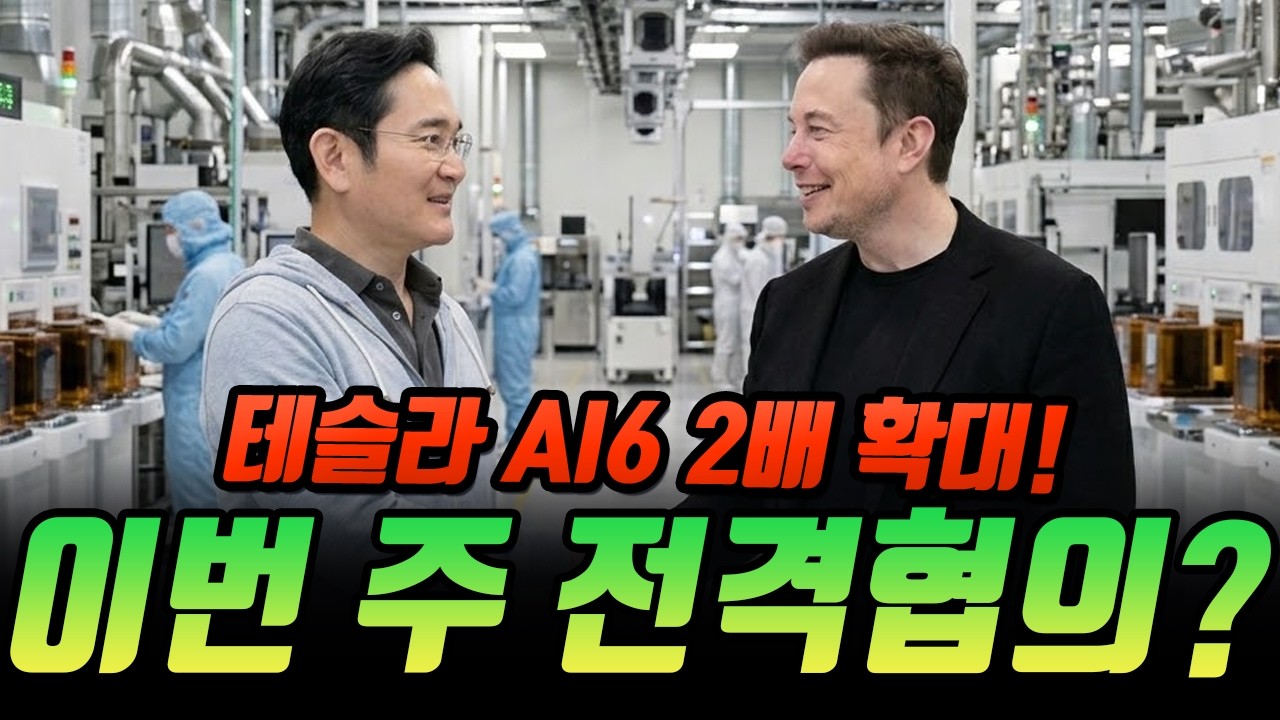
● War Fade Sparks AI Frenzy, Musk Empire Mega Merge
A Single Brief Covering: The Real Drivers of the Market Rebound + the “AI Acceleration Zone” + the Elon Ecosystem Convergence (Geopolitics, AI, Tesla, SpaceX, and X Money)
This note focuses on four points:
1) Why markets rebounded now, framed through geopolitical risk (Hormuz/oil/risk premium), presented in a news-style format.
2) Reframing Anthropic CEO Dario Amodei’s comments not as hype, but as evidence of an industrial-structure shift.
3) Tracking “real-world AI” execution speed via Tesla FSD, European regulation, robotaxi hiring signals, and South Korea sales data.
4) The synergy created when Elon Musk’s companies converge into one ecosystem across money/data/compute, including SpaceX regulatory tailwinds and X Money (financial services).
1) [Global Macro Update] A regime where markets respond more to “geopolitics + AI” than to individual company fundamentals
Equity performance has been more sensitive to geopolitical risk and the AI capex cycle than to earnings.
The recent rebound appears driven less by “escalation risk” and more by a shift in expectations toward “faster-than-feared stabilization.”
1-1. [Iran Issue Key Point] When the “risk premium” compresses, equities and oil tend to react first
The core message is that Iran’s military options (missiles/drones) are being depleted, and repeated launches increase location exposure, potentially enabling interdiction/strikes that further reduce launch capacity.
Market relevance is straightforward: if the Strait of Hormuz risk materializes, energy and supply-chain pricing can re-accelerate, raising inflation expectations, pushing rate expectations higher, and compressing equity valuations.
Conversely, if credible signals indicate reduced capacity or reduced willingness to sustain military action, the embedded geopolitical risk premium can unwind, supporting risk assets.
1-2. [Quantifying the Narrative] Rapid declines in missile/drone launches as a “termination” signal
The narrative emphasizes a sharp drop in launch volume (e.g., ~350 on day one, then a rapid decline toward ~40).
For investors, this raises a practical question: is supply capacity (inventory and/or launch infrastructure) being impaired?
Markets appear to be re-pricing toward a higher probability of near-term de-escalation rather than prolonged conflict.
1-3. [Secondary Development] Why crypto activity often rises during conflict regimes
A notable datapoint is increased crypto activity inside Iran.
When currency confidence weakens and capital controls tighten, flows frequently migrate toward digital assets due to flexible access and transfer pathways.
This functions less as a short-lived theme and more as a signal of how payment/store-of-value behavior shifts under stress.
2) [AI Trend Update] The practical meaning of “no visible ceiling”: demand has already shifted the operating model
Comments from Anthropic CEO Dario Amodei at a Morgan Stanley TMT conference drew attention, but the key market takeaway is not technological optimism; it is evidence that revenues and demand are entering an S-curve.
2-1. [Key Metric] What reported Anthropic revenue growth implies for investors
The referenced trajectory is approximately USD 0.1B two years ago to roughly USD 19B currently.
The investable signal is less about exact figure verification and more about the speed at which enterprise customers are moving AI from experimentation (POCs) into operating budgets and structural cost bases (CAPEX/OPEX).
At this stage, AI increasingly behaves like infrastructure spend rather than a cyclical discretionary item, pulling through hyperscaler capex, data centers, power, and semiconductors.
2-2. [Technology Progression] Pre-training → post-training (inference/reasoning) → agents → self-improvement
The sequence described:
- Prior constraint: scaling parameters becomes prohibitively expensive.
- Next phase: improving performance by increasing inference-time reasoning.
- Current phase: agents performing real work using tools.
- Next implied phase: AI systems contributing to improving AI systems.
The investment lens shifts from “model performance” to the expanding scope of task substitution. As white-collar automation scales, productivity effects can influence GDP estimates and corporate margins.
2-3. [Market Structure] From “OpenAI as default” to multi-model competition
The positioning suggests share gains by Anthropic versus OpenAI.
More importantly, enterprise buyers are increasingly optimizing model choice by task, rotating among models rather than committing to a single vendor.
This supports a broader set of winners beyond LLM providers: model routing, security, compliance, and data-governance layers in B2B stacks.
3) [Tesla Update] FSD as the fastest commercialization pathway for “real-world AI”
If LLMs transform office workflows, Tesla FSD targets streets and factories. The focus includes European regulatory engagement, real-world driving examples, and repeated observations of behavior that appears “perception-driven.”
3-1. [Interpreting FSD Clips] The key claim is “detecting risk before humans do”
A recurring pattern: the system slows or stops in a way that seems unnecessary, but a later camera review reveals an oncoming vehicle or hidden hazard.
If this pattern consistently holds, the regulatory persuasion point shifts from “more convenient than humans” to “safer than humans.”
3-2. [Europe Regulation] Ireland as a Level 2 permissive signal
Ireland reportedly signed documentation related to allowing Level 2 autonomy. Tesla operates within Level 2, implying incremental access, while additional approvals and regulatory processes likely remain for specific services.
For investors, the key is not one country’s decision, but whether European regulatory standards are shifting and which companies benefit first.
3-3. [Germany Robotaxi Signal] Hiring postings often function as timelines
Robotaxi-related power systems engineering roles reportedly appeared on Tesla’s Germany hiring site.
Such postings often arrive later than marketing but earlier than production, making them useful indicators that planning is moving into execution.
3-4. [Labor Dynamics] Declining representation by IG Metall and possible implications
Reportedly, IG Metall’s representation position weakened in Germany.
This may reflect a broader recognition that persistent resistance to innovation and productivity gains can be economically self-defeating for European manufacturing, implying potential policy and stance adjustments beyond Tesla-specific issues.
3-5. [South Korea Tesla Sales] If hardware doubles year-over-year, demand is more likely structural
The claim is that South Korea sales doubled from 2024 to 2025, with an even stronger trajectory in 2026 Q1.
Software can scale rapidly; hardware doubling in a single year more often requires simultaneous strength in demand, brand, and product competitiveness.
If South Korea continues to open regulatory and social acceptance pathways for autonomous driving, additional step-function demand shifts are possible.
4) [Elon Ecosystem Convergence] The compounding effects of integrating Tesla (real-world AI) + SpaceX (space infrastructure) + X (payments/finance)
The central framing is not that each company grows independently, but that data/compute, payments/distribution, and hardware/software interlock to compound.
4-1. [SpaceX Dominance] Impact of removing a “50% cap” on NASA contract share
The key point: a provision limiting any single company to 50% of certain NASA contract allocations was reportedly removed from a reauthorization bill.
If constraints tied to market share are relaxed, SpaceX can capture more volume proportional to performance.
This can accelerate optimization in launch cost, cadence, and reliability, and may be constructive for longer-term IPO expectations.
4-2. [X Money] The economic meaning behind “controlling the money rail”
Reportedly discussed: an X Money beta, potential deposit yield around 6% annually, and aggressive FX fee positioning.
The core issue is not “social media becomes finance,” but that once a platform controls payments/deposits/lending, behavioral data can feed underwriting, pricing, and limits.
When content/reputation/network data becomes an input to financial risk models, the platform evolves from an advertising business toward financial infrastructure.
4-3. [Semiconductors and Memory] Linking AI6 expansion, potential Samsung incremental orders, and DRAM price-tightness narratives
The discussion connects Tesla AI6 production expansion (with indications of incremental Samsung orders) to memory pricing dynamics.
In this phase, the market driver is less “better products” and more that AI infrastructure creates bottlenecks across power, servers, and memory, shifting pricing power upstream in the supply chain.
AI is therefore behaving less like a software-only boom and more like a macro capex cycle pulling through semiconductors, data centers, grid capacity, cooling, and networking.
5) Key Points Often Underemphasized in Mainstream Coverage (Investor Lens)
Point A. In geopolitics, markets price the energy/inflation pathway more than “winning vs. losing.”
Market impact ultimately flows through oil and inflation expectations. The rebound is more practically explained by potential risk-premium compression.
Point B. The substance of Amodei’s framing is budget reallocation, not model improvement.
Once AI moves from experimental spend to operating spend, budgets become stickier even in downturns, supporting durability in data center/semiconductor/power capex.
Point C. Tesla FSD is not only autonomy; it is a real-world data flywheel.
Robotaxis may be the headline outcome, but the ongoing value is global driving data as a training engine that competitors may struggle to replicate purely with capital.
Point D. The strategic risk of X Money is not “6% yield,” but platform-based credit creation.
If a platform integrates payments and lending, user activity can be transformed into collateral-like signals and credit capacity, altering platform power dynamics.
6) Investor Checklist (Treating These Topics Like Economic Indicators)
1) Monitor whether oil, shipping rates, and insurance premiums stabilize quickly.
2) Track whether US long-term yields and inflation expectations re-accelerate (war-driven inflation risk).
3) Watch hyperscaler capex guidance and data center constraints in power and cooling.
4) In European autonomy regulation (Level 2–3), prioritize language on liability/accident standards over “permission” headlines.
5) For X Money, focus on licensing, partners, and any stablecoin architecture; launch structure matters more than marketing.
< Summary >
- The market rebound appears driven more by expectations of earlier stabilization in the Iran-related situation and a corresponding unwind of geopolitical risk premium than by single-stock catalysts.
- The “no visible ceiling” AI narrative is best interpreted as S-curve demand pulling enterprise budgets and infrastructure investment into a structural shift.
- Tesla FSD continues building credibility through real-world performance data amid evolving European regulation; robotaxi hiring signals and incremental Level 2 permissiveness may represent gradual inflection points.
- SpaceX’s regulatory tailwind on NASA contract concentration and the financialization of X via X Money reinforce a convergence thesis in which data, compute, and payment rails compound across the Musk ecosystem.
[Related Posts…]
- AI investment and data center CAPEX reshaping global equity dynamics (NextGenInsight.net?s=AI)
- Tesla FSD/robotaxi regulatory developments, with early signals emerging in Europe (NextGenInsight.net?s=Tesla)
*Source: [ 허니잼의 테슬라와 일론 ]
– [테슬라 라이브] 일론 생태계의 대융합의 시작. 시장의 이유있는 반등 / 앤트로픽 CEO의 충격 발언 “AI 발전의 한계점이 전혀 보이지 않는다”
● Trump Hype Ignites Bitcoin Surge, Hormuz Oil Shock Tamed, Fed Cut Bets Roar Back
Trump-Led Bitcoin Rally: A Single Briefing on the Strait of Hormuz, Oil, and the Fed
This report covers: (1) why Strait of Hormuz risk abruptly shifted into a “market-stabilizing” input, (2) Goldman Sachs’ timeline for oil and logistics normalization, (3) why Bitcoin reacted with a one-day lag after Trump’s remarks, (4) the market signal from the congressional vote, and (5) the link between US midterm politics and crypto regulation.
1) US Equities Recap: “If oil calms, risk-on returns”
US equities advanced broadly, with strength concentrated in mega-cap technology (including Nvidia, Microsoft, AMD, Amazon, Tesla, Palantir, and Meta).
Session takeaway:crude’s surge paused → equity volatility eased → risk appetite improved.
Mechanically, higher oil prices raise inflation concerns, reduce expectations for Fed rate cuts, and pressure growth-stock valuations first.
2) Strait of Hormuz: The key variable is narrative control, not physical control
The core issue is less “who fully controls the corridor” and more which expectation path is embedded into markets.
2-1) US messaging: “We will prevent control”
Trump-aligned messaging referenced state-backed insurance/guarantees for vessels transiting the Strait and maintained the tone that Iran would be prevented from exercising control.
Defense-related statements used strong language (e.g., “full and complete dominance”) while avoiding explicit timelines. This combination is consistent with crisis communication aimed at suppressing market anxiety without committing to a schedule.
2-2) Iranian messaging: “We have full control”
Iran’s IRGC claimed the Strait is under complete Iranian naval control and dismissed US statements.
For markets, price action is being driven more by psychological signaling around oil and shipping routes than by direct kinetic escalation.
3) Goldman Sachs scenario: Pricing “faster-than-feared” normalization
Goldman Sachs has been summarized as assuming that even if oil exports/logistics through the Strait experience an initial “near-zero” shock, partial recovery could begin within ~5 days, with normalization around mid-April.
The investment implication is not whether the forecast is correct, but that once major banks begin pricing a normalization path, crude and risk assets (equities, crypto) can re-rate simultaneously.
4) Trump’s “15 out of 10” war-progress comment: markets reward perceived control
Trump characterized progress as “15/10” and delivered additional hardline messaging implying rapid removal of Iranian leadership.
For investors, the factual accuracy is secondary to the effect: the statement provides inputs that can be interpreted as reduced uncertainty, which is typically supportive for risk assets.
5) The Venezuela “supply” narrative: offsetting oil-risk premium
Trump’s reference to cooperation with Venezuela functions as a market signal that incremental supply could emerge, dampening oil-driven risk premiums.
In geopolitics, war headlines are frequently transmitted into markets via supply-shock pricing; introducing credible alternative supply possibilities can reduce tail-risk positioning.
6) US congressional vote: confirmation of executive latitude
A Senate measure led by Tim Kaine—intended to halt hostile action against Iran without congressional approval—failed 47–53.
Markets may interpret this not only as escalation risk, but also as reduced policy/decision uncertainty, lowering the probability of political gridlock affecting near-term military and energy-policy pathways.
7) Bitcoin rally: the one-day lag is the key observation
After pro-crypto messaging from Trump (including pushes related to regulatory “clarity”), crypto did not immediately reprice. The following day, Bitcoin strengthened to around $73,000, with Ethereum also higher.
7-1) Why the delayed reaction: “policy expectations + risk-on resonance”
1) When equities shift back to risk-on, crypto often benefits concurrently.
2) Political/regulatory catalysts do not translate into immediate cash-flow metrics; positioning adjustments frequently occur with a lag.
As a result, crypto often shows trend continuation starting the next session rather than instant spikes.
8) Midterms and crypto: structural incentives for repeated pro-crypto “support”
A key point is that crypto holders constitute an electorally relevant cohort. As predictive-market odds move against Republicans, Trump’s incentives to sustain pro-crypto policy signals rise.
For markets, this increases the probability that regulatory-easing narratives, industry-support initiatives, and institutionalization themes (including ETF/legislative momentum) reappear episodically during politically sensitive periods.
9) Additional escalation variables: Kurdish forces and Arab responses
9-1) Kurdish opposition: “ground effect without ground forces”
Reports that Kurdish-origin Iranian opposition groups in northern Iraq are preparing operations, with speculation of informal US support, matter because they offer the US a way to expand influence without direct ground-force commitments.
9-2) Arab League warning: limited force, but a regional-risk indicator
The Arab League publicly criticized Iran, warning that attacks on Gulf states would be a strategic mistake. While enforcement capacity is limited, such statements can still be consumed as signals of broader regional instability risk.
10) Core points often underemphasized in mainstream coverage
10-1) The Strait of Hormuz matters less for oil levels than for the rate path
Many narratives stop at “war → oil.” For investors, the higher-order variable is how oil feeds into inflation and shifts Fed rate-cut expectations.
Given the market’s sensitivity to rates, the critical question is not whether flows are disrupted, but the duration of elevated oil prices.
10-2) The failed vote can be read as uncertainty reduction, not “war support”
In political risk, markets often penalize not just adverse outcomes, but indeterminate outcomes. The vote outcome implies greater short-term executive flexibility, which can support an “uncertainty premium” unwind in risk assets.
10-3) Bitcoin’s trigger is not a single pro-crypto remark; it is electoral arithmetic
The relevant mechanism is structural: as midterms approach, political incentives to court crypto-aligned voters intensify. This raises the likelihood of recurring policy messaging around regulatory relief and sector promotion.
10-4) A one-day lag suggests positioning is still anchored to the Trump narrative
Delayed trend formation can indicate confirmation-based re-entry by larger pools of capital, rather than only short-term retail chasing.
11) Forward monitoring checklist (calendar-oriented)
For the Strait of Hormuz, prioritize real-time indicators over declarations:transit volumes, insurance premia, freight rates, and crude term structure (backwardation/contango).
For crypto, US political catalysts (legislation, regulation, polling) can intersect with broader risk sentiment; monitoring news–politics–liquidity jointly is often more informative than chart-only approaches.
These dynamics also connect to the global macro outlook and, structurally, to AI-related capex cycles (data centers, semiconductors) and large-cap technology earnings and investment plans.
< Summary >
Strait of Hormuz risk was managed via strong messaging without explicit timelines, easing crude’s upside momentum and supporting a risk-on rebound led by large-cap technology.
Goldman Sachs presented a faster-than-feared normalization path for logistics and oil flows; the failed congressional vote reduced policy uncertainty, which is typically supportive for risk assets.
Bitcoin strengthened to approximately $73,000 as pro-crypto political narratives and the broader risk-on move resonated with a one-day lag. As midterms approach, incentives for recurring pro-crypto policy “support” increase, reinforcing episodic regulatory-momentum themes.
[Related Articles…]
- Bitcoin: Key linkages between political events and price action
https://NextGenInsight.net?s=Bitcoin - Crude Oil Outlook: How geopolitical risk transmits into inflation and the rate path
https://NextGenInsight.net?s=Oil
*Source: [ Maeil Business Newspaper ]
– [홍장원의 불앤베어] 트럼프 리딩에 비트코인 랠리