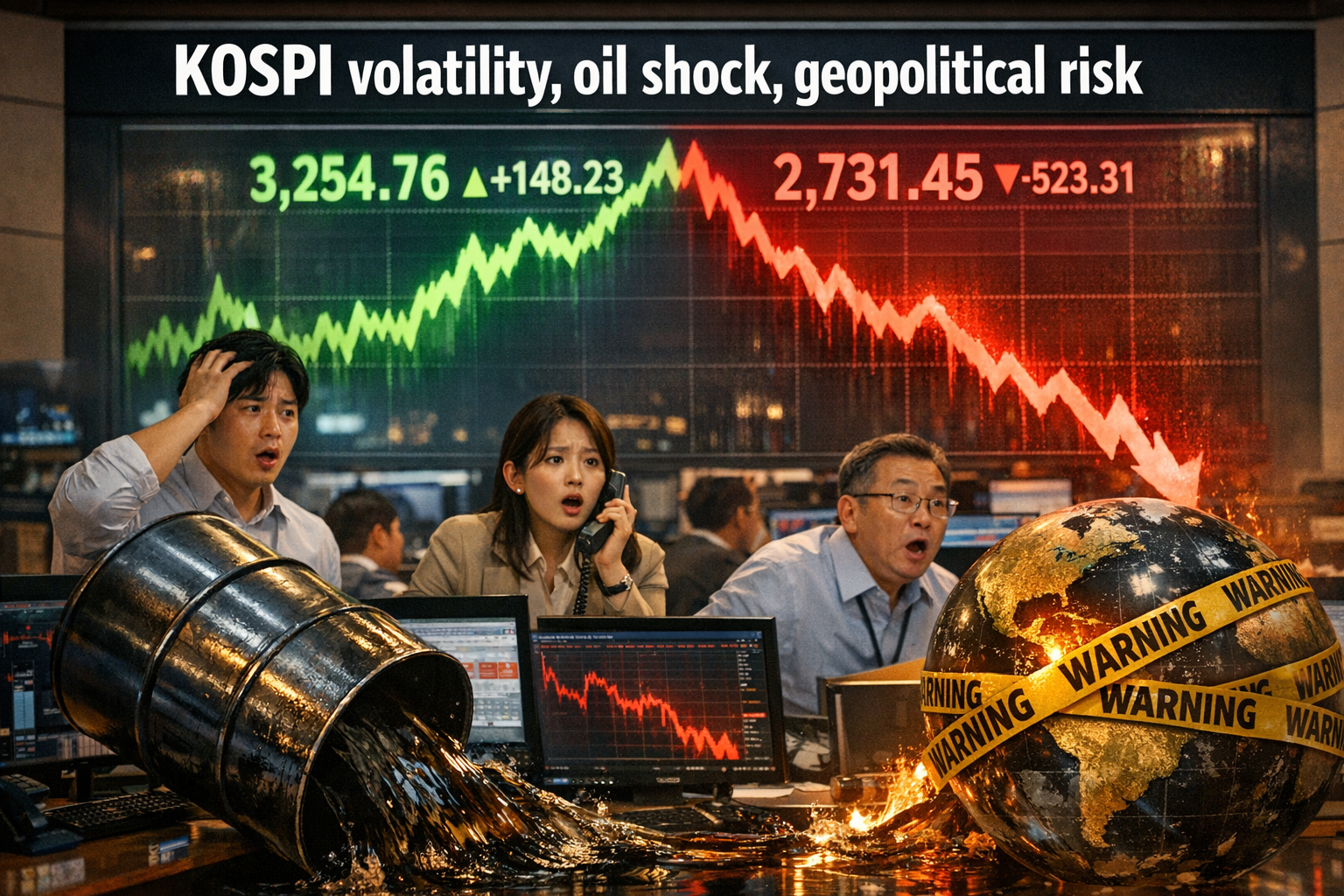
● KOSPI Whiplash Surge Then Crash Risk Soars Amid War Oil Shock Dollar Jitters
KOSPI “Sharp Rally Followed by Next-Day Selloff”: Why the Probability Has Increased
This note consolidates four core points:1) US equity weakness is not confined to technology; it is starting with cyclicals and small caps
2) The Israel-Iran conflict is transmitting into energy and logistics, creating direct headwinds for Korean equities
3) Why Hormuz risk is more than higher oil prices (insurance, freight, procurement, and sentiment)
4) Key point often underemphasized: Korea may destabilize first via power costs, input costs, and USD dynamics rather than exports
1) Global equities: The risk is broader than “Nasdaq-only”
The recent decline appears less like a narrow technology correction and more like broadening risk aversion across the US market.
While the Nasdaq is down roughly in the -1% range, the Dow (near -2%), S&P 500 (around -1%), and Russell 2000 (in the -2% range) have weakened more sharply, indicating heavier pressure in more cyclical segments.
This pattern is commonly associated with markets pricing in both slower growth and rising costs (energy) simultaneously.
In particular, outsized weakness in the Russell 2000 is often interpreted as a signal of rapidly turning liquidity conditions. If transmitted to Korea, foreign flows may destabilize not only large-cap exporters but also KOSDAQ, raising the probability of broader de-risking.
2) Geopolitics: The absence of a clear off-ramp is weighing on risk assets
Israel has escalated operations (including strikes in Tehran and actions against Hezbollah leadership), while Iran has responded with missile attacks.
US Central Command reported that Iran’s missile launches fell 86% over four days and drone activity declined 73%. While this could be interpreted as reduced capacity, markets may instead price higher uncertainty and the risk of asymmetric escalation.
If tensions expand to neighboring areas (including spillover risks involving nearby states), markets typically add a “prolonged conflict premium” to oil and freight. Financial markets operationalize war headlines primarily through energy, logistics, and FX.
3) Energy: Hormuz risk raises broader supply-chain costs, not only crude prices
The Strait of Hormuz is a critical corridor for crude oil, LNG, refined products, marine insurance, and freight. Once narratives such as “thousands of vessels stranded” circulate, pricing can move ahead of verified data.
Brent moving toward the 84–85 range represents not only a price increase but also a risk of re-accelerating inflation expectations. For Korea, higher oil and gas prices typically translate quickly into higher manufacturing input costs (power, gas, logistics), pressuring earnings estimates.
4) Political risk: Why statements about “intervening” increase uncertainty
Comments attributed to Trump suggesting involvement in shaping Iran’s next leadership are often interpreted by markets less as a stabilizing force and more as an uncertainty amplifier.
Policy and diplomatic variables are difficult to model and can trigger abrupt volatility on incremental headlines. If research commentary emphasizes that tools to lower energy prices are limited, markets may further widen the risk premium.
5) Korea (KOSPI/KOSDAQ): A large one-day surge can increase next-day volatility
A single-session move such as KOSPI +9% and KOSDAQ +14% can reflect strong buying but often includes short-covering, position resets, and momentum chasing. After such sessions, opposing forces can dominate the following day.
Profit-taking tends to accelerate when uncertainty (war, oil, FX) rises and cash becomes the preferred positioning.
If the Korea ETF (EWY) drops sharply intraday (e.g., -7% to -8%), next-day local sentiment typically weakens. Even if domestic flows improve, global passive and hedging capital often reduces exposure first through ETFs.
6) External narrative risk: “Sell the US, buy Asia” can reverse
A common narrative has been US overvaluation leading to rotation into Asia. However, a war-driven oil spike tends to pressure Asia first, particularly energy importers. This can flip rotation into a reversal (re-risking toward the US or moving to cash).
Korea is a major energy importer, and FX instability (KRW/USD) increases perceived risk for foreign investors. In practice, FX moves often coincide with shifts in foreign positioning.
7) Semiconductor risk transmission: Not demand, but power costs and operational risk
A key theme circulating in external media is LNG. Claims such as “Korea has nine days of natural gas inventory” can move markets regardless of verification, as risk-off positioning frequently precedes fact-checking.
The critical point is that semiconductors do not trade solely on demand expectations. Any disruption risk across power, water, gas, chemicals, or logistics can pressure valuations through concerns about operational continuity, ahead of reported earnings.
Key transmission channel:
- Hormuz risk → LNG/crude procurement anxiety → energy price increases
- Higher energy prices → higher power tariffs/industrial input costs → margin pressure risk
- Operational continuity concerns (including exaggerated rumors) → higher foreign investor risk premium → weaker flows
Even if the probability of physical production stoppages is low, equities often move on expected impact (probability × severity) before confirmation.
8) Investor checklist: Five variables to monitor daily
In this regime, monitoring matters more than prediction. Key indicators:
- Oil: Brent holding above ~85 increases inflation and cost-shock risk
- FX: KRW/USD spikes often coincide with weaker foreign flows
- US rates: oil-driven inflation concerns can reprice rate expectations
- KOSPI flows: ETF/EWY behavior versus onshore foreign net flows
- Semiconductor valuation: multiples may compress via risk premium before fundamentals change
9) Key points often underemphasized in mainstream coverage
- Point 1: Hormuz risk first raises transaction costs before physical shortages
Insurance, rerouting freight rates, and settlement/financing costs can rise first, affecting corporate margins faster than CPI. - Point 2: For Korean equities, input costs, FX, and foreign positioning are often more decisive than war headlines
High energy import dependence and high foreign ownership increase sensitivity to risk-off regimes; oil and KRW/USD can lead. - Point 3: A sharp one-day rally leaves crowded positioning
If negative catalysts emerge the next day, the market can shift into a selloff characterized by abundant sellers, increasing volatility; KOSDAQ can underperform. - Point 4: Rumors can be wrong yet still move prices
Even exaggerated inventory figures can trigger mechanical de-risking by foreign and systematic strategies; positioning often adjusts before facts are resolved.
10) Conclusion: “Rally one day, selloff the next” is a plausible base case near-term
With limited evidence of rapid de-escalation, rising oil, and a narrative shift that targets energy-importing Asian markets, elevated volatility remains likely.
Priority should be placed on disciplined risk controls (cash allocation, stop-loss and staged entry rules, sector concentration limits) rather than headline-driven trading.
< Summary >
US equity declines are broadening beyond technology into cyclicals and small caps, signaling risk-off conditions.
The Israel-Iran conflict transmits into oil, logistics, insurance, and FX, which is structurally negative for energy-importing markets such as Korea.
A prior-day surge in KOSPI/KOSDAQ can leave crowded positioning and raise the probability of next-day drawdowns.
Key monitoring variables: oil, KRW/USD, US rates, foreign flows (including EWY), and semiconductor risk-premium dynamics.
[Related Posts…]
- https://NextGenInsight.net?s=환율
- https://NextGenInsight.net?s=유가
*Source: [ 내일은 투자왕 – 김단테 ]
– 코스피 진짜 큰일났다 ㄷㄷㄷ