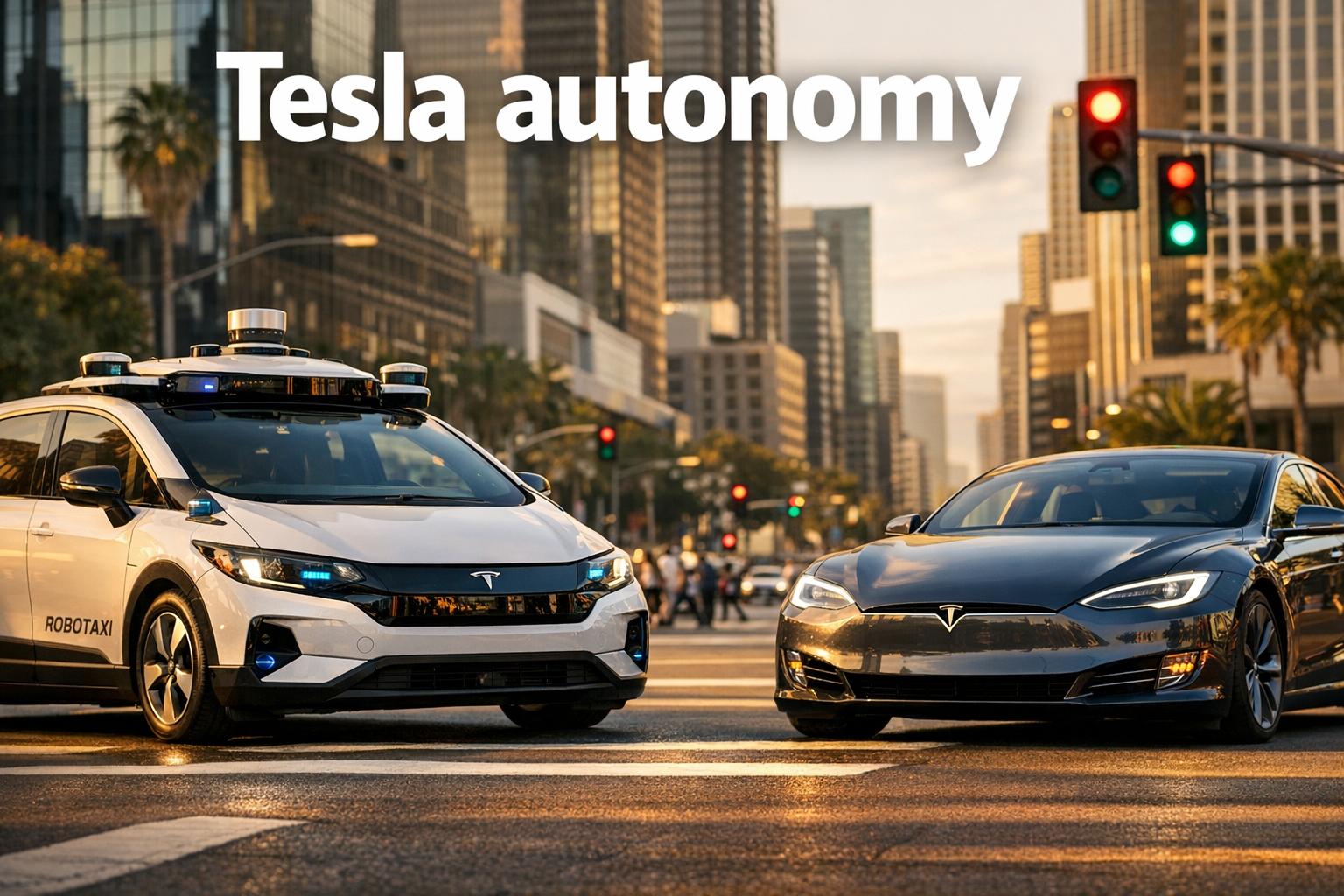
● NHTSA Ignites Robotaxi War, Tesla Looms, Oil Shock Meets EV Surge
U.S. NHTSA Advances Autonomous-Driving Safety Standards; Waymo, Zoox, and Aurora to Attend — Why Tesla Remains Central Despite Its Absence
This development is not a standalone Tesla headline. It reflects a broader policy shift in the U.S. toward moving autonomous driving from “experimentation” to “everyday deployment,” while investor focus remains disproportionately on Tesla’s next strategic step. It also coincides with a renewed oil-price shock driven by Middle East risk, even as ARK Invest’s Cathie Wood reiterates a longer-term view that oil prices could structurally decline alongside electric-vehicle adoption and autonomy-driven mobility efficiency gains.
The core linkage is the simultaneous movement of:regulatory normalization + autonomous commercialization + lower mobility cost + structural change in energy demand.
1. Key Takeaways
- The National Highway Traffic Safety Administration (NHTSA) will convene a national forum to establish autonomous-vehicle safety standards.
- CEOs of Waymo, Zoox, and Aurora are scheduled to participate.
- While positioned as a “safety guideline” forum, markets are treating it as a precursor to broader regulatory clearance for commercial autonomous deployment.
- With oil prices rising toward $90/bbl amid geopolitical risk, Cathie Wood cited potential long-run downside to below $50/bbl, attributing structural demand pressure not only to EV penetration but also to autonomy-enabled efficiency.
2. Why the NHTSA Forum Matters Now
2-1. Policy Signal: Transition From Pilots to Deployment Frameworks
Historically, U.S. autonomous-driving activity has centered on demonstrations, localized pilots, and constrained operations. The policy discussion is increasingly shifting from whether to restrict autonomy to how to define conditions under which it can be permitted. Regulatory clarity reduces uncertainty and typically improves the feasibility of capital deployment and manufacturing-scale planning.
2-2. Practical Objective: A Commercialization Checklist
Beyond general safety principles, the forum is likely to address operational thresholds that function as commercialization requirements, including:
- acceptable incident/accident rates and comparison methodology vs. human drivers
- requirements for remote assistance and operational oversight
- conditions for large-scale deployment of vehicles without steering wheels or pedals
- definitions and handling standards for edge cases in mixed traffic environments
2-3. Drivers of Policy Acceleration
Key factors supporting accelerated standard-setting include:1) Technical maturity: paid autonomous ride services already operate in select cities.
2) Strategic competition: autonomy spans semiconductors, cloud, mapping, AI models, communications infrastructure, and robotics, making standards leadership economically strategic.
3) Productivity and cost: high U.S. labor costs increase the potential economic impact of removing driving labor from logistics and mobility.
3. Why Waymo, Zoox, and Aurora Are Featured
3-1. Waymo: Current Benchmark for Commercial Operations
Waymo is viewed as the most observable commercialization reference point for regulators, reportedly providing more than 400,000 paid rides per week across cities including Phoenix, San Francisco, and Los Angeles. Waymo has stated that its airbag-deployment crash rate is approximately 85% lower than that of human drivers, though such figures require independent validation and consistent definitions.
3-2. Strengths and Constraints
- Strengths: safety-first approach using multi-sensor stacks (LiDAR/radar/cameras) and geofenced operations with structured oversight.
- Constraints: scalability challenges due to high-definition mapping, city-by-city operational tailoring, and potential dependence on remote support labor, which may affect unit economics at scale.
3-3. Strategic Implications of Zoox and Aurora
- Zoox (Amazon): signals integration potential across mobility and logistics ecosystems.
- Aurora: emphasizes autonomous trucking and industrial partnerships, including with Hyundai, underscoring that the regulatory agenda extends beyond passenger robo-taxis to freight and broader urban mobility automation.
4. Safety Debate: Framework Over Absolute Claims
4-1. The Primary Question: Relative Safety and Consistency
The relevant regulatory question is not whether autonomy is “perfect,” but whether it is measurably safer than human drivers under defined operating conditions, and whether performance is consistent across environments.
4-2. Implications of Recent Investigations
NHTSA’s scrutiny of autonomous software sends two signals:
- regulators are preparing to permit broader deployment, but require standardized safety evidence;
- nationwide expansion is unlikely to be justified by a single company’s localized performance.
Examples cited in public discussion include challenges in recognizing school-bus stop indications, misclassification of oncoming vehicles, and inappropriate passing behavior—representative edge cases that are common in real-world traffic and difficult to parameterize.
5. Why Tesla Draws Attention Despite Not Being Listed
5-1. Not on the Agenda, Still in the Market’s Focus
Tesla’s absence from the attendee list is noteworthy because Tesla operates on a different axis: vehicle fleet scale, data volume, over-the-air software distribution capacity, and manufacturing scale.
5-2. Core Advantage: Data and Deployment Velocity
Tesla’s key asset is not only its driver-assistance software but also its ability to collect real-world driving data at scale via a large deployed fleet. Performance improvements in autonomy are closely tied to exposure to diverse edge cases (weather, construction, unpredictable pedestrian behavior, and human-driver anomalies). Tesla’s installed base functions as a distributed sensing and data collection network.
5-3. Regulatory Clarity Could Favor Rapid Expansion
If federal standards become clearer, Tesla could be positioned to scale faster through software updates and standardized hardware platforms rather than city-specific operational builds. This creates a perceived asymmetry in time-to-scale once constraints are reduced.
6. Robo-Taxis and “Cybercab”: The Competitive Target May Be Uber, Not Waymo
6-1. Adoption Is Likely to Be Cost-Driven
Mass adoption depends on unit economics and user experience rather than technical novelty. The principal variable is cost per mile. Human-driven ride-hailing embeds labor as a dominant cost component; autonomy has the potential to structurally reduce that cost, shifting competition toward price and utilization.
6-2. Why Uber Represents the Immediate Demand Pool
While Waymo is a leading autonomy operator, the most directly addressable demand is the existing ride-hailing and taxi market (and potentially portions of public transit). Consumer choice is typically driven by price, wait time, and convenience. If a Tesla-style robo-taxi model achieves materially lower operating cost, it could disrupt ride-hailing pricing and alter how automakers are valued—from hardware manufacturers to software/platform and subscription-based mobility businesses.
7. Cathie Wood’s Oil View: Short-Term Spikes vs. Long-Term Structure
7-1. Separate Geopolitical Price Shocks From Demand Trajectories
Oil can rise rapidly on Middle East risk. The long-term thesis focuses on demand destruction and efficiency gains rather than short-term supply-driven volatility.
7-2. Autonomy as a Larger Variable Than EV Penetration Alone
The thesis emphasizes utilization. Privately owned vehicles are idle most of the day; autonomous fleets can operate at higher utilization. Higher utilization can reduce the number of vehicles needed to meet mobility demand, and electrification of those higher-utilization fleets can intensify structural pressure on oil demand.
7-3. High Oil Prices Can Accelerate Substitution
In the near term, higher fuel prices increase consumer burden; structurally, they also improve the relative total cost of ownership (TCO) proposition of EVs and efficiency technologies, potentially accelerating adoption.
8. Why Oil-Producing States Are Increasing AI and Robotics Investment
8-1. Strategic Diversification
Saudi Arabia and the UAE have increased investment in AI, robotics, data centers, advanced manufacturing, and smart-city infrastructure. This is consistent with hedging long-duration risk in oil-dependent economic models.
8-2. Changing Global Capital Allocation
Capital flows are shifting from traditional real estate/infrastructure allocations toward technology-driven growth themes. Increased emphasis on AI and robotics reflects positioning for a post-oil demand environment and signals potential long-term industrial restructuring.
9. Macro Implications
9-1. Inflation and Rates
Near-term oil strength can reaccelerate inflation through transport, input costs, and consumer prices, complicating central-bank policy. Over a longer horizon, autonomy and electrification may reduce mobility and logistics costs, functioning as disinflationary forces via efficiency and labor cost reduction.
9-2. Productivity and Labor Markets
Autonomy can raise productivity by reallocating time and increasing throughput in delivery and logistics. However, it also implies labor displacement risk in driving-heavy occupations, creating transitional adjustment costs.
9-3. Valuation Framework Shifts
As autonomy scales, market frameworks may evolve from manufacturing multiples toward software/data/network-effect and recurring-revenue models, particularly for firms with integrated hardware distribution and software monetization.
10. News-Style Summary
10-1. Policy
NHTSA will hold a forum to develop autonomous-vehicle safety standards, potentially initiating broader federal normalization.
10-2. Companies
Waymo, Zoox, and Aurora leadership will attend. Waymo is the leading commercialization reference but faces scalability and operational cost considerations.
10-3. Tesla
Tesla is not listed but remains a key focus due to fleet-scale data, manufacturing capacity, and potential for rapid deployment following regulatory clarification. Cybercab/robo-taxi strategy is viewed as a major potential beneficiary.
10-4. Energy
Despite geopolitical oil strength, the long-term argument emphasizes structural demand pressure from electrification and autonomy-driven efficiency.
10-5. Investment Lens
Primary focus is less on short-term oil volatility and more on whether autonomy commercialization reduces mobility costs and reshapes inflation, productivity, and platform competition.
11. Under-Discussed Critical Points
11-1. Liability and Accountability May Be More Important Than Safety Metrics
The central barrier to large-scale deployment is often the allocation of responsibility in accidents—among OEMs, software providers, remote operators, and vehicle owners. A workable liability framework is a prerequisite for scaling.
11-2. The Winner May Be the Fastest Deployable System, Not the Best Model
Certification, insurance, operations, hardware cost, service networks, and customer access can be as decisive as model performance. Autonomy is an operational industry, not only an AI benchmark contest.
11-3. The Long-Term Oil Debate Is About Demand Destruction Speed
Supply shocks dominate headlines, but long-horizon positioning depends on how quickly structural demand slows. Autonomy-enabled shared mobility may be a larger variable than EV adoption rates alone.
11-4. Tesla’s Strategic Question Is OS-Like Expansion, Not Unit Sales
If federal standards open deployment pathways, Tesla may be evaluated more like a mobility operating system with scalable distribution and recurring software economics than as a conventional automaker.
12. Key Items to Monitor
12-1. Official Language After the NHTSA Forum
Monitor whether outcomes remain “guideline review” or move toward explicit “federal standard setting,” and how concretely steerless/pedalless vehicle operations are addressed.
12-2. Congressional Legislative Velocity
Forum outcomes require follow-through in statute and regulation. Timing will affect commercialization speed.
12-3. Waymo Investigation Outcomes
Findings may set industry-wide precedents, either expanding permissible operating envelopes or tightening requirements.
12-4. Tesla Near-Term Milestones and Production Signals
Monitor Cybercab-related timelines, Austin operational expansion, unmanned operating scope, and FSD update cadence.
12-5. Divergence Between Spot Oil and Long-Term Expectations
Short-term oil spikes can drive volatility, but evidence of mobility efficiency gains may re-anchor investor focus on structural change.
13. Conclusion
The NHTSA forum is best interpreted as an early step in shifting autonomous driving from pilot programs toward formalized national deployment standards. While Waymo, Zoox, and Aurora are visible participants, investor attention remains on which companies can scale nationally once regulatory constraints are clarified. Tesla remains central due to data scale and deployment capacity. Oil headlines are driven by geopolitics, but longer-term positioning increasingly depends on whether autonomy and electrification structurally reduce mobility costs and oil demand.
< Summary >
- NHTSA’s autonomous-vehicle forum may mark the beginning of U.S. federal standardization enabling broader commercialization.
- Waymo leads in observable commercial operations, but scaling economics and operational dependence remain open issues.
- Tesla, despite not being listed, is viewed as a major potential beneficiary due to fleet data, manufacturing scale, and rapid software-based deployment capability.
- Cathie Wood’s oil outlook emphasizes structural demand pressure from EVs and autonomy-driven efficiency rather than near-term geopolitical spikes.
- Autonomy is positioned as a cross-sector inflection point linking transportation, AI, energy demand, inflation dynamics, productivity, and platform competition.
[Related Posts…]
- Autonomous driving deregulation and its impact on U.S. equities and the robo-taxi industry: https://NextGenInsight.net?s=autonomous%20driving
- Post-oil-spike implications for EV markets and inflation expectations: https://NextGenInsight.net?s=crude%20oil
*Source: [ 오늘의 테슬라 뉴스 ]
– 로이터 NHTSA 자율주행 안전 표준 정립 시작, 내일 웨이모·죽스·오로라 CEO 총출동, 캐시우드 이란, 고유가 전망 분석?● Tesla Autonomy Inflection Point, Google CEO Pay Shock, Waymo Monetization Surge, Robotaxi Wars, AI Power Shift
Tesla Autonomy Inflection Point Is Accelerating: Why the Alphabet CEO Compensation Change Is the True Core Signal
This is not a single-company headline.
It reflects a broader transition in autonomy and AI toward commercialization, regulatory normalization, and scalable unit economics.
This report consolidates:
- The practical inflection point in Tesla autonomy
- Early monetization signals from Google’s Waymo
- Robotaxi expansion dynamics
- The core competitive driver in humanoid robotics
- The structural shift in the AI industry that markets continue to underprice
The focus is structural:
- Why autonomous-driving KPIs were embedded in the Alphabet CEO compensation plan
- Why Waymo’s progress can be directionally positive for Tesla
- Why humanoid demos should be evaluated on generalization, not visual polish
- Why markets often overreact to fear signals while opportunity emerges behind the repricing
1. Key Developments (Summary)
Five high-signal points:1) Alphabet CEO Sundar Pichai’s compensation framework now includes autonomous-driving performance metrics.
2) Waymo continues to show technical edge-case limitations, but expansion and regulatory signaling are strengthening.
3) Tesla is advancing commercialization readiness via robotaxi hiring and production-related activity.
4) Humanoid robotics competition is increasingly defined by “generalizable AI,” not staged demonstrations.
5) Market sentiment remains fear-sensitive, while the industrial base is already reallocating toward AI and autonomy.
2. Evidence That Autonomy Is Transitioning Into a Revenue Business
2-1. Meaning of Autonomy Metrics in Alphabet CEO Compensation
The strongest signal in this cycle comes from Alphabet rather than Tesla.
Embedding autonomy milestones into CEO performance pay indicates:
- Autonomy is being evaluated as a revenue- and valuation-relevant business unit, not a long-horizon R&D project.
- Internal capital and leadership priority for autonomy has increased materially.
At large-cap scale, compensation design changes are among the clearest indicators of strategic reprioritization.
2-2. Why This Can Be Positive for Tesla
Waymo and Tesla compete, but Waymo’s commercial traction can accelerate industry-wide adoption by:
- Increasing regulatory comfort
- Establishing consumer familiarity and trust
- Validating the economic viability of robotaxi services for investors and municipalities
A common market pattern: early entrants often create category legitimacy, enabling faster scale by lower-cost or more broadly deployable platforms.
3. Waymo Is Expanding, Yet the Technical and Economic Gaps Remain Material
3-1. Market Expansion Is Not Equivalent to General Autonomy
Waymo’s geographic and service expansion is meaningful, but it does not necessarily imply robust general-purpose autonomy.
Observed operational hesitation in complex scenarios (e.g., unprotected left turns, dense intersection behaviors) suggests:
- Edge-case handling remains incomplete in unconstrained real-world environments.
Tesla’s approach emphasizes large-scale learning from diverse public-road data, targeting broader generalization rather than geo-fenced strength.
3-2. The Decisive Variable: Unit Economics and Deployment Velocity
The competitive outcome is not determined only by “the car can drive itself,” but by:
- Cost per vehicle and sensor stack burden
- Speed of multi-city deployment
- Operational scalability and maintenance complexity
- Software monetization capacity
If Tesla reaches unsupervised autonomy, the monetization stack extends beyond vehicle sales into:
- Subscription software
- Dispatch / network revenue
- Higher vehicle utilization
- Insurance
- Linkages to energy and charging infrastructure
This is structurally inconsistent with traditional auto valuation frameworks.
4. Robotaxi Hiring and Cybercab Build Activity: Commercialization Signals
4-1. Hiring Is More Reliable Than Press Releases
Ongoing hiring for robotaxi business leadership and operational expansion suggests:
- A more defined internal rollout plan
- Parallel progress on go-to-market execution, not only model training and engineering
Organization-building implies real budget allocation and near- to mid-term operational intent.
4-2. Increased Cybercab Sightings Imply Faster Iteration
More frequent Cybercab sightings at Giga Texas may indicate:
- Transition from prototype demonstration toward manufacturing iteration and test cycles
- Early-stage process optimization ahead of scale decisions
A key strategic optionality is the possible existence of a steering wheel/pedal variant:
- If for testing, it improves regulatory flexibility and validation pathways.
- If saleable, it provides a fallback revenue path if autonomy approvals slip.
This reduces the probability of a binary outcome. The structure becomes:
- Vehicle volume expansion + software monetization + incremental leverage upon regulatory clearance.
5. FSD Cumulative Driving Data at 8.5 Billion Miles: Why the Growth Rate Matters More Than the Level
5-1. Interpret as an S-Curve, Not a Linear Trend
The milestone is less important than the acceleration profile.
As user adoption expands and software quality improves:
- Total miles and feedback loops can compound
- Iteration cycles compress
- Data-driven advantages can deepen into a durable moat, especially for rare-event handling
5-2. More Important Than “10 Billion Miles” Is the Closing Velocity
Prior commentary has referenced ~10 billion miles as a rough benchmark for unsupervised autonomy readiness. The critical variable is:
- Whether the system is converging toward reliability at an accelerating pace, not whether a specific date is met exactly.
Markets typically overprice schedule slippage; technology investing is more sensitive to increasing probability of feasibility.
6. Humanoid Robotics: What Matters in Figure-Type Demos
6-1. The Core Question Is Not Only Teleoperation
A cleaning-task demo can be visually compelling, but the evaluation should center on:
- Whether behavior is narrowly scripted to a controlled studio environment
- Whether the system generalizes when layout, objects, and constraints change
6-2. Generalization Is the Economic Threshold
Industrial relevance requires robustness across:
- Different home configurations
- Variable object placement
- Changing factory workflows and task definitions
High-quality demos can be non-transferable. The investable frontier is generalizable autonomy under distribution shift.
7. Why Markets Repeatedly React to Fear, and How Investors Should Separate Signal From Noise
7-1. Media Incentives Favor Fear Narratives
High-visibility commentators often sustain attention through recurrent risk framing, particularly in complex domains.
Fear-based narratives are easier to consume than probabilistic, technical assessments, especially when the audience lacks domain grounding.
7-2. The Advantage Comes From Converting the Unknown Into the Measurable
Autonomy, space, humanoids, and generative AI are complex. Competitive advantage accrues to investors who:
- Decompose the technical stack
- Validate unit economics and scaling constraints
- Track data, hiring, production iteration, and regulatory posture as leading indicators
Capital ultimately reallocates toward structural productivity gains, even amid macro volatility.
8. In the AI Era, “Nonsense Detection” Becomes a Core Skill (for Humans and Models)
8-1. Plausible Language Is Not Equivalent to Truth
Generative models can produce high-confidence answers to invalid or fabricated concepts, highlighting:
- Persistent limitations in truthfulness and epistemic calibration
Humans exhibit similar vulnerabilities to confident, jargon-heavy messaging. Decision quality increasingly depends on filtering false authority and flawed frames.
8-2. Productivity Expansion Increases the Burden on Judgment
As AI expands content generation across documents, video, and analysis:
- Information volume rises sharply
- Decision-making can become harder without robust evaluation frameworks
The key differentiator shifts from information access to disciplined judgment under noise.
9. The “Human Computers” Analogy: The Structural Meaning of the AI Transition
The historical shift from humans performing computation to machines doing it implies a comparable transition for knowledge work:
- A material share of computer-based cognitive tasks may migrate to AI systems
This is not a simple tool upgrade; it reshapes job definitions, productivity, margins, and national competitiveness. Company actions should be interpreted as infrastructure positioning, not isolated equity stories.
10. Tesla Finance VP Departure: Focus on Content, Not Headline Noise
Executive departures can create short-term uncertainty, but require contextual assessment.
The public message associated with the departure emphasized:
- Alignment with mission and culture
- Respect for first-principles execution and long-term impact
This tone is not inherently consistent with internal fracture narratives. Nevertheless, key-person turnover remains a monitoring item, especially during commercialization transitions.
11. Undercovered Points With High Analytical Value
11-1. Waymo Progress Signals Market Opening, Not Tesla Failure
Waymo can de-risk adoption by normalizing regulation and consumer acceptance, expanding the total addressable market for scaled entrants.
11-2. Cybercab May Represent Both Robotaxi-First and Low-Cost Consumer Optionality
If autonomy approvals slow, a road-legal variant could still enable a volume-driven, low-cost model strategy, reducing binary risk.
11-3. The Core of Autonomy Is Economic Scalability
Value accrues when autonomy:
- Scales across cities
- Raises utilization
- Lowers operating cost
- Enables platform take-rates and recurring software revenue
11-4. Humanoids Are Ultimately a Generalizable AI Competition
The investable distinction is transferability to new environments and tasks, not choreographed execution.
11-5. Markets Overreact to Delays; Industry Compounds Through Accumulated Advantage
Long-run outcomes are shaped by cumulative:
- Data advantage
- Talent concentration
- Manufacturing iteration capability
- Regulatory adaptation capacity
- Capital endurance
- Software distribution reach
12. Monitoring Checklist (Investors and Industry Observers)
Key items to track:1) Waymo: pace of city expansion and monetization
2) Tesla: incremental robotaxi hiring and operational org changes
3) Cybercab: observed build cadence and specification shifts
4) FSD: growth rate of cumulative miles and version trajectory
5) Regulators: stance changes on unsupervised autonomy
6) Humanoids: evidence of generalization under real-world variability
7) Big Tech: capital allocation and executive compensation linkages to autonomy and AI
13. Conclusion: Focus on Structural Reallocation, Not Sentiment Volatility
Near-term noise remains: price volatility, regulatory uncertainty, and shifting timelines. However, the broader trajectory indicates autonomy and AI are moving from feasibility validation into monetization and scale preparation.
Alphabet’s CEO compensation linkage is a high-credibility signal of commercialization priority. Tesla’s hiring and production-related indicators reflect execution toward deployment readiness.
The central evaluation question is which organizations can convert this inflection into durable revenue and profit through scalable economics, regulatory navigation, and software-driven operating leverage.
< Summary >
- Adding autonomy to Alphabet’s CEO compensation signals a shift from research to monetizable business accountability.
- Waymo expansion can accelerate regulatory and market acceptance, indirectly benefiting Tesla by enlarging the category.
- Tesla is reinforcing commercialization readiness via robotaxi hiring, Cybercab iteration, and accelerating FSD data accumulation.
- In humanoids, generalization under changing environments is the decisive capability, not demo aesthetics.
- The key investment frame is industrial restructuring driven by AI and autonomy, not short-term fear narratives.
[Related Links…]
- https://NextGenInsight.net?s=autonomous%20driving
- https://NextGenInsight.net?s=AI
*Source: [ 허니잼의 테슬라와 일론 ]
– [테슬라 라이브&공지] 드디어 자율주행 변곡점! 구글 CEO마저 자율주행에 연봉까지 걸었다!
● Shipbuilders, Samsung, Oil Shock – Survive, Don-t Chase
Shipbuilding, Samsung Electronics, and the Commodities Shock: In the Current Market, “How to Endure” Matters More Than “What to Buy”
This is not a simple stock commentary. It links: why shipbuilding exposure was reduced; why Samsung Electronics can be attractive long term but may not offer an optimal entry after a sharp run-up; and how inflation, oil-price spikes, geopolitical risk, supply-chain restructuring, rare earths, and AI-driven biotech connect into the next investment framework.
The key conclusion: this market regime prioritizes risk management over chasing leadership. Even strong industries can be destabilized by macro shocks, while the next multi-year winners often form during periods of volatility.
1. Key Takeaways at a Glance
Four core points:
- Shipbuilding fundamentals remain constructive, but the sector has structural vulnerability to renewed inflation and cost shocks.
- Samsung Electronics remains positive structurally; however, after a rapid rally, new entries may face higher near-term drawdown risk.
- Forward-looking opportunities extend beyond semiconductors into rare earths, AI-driven biotech, and potential re-rating windows in US mega-cap technology.
- Korea’s outlook should be assessed through geopolitics, energy, supply-chain realignment, and the potential for deeper Korea–Japan cooperation.
This is less a specific stock call than a framework to distinguish risk from opportunity.
2. Shipbuilding Outlook: Not Over, but Why Exposure Was Reduced
Shipbuilding conditions remain favorable
The long-term view is not materially impaired:
- Many companies hold 3–4 years of backlog.
- Demand drivers include LNG carriers, naval vessels, low-emission ships, offshore projects, and defense-linked orders.
- Shifts in global trade patterns and energy transport can support a strategic-industry re-rating.
The primary rationale for trimming: cost risk
Shipbuilding is a contract/backlog business. Orders booked today are recognized over multiple years, with pricing partially fixed. If input costs rise materially during execution—steel, labor, electricity, logistics, components—margins can compress meaningfully.
Why inflation is particularly adverse for shipbuilding
Unlike sectors with fast pass-through, shipbuilding faces delayed price adjustment due to long production cycles and fixed-price contract elements. Oil spikes, raw-material inflation, and wage inflation can therefore produce larger-than-expected earnings downside.
Not a terminal call on the sector
The sector can still perform if geopolitical risk remains contained and defense/energy-related ordering persists. Groups with both shipbuilding and defense exposure may sustain stronger narratives amid elevated security spending.
Practical positioning guidance
- Assess margin structure, not only headline order growth.
- Monitor oil, steel, and wage trends as primary risk variables.
- Treat shipbuilding, refining, and defense as linked exposures under geopolitical stress regimes.
- For names that have already rerated sharply, position sizing and trim discipline may be warranted.
3. Samsung Electronics: Long-Term Constructive, Short-Term Heat Can Coexist
Positive company, but entry timing matters
A strong business does not imply an immediate buy. Structural supports include:
- Memory-cycle recovery
- AI-driven demand
- HBM competition
- Foundry and system semiconductor optionality
- Index and benchmark relevance in Korea
However, after a rapid price appreciation, risk/reward for new buyers can deteriorate.
Even strong uptrends typically require consolidation
Markets price expectations, not only fundamentals. If expectations are pulled forward too quickly, corrections can occur despite solid results, consistent with patterns seen in US mega-cap technology and semiconductor leaders.
Near-term variables to monitor
- Risk of US growth deceleration
- AI capex momentum and any moderation
- US election-related policy uncertainty and semiconductor restrictions
- Valuation sensitivity
- Correlation with global semiconductor performance, including Nvidia-led sentiment
A recession scare can pressure semiconductor equities even if the cycle is improving, given forward discounting.
Implementation view
- Existing holders can maintain a long-duration stance.
- New allocations may be better timed on pullbacks or staged entry, rather than momentum-chasing.
4. Core Market Drivers: Inflation, Oil, and Geopolitics
Re-acceleration of inflation changes the base case
If inflation re-accelerates:
- Rate-cut expectations can be delayed
- Corporate margins face cost pressure
- Equity valuation multiples can compress
Oil is a system-wide input cost and can propagate inflation across sectors.
Oil spikes create clear winners and losers
- Refiners may show relative resilience in oil-up regimes.
- Sectors with limited cost pass-through can underperform; shipbuilding is a prominent example.
- Airlines, transport, and parts of consumer-facing industries can face margin pressure.
Key screen: pricing power and hedging/contract structures.
Implications for Korea
Korea’s high energy import dependence and export-manufacturing concentration increase sensitivity to oil, FX, and rates. A combination of KRW weakness and rising oil prices can tighten macro conditions and raise index-level volatility, increasing the importance of selection and risk controls.
5. Global Outlook and Korea–Japan Cooperation: Relevance for Investors
Geopolitics is now a primary market variable
Geopolitical dynamics increasingly drive oil, FX, rates, supply chains, and defense spending, affecting both earnings and multiples.
Why Korea–Japan cooperation matters economically
Potential channels:
- Supply-chain realignment
- Semiconductor materials/components/equipment collaboration
- Joint energy and resource procurement
- Defense and maritime security coordination
- Tourism and infrastructure expansion
Korea and Japan remain competitors but also complementary: Korea’s manufacturing execution and technology scale versus Japan’s strength in materials, precision manufacturing, equipment ecosystems, and capital depth.
Industries to watch if cooperation deepens
- Rail and infrastructure
- Logistics and ports
- Tourism and regional development
- Joint procurement in industrial inputs
- Energy and resource development
- Defense and shipbuilding
Large-scale cross-border infrastructure concepts face feasibility and diplomatic constraints; the investable point is the shift toward alliance-driven industrial structuring.
6. US Equities and Next Themes: Amazon, AI Biotech, Rare Earths
Why consider US exposure
After broad rallies in Korea and the US, global allocation to USD assets and platform-scale growth can be rational, particularly in AI infrastructure.
Rationale for reassessing Amazon
Two drivers emphasized:
- Cloud and AI infrastructure scalability
- Satellite/space-adjacent optionality
In combination with core commerce and AWS, the profile can be viewed as a blend of defensiveness and long-duration growth exposure.
AI-driven biotech: a long-horizon pillar
Market attention often focuses on chips, data centers, and software. Over a longer horizon, AI applied to drug discovery, clinical design, precision medicine, and longevity research can attract sustained capital, given healthcare’s large addressable spend and AI-driven productivity gains.
Rare earths: the core of supply-chain competition
Rare earths underpin semiconductors, EVs, advanced weapons, robotics, AI hardware, wind, batteries, and magnets. Concentrated supply chains—especially high dependence on China—raise the probability of policy-led investment into alternative supply, processing, and strategic stockpiles. These exposures may be driven as much by industrial policy and security considerations as by near-term earnings.
7. News-Style Checklist: What to Monitor Now
Shipbuilding
- Backlog and defense linkage remain supportive.
- Inflation and input-cost spikes are primary downside risks.
- Emphasis on exposure management over aggressive additions.
Samsung Electronics
- Long-term fundamentals remain constructive.
- After a sharp rally, momentum entry risk is higher.
- Monitor the semiconductor cycle alongside US equity corrections.
Refining and Energy
- Potential relative strength during oil spikes.
- Monitor crude sourcing structure and geopolitical constraints.
US Equities
- Amazon may benefit from cloud/AI and space-infrastructure optionality.
- Corrections in AI leaders can transmit to Korean semiconductor sentiment.
Long-Horizon Themes
- AI biotech
- Rare earths
- Supply-chain restructuring beneficiaries
8. Underemphasized Points in Typical Market Coverage
1) Strong demand does not offset adverse cost structure
Shipbuilding can show improving top-line visibility while margins deteriorate if costs cannot be controlled or passed through.
2) “Positive long term” is not equivalent to “buy now”
Entry price and expectations matter; buying high-expectation regimes increases the probability of prolonged drawdowns.
3) The next capital cycle may favor AI infrastructure and AI biotech
Infrastructure layers (cloud, satellites, power, semiconductor inputs) and biotech applications may sustain longer investment durations than narrower software narratives.
4) Geopolitics is a required input
Taiwan, Japan, the US, China, North Korea, and the Middle East can simultaneously affect oil, FX, rates, supply chains, defense, shipbuilding, and semiconductors.
9. Consolidated Conclusion
The regime resembles a late-stage risk-on environment with simultaneous macro fragility. Strategy implications:
- Manage rather than chase leadership positions.
- Accumulate high-quality companies on corrections via staged entry.
- Use diversification and scenario planning to absorb macro shocks.
- Begin structured research on rare earths, AI biotech, and supply-chain realignment.
- Integrate Korean macro with global geopolitical pathways.
After broad rallies, avoiding poor timing can be more important than identifying the next outperformer.
10. Investor Checklist
- For shipbuilding, prioritize cost structure over order headlines.
- For Samsung Electronics, separate long-term thesis from short-term cycle and valuation risk.
- Track oil, US rates, and FX jointly.
- Analyze refining, defense, energy, and semiconductors as a connected system under geopolitical stress.
- Treat AI biotech and rare earths as strategic themes requiring early research.
- Avoid momentum-driven entry; define correction scenarios first.
Shipbuilding remains supported by backlog and demand, but is structurally exposed to inflation and input-cost shocks; exposure management is critical.
Samsung Electronics remains constructive over the long term, but after a sharp rally, new momentum entries may be less favorable than pullback-based accumulation.
Key market drivers are inflation, oil, geopolitics, and supply-chain restructuring.
Potential next themes include US mega-cap re-rating windows (e.g., Amazon), AI-driven biotech, and rare earths.
In the current regime, risk management and allocation discipline outweigh aggressive trend chasing.
[Related Articles…]
- Samsung Electronics earnings and the semiconductor cycle: why a reassessment is timely
https://NextGenInsight.net?s=Samsung%20Electronics - Rare earth supply-chain restructuring and key resources in the AI era
https://NextGenInsight.net?s=Rare%20Earths
*Source: [ Jun’s economy lab ]
– 조선주, 삼성전자에 대한 생각(ft.양양스승님 4부)