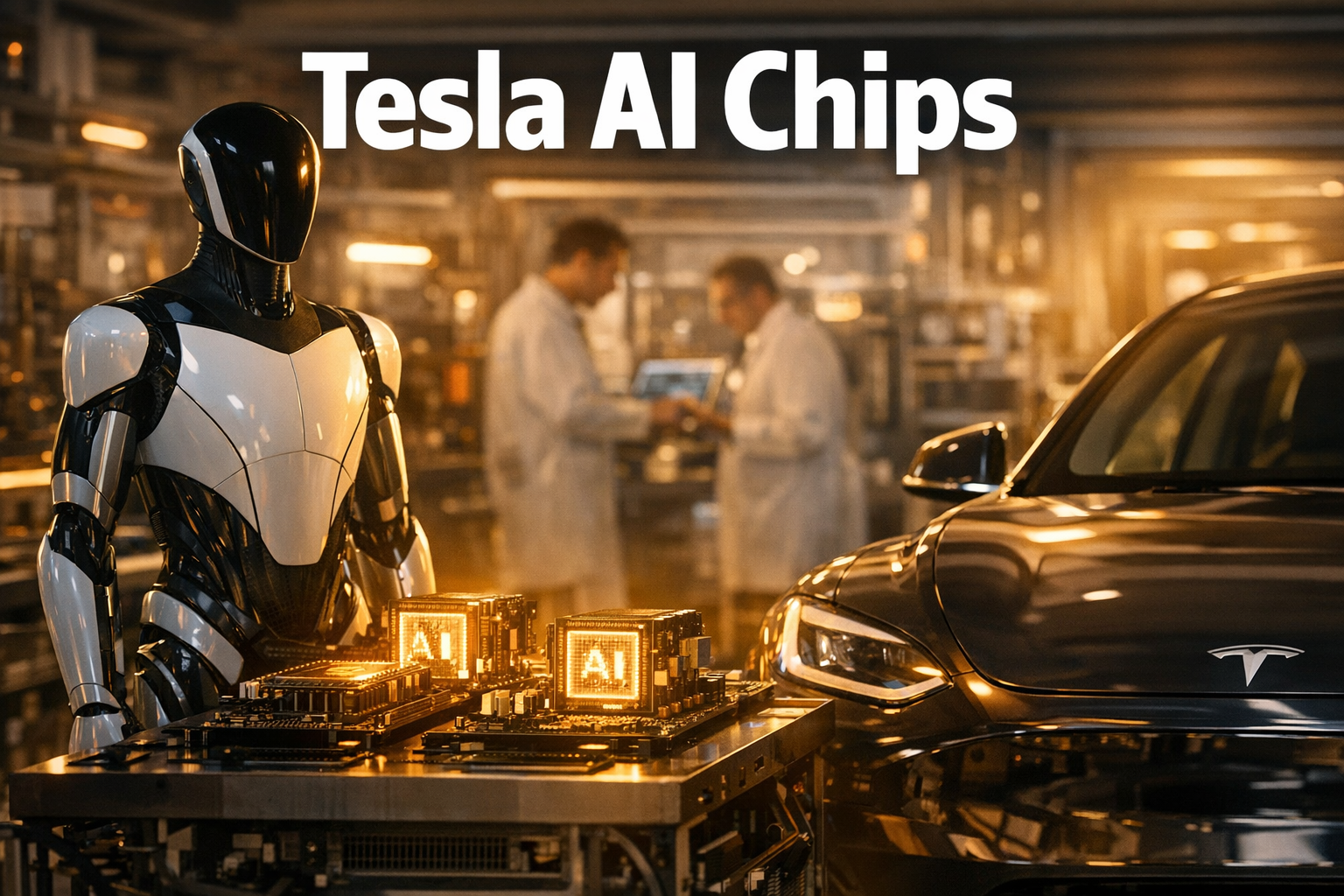
● Tesla Shockwave – SpaceX Stake, AI Cars, AGI Rush
Major Tesla Developments: SpaceX Equity Exposure, Digital Optimus, AI Chips, and the Next Macro Scenarios
This set of developments extends beyond a typical “Tesla-positive” headline and has cross-market implications.
Key themes:
First, Tesla’s acquisition of SpaceX-related equity exposure increases indirect participation in the broader re-rating of the commercial space sector and associated capital market dynamics.
Second, Tesla vehicles are positioned not only as mobility assets but also as potential inference-compute nodes and office-grade AI agent endpoints during idle time.
Third, the AI industry’s competitive focus is shifting from training to inference (deployment and service execution), with memory and bandwidth bottlenecks becoming more binding; this increases the strategic relevance of Tesla’s inference-optimized chips.
Fourth, accelerating expectations around AGI timelines raise the probability of a synchronized repricing across global equities, semiconductors, power infrastructure, and defense AI supply chains.
1. Executive News Brief: Immediate Takeaways
Tesla, via existing xAI investment exposure, has obtained SpaceX-related equity exposure.
While the stake appears small, the strategic direction is more important than the percentage.
If SpaceX pursues an IPO, Tesla would hold indirect exposure to a potential sector-wide valuation reset in aerospace and space services.
Market commentary also suggests that Nasdaq and S&P index stakeholders may become more flexible on inclusion practices to attract a listing of this scale.
This matters due to potential passive-flow mechanics.
If index inclusion occurs quickly and weightings are material, index funds and ETFs could be required to buy shares under mandate-driven rebalancing.
This frames the event as a structurally supported demand catalyst rather than a standard IPO.
Separately, Elon Musk indicated that if a vehicle runs “AI4” with a Digital Optimus capability, the car could perform office-type work during non-driving time.
This effectively extends Tesla’s narrative from automotive manufacturing toward distributed AI infrastructure and agent services.
2. Why Markets React to Tesla’s SpaceX Equity Exposure
2-1. Connectivity Matters More Than the Absolute Stake
Reported figures imply a very small exposure, commonly interpreted as below ~0.3%.
Direct near-term financial impact may be limited.
However, markets typically price strategic network effects, not only percentage ownership.
The perceived convergence of Tesla, xAI, and SpaceX into a tighter capital-and-technology network can support valuation premia over time.
US equity markets generally assign higher multiples to platform, network, and ecosystem models than to pure manufacturing.
2-2. The Signaling Value of a SpaceX IPO
Market speculation ranges to valuations above $1.75 trillion, with commentary extending toward $2 trillion scenarios.
If realized, SpaceX would rank among the most influential mega-cap technology-adjacent listings shortly after going public.
In that context, Tesla’s indirect exposure may be interpreted as more than mark-to-market upside, potentially reinforcing a multi-vertical thesis: automotive, energy, robotics, AI, and space linkage.
2-3. Passive Fund Forced-Buy Dynamics
A key question is not only valuation but the speed of index inclusion.
Faster inclusion accelerates passive demand.
If float-adjustment practices are relaxed, buying pressure can become large relative to available tradable shares, especially early in the listing cycle.
This can be a core mechanism behind sharp post-IPO price moves.
Under this framing, a SpaceX IPO could become a major US equity-flow event in 2026–2027.
3. Structural Shift: Monetizing Vehicle Idle Time
3-1. Beyond Robotaxi Monetization
Consensus monetization has focused on robotaxis: vehicles generating revenue through passenger transport.
The new message differs: monetization via idle-time compute used for office-type AI tasks.
This implies vehicles functioning as mobility assets and inference servers.
It intersects the automotive, cloud, and AI agent markets.
3-2. What “Digital Optimus” Implies
Digital Optimus, as described here, is closer to a software agent than a physical humanoid.
It implies an AI capable of reading screens, operating keyboards and mice, and executing general office workflows.
Use cases include email triage, document entry, data organization, research, workflow automation, and repetitive back-office processing.
The conceptual model is dual-use compute: driving inference while in motion, and digital labor while parked.
3-3. Why a Distributed Inference Network Is Plausible
Tesla vehicles already contain significant onboard compute, connectivity, and OTA software infrastructure.
Remaining requirements center on software integration, security, billing, power optimization, and job scheduling.
The broader architecture is “distributed AI infrastructure.”
Compared with centralized data centers, Tesla’s potential network would include vehicles, Superchargers, energy storage, solar, and robotics as distributed inference nodes.
If executed, this could introduce a distinct competitive structure in AI infrastructure economics.
4. Superchargers + Digital Optimus: Strategic Implications
4-1. Superchargers as AI Nodes
A key implication is the potential deployment of Digital Optimus units at Supercharger sites at scale.
This would convert parts of the charging network into inference infrastructure.
Superchargers are already grid-connected, and Tesla can integrate storage and solar.
A hybrid utilization model becomes conceivable: allocate electricity between EV charging and inference workloads based on demand and economics.
This reframes utilization from “energy dispensed to vehicles” toward “optimized allocation across charging and AI services.”
4-2. Power + AI as a Macro Theme
Power infrastructure is increasingly central as semiconductors and data centers scale and electricity becomes a binding constraint.
Tesla’s combination of EVs, storage, solar, charging, and distributed compute is relatively uncommon among large-cap peers.
Accordingly, the topic extends beyond a single-company initiative and connects to the broader AI-era power economy.
5. AI Industry Shift: From Training to Inference
5-1. Why Inference Is Becoming the Value Center
Competition has emphasized larger models and more training compute.
Commercial value increasingly concentrates in inference: the always-on execution layer when users query, agents act, and services run.
The practical competition becomes cost, latency, reliability, and scalability of real-time inference.
5-2. The Importance of Memory Bottlenecks
AI performance is increasingly constrained by memory bandwidth and data movement rather than raw compute.
This elevates the relevance of HBM, memory semiconductors, advanced packaging, and power efficiency.
Equity-market exposure therefore broadens beyond GPUs into memory, power delivery, cooling, networking, inference-optimized silicon, and edge compute.
5-3. Why Tesla’s AI Chips Gain Strategic Relevance
Tesla’s AI4 is designed as inference-optimized hardware for autonomy workloads.
It prioritizes real-time operation, low latency, energy efficiency, and on-device deployment rather than data-center training throughput.
As the market shifts toward inference-centric economics, this design orientation becomes more strategically relevant.
If cost structures enable mass deployment, a fleet-scale inference network could create different unit economics versus centralized data centers.
6. Grok 4.2 Beta and Defense AI Concerns
6-1. Core Risks in Defense-Oriented AI Supply Chains
In defense contexts, model ideology/values, bias, and hallucinations are treated as material supply-chain risks.
As AI integrates into weapons systems, aviation, defense design, and security decision-making, embedded value systems become operational risk factors.
Hallucinations, in particular, can translate into high-consequence failure modes.
6-2. Low Hallucination Rates as an Enterprise Requirement
For enterprise, industrial, and defense use cases, reducing hallucinations can be as important as benchmark scores.
In operational settings, a single fabricated output can generate disproportionate cost and risk.
Hallucination reduction is therefore a gating requirement for broader adoption.
6-3. “Model Philosophy” as a Competitive Axis
AI systems are unlikely to remain value-neutral tools.
Safety rules, refusal policies, and decision preferences reflect design choices.
Governments and enterprises may select models not only for performance but also for alignment with internal standards and governance.
7. AGI Timelines: Increasing Weight on 2026–2027
7-1. Timeline Compression as a Market Shock
AGI expectations have moved from distant horizons toward near-term ranges, with 2026–2027 increasingly discussed.
Markets move on changing expectations, not only on realized outcomes.
Part of the current re-rating in US technology equities may reflect earlier pricing-in of productivity acceleration.
7-2. A Shared View Across Rivals
Notably, even competing AI leaders increasingly acknowledge that timelines may be shorter than previously assumed.
Convergence in competitor expectations can increase perceived credibility.
Rapid progress across generative AI, coding agents, workflow agents, and robotics increases the speed of cross-domain compounding.
7-3. Global Macro Implications
If advanced AI diffuses across industries, global productivity structures could shift materially.
White-collar automation pressure may expand across software development, customer service, logistics, manufacturing, design, finance, and legal workflows.
A plausible outcome is asymmetry: higher GDP growth potential alongside increased labor-market disruption risk.
8. Optimus (Physical) and Digital Optimus as One Strategy
8-1. Parallel Scaling of Physical and Digital AI
Tesla is pursuing both real-world AI (autonomy and humanoid robotics) and digital AI (software labor agents).
These may share inference engines and training pipelines, allowing capabilities to transfer across domains.
8-2. Interpreting the “Six-Month” Reference
A six-month timeline is aggressive and may be aspirational.
The more relevant signal is prioritization: internal focus appears elevated within xAI/Tesla initiatives.
If the agent extends beyond coding into GUI-level execution, potential market impact increases.
8-3. Robot Charging Patent as a Scaling Indicator
Charging-related patents can indicate planning for repeatable operation, maintenance, and unattended deployment.
Industrial humanoid adoption requires not only AI performance but also charging logistics, routing, safety, and automated maintenance.
9. European FSD Expansion and Sales Recovery Optionality
9-1. Europe as a Regulatory Proof Point
Supervised FSD demonstrations in markets such as Germany and the Netherlands are not only marketing.
Europe’s stricter regulatory environment can provide validation and brand credibility if approvals progress.
9-2. Per-Vehicle Profit Model Over Unit Volume
FSD expansion may matter more for per-vehicle profitability than for deliveries.
Software subscriptions and option revenue can improve margins in a hardware-compressed industry.
Tesla’s medium-term value proposition is increasingly linked to fleet-based software monetization rather than unit sales alone.
10. “10x Economic Growth in 10 Years”: Signal vs. Overstatement
10-1. Directional Message
The numeric claim is aggressive.
The underlying message is that AI could drive a productivity step-change larger than the internet, potentially earlier than consensus.
If future cash-flow potential expands materially, near-term valuation debates may become less informative.
10-2. Investor Constraints and Risk Factors
Macro and execution risks remain: regulation, power constraints, semiconductor supply, rates, cyclical slowdowns, and geopolitics.
Long-duration themes can coexist with short-term volatility driven by positioning and valuation.
11. Underemphasized Points
11-1. Tesla’s Competitive Set May Shift
Near-term comparisons remain automotive (e.g., BYD, GM, Volkswagen).
Over time, relevant competition may expand toward NVIDIA, Amazon, Microsoft, OpenAI, Meta, defense AI contractors, and power-infrastructure players, as value drivers shift to inference networks, energy operating systems, and automation.
11-2. If Vehicles Replace Office Labor, Enterprise IT Economics Change
If Digital Optimus is commercialized, enterprises may reassess cloud spend, labor costs, outsourcing, and back-office automation budgets.
If a vehicle/Supercharger-based distributed inference network offers competitive pricing, it could pressure incumbent SaaS and cloud economics.
11-3. SpaceX IPO as a Test Case for Market-Structure Flexibility
The more structural question may be how far index and listing practices flex to accommodate ultra-large, previously private technology assets.
A precedent could influence subsequent mega-IPO pathways.
11-4. AI Winners Extend Beyond Model Providers
Value capture spans power, memory, cooling, networking, edge devices, inference silicon, agent operating layers, industrial data, and physical robotics.
Tesla combines automotive scale, robotics ambitions, energy assets, edge inference hardware, and real-world data collection, a relatively rare mix.
12. Conclusion for Investor Positioning
Core implications can be summarized in three points.
(1) SpaceX-related exposure and IPO optionality can add capital-markets-driven premium through space-sector re-rating and passive-flow mechanics.
(2) Digital Optimus suggests a pathway to link vehicles, Superchargers, AI chips, and power assets into a distributed inference network.
(3) As AI shifts toward inference-centric economics and AGI expectations accelerate, Tesla’s prior hardware and edge-inference strategy may gain incremental strategic value.
Overall, the developments connect Tesla, space, AI infrastructure, semiconductors, and power economics into a single structural theme set.
< Summary >
Tesla obtained SpaceX-related equity exposure, creating indirect linkage to potential space-sector valuation re-rating.
If a SpaceX IPO occurs, accelerated index inclusion could trigger mandated passive buying, creating material flow dynamics.
More strategically, Tesla positioned vehicles as potential idle-time office-grade AI agent endpoints via Digital Optimus.
Superchargers could evolve from charging sites into distributed AI inference nodes.
AI industry competition is shifting from training to inference; this increases the relevance of inference-optimized silicon such as Tesla’s AI4.
In defense and industrial markets, hallucination rates, embedded values, and supply-chain reliability are emerging as key procurement constraints.
AGI expectations are increasingly discussed in the 2026–2027 window, raising the probability of broad repricing across global equities and infrastructure.
The combined narrative links Tesla, SpaceX, AI, energy, semiconductors, and future industrial structure changes into a cohesive structural signal.
[Related]
*Source: [ 허니잼의 테슬라와 일론 ]
– [테슬라 대형 뉴스] 스페이스X 지분 확보! / 테슬라 차량이 돈을 벌게 됩니다. 그런데 자율주행으로 돈을 버는게 아니라 사무직으로 돈을 법니다! / 슈차와 디지털 옵티머스의 융합
● War, AI, Trump, Taiwan, Market Shock
War Risk (Iran), Taiwan Risk, the Trump Variable, and Investment Regime Shifts in the AI Era
This is not a short-term stock-picking framework. The central point is that the investment environment is increasingly driven by the interaction of geopolitical conflict, energy markets, inflation/interest-rate regimes, currency and fiscal dynamics, and the AI-led industrial transition.
1. Core Message
The key message can be summarized as follows:
The coming investment cycle is less about individual tickers and more about portfolio survival in a regime where war, energy, monetary conditions, and AI transformation move simultaneously.
Key principles emphasized:
- Prioritize capital preservation over aggressive return maximization.
- Avoid gambling behavior; focus on structural drivers.
- Prefer long-duration exposure to high-quality businesses over chasing momentum.
- Treat macro variables (oil, inflation, rates, FX, fiscal policy) as primary inputs.
2. Five Issues to Monitor
2-1. Middle East Risk: Iran as an Oil/Inflation Shock Channel
The primary risk is not the conflict headline itself but the macro transmission mechanism:
Oil spike → higher inflation → tighter or delayed easing in rates → global equity drawdowns.
Key implications:
- Disruption around the Strait of Hormuz or regional refining capacity can materially shift oil prices and risk sentiment.
- Energy and select defense segments may benefit, while most sectors face cost pressure.
- The focus should be on second-order macro effects, not only “war beneficiaries.”
2-2. Taiwan Risk: Heightened Attention Around 2028
The Taiwan scenario is framed as an extension of US–China strategic competition. The timeframe “around 2028” is discussed in relation to:
- The US election cycle and political constraints,
- China’s domestic economic conditions,
- Semiconductor supply-chain restructuring.
Potential impact:
- Semiconductor supply chains and maritime logistics are likely first-order shock points.
- A broader repricing of global risk assets could follow.
- For Korea, exposure is complex: limited ability to stay insulated given export composition and semiconductor linkage.
2-3. The Trump Variable: Fiscal Politics Over Trade Balance Optics
The trade deficit is not treated as a standalone “decline” indicator in a reserve-currency system. The emphasis is on:
US fiscal deficits and domestic political incentives.
Potential policy channels:
- Tariffs, industrial policy, energy policy, and a more explicit anti-China posture.
- These could reintroduce inflationary pressure and alter the expected rate path.
- The macro assessment requires integrating political decision-making alongside central bank policy.
2-4. AI as a Systemic Shock to Labor and Education
AI is treated as a structural shift rather than a narrow tech theme.
Key points:
- AI rapidly replaces memory-heavy and repetitive work.
- Competitive advantage shifts toward judgment, problem-solving, creativity, and AI literacy.
Investment relevance:
- The AI value chain extends beyond semiconductors into software productivity, automation, cloud/data centers, power infrastructure, applied AI in verticals (including biotech), and experience-driven digital industries.
2-5. Investment Rules: Risk Control and Long-Horizon Equity Exposure
Repeated principles:
- Avoid leverage.
- Avoid short-term trading.
- Avoid derivatives-based speculation.
- Hold high-quality companies over longer horizons.
- Do not over-allocate to cash.
Rationale:
- Over long horizons, high-quality equities have historically been among the most effective inflation hedges.
- “Equities” here implies businesses with durable fundamentals and a clear linkage to structural industry change, not indiscriminate exposure.
3. Sector Interpretation Within the Macro Regime
3-1. Shipbuilding
Constructive medium-to-long-term view driven by:
- Replacement demand for cleaner vessels,
- Climate compliance,
- Changing energy transportation patterns,
- Potential convergence of defense and shipbuilding.
Key risk:
- Oil spikes and raw-material inflation can pressure margins on backlogged orders.
3-2. Nuclear Power
Positioned as a beneficiary of rising baseload demand in an AI-intensive economy:
- Data centers, semiconductor fabs, and broader electrification increase power demand.
- Reliability constraints limit the ability of renewables alone to meet baseload needs.
3-3. Refining and Energy
Higher Middle East risk typically supports the sector.
The emphasis is not only on crude price sensitivity but also:
- Carbon capture,
- Shale productivity,
- Balance sheet and asset quality.
The sector may be re-rated as part of a broader framework combining carbon, power, and resource security.
3-4. Semiconductors and Samsung Electronics
Long-term demand drivers remain intact:
- AI, robotics, automation, cloud, and automotive electrification.
Near-term implementation:
- Differentiate structural attractiveness from entry timing.
- After sharp rallies, incremental buying may warrant greater selectivity and a focus on drawdowns rather than momentum.
3-5. AI Equities and AI-Enabled Biotech
The emphasis is on applied AI that produces measurable operational efficiency, not only upstream chip exposure.
AI-enabled biotech highlighted themes:
- Faster drug discovery,
- Personalized medicine,
- Potential longevity-related research.
4. Structural Social Shifts Relevant to Investors
4-1. Work-Time Reallocation Over Simple “Unemployment” Narratives
AI may pressure employment in certain functions, but a key adjustment mechanism could be:
- Work-time restructuring (e.g., shorter workweeks).
If leisure time expands, potential beneficiaries include:
- Entertainment, gaming, sports, travel, XR, and hobby-driven consumer categories.
4-2. Education System Repricing: Less Memorization, More Applied Capability
Likely direction:
- Assessment and instruction may shift toward open-resource and AI-assisted formats.
- Some teaching and evaluation functions may be partially automated.
This can alter:
- Education services,
- Hiring filters and credentialing,
- Organizational design and productivity expectations.
4-3. XR and the Growth of Experience-Oriented Digital Markets
XR is framed as a longer-duration theme that could matter as AI and immersive technology converge:
- Digital complements/substitutes for travel, entertainment, education, therapy, rehabilitation, and mental health services.
5. Undercovered Points in Typical Media Coverage
5-1. War as a Monetary and Asset-Allocation Issue
The focus is on system-level effects:
- Oil, the USD, sovereign debt markets, inflation expectations, and rate regimes.
This is an asset-allocation problem, not only a defense-sector trade.
5-2. AI as a Political Economy Issue
AI-driven labor displacement can translate into:
- Debates over basic income,
- Work-time regulation,
- Tax and welfare redesign.
Equity implications extend beyond “AI beneficiaries” to policy and distribution dynamics.
5-3. Scenario Discipline: Maintain an “Imagination File” and a “Failure Log”
Practical process:
- Document forward-looking industry scenarios.
- Record incorrect theses and the reasons they failed.
As complexity rises, structural reasoning may dominate headline-driven decision-making.
5-4. “Small Wealth” Strategy as a Robust Objective
In high-rate, high-volatility conditions:
- Survival-focused compounding and retirement-capital building may be more realistic than extreme return targets.
6. Practical Portfolio Application
6-1. Build Portfolios by Scenario, Not by Buzzword
Allocate by conditional outcomes:
- Middle East escalation: relative support for energy and select defense; broader cost pressure elsewhere.
- Sustained AI capex: semiconductors and power infrastructure.
- Growth slowdown: higher volatility for expensive growth assets.
6-2. Prioritize Preparation Over Chasing
The posture favors:
- Pre-selection of structurally advantaged sectors,
- Dry powder for dislocations,
- Avoiding momentum entries in crowded AI/semiconductor exposures.
6-3. Integrate Macro and Industry Structure
Omitting oil, rates, USD, FX, fiscal policy, and supply-chain geopolitics increases risk, particularly for export-heavy markets such as Korea.
7. Conclusions
Key takeaways:
- War and energy shocks translate back into inflation and interest-rate constraints.
- AI is not only a tech rally; it can reshape labor, education, and political economy.
- In this regime, avoiding leverage and short-term speculation, and focusing on structural industry transitions with risk control, is prioritized.
< Summary >
- Iran-related conflict risk and Taiwan risk are not isolated geopolitical events; they can directly affect oil, inflation, rates, and global equity valuations.
- US political dynamics and fiscal deficits may be more consequential than trade deficit narratives; the Trump variable can alter inflation and rate expectations via tariffs and industrial policy.
- AI is a structural transformation that extends beyond semiconductors into labor markets, education systems, and policy frameworks.
- Core strategy emphasizes risk management, long-horizon ownership of high-quality businesses, and avoidance of leverage, short-term trading, and derivatives speculation.
- Shipbuilding, nuclear, refining/energy, semiconductors, and AI-enabled biotech should be analyzed as linked exposures within a unified macro and industrial-transition framework.
[Related Articles…]
- AI Era Labor Restructuring and Korea’s Industrial Survival Strategy: https://NextGenInsight.net?s=AI
- Post-Return-of-Trump Global Outlook and Key Equity Market Variables: https://NextGenInsight.net?s=%ED%8A%B8%EB%9F%BC%ED%94%84
*Source: [ Jun’s economy lab ]
– 양양스승님과의 만남, 이란전쟁과 대처법 풀버전
● Oil Shock, Trump Pivot, Markets Panic
Trump’s New Rationale: Why “Higher Oil Prices Mean the U.S. Profits” Is Increasing Market Anxiety
This is not simply news that global oil prices rose.
The core issue has five elements:
1) Iran’s stated willingness to fully block the Strait of Hormuz differs from its observed actions.
2) Trump’s messaging is shifting subtly toward “higher oil prices can benefit the U.S.”
3) Persistently high oil prices are destabilizing both the U.S. equity market and expectations for rate cuts.
4) Political timing and midterm-election strategy are emerging as variables as important as, or more important than, the Federal Reserve.
5) Although the headline risk appears to be war, markets are primarily repricing faster inflation and broader asset valuations.
This report summarizes Iran’s mixed signals, changes in Trump’s rhetoric, the transmission of an oil spike into equities and monetary policy, and the key points often missed in mainstream coverage.
1. The Primary Driver of Today’s Weak Market: Fear of “Sustained High Oil,” Not War Headlines
The immediate driver of U.S. equity weakness was not a one-off geopolitical shock.
Markets focused less on whether oil would spike temporarily and more on whether elevated prices could persist.
Historically, Middle East risk has often triggered short-lived market reactions followed by recovery. This episode differs.
With WTI moving toward the $100 level, investors increasingly priced in second-order effects across corporate costs, consumer sentiment, inflation, and the interest-rate path.
Weakness in growth and semiconductor names reflected their high sensitivity to discount-rate expectations. Equities ultimately reflect earnings and valuation multiples; higher oil can compress both earnings forecasts and multiples via higher discount rates.
This combination is the key concern.
2. Iran’s Messaging Is Hawkish, but Its Actions Appear Selective
Public statements from Iran have been highly confrontational.
References to blocking the Strait of Hormuz, pressure on U.S. bases in the region, and further attack risk are sufficient to elevate market stress.
However, observable developments do not align with a full-blockade scenario.
The key question is “who is blocked and who is allowed to pass.”
Reportedly, an India-linked vessel carrying Saudi crude entered without incident, with indications that Iran informally assured safe passage for India-linked shipping. China-related flows also appear to be treated as exceptions.
This matters because Iran cannot ignore the practical need to sustain oil exports and foreign-currency inflows. China remains one of the most important demand anchors for Iranian crude; fully disrupting China-related logistics would impair Iran’s own cash flow.
The current posture is best characterized as a dual strategy balancing political signaling and economic constraints.
3. Situation Snapshot (News-Style Summary)
1) Rising Middle East tensions
Hawkish Iranian messaging has revived concerns over a Strait of Hormuz disruption.
2) Shipping not fully halted
Available indications (India-linked passage, China-related flows) suggest selective control rather than total closure.
3) Oil price surge
The market is increasingly focused on the possibility of a prolonged period of elevated energy prices.
4) U.S. equities decline
Higher oil has reduced risk appetite, increasing broad equity drawdown pressure, particularly in rate-sensitive segments.
5) Fed rate-cut expectations pushed back
Markets are increasingly pricing few to no cuts this year, or a single cut late in the year.
6) Shift in Trump’s rhetoric
Trump is advancing the argument that, as the world’s largest oil producer, the U.S. benefits when oil prices rise.
7) Political variables gain weight
With midterms in view, sustained high oil risks conflicting with prior “lower oil” messaging.
4. Why Oil Now Matters More Than the Fed: The Mechanism Undermining Rate-Cut Expectations
Markets have been supported by the expectation that the Federal Reserve will eventually lower policy rates.
Higher oil complicates that trajectory.
Energy-price increases can lift headline inflation directly and drive broader pass-through via transportation and input costs. Under that backdrop, the Fed is less able to ease quickly.
This is a primary source of current market instability: political pressure for lower rates is rising while the market increasingly prices policy staying restrictive.
As the gap widens between political demands and monetary-policy constraints, perceived policy credibility can weaken, increasing market volatility.
5. Why Trump’s “New Rationale” Emerged: A Signal That Low-Oil Promises Are Harder to Sustain
Trump’s claim that “higher oil means the U.S. makes money” is notable.
It contrasts with his prior emphasis on low oil prices, cheap gasoline, and cost-of-living relief.
Introducing the “producer-benefit” narrative suggests that the current high-oil environment is becoming politically difficult. In practical terms, it functions as a secondary narrative: if oil prices do not fall, the messaging can pivot to “high oil supports U.S. energy and national interest.”
This appears consistent with early-stage campaign message adjustment rather than a full repositioning.
6. Why “Higher Oil Is Unambiguously Positive for the U.S.” Is Only Partly Accurate
The U.S. has strengthened its profile as a net energy exporter, and higher oil prices can benefit U.S. energy producers, shale activity, and select regional economies.
At the national level, effects are mixed.
Voter experience is driven primarily by retail gasoline prices and broader living costs, not upstream producer profitability. Higher gasoline prices reduce discretionary spending, raise inflation sensitivity, and weaken sentiment.
In an election context, that trade-off is particularly acute. Energy-sector outperformance does not offset household cost pressures in political terms.
7. What Iran’s Internal Message Divergence Implies: Markets Fear Governance Noise More Than a Single Extreme Outcome
A critical element is the lack of consistent alignment across Iranian internal messaging.
Alongside hawkish statements, there are also indications of openness to negotiation from other political actors, and differences between symbolic positioning and operational diplomacy.
This supports two interpretations:
1) Incomplete internal coordination.
2) Intentional multi-layer signaling to maximize deterrence and bargaining leverage.
In either case, uncertainty rises. Markets may be more stressed by a prolonged period of ambiguous, stop-and-go risk premia that sustains oil volatility than by a single, clearly defined “worst-case” event.
8. Implications for U.S. Equities: Likely Pressure Points and Relative Resilience
The initial pressure point is rate-sensitive growth.
High-multiple technology and semiconductor stocks tend to react negatively to higher discount-rate expectations.
Transportation, airlines, and consumer-linked sectors face both higher input costs and potential demand softening.
Relative resilience may be found in energy producers, select materials exposures, and defensive sectors with stable cash flows.
However, if high oil persists long enough to amplify recession risk, the impact can broaden from sector rotation to a more generalized de-risking across risk assets.
9. The Most Important Points Often Underemphasized
Many outlets focus primarily on “Hormuz closure,” “escalation risk,” and “oil spikes.” The more decision-relevant points are:
1) Iran is more likely to maximize uncertainty via selective passage than a full closure
A total blockade damages Iran as well; selective pressure can preserve a geopolitical premium while limiting self-harm.
2) Trump’s messaging shift may be pre-emptive political risk management
“High oil benefits the U.S.” can function as a fallback narrative if price containment fails.
3) The market’s central fear is not war, but the disappearance of rate cuts
Equities are more sensitive to “oil-driven inflation constraining the Fed” than to headline conflict risk alone.
4) The decisive variable may be political exit management, not military action
If regime stability is not immediately at risk, the key question becomes how a diplomatic off-ramp is constructed and communicated.
10. Seven Indicators to Monitor
1) Strait of Hormuz transit data
Operational disruptions, measured via AIS tracking and freight-rate shifts, are more informative than statements.
2) India- and China-linked crude flows
Exceptions reveal actual intent and constraints.
3) Whether WTI holds around $100
This level functions as both a psychological threshold and a potential policy inflection point.
4) Changes in the Fed’s inflation characterization
Key distinction: “transitory energy effect” versus “second-round pass-through risk.”
5) Further Trump statements
Watch whether messaging reverts to a low-oil emphasis or reinforces the “producer-benefit” framework.
6) Midterm polling and cost-of-living sentiment
Gasoline and headline inflation can translate directly into political risk.
7) Bitcoin and broader risk-asset response
Weaker liquidity expectations can pressure high-duration assets, growth equities, and other high-beta exposures simultaneously.
11. Investor Takeaway
Interpreting this episode as “war risk” alone is incomplete.
A more functional framing is: “high oil → inflation pressure → prolonged Fed hold → equity valuation compression.”
Trump’s rhetoric should be viewed less as short-term market reassurance and more as a signal of potential campaign narrative adjustment.
This is a cross-asset, multi-driver issue linking geopolitics, monetary policy, election strategy, and energy supply chains.
12. Conclusion: Markets Fear the Difficulty of Bringing Oil Down, Not the Price Increase Alone
Trump’s statement that “higher oil means the U.S. profits” is partially correct in a narrow producer sense.
Markets are focused less on literal accuracy and more on why that framing is being introduced now: it suggests constraints on price control, limited room for monetary easing, and rising political exposure ahead of elections.
Near-term market direction will likely be driven less by headlines and more by the duration of elevated oil and the structure of any political or diplomatic exit strategy.
In summary, the core market shock is not “war,” but a “policy trap” created by sustained high oil.
< Summary >
Iran continues hawkish rhetoric, but observed behavior suggests selective passage for India- and China-linked shipping, making a full blockade less likely than targeted pressure.
Rising oil prices are contributing to U.S. equity weakness and pushing out rate-cut expectations; markets are more concerned about prolonged high oil and inflation re-acceleration than conflict headlines alone.
Trump’s claim that “the U.S. profits when oil rises” diverges from prior low-oil messaging and may indicate an evolving election narrative.
Key variables include selective controls rather than full-scale conflict, the risk of prolonged Fed restraint, and the design of a political exit strategy.
[Related Articles…]
https://NextGenInsight.net?s=oil
https://NextGenInsight.net?s=interest-rates
*Source: [ Maeil Business Newspaper ]
– [홍장원의 불앤베어] 트럼프 새논리? “유가 오르면 미국이 돈번다. 그러나”