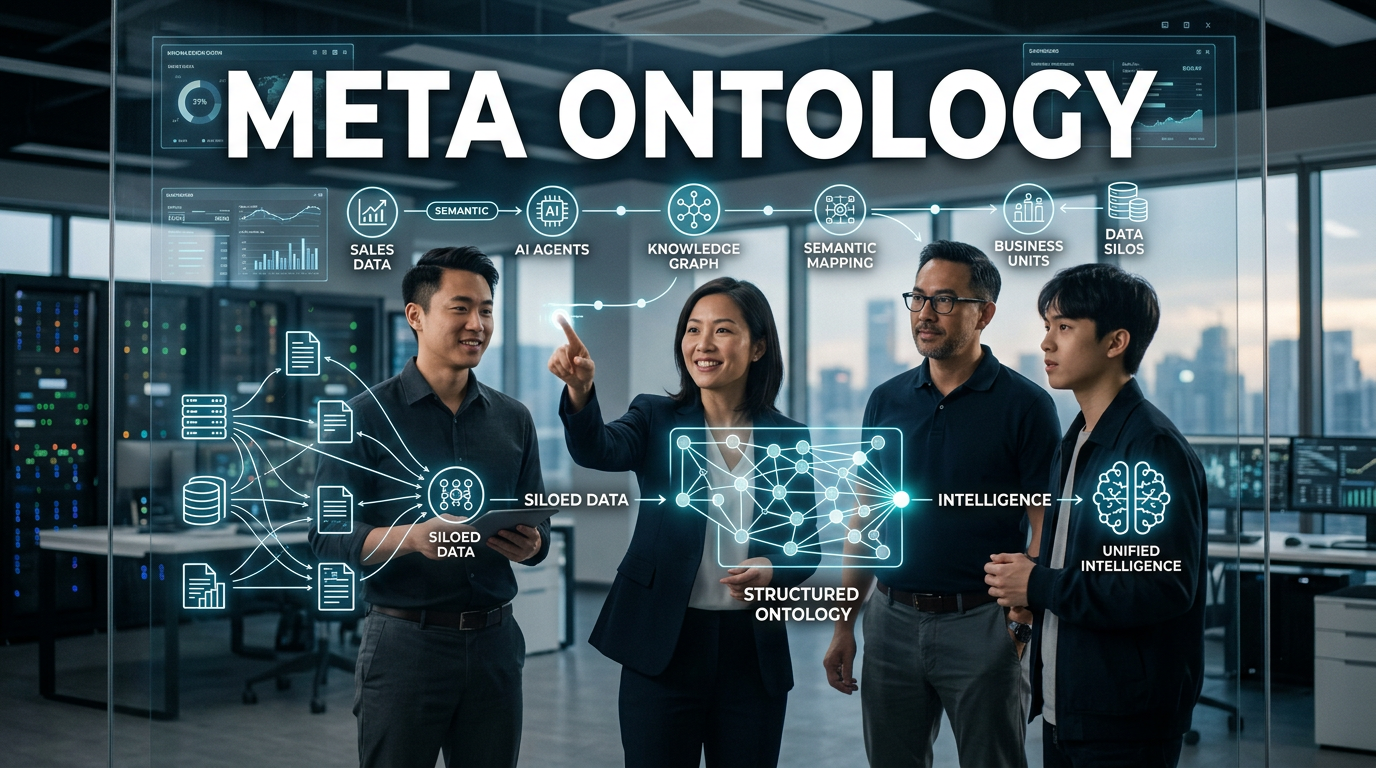

● AI Agents Are Dead, Ontology Is the Billion-Dollar Power Shift
Those who clicked on this article today will gain AI business insights that are at least one year ahead of others.
Did you know that while countless people are intoxicated by the glamour of AI Agents, the core point that actually generates money and determines corporate survival lies in ‘Ontology’?Today’s coverage includes the method to perfectly control the fatal hallucination of generative AI, the secret of how global big tech companies like Palantir dominated the enterprise market, and the ultimate knowledge of data structuring that controls everything from individual tasks to physical AI (robots, autonomous driving).From now on, I will most quickly and accurately dissect the ‘next-generation paradigm of agents’ that is only discussed among real practitioners and AI engineers, which YouTube or obvious news will never tell you.
📺 [Core Point News Briefing] A 1-minute summary news format for readers
Currently, the AI adoption rate of global companies is surging, but at the same time, the project failure rate is also increasing exponentially.The biggest cause is the ‘hallucination phenomenon’, an inherent limitation of LLMs (Large Language Models).Because no matter how smart an AI agent is, acting on false information will cause fatal losses to the company, so large corporations are still hesitant to apply it in practice.However, recently, leading companies spearheaded by Palantir are completely changing the market dynamics by building a 100% reliable AI infrastructure through ‘Ontology’ technology that connects concepts and relationships, rather than simple data storage.
🔥 [Exclusive] The ‘real core point’ insights never mentioned elsewhere
When everyone is obsessed with prompt engineering or video generation AI, what we really need to pay attention to is ‘Meta-Ontology’ and ‘Role-Based Access Control (RBAC)’.YouTube often only talks about RAG (Retrieval-Augmented Generation) or LangChain, but what is really important in a corporate environment is the ‘Meta-edge’ design that defines causal relationships between data.Formulating universal and flexible knowledge graph rules that can be applied regardless of the domain, whether it is manufacturing, construction, or finance, is the core point.Only when this is combined with an access control (RBAC) system that strictly restricts which agents can access which data, can we finally prevent catastrophic disasters like AI deleting company emails or leaking confidential information, and achieve perfect business automation.
The Era of Agents is Over, Now is the Era of Ontology
Limitations of Generative AI and Corporate Dilemmas
Since the Agentic AI era began in earnest last year, people have been instructing AI to do tasks all night long.It creates outputs (MVP) quickly and flashily, but can we really trust and use those results 100% in actual practice?Many large companies still prohibit or strictly control fully integrating generative AI into their workflows due to security and error issues.If these limitations of generative AI are not overcome, it will end merely as a flashy technical demonstration, and most projects that are supposed to lead to actual business value creation will fail.Because if a person ultimately has to review and revise the strategies or reports produced by AI again, it is not automation in the truest sense.
From Philosophy to Engineering, The Birth of Active Ontology
Ontology was originally a philosophical term, but it has now become the most important backbone for structuring data in the AI era.Rather than simply collecting data, it is a knowledge system that divides data into nodes and edges and perfectly connects the relationships between concepts through mathematical modeling.In the past, it was fixed knowledge like “If it uses gasoline, it is a car, otherwise it is a toy,” but now with the advent of electric vehicles (EVs) and autonomous driving, it must evolve into a continuously changing dynamic model, namely an ‘Active Ontology’.In an environment where new AI and data are pouring out every day, building a living data ecosystem where information moves on its own, forms relationships, and exchanges influence is the current trend.
The Alchemy That Turns Data into Gold, The Building Process
Sophisticated Design Starting from Small Data
Starting an ontology absolutely does not require massive big data from the beginning.On the contrary, pouring in massive amounts of data from the start can be poisonous to the system.It is much more important to practice refining and elaborating data starting with small CSV, PDF, or Excel files.As long as the structure (schema) is properly designed, as more data is added, the completeness of knowledge naturally increases and forms a massive ecosystem.No matter how fancy a structure is built, if the input data is garbage, the output will inevitably be garbage, so the bottleneck of improving data quality must be resolved.
The Importance of Data Pipelines and Engineering
Let us take an Excel file of electric vehicle charging stations on a public data portal as an example.We throw this data to an LLM to extract (parse) only the necessary information such as location, price, and scale, and then go through the process of filtering only the Seoul area.The basic flow is to embed this processed data into a vector DB like Chroma, and expand the relationships through a graph DB like Neo4j.If query languages like SQL or SPARQL are difficult, we are now in an era where you can simply instruct an LLM in natural language, “Analyze the relationships using Neo4j,” and it will perform the task.Ultimately, to survive in this market, when everyone else is just typing prompts, you must develop data engineering capabilities and combine them with your AI journey to gain unrivaled competitiveness.
The Future Standard Proven by Palantir and Physical AI
Why Are Large Corporations and Physical AI Staking Their Lives on Ontology?
If an individual is using ChatGPT merely for research purposes, an ontology might not be necessary.However, in a physical AI and agentic environment where robots roam factories, autonomous vehicles drive on roads, and cloud bots process payments on their own, the story is completely different.Because even a single hallucination phenomenon can lead to a catastrophe such as massive financial losses or human casualties.Therefore, to ensure that AI absolutely makes no mistakes, we must make agents swim only on top of an ontology that provides strong rules (world models) based on the physical laws and facts of the world.This is the essential gateway that global companies must pass through to achieve a successful Digital Transformation (DX).
Palantir’s Strategy and the Power of Meta-Ontology
Palantir, an indispensable company when analyzing global economic forecasts, is the absolute powerhouse in this ontology ecosystem.Their FDEs (Forward Deployed Engineers) are deployed to specific companies to analyze complex data for months and perform the task of ontologizing it.What is amazing is that they build systems of the same quality even in completely different domains such as IT, manufacturing, construction, and defense.The reason this is possible is that they utilize a very flexible and universal grammar that is not limited to a specific industry, namely ‘Meta-Ontology’ and ‘Meta-edge’.Logistics companies with complex supply chains or finance and healthcare sectors that require high precision must hurry to adopt this system.
Perfect Orchestration of Knowledge Graphs and Agents
The Journey from Parsing to Graph RAG
When a document comes in, the first task is chunking, which breaks the data into smaller pieces so that AI can easily digest it.It goes through vectoring (embedding) to place data with similar attributes into X, Y, and Z coordinates in a three-dimensional space, and draws lines (edges) that bind these nodes through mutual causal relationships.Through this process, a three-dimensional knowledge graph (Graph RAG) is completed, such as “A affects B” or “D is produced after C,” rather than a simple listing of data.Only by applying an RBAC system to establish access rights and hierarchies for each data point can the boundaries of a perfect world be built where agents can safely collaborate without confusion.
CLI Overcoming the Limitations of MCP, and Practical Application Cases
Recent AI workflows have evolved to perform complex multi-steps through LangChain or LangGraph.In the past, APIs or MCP (Model Context Protocol) were mainly used to connect external tools, but there were disadvantages such as context leakage and token waste.Recently, services like Obsidian or Google Cloud Platform have been supporting a lightweight CLI (Command Line Interface) environment, drastically reducing such resource waste.I, too, ontologized in-house data utilizing an open-source local model (LM Studio) and the Langgent framework in practical construction/landscaping work.Beyond simply drawing pictures, based on learned knowledge, I automated logical reasoning such as “Since the proportion of people who like trees is high, let’s design a pavilion made of wood material,” and even 3D modeling rendering.Ultimately, when a smart brain (Agent) and strong limbs (Ontology) are combined, we can achieve perfect AX (AI Transformation), the true completion of the Fourth Industrial Revolution.
< Summary >
- Paradigm Shift: The era of simple AI agents vulnerable to hallucinations is fading, and we have entered an era where an ecosystem based on ‘Ontology’, a reliable data structure, is essential.
- Meta-Ontology and Access Control: Flexible ‘Meta-edge’ design applicable to all domains and strict Role-Based Access Control (RBAC) are the secret weapons that can prevent fatal mistakes by AI in corporate environments.
- Data Pipeline Optimization: Rather than massive big data, the engineering capability to start with precisely processed small data and develop it into a knowledge graph (Graph RAG) through parsing, chunking, and embedding is the core point.
- Global Standard: Big tech companies like Palantir are already leading perfect business automation (AX) by applying ontology to fields such as complex supply chains, finance, and physical AI (autonomous driving, robots).
[Related articles…]
The Secret Behind the Surge in Palantir’s Stock Price, Analysis of Enterprise AI and the Ontology Ecosystem
2024 Physical AI Commercialization Trends and Data Pipeline Strategies
*Source: Alex AI