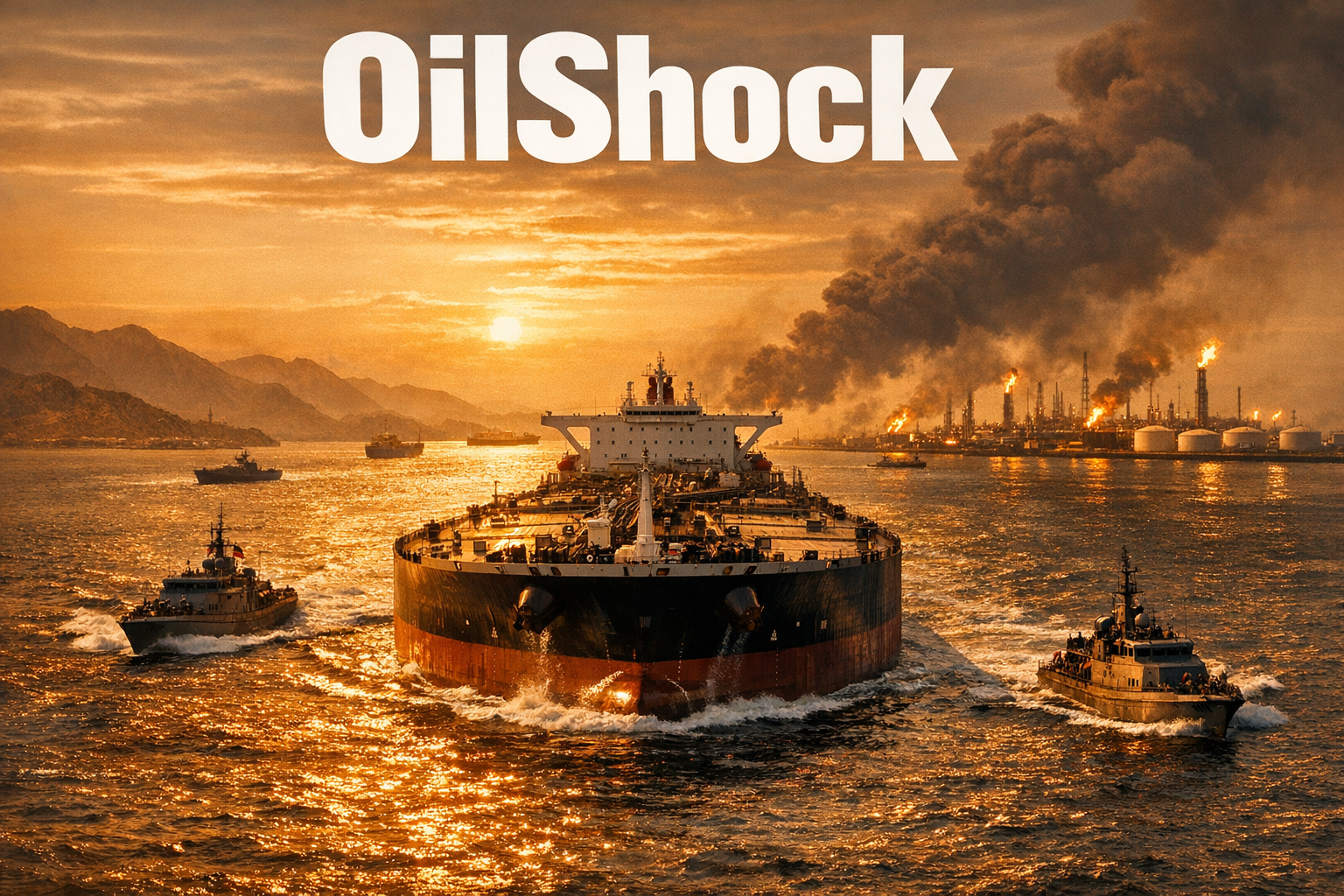
● Trump-s Final Card, Kharg Island Strike Sparks Oil Shock, Inflation Panic, Korea Stocks on Edge
Trump’s “Last Card”: Why a Strike on Kharg Island Matters—Key Implications for Oil, Inflation, and Korean Equities
This is not a routine Middle East headline. It is a geopolitical shock with direct transmission channels into energy prices, inflation expectations, global supply chains, and Korea’s macro and equity sensitivity.
This report summarizes: (i) why Trump targeted Kharg Island and why markets interpret it as an endgame pressure tool, (ii) how it can impact global oil and logistics costs, and (iii) why Korea is structurally more exposed than the US. It also addresses how markets front-run fear, how war headlines translate into equity direction, and the key investor blind spots highlighted by Ken Fisher.
Focus areas:
- Why Trump acted at this timing
- Why markets may be less surprised than headlines imply
- How material the risk is for Korea
1. Core issue: Why Kharg Island is strategically critical
The target was reported as Iranian military facilities on Kharg Island.
Kharg Island is not merely a military outpost; it is widely viewed as Iran’s primary crude export hub, with a large share of Iranian exports flowing through this node. It is effectively a central artery of Iran’s energy-export system.
While the strike reportedly avoided direct oil infrastructure, the more consequential signal was the follow-on message: if Iran continues to disrupt the Strait of Hormuz, energy facilities could be targeted. The market-relevant takeaway is the escalation boundary being communicated.
2. Why this can be framed as a “last card”
The action is best read as a final-stage coercive lever designed to force negotiations rather than a step intended to initiate a prolonged conflict.
Key logic:
- Energy-export infrastructure has not been directly hit yet, but the capability and willingness to escalate were demonstrated.
- A sustained crisis in the Strait of Hormuz would likely lift global oil prices and feed into US inflation and financial conditions, which is also costly for the US.
- Higher oil prices can re-accelerate inflation expectations, affecting rates, consumption, and equity risk premia.
Accordingly, a high-intensity but controlled signal—paired with negotiation pressure—can be interpreted as an attempt to stabilize the corridor and contain oil-driven inflation risk.
3. If Kharg energy infrastructure is struck: probable market effects
The market’s primary tail-risk scenario is direct damage to energy infrastructure on Kharg Island.
Potential consequences:
- Disruption of Iranian crude exports for weeks to months
- Intensified competition for substitute crude, particularly from China
- Upward pressure on global benchmark oil prices
- Higher global supply-chain costs
- Rising transport, manufacturing input, and power costs
- Renewed inflation pressure across major economies
China is a key demand center for Iranian crude; a supply interruption would likely reprice marginal barrels globally as alternative sourcing costs rise.
4. Iran’s response function: the main risk is second-order escalation
Iran has signaled that if its energy facilities are attacked, it may target US-linked or allied energy assets in the region.
This expands risk beyond Iran’s territory:
- Energy installations across the Gulf
- Tanker routes and maritime chokepoints
- Infrastructure associated with US partners
Markets typically price not only realized supply loss but also the uncertainty regarding the scope and duration of disruption. Risk premia can rise before any physical damage to energy assets occurs.
5. Why the announcement timing (Friday evening) matters
The release timing may have been selected to reduce immediate market panic by limiting real-time reaction windows.
A late-Friday announcement:
- Delays reflexive risk-off flows
- Allows a weekend window for policy messaging and information digestion
This can be interpreted as combining a deterrence signal with an implicit intent to manage financial market stability.
6. Strait of Hormuz and tanker escort: why Korea is explicitly referenced
Trump also indicated the potential for US naval escort operations in the Strait of Hormuz and urged participation by major importing countries, including China, Japan, Korea, the UK, and France.
Korea is referenced for structural reasons:
- High energy import dependence
- Meaningful exposure to Middle East crude supply
Instability in the strait is therefore directly linked to Korea’s energy security and industrial cost base.
7. Why Korea’s economy and equity market are more sensitive
Korea’s heightened sensitivity is structural:
- High dependence on Middle East energy imports
- High manufacturing weight, making margins vulnerable to input-cost inflation
- Export-driven model, sensitive to freight and logistics costs
- KRW weakness can amplify imported inflation
- Retail investor flows can respond quickly to headline risk
For Korea, higher oil prices transmit into trade balance dynamics, corporate earnings, consumer sentiment, and CPI.
8. Why markets may remain relatively composed
Ken Fisher has argued that even if war dominates headlines, markets may have already priced a significant portion of fear.
Key mechanism:
- Oil often rises on the probability of conflict before conflict is formally recognized.
- Once uncertainty resolves, risk premia can compress even if hostilities continue.
Fisher has suggested that oil prices could be lower six months after a conflict begins than they were immediately prior. The core message is not complacency, but the risk of extrapolating short-term fear into permanent price regimes.
9. Fisher’s key investor takeaway
The emphasis is not “everything is fine,” but:
- Headlines are loud; markets discount forward
- Single geopolitical events rarely create extended bear markets by themselves
- Oil spikes are not typically permanent
- Equities tend to react more to rates, liquidity, and growth than to war headlines alone
- Strategy changes driven by fear headlines often increase error risk
A parallel example is 2022, where aggressive rate hikes can be viewed as a more fundamental driver of equity weakness than war itself. Geopolitics can be a catalyst; the rate and growth cycle more often determines the trend.
10. Why higher oil does not mechanically imply equity collapse
Many investors equate “oil up = equities down,” but historical market behavior is not linear.
What matters more than level:
- Duration of the oil move
- Corporate ability to pass through costs
- Central bank reaction function
- Whether conditions tip into recession
A rise in energy prices alone is insufficient to conclude a bear-market outcome.
11. Key variables investors should monitor
A checklist approach is preferable to reactive positioning:
- Whether Kharg energy infrastructure is actually hit
- Whether a Strait of Hormuz closure becomes credible
- Whether escalation spreads to Saudi/UAE or broader regional assets
- Whether oil stabilizes after an initial spike
- Whether US inflation expectations re-accelerate
- Whether the Fed’s rate path meaningfully shifts
- Magnitude of KRW moves and imported inflation pressure in Korea
The most important factor is not the initial oil spike but its persistence. Markets can absorb short shocks; prolonged shocks raise the probability of simultaneous inflation, tighter financial conditions, and growth deceleration.
12. The most important point often missed in coverage
Many reports focus on the occurrence of the strike; market impact depends more on why this level was chosen now.
Three central interpretations:
- Maximum negotiation pressure one step below direct energy-export strikes
- Objective closer to corridor stabilization and oil containment than to uncontrolled escalation
- Evidence of timing and messaging intended to manage market shock
If this framework holds, markets may overreact initially and stabilize once escalation boundaries are clarified. If the pressure fails, the next steps—energy facilities, tankers, broader Gulf escalation—carry materially higher systemic risk.
13. Practical framing for Korea-based investors
Separate two horizons:
1) Short-term headline shock
- Likely sector dispersion: refiners, shipping, defense, and commodities may outperform; domestic demand, airlines, and chemicals may face pressure.
2) Long-term allocation discipline
- Frequent strategy changes based on geopolitical headlines can be detrimental to long-run returns.
- The priority is monitoring second-order effects across oil, rates, FX, and supply chains rather than executing fear-driven exits.
14. One-page news-style summary
Event: Trump struck Iranian military facilities on Kharg Island.
Strategic meaning: Demonstrates credible threat to Iran’s primary crude-export hub.
Market point: Not a direct strike on oil infrastructure yet, but signals potential next-step escalation.
Risk: If energy facilities are hit, higher probability of oil spike, supply-chain stress, and renewed inflation pressure.
Iran’s stance: Warns of possible retaliation against regional energy-related targets if its energy assets are attacked.
Strategic interpretation: High-intensity pressure designed to accelerate negotiation rather than sustain prolonged disruption.
Korea impact: Higher sensitivity due to Middle East energy dependence and industrial cost structure.
Investor view: Near-term volatility is likely; medium-term direction depends on oil persistence and the rates path.
Ken Fisher view: War fear may be substantially pre-priced; probability of a war-driven long bear market is limited.
15. Conclusion: Markets price duration, not just shock magnitude
The strike is non-trivial, but the key determinant is the next step:
- Whether escalation expands to energy infrastructure
- Whether Hormuz risk becomes prolonged
- Whether oil spikes and then mean-reverts
- Whether inflation and rate expectations are forced materially higher
Current conditions represent elevated risk without confirmation of the worst-case scenario. If the signal succeeds in restoring deterrence and corridor stability, markets may normalize faster than headlines suggest. A one-step escalation, however, materially increases the probability of simultaneous oil, inflation, and financial market stress.
< Summary >
A strike on Kharg Island’s military facilities is a deterrence signal aimed at Iran’s crude-export nerve center. Direct attacks on energy infrastructure have not been confirmed, but escalation would raise the probability of an oil spike, renewed inflation pressure, and supply-chain disruption. Korea is structurally more exposed due to high Middle East energy dependence. Markets may have partially priced the fear premium; Ken Fisher’s framework argues that war headlines alone rarely define long-term equity trends. The decisive variable is the persistence of oil and maritime risk, not the initial shock.
[Related Articles…]
- https://NextGenInsight.net?s=oil
- https://NextGenInsight.net?s=inflation
*Source: [ 내일은 투자왕 – 김단테 ]
– 트럼프의 마지막 카드
● Kharg Island Strike, Oil Shock, Inflation Surge, Rate Cut Panic, Korea Hit Hard
Kharg Island Airstrikes: Is a Fourth Oil Shock Becoming Plausible? Immediate Market Read-Through for Crude, Inflation, Rates, and the Korean Economy
This development is not a routine Middle East headline. It is a supply-chain risk signal with direct implications for crude pricing, inflation expectations, monetary policy paths, liquidity conditions, and asset valuation.
1. Issue Snapshot: Why Kharg Island Moved Markets
Kharg Island is a core export hub for Iranian crude and a critical node for storage, processing, and loading. Rising perceived strike risk to this facility increases the probability of disruption to:
- Iranian export volumes
- Foreign-currency inflows
- Fiscal capacity and conflict sustainability
For markets, the dominant concern is not escalation headlines but the likelihood of tangible supply impairment.
2. Why Kharg Island Matters: A More Direct Signal Than the Strait of Hormuz
Middle East risk is often framed around a Strait of Hormuz closure. In this case, the more actionable variable is the operational integrity of a primary export terminal with concentrated infrastructure:
- Collection point for upstream output (offshore/onshore)
- High-density storage tanks and loading facilities
- Origin point for large-scale tanker shipments
- Core pillar of Iran’s external revenue
If the Strait is an “artery,” Kharg functions closer to a “heart”: physical damage or operational constraints translate more directly into export disruption risk.
3. Why Crude Reacts So Quickly
Crude is a forward-looking market where futures pricing embeds probabilities of future supply stress rather than only spot physical tightness. Even without confirmed terminal destruction, the inclusion of a key hub within an active threat envelope can reprice risk premia rapidly.
4. Why Dubai Crude Is Increasingly Relevant
In this phase of Middle East risk, Dubai benchmarks may react more sensitively as Middle East supply premia widen. This is particularly relevant for Korea due to:
- High Middle East import dependence
- Pricing exposure aligned more closely with Dubai-linked crude characteristics
Implication: Korea’s effective input-cost shock can exceed the “global average” move implied by Brent alone.
5. Oil Does Not Immediately Translate Into CPI—Duration Changes the Outcome
Short-term crude spikes often transmit first through financial market volatility because a meaningful share of refined products and industrial inputs reflects previously contracted or earlier-priced imports.
If the shock is brief, the macro impact can remain contained. If risk persists for a month or longer, pass-through becomes more material:
- Refiners re-import at higher prices
- Corporate unit costs rise
- Logistics costs rise
- Upstream materials (chemicals, plastics, packaging, fertilizers, apparel inputs) reprice
- Consumer inflation pressure increases
Framework:
- Short-term: sentiment and risk premia
- Medium-term: cost pass-through
- Longer-term: inflation persistence
6. Why Diesel Can Be More Sensitive Than Gasoline
6-1. Demand-side factors
Diesel has higher industrial, freight, and logistics intensity. End-use demand is less elastic because it is harder to substitute away from:
- Trucks and freight fleets
- Agricultural machinery
- Industrial equipment
Gasoline demand, by contrast, is more discretionary and can adjust via reduced travel or modal substitution.
6-2. Supply-side factors
Refining yields do not produce gasoline and diesel in fixed proportions. In addition, Middle East crude slates commonly used in Korea can tighten diesel availability under stress scenarios. Combined effects:
- Constrained supply
- Sticky demand
- Higher probability of sustained diesel outperformance
This is primarily a logistics and industrial cost channel, not only a retail fuel issue.
7. Fourth Oil Shock Risk: Sensational Label vs. Measurable Conditions
The relevant metric is not the absolute oil price level but the speed of repricing and the breadth of pass-through to costs, inflation expectations, and policy reactions.
Conditions that raise the probability of a broader macro shock:
- Expanded geopolitical risk in the Middle East
- Higher perceived probability of supply disruption
- Futures-market front-running of risk
- Rising inflation expectations
- Increased likelihood of a policy-path shift
With global growth already showing deceleration signals, an energy-driven price shock increases the risk of stagflation dynamics.
8. Most Practical Macro Scenario: Stagflation Risk
Stagflation is characterized by slowing growth alongside rising inflation. Policy becomes more constrained because:
- Growth weakness argues for easing
- Inflation persistence argues for restraint or tightening
Central banks are typically incentivized to prioritize inflation control, limiting the ability to cut rates even if growth slows.
9. Federal Reserve Implications: How the Rate Path Could Shift
The key question for markets is whether oil-driven inflation pressure delays or reduces expected easing. Potential shifts include:
- Delayed start of rate cuts
- Reduced total cuts within the year
- In a more hawkish tail case, renewed discussion of additional tightening
Even without actual hikes, markets can reprice on probability shifts, affecting equities, rates, FX, and commodities simultaneously.
10. Why Korea Is Structurally More Exposed
Korea is more vulnerable to an oil shock due to:
- Very high reliance on imported crude
- High Middle East exposure
- Manufacturing/export structure with high energy and logistics sensitivity
- Potential amplification via currency depreciation, which raises import prices
A combined move in crude and USD/KRW creates a dual pressure on import costs and domestic inflation. This can constrain the Bank of Korea’s ability to pivot toward easing.
11. Asset-Market Implications: Focus on the Discount-Rate Regime
The primary market risk is a disruption to the expected liquidity and easing narrative. Key transmission channels:
- Higher discount rates increase valuation pressure on growth equities
- Upward pressure on long-end yields
- Lower risk appetite across asset classes
- Potential USD strength
- Higher capital outflow pressure on emerging markets
Even strong earnings in technology and AI-related sectors can face higher volatility if discount rates rise.
12. China: More Buffer, Different Policy Context
China is not immune but may be less exposed through the same channels as Korea due to:
- Greater flexibility in energy sourcing
- Capacity to absorb more Russian energy flows
- Longer-run structural shifts toward renewables and EV ecosystems
With deflationary pressure a key concern, an energy-driven price impulse could partially offset disinflation, though it still raises manufacturing cost burdens.
13. Real Estate and Credit: Higher-for-Longer Risk
If high oil prices persist and inflation pressures re-accelerate toward the 4–5% range, rate paths could re-open upward. Real estate and leveraged credit would face renewed headwinds:
- Higher mortgage-rate burden
- Increased funding costs for commercial real estate
- Higher risk in project finance and private credit
- Weaker transaction volumes and greater price-adjustment pressure
This is a discount-rate shock to financial conditions, not only a commodity-price story.
14. Key Points (News-Style Summary)
First. Kharg Island risk targets a critical Iranian export hub, raising credible supply-chain disruption concerns beyond a generic conflict headline.
Second. Crude prices reprice on disruption risk before confirmed physical shortages; Dubai-linked premia are increasingly important in this episode.
Third. If the shock is brief, impacts may remain largely financial; if sustained beyond roughly one month, pass-through to inflation and import prices becomes more likely.
Fourth. The primary macro risk is stagflation, which can keep both the Fed and the Bank of Korea more cautious on rate cuts.
Fifth. Korea’s high Middle East import reliance and manufacturing structure increase sensitivity to the combined impact of oil and FX.
15. Under-Discussed Core Point: Duration Matters More Than the Peak
The critical variable is not the maximum oil price print but how long elevated prices persist and whether that duration alters the central-bank policy trajectory.
Additionally, operational threats to export terminals can be more “market-real” than a full Strait of Hormuz closure, because:
- A closure carries higher geopolitical and international escalation costs
- Targeted threats to loading/storage infrastructure can impose market fear and risk premia with limited military action
Markets may therefore focus less on formal closure scenarios and more on the ongoing safety and operability of key loading and storage assets.
16. Key Variables to Monitor
- Frequency and intensity of additional strikes
- Operational status of Kharg Island and nearby loading facilities
- Any disruption to Strait of Hormuz transit
- Dubai–Brent spread dynamics
- US CPI/PCE inflation response
- Fed communication shifts and potential dot-plot adjustments
- USD/KRW and Korea’s import-price trajectory
This began as geopolitical risk but may transmit into inflation, monetary policy, and a broader asset revaluation regime.
17. Conclusion
Kharg Island risk is a high-impact variable linking crude prices, inflation, policy rates, Korea’s macro sensitivity, and cross-asset valuations.
It is premature to label the situation a definitive “fourth oil shock,” but the probability of sustained risk premia has increased. The dominant determinants are:
- the persistence of elevated oil prices, and
- whether that persistence alters the expected policy path of the Fed and the Bank of Korea.
[Related Articles…]
- https://NextGenInsight.net?s=international%20crude%20oil%20prices
- https://NextGenInsight.net?s=policy%20rate
*Source: [ 경제 읽어주는 남자(김광석TV) ]
– [LIVE] ‘이란의 심장’ 하르그섬 공습. 4차 오일쇼크 오는가? [즉시분석]
● Hormuz Flashpoint, US-China Proxy War, Oil Shock, Supply Chain Chaos, FX Panic
Strait of Hormuz Tensions: A Broader Risk Than the Iran Variable Alone—Why Investors Must Read This Through the Lens of a US–China Proxy Dynamic, Oil, Supply Chains, and FX
Markets are not primarily reacting to whether “Iran will close the Strait of Hormuz.”
The key issue is that this has moved beyond a Middle East geopolitical risk event into a US–China competition over energy leverage.
This episode embeds multiple transmission channels: potential upside risk to global crude prices, supply-chain reconfiguration, renewed inflation pressure, higher equity volatility, and—over the longer term—experiments that could marginally expand non-USD settlement (including RMB) in energy trade.
Many headlines focus on the probability of “Hormuz closure.” The more material angle for investors is the strategic layer: China’s discounted crude procurement, the US use of maritime security as pressure on China, and second-order impacts on Korea’s macro and markets.
1. Current Situation at a Glance: Why the Strait of Hormuz Has Returned to the Center of Global Macro
Recent attention intensified after reports suggested Iran is considering a comparatively favorable stance toward crude shipments linked to China transiting the Strait of Hormuz.
While not an official announcement, markets are treating the signal as a strategic message using energy logistics as leverage.
In practical terms, Iran appears to be indicating that it may preserve energy flows toward China while applying pressure on the US-led order.
The US response was immediate.
Messaging associated with the Trump camp emphasized that major countries should deploy naval assets and coordinate to ensure safety in the Strait—explicitly naming China early.
This functions as public pressure: urging China not to align with Iran and to participate in maintaining maritime order.
2. Key News Takeaways: 5 Scenes That Matter
2-1. Iran’s Signal: Using “Selective Transit” as Leverage
For Iran, a full closure is less practical than selective pressure—keeping certain flows open while constraining others.
A complete blockade would impose substantial costs on Iran, potentially antagonizing the broader international community and complicating relations with major buyers such as China.
A more feasible approach is to protect China-bound flows while threatening the US-centered system.
This has both military and monetary dimensions: testing stress points in USD-centric oil trade and probing expansion of RMB settlement.
2-2. The US Signal: Beyond Iran Containment Toward Disrupting China’s Energy Advantage
US pressure around Iranian export nodes is not solely about nuclear issues or regional security.
Market participants also interpret US actions as an attempt to disrupt China’s access to discounted energy.
China has benefited from discounted Iranian crude—supporting manufacturing competitiveness and lowering energy costs despite sanctions risk.
From a US perspective, sustaining that channel provides China a structural cost advantage.
Accordingly, this episode may represent indirect pressure on China’s cost structure and energy security rather than a narrow sanctions event.
2-3. Trump’s Public Comment: Why China Was Named First
China’s early placement in the statement is materially indicative.
It suggests the core counterpart is China, not only Iran.
While France, Japan, Korea, and the UK were also mentioned, China remains the principal economic stakeholder benefiting from the current configuration.
The implicit choice framed for China is whether to continue benefiting from discounted Iranian crude or prioritize broader engagement with the US.
2-4. Why the Strait of Hormuz Matters
The Strait of Hormuz is a critical chokepoint for global crude and LNG shipments.
Elevated risk transmits beyond the region into crude prices, freight rates, insurance premiums, refining margins, logistics costs, and consumer inflation.
Financial markets are often more sensitive to the duration of uncertainty than to short-lived military incidents.
If uncertainty persists, inflation can re-accelerate and complicate central-bank easing paths.
2-5. The Core Frame Is Shifting Toward a US–China Proxy Dynamic
The Strait is increasingly a venue where the US and China test each other’s vulnerabilities.
The US emphasizes maritime order and allied coordination to pressure China; Iran seeks survival space through energy linkage to China; China faces an increasingly consequential strategic trade-off.
3. Global Macro Impact: Why This Is Not Only an Oil Story
3-1. Upward Pressure on Crude and Re-acceleration Risk in Inflation
The most direct channel is global crude pricing.
Even without physical disruption, markets may price a geopolitical risk premium.
Higher crude can feed through gasoline, jet fuel, petrochemical inputs, transport costs, and broader producer prices, raising CPI risks and weakening rate-cut expectations.
For both the US and Korea, a renewed inflation impulse is typically negative for equities, potentially resembling a stagflationary mix of weaker growth and higher costs.
3-2. Supply-Chain Fragility Risk Re-emerges
Global supply chains remain sensitive despite diversification since the pandemic.
Higher marine insurance, rerouting, and shipping delays would raise costs for manufacturing and trade.
Energy-intensive sectors (chemicals, refining, steel, shipping, airlines, autos) are likely to be most exposed.
3-3. FX and Safe-Haven Flows
Geopolitical risk often strengthens classic safe-haven flows: USD strength, higher gold prices, and demand for US Treasuries.
Risk-sensitive currencies such as KRW can see higher volatility. For energy-importing economies, higher crude and weaker currency can jointly widen pressure on trade and inflation.
3-4. Equities and Positioning
In the near term, attention may shift toward defense, energy, and selective shipping exposure.
Airlines, transport, consumer sectors, and margin-sensitive manufacturers may face cost pressure.
More important than thematic trades is the interaction among rates, inflation, USD, China growth, and US election-driven foreign policy.
4. China’s Likely Choice Set: The Primary Watch Point
4-1. Why China Is Unlikely to Align Quickly With the US
Discounted Iranian crude is economically material for China.
It reduces energy input costs and sustains trade networks outside the US sanctions perimeter.
It also aligns with longer-term objectives to expand RMB settlement.
Immediate, full cooperation with US requests therefore appears unlikely.
4-2. Why China Also Avoids Public Alignment With Iran
China faces constraints.
Excessive regional instability would harm China via higher energy risk, disrupted maritime logistics, and reduced diplomatic room with the US.
A more probable posture is public neutrality combined with quiet pursuit of energy interests.
4-3. Why a US–China Leaders’ Meeting Becomes More Important
If a leaders’ meeting occurs later this month, the Strait issue may operate as an implicit bargaining chip.
The US may challenge China’s energy procurement structure; China could offer incremental cooperation or US energy purchases in exchange for concessions elsewhere.
Although framed as maritime security, the negotiation space can extend into trade, technology, finance, currency, and energy.
5. Why This Matters for Korea: Macro and Investor Relevance
5-1. Korea’s High Sensitivity to Hormuz Risk
Korea is structurally exposed as a major energy importer.
Greater risk of Middle East supply disruption raises costs for corporates and households.
Refining, petrochemicals, airlines, shipping, and broad manufacturing can face higher input and logistics costs.
5-2. Monitor Crude and USD/KRW Together
Higher crude plus KRW depreciation creates a dual shock.
Energy imports priced in USD become more expensive, raising import-price inflation and compressing real consumption while pressuring corporate margins.
5-3. Korea Equity Sectors to Watch
Short term: refining/energy, defense, and selective shipping.
Negative sensitivity: airlines, transport, and input-heavy manufacturing.
The main investor question is not “beneficiary hunting,” but whether higher crude is persistent, whether US–China tensions move toward negotiation, and how FX and rates reprice.
6. Under-Discussed Points
6-1. Potential Dimension: Competition Over Energy Settlement Currency
This is not only a maritime security issue; it may connect to incremental challenges to USD-dominant energy trade.
If China expands RMB settlement with Iran and Iran leverages that strategically, longer-term effects on the financial order could emerge.
This is unlikely to destabilize the USD system in the near term, but repeated experimentation can slowly build structural alternatives.
6-2. The US Target May Be China’s Cost Competitiveness, Not Only Iran’s Military Capacity
Iran is a direct sanctions target, but the larger concern may be China’s ability to sustain manufacturing competitiveness through discounted energy.
This makes the episode both a security issue and an industrial-competitiveness issue.
6-3. Markets React More to “Persistent Uncertainty” Than to a One-Off Closure Risk
Markets often normalize after short shocks.
However, prolonged uncertainty—drone threats, mines, insurance repricing—raises sustained costs and risk premia.
For investors, the duration of uncertainty can matter more than the probability of full-scale war.
6-4. Linkage to AI and Industrial Strategy
AI infrastructure expansion requires power, semiconductors, data centers, cooling, logistics, and raw materials.
Energy instability can affect data-center operating costs, semiconductor manufacturing costs, and capex planning.
Energy security remains a foundational variable for industrial competitiveness in the AI era.
7. Scenarios to Monitor
7-1. Scenario A: Elevated Tension, Limited Physical Disruption (Base Case)
Most probable.
Crude may rise temporarily, but sustained spikes may be limited.
Market focus could shift toward US–China diplomacy.
7-2. Scenario B: China Remains Unresponsive; US Pressure Escalates
Tensions around Iranian export infrastructure and maritime transport could rise.
Crude volatility increases; China-related assets and EM markets may reprice.
7-3. Scenario C: Partial Clashes and Persistent Maritime Disruption
Most negative for markets.
Not a full blockade, but sustained shipping insecurity lifts insurance and freight, reinforcing crude and inflation pressure.
Global growth risks rise alongside inflation sensitivity.
7-4. Scenario D: Diplomatic Containment Via US–China Bargaining
Through summit-level or follow-on talks, China provides limited cooperation and the US moderates military signaling.
Markets would likely price relief.
Even with near-term containment, structural US–China friction over energy, currency, and supply chains persists.
8. One-Line Summary (Investor Lens)
The key risk is not binary closure of the Strait, but whether Hormuz risk becomes a persistent uncertainty factor intertwined with US–China strategic competition.
If so, the shock transmits simultaneously into crude, FX, inflation, rates, supply chains, and equities.
9. Practical Checklist for Investors and Corporate Practitioners
1) Track global crude, freight/insurance conditions, and USD/KRW jointly.
2) Monitor summit-related messaging on energy purchases, Strait security, and Iran sanctions language.
3) In Korea equities, prioritize changes in inflation and rate expectations over short-term themes.
4) Treat AI, semiconductors, and manufacturing investment as sensitive to energy cost and supply stability.
5) Focus on control of energy flows and logistics leverage, not headline narratives.
< Summary >
The Strait of Hormuz issue is evolving from an Iran-specific risk into a US–China competition over energy leverage.
Iran signals protection of China-bound flows; the US uses maritime-security coordination to pressure China.
This can affect global crude, inflation, rates, FX, supply chains, and Korea’s macro and markets.
The primary variable is not full blockade probability, but the duration of uncertainty and how it is used in US–China bargaining.
Investors should track not only oil, but also FX, inflation, summit dynamics, and supply-chain conditions.
[Related Posts…]
-
International crude price spikes: how Korea’s equities and FX responded in prior episodes
https://NextGenInsight.net?s=international%20crude%20oil -
In the AI infrastructure era, why energy security can matter more than semiconductor capex
https://NextGenInsight.net?s=AI
*Source: [ Maeil Business Newspaper ]
– [홍장원의 불앤베어] 결국 미중 대리전으로 흘러가고 있다. 美 “중국 군함 파견해달라” vs 이란 “중국 가는 배는 호르무즈 프리패스”