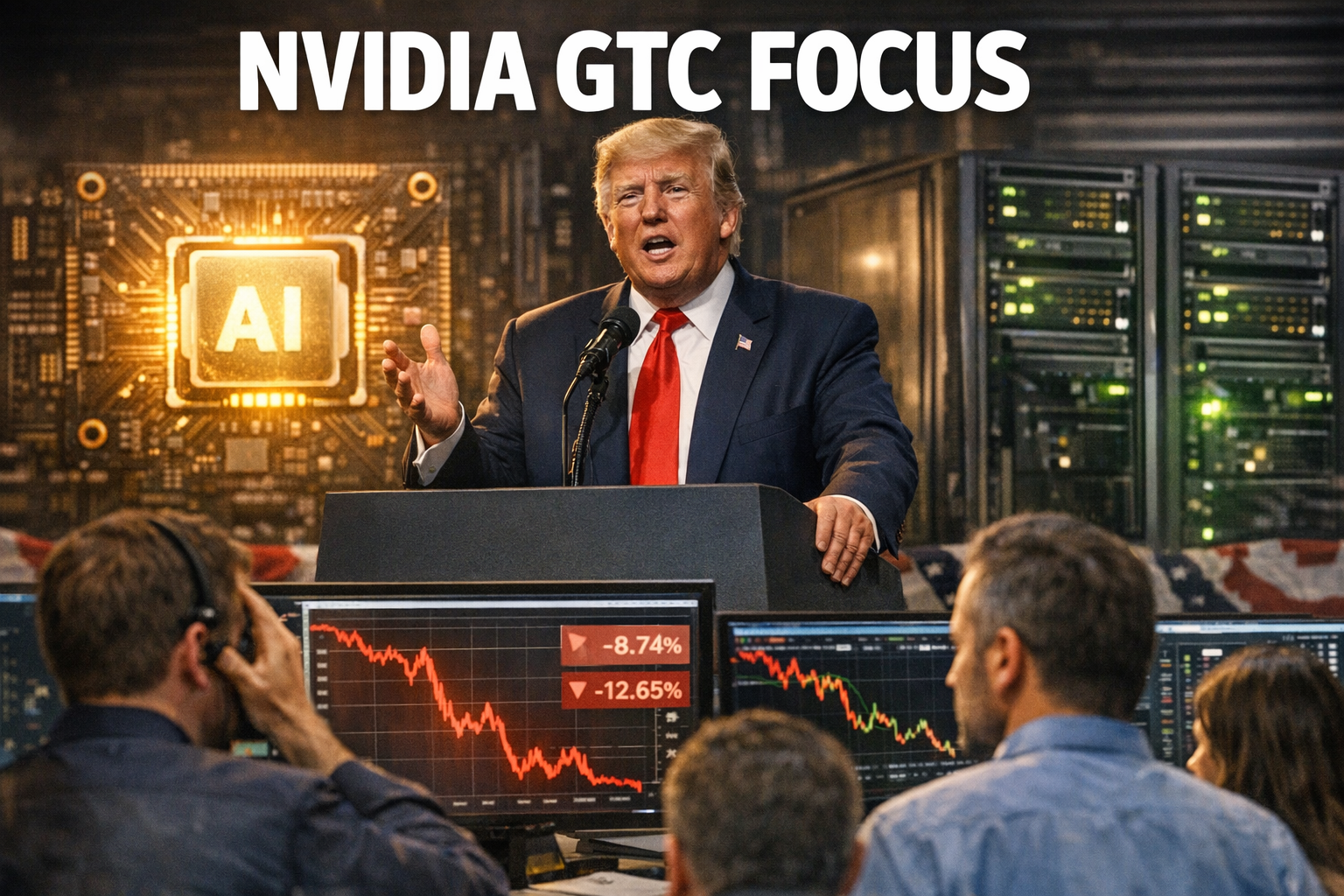
● Markets Crumble, Stagflation Fears Surge, Dollar Soars, Defense Stocks Ignite
Breakdown of the 6,900 Futures Level, Middle East-Driven Stagflation Risk, USD Strength, and Three Defense-Linked Names Quietly Watched by Wall Street
The critical issue is not merely “equities are declining.” The current move reflects a single, connected macro complex:
- Breakdown of the 6,900 futures level
- Escalating Middle East geopolitical risk
- Rising stagflation concerns
- Higher US Treasury yields
- Stronger US dollar and a sharp rise in FX rates
This is increasingly intersecting with themes such as defense, drones, communications infrastructure, and AI-enabled battery technology.
1. Key Market Message: Why This Drawdown Is Not a Routine Pullback
Market fragility is driven by multiple variables moving simultaneously. In many cycles, markets can absorb stress from one factor (rates, earnings, oil, or geopolitics). The current episode combines several:
- Futures breaking below 6,900, indicating a loss of a psychological support level
- Increased probability of prolonged Middle East tensions
- Potential oil upside re-accelerating inflation
- War-related fiscal burden increasing Treasury supply concerns
- Higher long-term yields pressuring growth-stock valuations
- Preference shifting from gold to USD liquidity, signaling demand for cash
This mix is challenging because it reduces the clarity of “what to buy” and increases sensitivity to marginal news flow.
2. What the Breakdown of the 6,900 Futures Level Signals
The 6,900 level functioned less as a price point and more as a consensus “line that should hold.”
2-1. Why 6,900 mattered
It was interpreted as evidence that liquidity had not fully deteriorated, implying that dip-buying flows could still emerge.
2-2. What changes when it breaks
Once a widely observed level fails, the same headlines can produce larger price reactions. In strong markets, bad news is often absorbed; in weak markets, it is amplified.
2-3. Practical implication for investors
Rather than buying solely because assets appear “cheap,” priority shifts to confirming whether the market can reclaim the broken level and whether rebounds are trend reversals or technical bounces.
3. Why Middle East Risk Is a Macro Variable, Not a Headline
The market focus is not only the conflict itself, but the potential to reshape economy-wide cost structures.
3-1. First shock: oil prices
Higher oil is not limited to an energy-sector tailwind; it propagates through costs:
- Higher transportation costs
- Higher aviation and shipping costs
- Higher manufacturing input costs
- Greater pass-through pressure into consumer prices
This can re-ignite inflation.
3-2. Second shock: logistics costs
The US economy is highly dependent on trucking. Higher diesel prices lift delivery costs across staples, food, and broad consumer goods, affecting both CPI and perceived inflation. Cost increases tend to be sticky.
3-3. Third shock: Treasury issuance and higher yields
A prolonged conflict can imply higher fiscal outlays, increasing Treasury issuance. Greater supply typically pressures bond prices and lifts yields, linking geopolitical risk to long-end rate increases.
4. The Primary Concern: Stagflation Risk vs. Inflation Alone
Stagflation refers to slowing growth alongside persistent inflation, a difficult setup for risk assets:
- Slower growth pressures corporate earnings
- Higher inflation weakens expectations for rate cuts
- Higher long-term yields raise discount rates and compress growth valuations
4-2. Why stagflation concerns are rising now
Markets had been positioned for eventual easing. If oil-driven inflation pressure returns while long rates rise, central banks may face constraints on easing despite growth risks.
4-3. Implications of the 30-year yield approaching 5%
Long-end yields affect mortgage rates, corporate funding costs, and long-duration discount rates. This can tighten conditions for housing and durable goods demand, with second-order effects on consumption, capex, and earnings.
5. Why the USD Is Outperforming Gold: Liquidity Preference in Stress Regimes
5-1. Liquidity dominates in acute risk-off phases
In high-stress periods, investors may prioritize immediate deployability over store-of-value characteristics. USD cash becomes the preferred asset.
5-2. Gold may already be extended
After a sustained rally, gold can be less responsive during incremental stress episodes, while USD demand can rise as a relative safe haven.
5-3. FX moves reflect global capital rotation
USD strength can indicate capital moving from risk assets toward USD-denominated assets. This dynamic often increases pressure on emerging-market currencies and assets. FX thus functions as a real-time gauge of risk aversion.
6. US Equity Strategy: Focus on Portfolio Resilience, Not Bottom-Fishing
The appropriate stance is neither full capitulation nor aggressive “this is the bottom” positioning.
6-1. Highest-risk behaviors in drawdowns
- Panic selling and exiting markets entirely
- Rotating into whatever recently outperformed without a framework
- Repeated short-term trading without defined criteria
- Chasing entries with insufficient cash buffers
These behaviors often result in selling lows and re-entering higher.
6-2. Questions to prioritize
- Can the portfolio withstand a higher-for-longer rate environment?
- Do holdings have earnings support?
- Is cash allocation adequate?
- Is there a scenario plan for further downside?
Risk control and survivability take precedence over directional precision.
7. Three Defense-Linked Themes Quietly Monitored by Wall Street
The items below are not recommendations; they summarize why these names are being discussed within the current narrative.
7-1. UMAC: A US-based alternative in the drone component supply chain
UMAC is positioned more as a supplier within drone components than as a full system manufacturer, with relevance to defense procurement where control of components and supply chains is strategic.
Key discussion points:
- Potential positioning as a US military supplier
- Presence of commercial customers
- Emphasis on US-based production aligned with reduced China dependency
- Increased attention tied to a high-profile shareholder connection
Primary risk: limited profitability and less-established earnings quality.
7-2. INSG: Communications infrastructure as a battlefield necessity
INSG provides 4G/5G-based mobile broadband solutions. The defense linkage reflects the shift toward data-centric operations:
- Remote operation of equipment
- Real-time video transmission
- Field communications reliability
- Connectivity for drones and unmanned systems
Relative positives include more stable revenue characteristics and reported profitability. Risks include small-cap volatility and lower visibility versus major defense primes, though government-related demand could support re-rating.
7-3. SES: AI-enabled next-generation batteries and potential defense-drone linkage
SES is described as an AI-integrated advanced lithium battery company, with attention driven by possible relevance to defense drones:
- Battery performance upgrades
- Potential improvements in drone endurance and efficiency
- Strategy emphasizing US-based manufacturing
Risk profile: high volatility and speculative characteristics; often treated as a high-risk thematic trade rather than a core long-term holding.
8. Underappreciated Point: Supply Chains and Data Matter More Than Finished Weapons
Media coverage often reduces conflict to “defense stocks rise.” Market focus increasingly extends beyond traditional weapons systems toward:
- Supply chains
- Communications modules
- Power systems
- Batteries
Drivers in modern conflict:
- Unmanned systems
- Real-time data transmission
- Sustainment-grade power and energy density
- Supply chains less dependent on China
This frames the theme as a convergence of defense with advanced manufacturing, connectivity, and AI-enabled systems.
9. Technical Reference Levels for Major Names
The price levels below reflect the source’s technical markers and may differ from current market prices; they should be validated against live charts.
9-1. Micron Technology (MU)
- Key support zone: 400–380
- Upside target area on a recovery: 455–480
- Next downside risk area if support fails: near 320
Interpretation: strong results can re-anchor AI-memory expectations; a break below 380 would be a negative signal.
9-2. Lululemon (LULU)
- Resistance: 190, 200
- Downside risk zone: 130–125
Brand strength persists, but consumption sensitivity and competition elevate the importance of earnings delivery.
9-3. Amazon (AMZN)
- Key lower bound: 200
- If broken: next area near 180
Cloud and advertising can support defensiveness, but broad index weakness can drive tests of range support.
9-4. Microsoft (MSFT)
- Support box: 395–380
- Downside risk: near 360
Despite quality characteristics, higher discount rates remain a constraint; confirmation of support is emphasized over short-term bounces.
9-5. Tesla (TSLA)
- First level to monitor: 380
- Additional downside area: 360
High beta and company-specific factors amplify volatility; in risk-off regimes, valuation premia can compress quickly.
10. What Oracle and Adobe Indicate: Earnings Dispersion Is Increasing
Even within the same earnings season, market reactions diverge meaningfully:
- Oracle: supported by AI-related upside narrative and cloud expansion
- Adobe: pressured by growth fatigue and competitive concerns
Implication: “AI exposure” alone is insufficient; markets are increasingly evaluating monetization, revenue conversion, and valuation simultaneously.
11. One-Page Market Map
- Macro: Middle East risk increases oil and inflation sensitivity
- Rates: war-related fiscal concerns and issuance risk lift long-end yields
- FX: USD favored over gold in liquidity-driven stress; FX rises reflect risk aversion
- Equities: futures break below 6,900 weakens sentiment
- Themes: attention shifts from traditional primes toward drone, comms, battery supply chain exposures
- Earnings/technicals: support levels in key large-cap and widely held names are central
12. Practical Takeaways for Individual Investors
- Emphasize response capability over prediction
- USD strength may indicate accelerating demand for cash liquidity
- Rising stagflation risk can pressure both growth and consumer sectors
- Defense exposure increasingly extends to supply chains rather than only finished platforms
- Large-cap technology is highly sensitive to support integrity under higher yields
- Portfolio rebalancing should be framed as resilience management, not forced liquidation
13. Most Material Points Often Missed in Mainstream Coverage
- The drawdown’s core mechanism is not the conflict itself, but the way it delays rate-cut expectations
- The defense rally logic increasingly moves from missiles to drones, from drones to supply chains, and from supply chains to US-based production
- USD strength is not merely an FX story; it signals the intensity of global risk aversion
- In drawdowns, quality assets can decline; key variables are liquidity buffers and downside levels
- The market is transitioning from AI narrative-driven gains to simultaneous validation of AI monetization and the rate environment
Overall, this is a convergence of geopolitics, inflation pressure, higher yields, USD strength, and AI valuation sensitivity.
14. Conclusion: Structure Matters More Than Precision
Markets can offer attractive entry points during stress, but the process can be prolonged and volatile. Priority actions:
- Assess whether holdings can withstand higher rates and slower growth
- Maintain cash allocation and a staged response plan
- Anchor thematic exposure to macro linkages rather than narrative momentum
< Summary >
The breakdown of the 6,900 futures level signals weakened sentiment. Middle East risk can transmit through higher oil prices, logistics inflation, and upward pressure on Treasury yields, increasing stagflation concerns. In this setting, the USD can outperform gold as investors prioritize liquidity. For US equities, the focus shifts from aggressive dip-buying to portfolio resilience. Three names cited in the defense-related narrative are UMAC, INSG, and SES, with emphasis on drone, communications, and battery supply chains rather than only traditional defense primes. Key technical support levels are highlighted for MU, LULU, AMZN, MSFT, and TSLA, while the market increasingly demands both earnings delivery and AI monetization under a restrictive rate backdrop.
[Related Articles…]
- Stagflation concerns and US equity response strategy: https://NextGenInsight.net?s=stagflation
- How USD strength and rising FX rates affect global markets: https://NextGenInsight.net?s=usd
*Source: [ 미국주식은 훌륭하다-미국주식대장 ]
– 월가에서 주목하는 전쟁 수혜주 “트럼프가문 대주주”