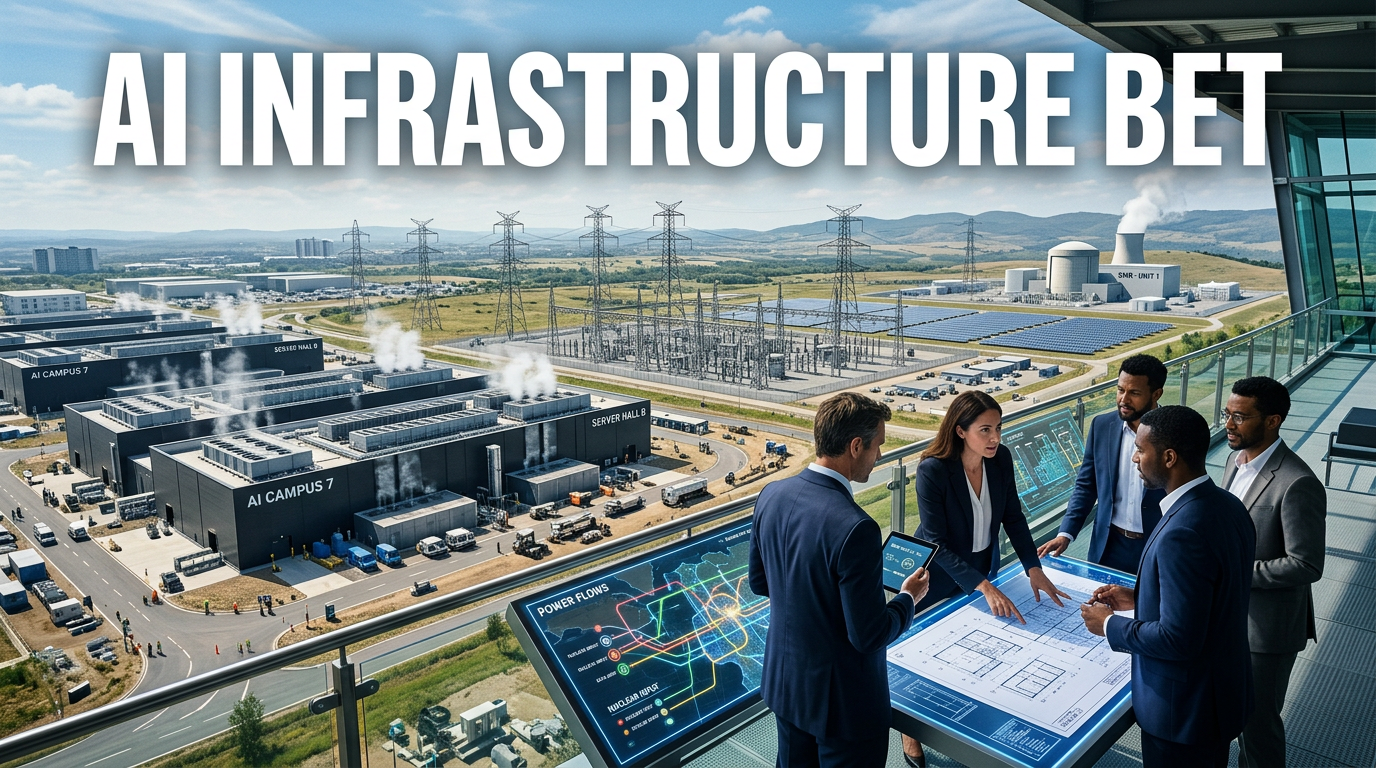
● AI Layoff Tsunami, Agentic Takeover, Stablecoin Surge, Chip War
AI-Driven Layoff Wave: Early Phase or Structural Shift?
From Big Tech restructuring to AI agents, stablecoins, and semiconductor supply chains
What matters to markets is not simply “AI is trending,” but three developments:
1) Big Tech is reducing headcount not primarily due to recessionary pressure, but to fund AI capex and operating investment.
2) Generative AI is moving beyond Q&A into an “AI agent” phase that can operate applications, execute payments, generate documents, and complete end-to-end workflows.
3) These shifts may influence U.S. equities (especially Nasdaq), semiconductors, stablecoins, and global capital allocation simultaneously.
This report explains why the current layoff cycle differs from prior episodes, why AI agents may reshape hiring and organizational design, why stablecoins can intersect with AI-led payments, and why U.S. tech could regain capital جذب via supply-chain investment and IPO-driven flows. It concludes with key points that are often underemphasized in mainstream coverage.
1. Why this round of Big Tech layoffs differs from prior restructurings
AI-investment-driven layoffs rather than cyclical recession-driven layoffs
Historically, Big Tech layoffs were associated with rate hikes, advertising slowdown, recession concerns, or post-pandemic overhiring corrections. Recent signals indicate a different driver: cost structure changes designed to reallocate resources toward AI.
This is less defensive downsizing than an offensive rebalancing:
- Not primarily “lack of liquidity,” but “AI investment requirements.”
- Spending pressure is concentrated in GPUs, servers, power, data centers, model development, AI research talent, M&A, and broader capex.
Signals from Meta and Oracle
Market discussion continues around potential workforce reductions at Meta and an expanded restructuring at Oracle. Specific figures vary by source; the salient point is the direction of travel:
“Future competitive positioning is increasingly determined by AI investment scale rather than total headcount.”
Because AI investment is difficult to pause once initiated, companies may target major cost lines—labor among them—to sustain infrastructure buildout.
Why this restructuring cycle may persist
If AI adoption structurally raises productivity, firms may have limited incentive to revert to prior staffing levels. In prior cycles, hiring often resumed with macro recovery; in this cycle, recovery may coincide with AI-enabled substitution. This raises the probability that workforce reductions are not purely transitory.
2. The center of gravity in layoff rationale is shifting toward AI
Statistical significance versus explicit corporate attribution
Companies rarely state “AI caused layoffs” directly. However, capital allocation and organizational redesign increasingly indicate AI-first strategies as a primary catalyst behind restructuring.
A key market question has emerged:
- Is AI moving from “augmenting workers” to “reducing required headcount”?
Why the next phase may be the inflection point
Consumer perceptions often remain anchored to chat-style AI. In enterprise settings, AI is already advancing into workflow execution:
- locating and retrieving documents
- organizing files and knowledge bases
- searching and synthesizing information
- drafting and formatting presentations
- operating applications
- initiating or completing payments
Compared with legacy automation (task-level), AI agents can connect multiple steps into end-to-end execution (workflow-level), increasing the scope of substitution.
3. Generative AI Round 2: From response-based AI to execution-based AI
“Action” becomes the differentiator
The shift is from AI that explains to AI that performs. With delegated permissions, AI can operate computers and smartphones to execute tasks. This implies process redesign, not just incremental productivity tooling.
Change 1: Declining need for manual file and folder navigation
AI can use context across documents, prior work, email, and cloud storage to retrieve the correct materials without manual searching. Functions likely to compress include:
- information gathering and research support
- document preparation and editing
- content restructuring and synthesis
Change 2: AI-driven direct control of mobile applications
In Android ecosystems, AI can launch apps, navigate menus, place orders, call services, and act based on calendar and location context. Likely early mass adoption use cases:
- coffee and food ordering
- ride-hailing
- reservations
- comparison shopping
- basic payments
This implies a mobile UX transition: user intent specified by voice/text, execution handled by an agent.
Change 3: AI operating on-screen workflows on PCs
Across major platforms, the direction is consistent: AI interacting directly with tools and interfaces. Typical flow:
- open browser and search
- extract relevant information
- compile into slides or documents
- route for approval
Roles with elevated exposure include:
- administrative support
- operations support
- content production (first drafts)
- Tier-1 customer support
- baseline research
- marketing draft generation
4. Weekly news-style synthesis: Key AI market issues
Expanding signs of Big Tech restructuring
Meta, Oracle, Amazon, and other large technology firms are increasingly associated with potential workforce reshaping conditioned on AI investment expansion. The key framing is capital allocation re-prioritization rather than macro deterioration alone.
AI agent commercialization accelerating
Microsoft, Google, Anthropic, xAI, Perplexity, and others are expanding tool-use and action-taking capabilities. Competitive focus is shifting from benchmark performance toward execution reliability.
Convergence of mobile and PC workflows
AI agents are increasingly bridging smartphone app operations with PC-based document, search, and workflow tasks, implying cross-platform orchestration.
AI payments and stablecoin narrative gaining visibility
Messaging across large crypto platforms converges on a thesis: if AI agents execute high-frequency, automated payments at scale, digital wallets and stablecoins may provide a more native payment layer than traditional banking rails.
Intensifying semiconductor supply chain and data center competition
Industry leaders emphasize chips and infrastructure as the binding constraint. Model quality may commoditize, but access to compute, power, and data centers is less likely to equalize rapidly. Implicated sectors:
- semiconductor equipment
- design automation (EDA)
- data center power and cooling
- advanced packaging and back-end processes
- high-performance memory and AI server components
5. Labor market impact: Primary and secondary effects of AI agents
Job families likely to face early compression
Exposure is highest in repetitive, digitized office workflows:
- research and analyst support
- first-draft PPT, reports, and proposals
- basic data cleanup and document editing
- scheduling, reservations, Tier-1 customer response
- entry-level marketing copy and content drafts
- app-based ordering, reconciliation, and comparison tasks
Risk is not limited to manual labor; entry-level white-collar roles may be first affected.
Why middle management is also exposed
AI agents can automate “coordination” functions:
- material aggregation
- agenda and minutes summarization
- status tracking
- KPI compilation
This can incentivize flatter organizational structures if fewer human layers are required to produce comparable outputs.
Second-order effects of layoffs
The primary risk is not only job losses but potential macro spillovers:
- weaker consumption
- housing market stress
- credit risk
- youth employment deterioration
- erosion of middle-class purchasing power
A potential feedback loop is possible: AI investment -> headcount reduction -> weaker consumption -> slower revenue -> further restructuring.
6. Stablecoins and AI payments: Why they should be analyzed together
AI agents may prefer wallets over bank accounts
As agents execute payments on behalf of users, traditional financial rails may be constrained by authentication friction, regulatory complexity, account linking, and cross-border limits. In contrast, crypto wallets and stablecoins are:
- programmable
- globally accessible
- continuously available (24/7)
Why stablecoins are a leading candidate
- lower price volatility relative to non-stable crypto assets
- faster cross-border settlement
- advantage in small, high-frequency transactions
- easier integration into automated agent payment flows
- strong API compatibility
Illustrative use cases: automated subscription management, international SaaS payments, logistics booking, and software procurement.
Market significance of Circle, Coinbase, and Binance commentary
The question is not a “crypto theme” alone, but whether stablecoins can be valued as payment rails for an AI agent economy. If adopted, crypto markets could be increasingly framed as payment infrastructure rather than purely speculative assets.
7. U.S. equities, Nasdaq, and second-half capital flows
Why U.S. equities could regain incremental flow support
Key potential drivers:
- AI-related IPO expectations
- visibility of returns on Big Tech AI investment
- passive inflows driven by index inclusion mechanics
IPO expectations: OpenAI, Anthropic, SpaceX
While timelines are not confirmed, markets are sensitive to IPO probability for large private technology assets. If listed, these names could redirect global capital toward U.S. growth equities, including institutional and ETF flows.
Why index inclusion matters
Beyond listing events, rapid inclusion in major indices (S&P 500, Nasdaq, Russell family) can create mechanical demand from global passive capital. This can amplify flow dynamics independent of discretionary positioning.
Implications for incumbent strategic investors
Large incumbents (e.g., Alphabet, Amazon, Microsoft, Nvidia, SoftBank) have invested in private AI leaders. Public revaluation via IPOs could strengthen narratives and valuation support for existing stakeholders.
8. Why semiconductors remain the decisive front in the AI cycle
Post-model-commoditization constraint: cost and scale of inference/training
As models converge in capability, differentiation increasingly shifts to:
- ability to run at scale
- cost efficiency
- compute availability
- power and data center capacity
Implications of vertical integration commentary (e.g., in Musk-led ecosystems)
AI, autonomous driving, robotaxis, and humanoid robotics are compute-intensive. Reliance on external supply may be insufficient, increasing incentives for supply-chain control and design/manufacturing capability expansion.
Areas with potential structural demand support
- semiconductor equipment
- EDA software
- data center power and cooling infrastructure
- advanced packaging and back-end manufacturing
- high-performance memory and AI server components
This is positioned as foundational infrastructure rather than a short-duration theme.
9. Underemphasized points in broader media coverage
Key point 1: AI is replacing workflows, not only job titles
The practical path is often partial absorption of multiple task steps within a role, leading first to reduced hiring demand and later to restructuring.
Key point 2: AI agents can reshape payment infrastructure for software markets
Once agents execute payments, multiple sectors may be affected simultaneously: e-commerce, SaaS, fintech, advertising, subscriptions, and cross-border payment systems. Stablecoins can be interpreted as a payments layer for agent-led commerce.
Key point 3: Hiring slowdowns may be more consequential than headline layoffs
Media focus on layoff counts; structurally, reduced entry-level hiring can exert larger long-run pressure, particularly for younger cohorts.
Key point 4: U.S. tech strength can be reinforced by new listed assets, not only earnings
Major market upcycles often coincide with the emergence of new investable assets. Large AI and space-related IPOs could function as incremental capital جذب mechanisms for U.S. equities.
10. Practical checkpoints for employees and investors
Employee perspective
- purely repetitive document production is likely to lose scarcity value
- productivity dispersion between AI-capable and non-capable workers may widen
- skills with rising relevance: research, documentation, automation, prompt design, data interpretation
- framing: prioritize whether workflows can be executed materially faster with AI
Investor perspective
- near term: layoff headlines may elevate growth and consumption concerns
- medium term: AI infrastructure capex can support semiconductors, data centers, and U.S. tech equity narratives
- analysis should extend beyond software to equipment, design tools, power, cooling, and payment rails
- second-half: IPO momentum and potential index inclusion can create incremental flow support
11. Conclusion: Risk of a “worst-case” scenario
A definitive “mass layoff tsunami” is not confirmed. However, the current adjustment differs from purely cyclical downsizing. As AI begins to execute real workflows, firms can deploy it to both reduce costs and fund growth investment. This suggests labor markets may face structural adjustment that does not automatically reverse with macro recovery.
From a capital markets perspective, the same shift may underpin a new investment cycle across U.S. equities, Nasdaq, semiconductors, stablecoins, and AI infrastructure.
< Summary >
Recent Big Tech layoffs appear increasingly linked to cost reallocation toward AI investment rather than recession-only dynamics.
Generative AI is moving from Q&A tools to AI agents that can execute tasks across apps, search, document creation, and payments.
This shift may compress office roles and middle-management coordination functions; reduced new hiring may represent a larger long-term risk than layoffs alone.
AI-led payments can increase the relevance of stablecoins and digital wallets as programmable payment rails, while semiconductors and data centers remain core constraints in AI competition.
In the second half, IPO expectations for large private technology assets could reinforce capital flows into U.S. equities and Nasdaq via discretionary and passive channels.
Overall, AI implies structural labor market pressure alongside the potential start of a new capital investment cycle.
[Related Articles…]
- AI Agents and the Future of Jobs and Productivity (NextGenInsight.net?s=AI)
- Semiconductor Supply Chain Realignment and U.S. Tech Equity Investment Considerations (NextGenInsight.net?s=semiconductors)
*Source: [ 소수몽키 ]
– AI투자 → 대량 해고 쓰나미 시작? 최악의 시나리오 현실화될까
● Oil Shock, AI Credit Bomb, Fed Chaos
The Key Variable More Disruptive Than the Middle East War: Why AI-Linked Private Credit Risk and Fed Policy Dispersion Are Driving Market Volatility
Market attention is concentrated on visible variables such as the Middle East conflict, oil price trajectories, the Strait of Hormuz, and FX outlooks.
However, the more material drivers lie elsewhere.
This report summarizes: (i) the transmission channels through which an oil shock affects the Korean and US economies, (ii) why inflation and growth deceleration can occur simultaneously, (iii) why the Federal Reserve’s rate-setting has become more complex, and (iv) why comparatively underreported AI-related private credit risk may represent a latent weak link for financial markets.
Key focus areas include: the impact of Middle East risk on Korea’s trade balance and USD/KRW, US affordability pressures and political risk, private credit fragilities beneath the AI capex cycle, and an unusual policy environment in which Fed officials discuss rate cuts, holds, and even hikes in parallel.
1. Key Takeaways at a Glance
The issue is not limited to geopolitics.
A Middle East conflict can tighten energy supply conditions and disrupt logistics, raising the probability of simultaneous growth slowdown and inflation pressure.
Korea is particularly exposed due to high energy import dependence and meaningful volumes transiting the Strait of Hormuz, increasing sensitivity to trade balance deterioration, KRW depreciation, and inflation.
In the US, higher oil prices can erode household purchasing power, constrain the case for Fed easing, and elevate political pressure.
In parallel, AI-linked private credit risk is accumulating and may amplify market fragility.
The current regime combines geopolitical risk with credit/financial risk.
2. Why a Middle East Conflict Can Create Larger Financial-Market Shock
2-1. War, oil, and supply chains move together
Wars typically raise growth-downside concerns.
A Middle East conflict is structurally different because the region is central to global energy supply, increasing the likelihood of a direct oil-price impulse.
If supply-chain frictions coincide, corporate input costs rise alongside transport and commodity costs.
This configuration increases the probability of weaker growth with higher inflation.
2-2. Not necessarily stagflation, but a similar direction of travel
The principal risk is that inflation rises due to supply shocks rather than demand strength.
Under a supply-driven inflation impulse, growth can soften while prices accelerate.
Markets therefore focus more on the inflation path and central-bank reaction function than on growth forecasts alone.
3. Why the Shock Can Be More Severe for Korea
3-1. High dependence on imported energy
Korea’s economic structure implies high reliance on imported energy.
A large share of crude oil and gas is sourced from the Middle East, with significant volumes transiting the Strait of Hormuz.
If risk persists, markets may price not only higher oil prices but also physical supply disruption risk.
3-2. Trade-balance sensitivity transmits quickly into FX
Higher oil prices raise the import bill and can deteriorate the trade balance.
Concerns over shrinking surpluses or a move toward deficit can translate into KRW depreciation pressure.
Transmission chain:oil up → trade balance concerns → USD/KRW up → import prices up
This can lift inflation pressure more materially than implied by oil prices alone.
3-3. The Bank of Korea’s easing window may narrow
In a typical slowdown, policy easing becomes a consideration.
If inflation rises concurrently, the policy trade-off changes materially.
A simultaneous increase in commodity prices and FX depreciation reduces monetary-policy flexibility.
Outcome risk: weaker growth with limited ability to cut rates.
Historically, oil-spike episodes have at times increased tightening pressure despite growth concerns.
4. The US Is Not a Safe Harbor
4-1. The central issue is affordability (purchasing power)
A key US macro variable is household purchasing power.
If employment momentum moderates while oil and living costs rise, consumer sentiment and real spending capacity can weaken quickly.
When incomes do not keep pace with gasoline and essentials, real purchasing power declines.
4-2. Higher oil prices can translate into political risk
In the US, energy prices have direct political salience.
Higher gasoline prices can intensify voter dissatisfaction and influence electoral dynamics.
Oil-price increases can therefore combine three pressures: weaker consumption, deteriorating sentiment, and higher policy burden.
4-3. Expectations for Fed easing may weaken
Markets have priced some probability of rate cuts.
If oil-driven inflation re-accelerates, the justification for easing diminishes.
Prolonged restrictive rates increase fiscal strain via higher interest expense, and additional defense-related spending can tighten fiscal space.
This can reduce both monetary and fiscal policy flexibility.
5. Underreported but Material Risk: AI-Linked Private Credit
5-1. AI investment is a growth engine, but partly debt-financed
AI-related investment has supported equity performance and macro growth narratives.
Capex spans semiconductors, data centers, cloud, software, and power infrastructure.
Funding needs have attracted non-bank capital, including private credit.
5-2. Software underperformance can pressure collateral values and confidence
Some software firms have not delivered cash-flow performance consistent with expectations.
While AI narratives supported funding, monetization timelines remain uncertain and dispersion across firms is widening.
Idiosyncratic stress can trigger broader reassessment of credit quality.
When assets become suspect, capital-retrenchment dynamics can compress valuations and reduce collateral value.
5-3. Private credit differs from banks, but remains system-relevant for risk assets
This risk does not map directly to a 2008-style payments-system crisis.
Private credit vehicles are not the core of settlement infrastructure, so the transmission mechanism differs.
However, a credit tightening in this segment can slow the AI investment cycle and weaken a key pillar of growth expectations.
Even absent a banking crisis, impacts can be meaningful for growth-stock valuation, tech risk appetite, and corporate funding conditions.
5-4. The principal fear is correlated outflows
Market stress becomes acute when many investors attempt to exit simultaneously.
In less-liquid assets, synchronized redemptions can create outsized price dislocations.
The core risk is not only defaults, but also confidence erosion and redemption pressure.
6. Why the Fed’s Policy Problem Has Become Harder
6-1. The policy set is not limited to cut vs. hold
Markets typically frame Fed outcomes as easing versus maintaining rates.
Currently, Fed discourse includes rate cuts, holds, and the possibility of additional hikes in the same cycle.
This indicates elevated uncertainty around the reaction function.
6-2. Oil-price dynamics widen internal policy dispersion
Some view oil shocks as temporary; others interpret them as signals of renewed inflation acceleration.
This split can widen disagreements: one camp prioritizes growth risks and easing, another prioritizes inflation risks and continued restriction.
Policy ambiguity increases volatility across rates, equities, and FX.
6-3. Leadership and governance uncertainty can weaken policy credibility
Monetary policy effectiveness depends on consistent communication and perceived independence.
If leadership transition risk, confirmation delays, or political disputes intensify, markets may question continuity and independence.
In such cases, diminished credibility can become a larger destabilizer than the level of rates.
7. Market Transmission Path Investors Should Monitor
7-1. Stage 1: Oil and FX
Primary indicators: oil-price persistence and USD/KRW direction.
If oil remains elevated and the KRW weakens, import prices and inflation expectations can reprice rapidly.
7-2. Stage 2: Shifts in rate expectations
A larger oil shock can push back Fed cut expectations.
The Bank of Korea may face similar constraints.
This can pressure bond duration and long-duration equity, including growth and technology.
7-3. Stage 3: AI investment sentiment
AI is a primary driver of global growth expectations.
Deterioration in AI financing conditions can spill over from a sector issue into broader risk-asset sentiment.
7-4. Stage 4: Credit-market contagion
Monitor whether private credit stress transmits to high yield, leveraged loans, and venture/growth funding.
While not yet a banking-system event, a sustained widening in credit spreads would likely raise market sensitivity.
8. Most Underemphasized Point in Broader Coverage
8-1. The core issue is policy dilemma, not the war headline
Coverage often focuses on escalation and price levels.
The more consequential effect is reduced policy room: easing supports growth but may conflict with inflation; fiscal support is constrained by debt-service costs.
This policy bind is the central risk.
8-2. AI is both a growth catalyst and a potential source of financial instability
Markets often treat AI as a pure growth narrative.
If funding structures rely materially on leveraged or non-bank credit, sentiment reversals can produce amplified drawdowns.
8-3. The key Fed risk is not the rate level but fragmentation of consensus
The market focus is typically the number of cuts.
A more destabilizing development is widening internal dispersion, rising political pressure, and leadership uncertainty reducing predictability.
Lower predictability mechanically increases asset-price volatility.
9. Consolidated View
The global macro backdrop reflects four simultaneous forces: supply shock risk from the Middle East conflict, oil-driven inflation pressure, AI-linked private credit fragility, and elevated uncertainty around Fed policy.
Any single factor may be absorbable; the combination can destabilize growth, inflation, FX, rates, and risk-asset sentiment concurrently.
Investors should monitor oil, global growth conditions, the inflation path, Fed reaction function, and AI financing structures as a linked system rather than as isolated headlines.
< Summary >
A Middle East conflict can disrupt energy supply and logistics, increasing the likelihood of slower growth alongside higher inflation.
Korea is more vulnerable due to energy import dependence and Strait of Hormuz exposure, which can worsen the trade balance, weaken the KRW, and raise inflation.
In the US, affordability pressures and political risk may rise, reducing the scope for Fed easing.
Concurrently, AI-linked private credit risk represents a latent financial-market vulnerability.
This risk differs from a 2008-style crisis but can still shock AI investment sentiment and broader credit conditions.
Fed policy uncertainty has increased to the point that cuts, holds, and hikes are discussed in parallel.
The current market regime is defined less by war headlines than by the combined impact of oil, FX, inflation, AI credit risk, and Fed policy dispersion.
[Related Posts…]
AI Investment and Financial-Market Volatility: Key Points to Monitor Now
Oil Price Spikes and the Global Economic Outlook: Implications for Korean Equities and FX
*Source: [ 경제 읽어주는 남자(김광석TV) ]
– 중동 전쟁보다 더 위험한 변수. AI 대출 리스크와 금융시장 불안 | 경읽남과 토론합시다 | 오건영 단장_1편
● Buy Stocks Now, Oil Shock, AI Cash Rotation
Reasons to Consider Buying Equities Now: A Unified Framework Combining Seasonality, Oil Prices, the U.S. Political Cycle, and AI Capital Rotation
The key driver in the current market is not simply whether valuations appear cheap or expensive. The higher-probability question is timing, and how that timing interacts with oil-price shocks, Iran-related geopolitical risk, the U.S. midterm-election cycle, and the AI investment cycle.
This report links: (i) seasonality patterns in Korean and U.S. equities, (ii) a 2026–2028 macro and allocation outlook, and (iii) capital rotation from AI semiconductors toward infrastructure, power, commodities, and emerging markets.
It also addresses three frequently under-discussed topics: (1) why stronger market windows tend to recur at specific times, (2) what equity markets have typically looked like one year after war-related oil spikes, and (3) why “AI cooling” may be better described as a change in the phase of capital deployment.
1. Key Takeaways
- From a seasonality perspective, the current period can be interpreted as a window in which increasing equity exposure has historically offered better odds.
- In Korea, mid-March through late April is often cited as a relatively strong seasonal stretch.
- The primary near-term shock is geopolitical risk and an oil-price spike. Historically, in the U.S., episodes of 20–30% oil increases over 1–2 weeks were often followed by 1–2 months of market consolidation, yet equities were frequently higher 12 months later.
- The U.S. political cycle suggests 2026 should be analyzed with more granularity than a generic “midterm year” label; risk assets, including Korea, may remain relatively supported through 2027 under certain historical patterns.
- AI investment is not necessarily contracting; capital appears to be rotating from Phase 1 (GPUs/LLMs) toward Phases 2–3 (data centers, power, and related physical infrastructure).
2. What “Seasonality Investing” Means
Seasonality investing is based on the premise that certain assets exhibit recurring periods of relative strength and weakness over the year. While not deterministic, patterns are repeatedly observed across annual, monthly, and even intraday horizons.
2-1. Simplified Concept
Equity markets can show “peak” and “off-peak” periods, reflecting recurring funding and execution rhythms among individuals and institutions.
2-2. Why Patterns Can Persist
- Longer-cycle influence: the U.S. presidential cycle.
- Shorter-cycle influence: institutional budgeting and deployment timing, quarterly inflows, and year-end portfolio rebalancing.
3. Is March a Historically Favorable Entry Window?
A core claim is clear:
- Mid-March through late April has often been a notably strong period for Korean equities, with performance frequently clustering around roughly March 15 to approximately April 29.
3-1. Potential Drivers of March–April Strength
- U.S. tax refunds may add liquidity in March–April.
- In markets with significant annual dividend flows (Korea/Europe/Japan), March–April can see dividend reinvestment effects.
- Post–early-year consolidation can coincide with renewed risk-on positioning.
3-2. Historically Weaker Window
The “Sell in May” concept (May–October relative weakness) is frequently referenced. While not a rule, it can serve as a framework for exposure management. In years such as 2018 and 2022, the May–October window was notably difficult, and a seasonality-based approach was described as helpful for drawdown control.
4. Monthly and Calendar-Based Allocation Signals
4-1. Annual Pattern (U.S.)
U.S. equities have often been stronger from November to April and weaker from May to October.
Korean equities are described as exhibiting an additional concentration of strength from mid-March to late April.
4-2. Monthly Flow Effects
Month-end and month-start periods can coincide with inflows; mid-month performance is often weaker. Quarter-start months are also commonly associated with stronger deployment.
4-3. Intraday Pattern (Tactical Observation)
Some analyses argue that returns accrue more from the close to the next session’s open than during intraday trading.
5. Geopolitical Risk and Oil Spikes: Do They Break Seasonality?
Investor concern is centered on geopolitics and oil. Rapid oil increases raise inflation and rate concerns and can tighten financial conditions.
5-1. Are Oil Spikes Always Negative for Equities?
- Near term: often negative; markets may contract for 1–2 months.
- Medium term (historical U.S. examples): after rapid 20–30% oil spikes, equities were frequently meaningfully higher 12 months later.
5-2. Mechanisms Often Cited
Initial fear can be followed by policy responses intended to stabilize growth (liquidity measures and fiscal support). Markets can also adapt quickly to new price regimes.
5-3. Applicability to the Current Episode
No direct equivalence should be assumed. The key variables are policy response, the speed of energy-price normalization, and whether risk appetite and flows recover.
6. U.S. Midterm Elections: Is 2026 Structurally Negative?
A common narrative is that “midterm years are weak.” The report argues this is incomplete.
6-1. Year 2 vs. Year 6 Midterms Are Not the Same
- Year 2 midterms can carry heightened political uncertainty tied to reelection dynamics.
- Year 6 midterms occur in a later-term phase; uncertainty can be lower from a market perspective.
6-2. Historical Read-Through
Post–World War II examples of Year 6 midterms are described as generally supportive for equities. Even when shocks occurred (e.g., Korean War, the 1998 emerging-market/Russia crisis), U.S. equities often recovered after a period of adjustment.
6-3. Implications for 2026
Rather than “uniformly high risk,” the more relevant framing is the potential for mid-year volatility followed by recovery into year-end, conditional on macro and policy variables.
7. 2027–2028 Outlook: Why the Next Allocation Shift May Matter More
The emphasis shifts from near-term timing to a broader 2027–2028 allocation regime change driven by politics and global asset allocation.
7-1. Why 2027 Could Remain Supportive for Korea/Asia (Conditional)
A late-cycle political phase is argued to be associated with more moderate external policy posture, which could reduce friction and be relatively constructive for Asian and emerging-market assets.
7-2. Why 2028 May Require Higher Caution
With a U.S. presidential election, policy uncertainty and risk premia can rise. The market may begin to price this risk from the second half of 2027.
8. Korea vs. the U.S.: Similar Direction, Different Elasticity
Korea and the U.S. are highly linked, but sensitivity differs.
8-1. Downturn Sensitivity
When the U.S. corrects, Korea often experiences a larger drawdown due to risk-off capital behavior toward emerging markets.
8-2. Upside Beta
When global risk appetite improves, Korea can rebound more sharply, particularly in more favorable portions of the broader cycle.
8-3. Core Indicators for Korea-Focused Investors
KOSPI alone is insufficient. Key cross-market variables include U.S. equities, USD, rates, oil, and foreign investor flows.
9. Why Emerging Markets Are Back on Allocation Discussions: AI Meets Commodities
The renewed interest in emerging markets is framed not as a simple “cheap valuation” argument but as a supply-chain and capital-expenditure argument:
- AI infrastructure expansion increases demand for commodities, and many major commodity producers are emerging markets.
9-1. Why Emerging Markets Matter in an AI-Driven Cycle
AI deployment increasingly requires physical infrastructure: data centers, power generation, grid buildout, and metals and fuels needed for those systems.
9-2. Commodity Supply Concentration
Beyond select developed producers (e.g., Canada, Australia), many key suppliers are emerging markets (e.g., Brazil, Indonesia, Chile, South Africa). AI-related demand may therefore transmit beyond U.S. mega-cap technology into resource and emerging-market exposures.
10. Is AI Investment “Cooling,” or Rotating?
Market commentary often interprets consolidation in certain AI equities as the end of the theme. This report frames it as phase rotation.
10-1. AI as a Multi-Phase Capital Cycle
- Phase 1: GPUs, semiconductors, LLMs
- Phase 2: Data centers
- Phase 3: Power and grid infrastructure
- Phase 4: Physical AI (industrial automation and productivity)
- Phase 5: AI platform dominance
10-2. Current Phase Assessment
The current period is characterized as a transition into Phases 2–3, with capital spreading from core AI compute into data-center infrastructure, power equipment, nuclear, transmission, industrials, and commodities.
10-3. Implication
The theme may be broadening rather than weakening; larger capital pools can increasingly accrue to infrastructure enabling AI workloads.
11. Under-Emphasized Strategic Points
11-1. Seasonality as an Exposure Tool, Not an All-In/All-Out Signal
The recommended use is position sizing and exposure adjustment, not binary market timing.
11-2. War and Oil Shocks: Markets Often Price Policy Response
Headlines focus on the shock; markets focus on second-order effects such as liquidity, fiscal response, and stabilization measures.
11-3. “AI Cooling” Narratives May Miss the Phase Shift
Capital rotation from semiconductors to power, nuclear, copper, industrials, and emerging markets is consistent with infrastructure scaling.
11-4. Allocation Focus: 2027–2028 May Be More Material Than 2026
Maintain flexibility for risk assets into 2027 while gradually preparing for potentially higher political uncertainty into 2028.
12. Practical Portfolio Framing
12-1. Near-Term Checklist
- Validate whether the mid-March–late April seasonal window is materializing.
- Assess whether the oil move is extending or stabilizing after an initial shock.
- Monitor recovery in flows across U.S. equities and KOSPI.
12-2. Sector and Theme Map
Track not only AI Phase 1 (semiconductors/platforms) but also Phases 2–3: data centers, power infrastructure, nuclear, and commodities. Emerging-market ETFs and resource exposures can be relevant for medium-term positioning.
12-3. Risk Controls
Seasonality provides probabilities, not certainty. Geopolitics, rates, USD strength, and earnings shocks can disrupt patterns. Gradual entry, exposure sizing, and diversification remain central.
13. One-Sentence Summary
Despite elevated headline risk from geopolitics and oil, the broader setup aligns a historically stronger seasonal window with the U.S. political cycle and a widening AI-driven capital rotation into infrastructure, commodities, and emerging markets; the primary implementation lever is exposure adjustment rather than binary timing.
< Summary >
- Mid-March through late April is presented as a historically stronger window for Korean equities.
- Iran-related risk and oil spikes may be near-term shocks; historically, U.S. equities were often higher one year after comparable oil surges.
- U.S. midterms should be segmented by cycle position; Year 6 dynamics differ from Year 2.
- Conditions may remain relatively constructive for Korea/Asia through 2027, while 2028 may warrant higher attention to political uncertainty.
- AI investment is framed as rotating from semiconductors into data centers, power, commodities, and emerging markets.
- The central conclusion emphasizes structure and exposure sizing over headline-driven reactions and binary timing.
[Related Articles…]
- AI Infrastructure Investing: Where the Next Opportunity Lies After Semiconductors
https://NextGenInsight.net?s=AI - KOSPI and U.S. Equities: Key Takeaways for 2026 H2 Investment Strategy
https://NextGenInsight.net?s=KOSPI
*Source: [ Jun’s economy lab ]
– 지금은 주식을 사야 하는 계절입니다 내년에 파세요(ft.강환국 작가 1부)