● Korean Haptic Suit Shocker, 97 Percent Overseas, Meta-Backed XR Breakout
In Korea it sells 3%, but the world is crazy about this haptic suit: bHaptics reveals the real battleground of the XR·VR market
When people hear “haptics,” many still think of nothing more than smartphone vibration.But in the global market right now, “touch” is rapidly establishing itself as the core layer of XR·VR immersion.
In this piece, rather than stopping at the level of “a Korean startup is doing well overseas,”we’ll lay out in one place why bHaptics became Meta’s official partner,why 97% of its revenue comes from overseas,and where haptics technology will sit going forward within the outlook for the XR market and the currents of AI, wearables, and digital transformation.
In particular, this article includes:the point that “the essence of haptics technology is not hardware but software engineering,”“what surviving companies have in common even as the VR market cools,”“why it resonates in North America and Europe before it does domestically,”and even the structure that “the lack of standards actually becomes a powerful barrier to entry,” which other news or YouTube channels rarely highlight.
If you follow XR·VR, the metaverse, the global economy, AI trends, and next-generation interfaces beyond semiconductors, you’ll likely find this a compelling read.
1. Core point at a glance
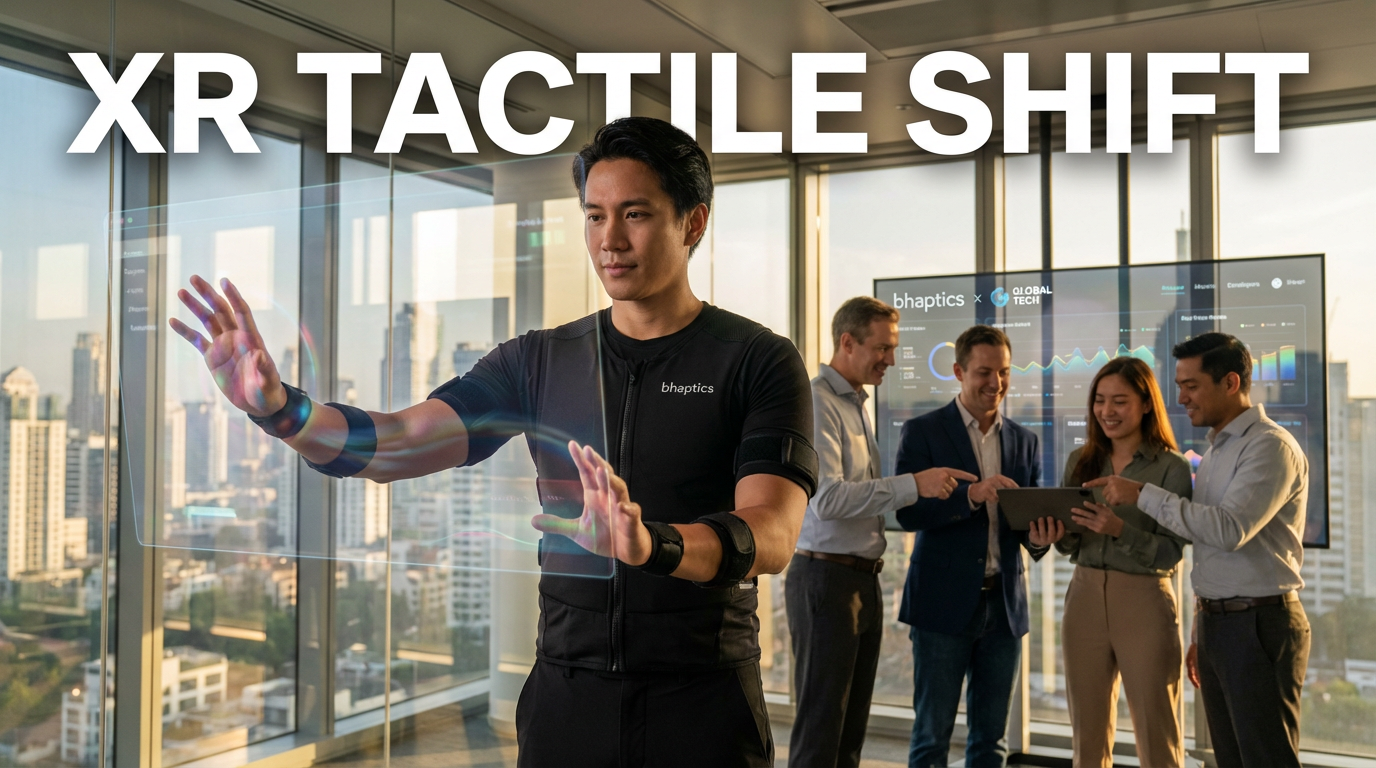
bHaptics is a Korean startup that makes wearable haptic suits and gloves.
This company is regarded not just as a top-tier player but as one with a very large presence in the global VR haptic suit market.
As of last year, 97% of its revenue came from overseas markets such as the U.S. and Europe,while Korea’s share of sales remained at around 3%.
It is also included in Meta’s official partner program,and is proceeding with sales within Meta’s platform as well as brand tie-ins.
On the surface, it may look like “a company that makes good devices,”but the core of its competitiveness is software rather than hardware—more precisely, content integration and tactile experience design.
And this point is also a fairly important hint about where Korean tech companies can become strongamid future AI trends, digital transformation, and global supply-chain reorganization.
2. What is haptics, and why is it being spotlighted again now?
2-1. Haptics is not “vibration,” it’s a “tactile interface”
Haptics is not simply a function where a device buzzes.It’s more accurate to see it as a “touch-based interface” that, along with sight and hearing, forms the user’s sensory system.
Smartphone notification vibrations,Apple Watch feedback,and even the recoil of a game controller are all, broadly speaking, haptics.
But what bHaptics makes goes one step further.By distributing tactile feedback across multiple points on the body—such as the upper body, arms, and fingers—it creates immersion that makes users feel things like “I got hit,” “rain is falling on my body,” or “wind is passing by.”
2-2. What matters is not the stimulus, but the “illusion”
There is a truly important point here.The core of a haptic experience is not strong vibration itself.
Even with the same vibration,depending on when,where,in what pattern,and in conjunction with which content scene it is delivered,the experience becomes completely different.
In other words, what users feel is not “physical stimulus,”but the “cognitive illusion” created by that stimulus.
This is exactly why haptics matters in the XR·VR market.With only sight and sound, you may remain at the level of watching a screen,but when touch is added, users feel embodied presence, as if they’ve entered the content.
2-3. Why does touch become more important in the XR era?
In the PC gaming era, the need for touch wasn’t that great.Because you were already touching a keyboard and mouse with your hands.
But XR·VR is different.It’s an environment that uses the entire body as an interface, sodepending on what the user experiences in the virtual space,the importance of touch becomes much greater.
Simply put,a firefight on a screen is something you see with your eyes,but a firefight in VR becomes an experience you “go through” with your body.
This shift could expand in the future not only across consumer tech but also intoeducation, medical simulation, defense training, remote collaboration, and fitness.
3. bHaptics’ real competitiveness: software over hardware
3-1. The haptics market still doesn’t have an “MP3-like standard”
Audiovisual content already has standards.Audio has formats like MP3,and video has well-established encoding and playback ecosystems.
But for haptics, there are virtually no such global standards.
Why does this matter?Because it means you can’t dominate the market just by making a device well.If there isn’t a software environment that content creators and game developers can easily plug into,even great hardware ends up as just an expensive accessory.
3-2. bHaptics moved “like a software company” from the start
bHaptics makes money by selling hardware, butit’s said that from the early days of founding, it had a higher proportion of software engineers than hardware engineers.
That is quite symbolic.
They believed the decisive battle in the haptics market is not device performance butcontent integration tools,SDKs,pattern design tools,auto-generation algorithms,and developer convenience.
In the end, customers look first not at “how good is this device,” but“does it connect immediately with the game I’m playing right now?”
3-3. Integration with 330+ games: what this number means
Currently, bHaptics integrates with roughly 330 games,and that number continues to grow.
The point here is the network effect more than the raw number itself.
The more supported content there is, the more reasons consumers have to buy the device,and the more users there are, the more reasons developers have to support it.
This structure is very similar to the platform economy.
So bHaptics can be seen not as a simple manufacturer but,on a small scale, as a “tactile platform,”and on a larger scale, as a company building an “XR experience layer.”
3-4. It must never be difficult for developers
bHaptics designed its SDK to minimize complex workwhen developers add haptic events.
It enables integration with the insertion of an event at the level of a single line,and if more detailed pattern design is needed, in-house specialist designers support it.
This is a very practical strategy.
Developers’ main job is making games and content,not being haptics artists.
Even if the technology is good, if it’s hard or annoying to attach, it won’t be adopted.This is a case that shows well that for B2B software to succeed in the era of digital transformation,“minimizing adoption friction” matters more than “features.”
4. Core know-how of the haptic experience: timing is everything
4-1. Touch can’t be late, and it can’t be early either
The most important thing in haptics is timing.
A scene where you’re shot,the moment rain begins to fall,the flow of wind brushing pastmust align exactly with sight and sound for immersion to come alive.
If it’s off even slightly, users immediately feel it’s fake.
This is a surprisingly sensitive domain.
The human sensory system feels realism when multiple inputs are aligned at the same time,and touch is one of the elements where immersion breaks most easily when that alignment is off.
4-2. Haptics is engineering and also art
As the CEO puts it, this area is still, to a significant extent, closer to art.
Because tactile sensitivity differs by person,and preferred patterns also vary by situation.
Ultimately, haptic design at the current stage isless like a complete scientific formulaand more like creative work to find the point most users feel is natural.
That’s why this industry isn’t simple parts assembly,but a complex industry that simultaneously requirescognitive psychology,user experience,content grammar,and engineering.
5. The reality hardware startups must face: lessons in durability and recalls
5-1. A tech demo and a real product are completely different
One impressive part of the bHaptics case is this:the first devices they made began breaking after just a few days in the field.
Even if it looks fine in a lab or demo environment,when real customers use it repeatedly, durability issues show up immediately.
A similar example is how cutting the cost of a single zipper led to hundreds of recalls.
This is a point every hardware startup should take to heart.
Innovation starts with technology,but brand trust is completed through quality control and after-sales service.
5-2. A hardware business costs both money and time
A good product doesn’t come out just because you spend a lot of money.You need money and time together.
Especially because wearable devices are worn on the body,you have to satisfy, at the same time,durability,weight,design,wearing comfort,safety,and even aesthetic feel.
This also connects with patterns often seen in industries where supply chains and manufacturing capabilities matter, such as semiconductors and electric vehicles.
In the end, global manufacturing competitiveness comesnot only from technical skill but from the stamina to iterate improvements.
6. Why did it catch on in the U.S. and Europe before Korea?
6-1. The answer is clear when you look at the numbers
About 50–55% of bHaptics’ revenue comes from North America,and 25–30% comes from Western Europe.
The remainder comes from other regions such as Oceania and Japan.
In other words, the market’s center of gravity is effectively the U.S. and Europe.
6-2. The reason is not simply “income level”
Of course, North America and Europe have high GDP,and their high-priced hobby markets are relatively large.
But the more fundamental difference isa cultural tendency for individuals to spend money on their hobbies and entertainment.
Korea still has strong standards around practicality,value for money,and immediately felt value.
In contrast, for some consumers in the U.S. and Europe,the mindset of “my two hours a day are valuable, so I’ll spend money to make that time more fun” is relatively more natural.
This difference has a fairly large impact in new-technology consumer markets like XR·VR.
6-3. It’s not that the Korean market is small; the “category understanding cost” is high
Another important point is this:for new-technology products like haptics, if consumers can’t understand them intuitively, selling becomes extremely difficult very quickly.
For example, even if a device worn on the arm lets you feel a gun’s recoil,the general public initially can’t immediately imagine its value.
In other words, it’s not product capability but a high “explanation cost.”
In that case, it’s natural to see reactions first in markets where VR and gaming culture is more broadly established.
This has major implications for startups’ global expansion strategies as well.Rather than “validate domestically first, then expand abroad” by default,it may be more efficient to target overseas markets with higher category understanding first.
7. What it means to be selected as an official Meta partner
7-1. It’s not a simple partnership, it’s entry into the ecosystem
bHaptics joined Meta’s official partner program,Meta’s logo is included together on product packaging,and sales are also being conducted through Meta channels.
This goes beyond a simple marketing point.
It’s closer to meaning that a giant platform called Metarecognized bHaptics not as an accessory brandbut as an ecosystem expansion partner.
7-2. In platform wars, accessories matter more than you think
Platform companies ultimately want to increase usage time and user experience.
From that perspective, haptics is a complement that raises the usage value of XR devices.
If devices are used more often,feel more immersive,and content session time grows longer,then from the platform’s standpoint, a haptics partner becomes a strategic asset.
This is similar to how, in the smartphone era, camera modules,TWS earbuds,and smartwatches were key to ecosystem expansion.
8. Why has AI barely gone into the product yet?
8-1. The surprisingly most practical reason: compute resources
An interesting point is that AI still hasn’t been fully built into bHaptics products.
Because users are already running high-spec games,and they don’t want an AI for haptics generation to take GPU resources.
This is a fairly important point when looking at recent AI trends.
AI may seem like it can go anywhere, butin environments where real-time performance,latency,power,and compute cost matter,even great models have limited practical applicability.
8-2. Instead, “lightweight AI” is promising
bHaptics stated it is preparing to apply AI to an algorithm that automatically generates haptics based on audio.
This direction is quite realistic.
Even if it’s not as perfect as handcrafted haptics,it makes it possible to expand existing content more easily.
As on-device AI,lightweight models,and edge computing advance further,areas likeautomatic tactile generation,per-user optimization,and situation-based response correctionare likely to open up in earnest.
In other words, AI isn’t front and center right now,but in the mid-to-long term it can become a core layer that raises productivity in the haptics industry.
9. XR·VR market outlook: it’s not over, it’s normalizing
9-1. The slowdown is real, but it’s not “disappearing”
As the metaverse boom cooled over the past few years,there were many interpretations that the XR·VR market was over as well.
But the view on the ground is a bit different.
The VR gaming-centered market has clearly slowed compared to before,but it still maintains a market where roughly 10 million devices are sold annually.
It’s not a market that vanished;it has entered a stage where the hype has drained and things are becoming realistic.
9-2. Meta’s strategy adjustment could actually be positive for the ecosystem
The trend of Meta partially adjusting its strong drive to directly control VR contentmay look like contraction in the short term,but in the long term it may be ecosystem normalization.
If a platform tries to do everything itself,there’s less room for external partners,but now external companies actually have more room to play roles across various layers.
That means it may not be a bad environment for companies like bHaptics.
9-3. Even conservatively, VR gaming has console-class market potential
According to the CEO’s outlook,VR gaming is seen as a market of at least 30–40 million units annually,and with expansion, it could reach around 50 million units.
Even if it doesn’t rise to the level of a mobile substitute,it’s a sufficiently meaningful scale as a console-class platform.
Economically,once a market of this size forms,it triggers chain effects acrossaccessories, content, platform software, semiconductors, displays, and sensor industries.
9-4. Smart glasses and VR are similar yet different
There’s a commonly confusing point here.
VR·MR·XR headsets andAI glasses·smart glasses overlap in some ways,but their usage grammar is quite different.
Smart glasses prioritize everyday use,lightness,and always-on wearability,while VR is centered on immersive experiences.
So even if smart glasses grow, it’s hard to saythe haptics wearable market will immediately explode alongside them.
Rather, full-scale demand for tactile technology is more likely to come first from the immersive content side.
10. How far will haptics expand going forward?
10-1. Beyond games, toward an emotional exchange interface
In the long term, haptics may go beyond being a simple gaming accessory to expand intointeractions with virtual beings,remote emotional connection,virtual pets,and digital human interactions.
For example, the feeling of petting a virtual pet by hand,the presence of a virtual object,or conveying emotional exchange with a character through touch.
Because people often retain tactile memories more strongly than visual ones,if this market opens, the impact could be larger than expected.
10-2. If it goes into education, training, and healthcare, the market’s nature changes
Entertainment is central right now,but if you want to see real industrial scalability, you need to pay attention to the education and training markets.
In areas likemilitary training,disaster response,medical procedure training,and remote work simulation,touch can increase learning accuracy and reaction speed.
When it moves into this domain, it becomes not a simple consumer good,but a high value-added B2B·B2G industry.
And budgets in these areas can sometimes be maintained relatively well even in downturns,which also makes them meaningful from a mid-to-long-term growth perspective.
11. The real lessons from a tech entrepreneurship perspective
11-1. What you must look at before technology is marketability
For tech founders, what’s most needed isa sales mindset that keeps asking to the very end, “Will this actually sell?”sounds extremely realistic.
Having great technology andgetting people to pay are completely different issues.
Especially for deep-tech startups,you must first check whether customers understand it intuitively,whether the explanation cost is too high,and whether there is willingness to pay.
11-2. The hardest part is the “stretch where you endure for a long time,” neither a jackpot nor a wipeout
In tech entrepreneurship, rather than instantly succeeding or failing,it’s more common to endure for a long time in an ambiguous middle ground.
What’s needed in that stretch is perseverance and optimism.
Especially in hardware and deep tech,it’s often not a short game,but a long-term battle of at least 8–10 years.
This is also true in the recent global economic environment.In periods of high interest rates and reduced investment,endurance matters more than flashy stories.
12. The most important content that other news or YouTube rarely points out
12-1. The core barrier to entry in the haptics industry is “being first to seize the absence of standards”
Most people see bHaptics as “a hardware company that makes things well.”But the real core point is thatin a market that still lacks standards, it is first to seize the de facto workflow and integration structure.
That is a much stronger competitiveness.
In the early stages of an industry without standards,who connects developers and the content ecosystem more easilydetermines long-term dominance.
12-2. Touch may look later than AI, but in reality it could be the core of the next-generation interface
Right now, most market attention is focused on generative AI.
But the way people ultimately feel technology is through interfaces:screens, sound, input methods, and touch.
No matter how smart AI becomes,if humans cannot experience it “with their bodies,” there are limits to service expansion.
In that sense, haptics may be a core foundation that supports the experience economy in the stage after AI.
12-3. The area where Korean startups can win globally may be “experience design” rather than “components”
Korea has strengths in manufacturing and engineering,but what may matter more going forward is not simple manufacturing,but experience design capabilities that bundle hardware and software together.
bHaptics shows that possibility.
The point is that rather than making a good motor,a company that also designs what sensation that motor should deliver in which momentcan capture the real added value.
13. Points to check from the perspective of investors and industry observers
13-1. Looking at only “headset sales volume” gives a half-baked interpretation of the XR market
When looking at the XR industry going forward,you should consider not only headset sales volume but alsoaccessories,SDK adoption,the number of content integrations,and the status of platform partnerships.
Because the real ecosystem doesn’t move on a single device alone.
13-2. The combination of AI and haptics is more likely to break out first in “correction” rather than “generation”
Many people expect AI to automatically generate all touch right away,but realistically, latency and compute resource issues are significant.
So early on,there’s a high chance results will come first from areas likeautomatic correction,lightweight generation,per-user tuning,and content conversion.
13-3. Even amid a global economic slowdown, hobby and experience consumption remains strong among certain segments
Even if the economic outlook is uncertain,some consumer segments in North America and Europecontinue to open their wallets for technologies that enrich their time.
This flow is also linked to markets for high-end gaming gear,premium audio,and wearable devices.
In the end, tactile technology is less a domain that collapses completely in a recession,and more a market likely to survive steadily around a core fan base.
14. Final wrap-up
The bHaptics case is not a simple success story.
This case offers fairly important hints aboutwhat Korean startups need to resonate in the global market,how the XR·VR market is normalizing,and where the next layer of human experience after AI lies.
There are three core points.
First,the essence of haptics is not hardware but software and content integration.
Second,the XR market hasn’t disappeared—only the hype has faded—and there are still major opportunities for accessory and experience-layer companies.
Third,future technology competition is likely to be a fight not only over smarter AI,but over who first captures the interface that people feel more deeply.
And in that fight, touch may become a far more important card than expected.
< Summary >
bHaptics is a global haptics startup that recorded 3% share in Korea and 97% overseas revenue.
The core of its competitiveness lies not in hardware but in software, SDKs, content integration, and tactile design know-how.
Being selected as an official Meta partner is not simple collaboration; it strongly signifies inclusion in the XR ecosystem.
The XR·VR market has slowed, but it hasn’t disappeared; it’s more accurate to see it as entering a normalization stage.
AI is still applied only in limited ways, but there is strong potential ahead in audio-based auto-generation and personalization.
Haptics is a next-generation technology that can expand beyond games into education, healthcare, training, and emotional interfaces.
[Related posts…]
XR market outlook and a summary of smart glasses changes
Next-generation interfaces created by AI trends and digital transformation
*Source: [ 티타임즈TV ]
– 한국에선 3% 팔리는데 세계1위 햅틱 슈트 (곽기욱 비햅틱스 대표)