● Fed Freeze, One Cut Shock, Oil War Panic
March FOMC Hold: Key Takeaways — Signal of One Rate Cut This Year, Middle East War and Oil Prices as Core Variables
The March FOMC delivered more than a rate hold. The decision incorporated the expected path of the federal funds rate, the Federal Reserve’s updated inflation risk assessment, the potential policy impact of rising oil prices driven by geopolitics, and implications extending to the Bank of Korea and global markets.
Key investor questions addressed included: (i) the feasible number of rate cuts this year, (ii) whether Middle East conflict could re-ignite inflation, and (iii) likely market sensitivities across equities and FX.
This report summarizes the March 2026 FOMC in a structured, news-style format, covering dot plot and SEP changes, Chair Powell’s key messages, the Fed’s assessment of inflation, growth, and labor conditions, spillovers to Korea and asset markets, and a central but under-emphasized point: the importance of policy duration over the level of the policy rate.
1. March FOMC Decision at a Glance
The FOMC held the federal funds rate at 3.50%–3.75% in March 2026.
The main market focus was the forward message: expectations for easing shifted more conservatively. The Fed emphasized a “wait for confirmation” approach, which markets interpreted as implying only one rate cut this year.
- Policy rate: held at 3.50%–3.75%
- Core message: no urgency to ease
- Market interpretation: fewer cuts priced for 2026
- Key variables: Middle East war, higher oil prices, near-term inflation pressure
- Policy stance: data-dependent, cautious approach maintained
2. The Market’s Largest Surprise
The notable shift was not the hold itself, but a more explicit focus on inflation risk.
The Fed referenced energy price increases linked to geopolitical risk as a “near-term inflation factor.” While not framed as structurally inflationary, it was also not dismissed as a purely transient external shock.
Implication: the Fed does not view price stability as sufficiently secured. If growth remains resilient and labor markets do not deteriorate sharply, the case for delaying rate cuts strengthens.
3. Chair Powell’s Remarks — Practical Interpretation
Powell’s press conference signaled caution. Key points:
- Short-term inflation expectations have risen in recent weeks
- Drivers include supply disruption risk in the Middle East and higher oil prices
- Persistence and macro pass-through remain uncertain
- Energy price increases are not being ignored
- The primary focus remains core inflation and the trajectory of goods inflation
A key takeaway: Powell did not formalize a “look-through” stance on energy. The emphasis was on preventing energy-driven inflation from feeding into broader prices or expectations.
4. Statement Language and the Fed’s Evolving Stance
Small changes in the statement materially influenced market interpretation. The perceived directional shifts:
- Re-intensified vigilance on inflation
- Reduced confidence in imminent easing
- Greater sensitivity to external/geopolitical variables
- Less certainty that disinflation will proceed smoothly
The Fed appears to maintain the disinflation narrative while highlighting a potentially uneven path, favoring extended confirmation via data rather than rapid policy pivoting.
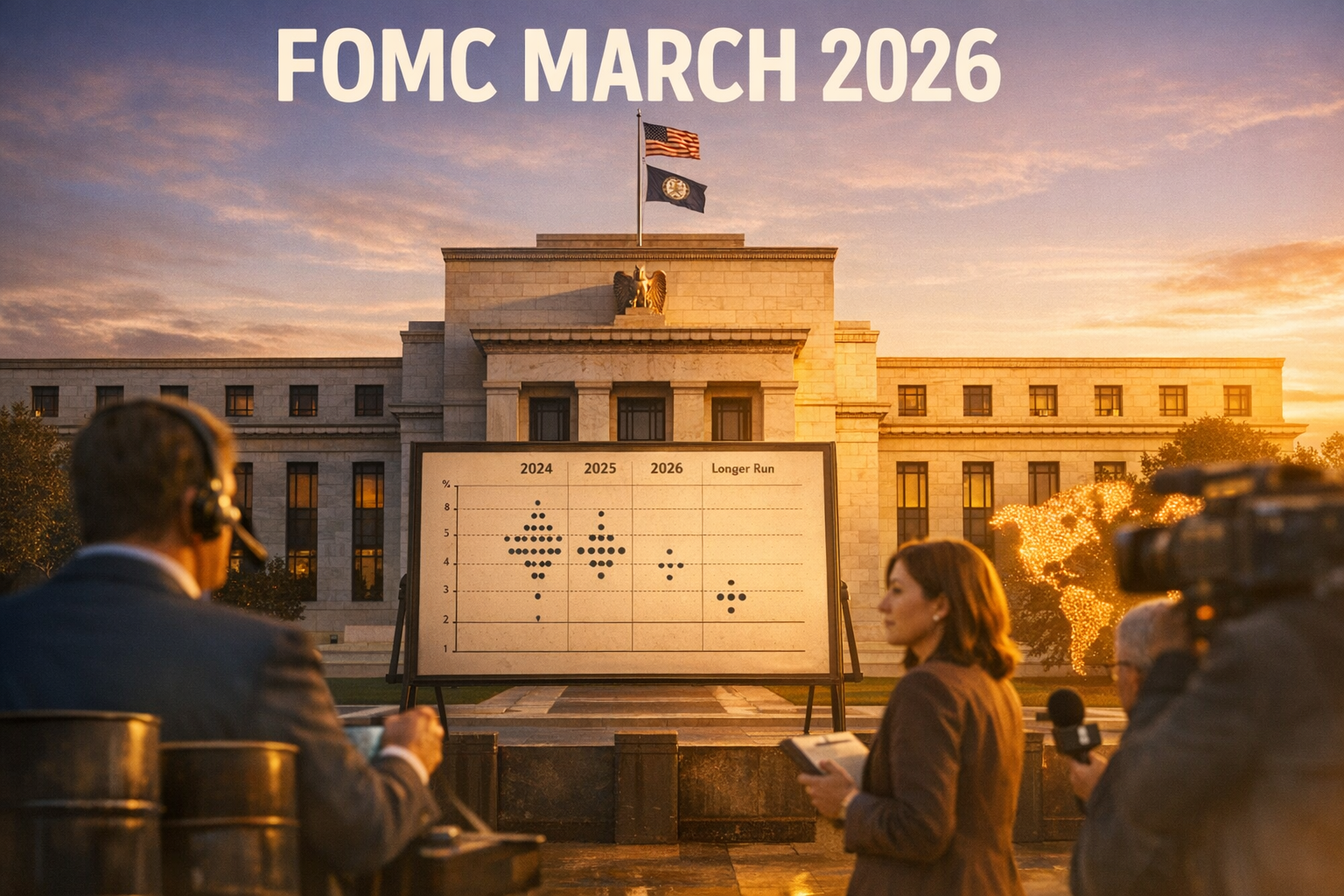
5. SEP and Dot Plot — Why “One Cut” Became the Base Case
The SEP summarizes officials’ economic projections; the dot plot indicates their views of an appropriate policy rate path.
Markets had contemplated two or more cuts, but the dot plot reduced that probability. The median stance was interpreted as: easing may occur, but in a limited manner—supporting a “one cut in 2026” reading.
Implications:
- The Fed is more concerned about inflation re-acceleration than recession risk
- Policy may remain restrictive longer than previously expected
- Direct impact on Treasury yields, USD, and equity valuation multiples
- Potential headwinds for emerging-market FX and capital flows
6. Inflation Assessment
Inflation is not considered fully contained.
- Headline inflation remains sensitive to energy prices
- Core inflation is influenced by services, shelter, and wage dynamics
- Higher oil prices can lift headline inflation and potentially affect inflation expectations
Key monitoring variables:
- Whether goods prices re-accelerate
- Whether services disinflation persists
- Whether inflation expectations remain anchored
- Whether energy shocks remain temporary or generate second-round effects
The policy focus is on pass-through from energy into transportation, production costs, and broad consumer prices.
7. Growth Assessment
The U.S. economy is not viewed as decisively weakening.
Consumption and employment remain relatively supportive, and business activity does not indicate abrupt contraction. This resilience allows the Fed to prioritize inflation risk management over rapid easing.
- Consumption not collapsing
- Business investment adjusting selectively rather than freezing
- Financial conditions remain tight, but not indicative of systemic stress
- Growth is slowing, but recession probability is not decisive
8. Labor Market Assessment
Labor conditions remain central to the policy function. Strong employment supports wages; wages can sustain services inflation. The Fed tracks more than the unemployment rate, including wage growth, job openings, and labor market tightness.
Current characterization:
- Cooling, but not a sharp downturn
- No clear recession-style spike in unemployment
- Wage pressures not fully resolved
- Services inflation may decelerate more slowly than expected
Conclusion: the Fed has not yet received sufficient confirmation of simultaneous labor cooling and durable inflation progress to justify rapid easing.
9. Why Rate-Cut Expectations Were Repriced
Markets often move ahead of the Fed. Overly rapid repricing toward cuts can loosen financial conditions—equity rallies and lower long yields—potentially re-stimulating demand and inflation. This dynamic is a policy concern.
Post-meeting repricing reflected:
- Higher inflation uncertainty from geopolitics and oil prices
- A more hawkish-than-expected dot plot interpretation
- Resilient growth and labor conditions reducing urgency to cut
These channels transmit to U.S. yields, the dollar index, USD/KRW, and Korean equity flows.
10. Implications for Korea and the Bank of Korea
For Korea, the outcome is restrictive.
If U.S. rates remain high for longer, the U.S.–Korea rate differential remains a constraint. Combined with higher oil prices, Korea faces dual pressures through import prices and FX.
Given Korea’s energy import dependence, Middle East instability and oil prices can directly lift CPI and corporate cost structures, potentially limiting the Bank of Korea’s easing flexibility.
- Higher USD/KRW volatility risk
- Increased import-price pressure
- Slower domestic disinflation
- Greater likelihood that BoK cuts are delayed or more conservative
11. Asset-Market Transmission: Equities, Bonds, FX, Commodities
The message was mixed across asset classes.
11-1. Equities
Reduced rate-cut expectations can increase valuation pressure, particularly for growth and technology stocks that are sensitive to long-duration discount rates. Large-cap AI-linked names may partially offset rate pressure if earnings momentum remains strong.
11-2. Bonds
Fewer expected cuts can raise yield volatility across the curve. Higher inflation uncertainty typically increases long-end sensitivity.
11-3. FX
A “higher for longer” U.S. profile supports the USD via sustained carry and relative yield attractiveness, which can weigh on KRW.
11-4. Commodities
Oil was central to the meeting’s risk framing. Prolonged geopolitical risk increases perceived supply disruption probability, reinforcing inflation risks globally.
12. Key Checkpoints (News-Style Summary)
- Decision: Fed holds policy rate at 3.50%–3.75%
- Policy direction: market expectation for 2026 cuts reduced; effectively signals ~1 cut
- Inflation view: Middle East war-driven oil gains treated as a near-term inflation factor
- Uncertainty: duration and macro pass-through of the oil shock remain unclear
- Macro view: growth and labor cooling are present but not recessionary
- Market impact: firmer USD bias, higher rates volatility, equity valuation pressure risk
- Korea impact: FX and import-price pressures; reduced BoK policy room
13. Under-Discussed Core Point
The main issue is not whether there is exactly one rate cut. It is the evolving reaction function and the implied duration of restrictive policy.
Historically, weaker growth data often translated into expectations for easier policy. The current environment differs: the Fed is more sensitive to inflation re-acceleration, including supply-side shocks such as oil and geopolitics that are not directly solvable via interest rates.
Key implications:
- The core variable is policy duration, not the current rate level
- Restrictive policy may persist longer than markets previously assumed
- Middle East conflict and oil prices are practical constraints that can delay easing
- Global macro sensitivity is shifting toward inflation re-acceleration risk
14. Key Upcoming Policy and Data Catalysts (2026)
Markets are likely to respond more to subsequent data than to the decision itself.
- U.S. CPI and PCE releases
- U.S. employment reports and wage growth
- Oil prices and Middle East geopolitical developments
- Upcoming FOMC minutes and Fed official communication
- Bank of Korea MPC meetings and inflation forecast revisions
The key combination is inflation and employment: higher inflation with resilient labor supports delay; faster labor cooling with stable core inflation supports renewed easing expectations.
15. Investor-Relevant Bottom Line
The March FOMC cannot be reduced to a headline “rate hold.”
- The Fed does not view the inflation fight as concluded
- Middle East conflict and oil prices are policy-relevant variables that can delay easing
- Any rate cuts in 2026 may be fewer and later than prior market expectations
Positioning should integrate the U.S. policy path, inflation dynamics, FX, and oil prices.
16. Why This Matters for AI-Thematic Investors
Rates and the AI investment cycle are closely linked:
- Higher-for-longer rates affect AI infrastructure capex and financing conditions
- Big Tech data-center buildout pace and capex strategy are rate-sensitive
- Semiconductors, power grid, and cloud-related valuation levels are linked to discount rates
- USD strength affects global AI supply chains and imported equipment costs
AI-related exposure requires integration of rates, energy, FX, and supply-chain variables.
< Summary >
The Fed held the policy rate at 3.50%–3.75% in March 2026. The key message was a reduction in expected 2026 easing, with markets converging on an interpretation of roughly one rate cut. Powell described Middle East conflict-driven oil price gains as a near-term inflation factor, while noting uncertainty around duration and pass-through. With growth and labor not deteriorating sharply, the Fed is unlikely to rush policy easing. For Korea, FX and import-price pressures may rise, reducing BoK flexibility. The primary issue is the duration of restrictive policy, with implications across equities, bonds, the USD, and AI-related investment conditions.
[Related Articles…]
- https://NextGenInsight.net?s=FOMC
- https://NextGenInsight.net?s=stablecoin
*Source: [ 경제 읽어주는 남자(김광석TV) ]
– [속보] 3월 FOMC 금리동결, ‘올해 1회 금리인하’. “중동 전쟁과 국제유가 상승, 단기 인플레 요인…추가 영향은 불확실” [즉시분석]
● Fed Shock, Sticky Inflation, Dollar Surge, Wall Street Jitters
Key Takeaways from the March 2026 FOMC: Rates, Inflation, FX, and U.S. Equities in One View
The March 2026 FOMC should not be assessed solely through the policy-rate decision. This note consolidates the Fed’s policy bias, Chair Powell’s tone, revisions to U.S. macro projections, global market reactions, and the implications for KRW/USD and Korean risk assets. Markets may focus on “hold vs. cut,” but the more material issues are the expected duration of restrictive policy, the Fed’s relative sensitivity to inflation versus labor-market risks, and the resulting pressure on U.S. and Korean equities. Additional under-discussed points are included.
Primary items to assess in the March FOMC
- Statement language changes may matter more than the policy-rate level.
- Powell’s emphasis on inflation versus employment will shape risk pricing.
- The dot plot and SEP revisions can reprice expected cuts for the year.
- USD strength and FX trends directly affect Korean equities and foreign flows.
- U.S. equity performance should be framed as a liquidity/discount-rate versus valuation trade-off, not a one-day event reaction.
March 2026 FOMC summary (news-style)
The Fed’s March 2026 meeting delivered signals on both near-term rates and forward guidance. The key issue was not whether rates moved immediately, but how credible the Fed views ongoing disinflation. With U.S. growth not fully rolling over and inflation proving sticky, expectations for rate cuts have been recalibrating. This meeting therefore functions as a reference point for global macro and cross-asset pricing in 1H 2026.
1. Statement language: what to monitor
Policy stance matters more than the rate level
The FOMC statement is brief, but marginal wording changes can shift broad risk sentiment. The central item is whether language about “confidence” in inflation converging to target was maintained, strengthened, or made more cautious.
If the statement continues to signal insufficient confidence in disinflation, markets are likely to read this as a willingness to delay easing. If confidence is incrementally reinforced, expectations for policy normalization within the year may rebuild.
Labor-market phrasing is also material
The labor market remains a core input to the Fed’s reaction function. A resilient labor market increases the Fed’s capacity to keep rates elevated. A clearer slowdown increases sensitivity to growth risks.
Accordingly, changes in descriptors such as “strong,” “solid,” or “moderating” should be treated as indicators of shifting policy priorities rather than editorial adjustments.
2. Powell press conference: what markets are prioritizing
The key question is not “is a cut near,” but “how long can it be delayed”
Market participants typically seek dovish signals, but in this meeting the more important variable is how long the Fed intends to remain data-dependent before easing. Repeated emphasis that inflation is not yet “safe” would likely reduce the market-implied number of cuts.
In that scenario, U.S. Treasury yields may face renewed upside pressure, while U.S. equities—particularly duration-sensitive growth—could see valuation compression via higher discount rates.
Press-conference phrases to track
- Whether “more confidence is needed” is repeated
- Whether recent inflation prints are framed as noise or re-acceleration
- Whether labor-market cooling is described as limited or broad-based
- Whether the policy rate is characterized as “sufficiently restrictive”
- Whether quantitative tightening and liquidity conditions are discussed
If Powell describes policy as restrictive while still discouraging near-term cuts, markets may interpret this as “higher for longer,” a key constraint for global risk assets.
3. Dot plot and macro projections: the core signal
The dot plot is a directional indicator, not a single “average view”
Because dots represent individual participant projections, the shift in distribution matters more than the absolute level. Fewer expected cuts versus prior projections would likely be interpreted as hawkish.
If the projected path is largely unchanged, markets may view the Fed as maintaining its baseline despite recent inflation stickiness, potentially supporting a risk-on response.
Three SEP items to prioritize
- Upward/downward revision to growth
- Revision to core inflation
- Change in the unemployment-rate path
An upward revision to growth alongside higher inflation implies stronger activity but slower disinflation, increasing the Fed’s justification to delay cuts.
Conversely, weaker growth and higher unemployment projections would raise the probability of policy accommodation in the second half. The SEP should be read as evidence for “soft landing” versus “endurance under restrictive policy.”
4. Why equities and bonds react strongly to the FOMC
U.S. equities are a discount-rate and expectations trade
U.S. equities have often priced in some easing expectations. A more hawkish outcome tends to increase volatility, particularly in high-multiple technology and long-duration equities.
Large-cap AI-linked names may have strong earnings narratives, but elevated valuations still require supportive discount-rate conditions. Signals consistent with prolonged restriction can pressure AI beneficiaries in the near term.
Treasury yields and the U.S. dollar can be more informative than equities
Equity moves alone can miss the broader signal. The more consequential variables post-FOMC are U.S. 2-year and 10-year Treasury yields and the DXY trend.
The 2-year yield is most sensitive to policy expectations. The 10-year embeds growth, inflation, and long-run fiscal risk. A synchronized rise in front-end and long-end yields would suggest markets are pricing a longer period of tight policy.
5. Key implications for Korean investors: FX and KOSPI sensitivity
KRW/USD is a condensed measure of capital flows
For Korean investors, the FOMC is also an FX event. A hawkish Fed increases the probability of USD strength, and KRW depreciation can directly affect foreign positioning and risk appetite in Korean equities.
A rapid move higher in USD/KRW can shift market drivers from fundamentals to flow- and risk-off dynamics. Export-heavy sectors (e.g., semiconductors) may benefit mechanically, but tighter overall financial conditions can dominate at the index level.
Indirect constraints on Bank of Korea policy space
A persistent U.S.–Korea rate differential can limit the Bank of Korea’s flexibility to ease. The FOMC therefore affects not only U.S. rates but also domestic policy autonomy and the pace of demand recovery.
If the Fed maintains elevated rates for longer, other central banks face greater difficulty prioritizing domestic growth in isolation.
6. Global macro significance in 2026
A test of whether the soft-landing baseline remains intact
The baseline narrative is gradual deceleration without a sharp downturn, steady disinflation, and a transition toward easing. This FOMC can reinforce or destabilize that trajectory.
If the Fed emphasizes re-acceleration risks, markets may shift from “soft landing” toward “higher for longer,” affecting EM flows, commodities, USD strength, and global equity valuations.
Spillovers to China, Europe, and emerging markets
U.S. policy transmits globally. A stronger USD can tighten EM financial conditions and partially offset stimulus effects in Europe and China. The FOMC remains a global pricing anchor.
7. Why the FOMC should be assessed alongside AI trends
The AI cycle is sensitive to the cost of capital
AI demand fundamentals are strong, but AI capex (data centers), semiconductor capacity expansion, cloud build-outs, and startup funding are all influenced by financing costs.
A hawkish outcome can pressure near-term multiples even if long-term AI growth remains intact. A policy stance supportive of easing can re-expand valuation premia across the AI ecosystem.
The key medium-term question: AI productivity and inflation dynamics
Over time, AI-driven productivity gains could reduce labor-cost pressure and become relevant to structural disinflation assessment. While not necessarily an immediate policy variable, AI can alter the growth-inflation trade-off.
AI should be treated as a macro-relevant factor, not only an equity theme.
8. Under-discussed but material points
Point 1: The key issue is not the first cut date, but potential re-evaluation of the neutral rate
Many commentaries focus on timing of the first cut. More consequential is whether the Fed is implicitly revising its view of a higher neutral rate. If so, the terminal resting level of policy rates may be higher than in prior cycles, altering valuation anchors.
Point 2: Even if headline inflation falls, sticky services inflation can extend the wait
Stabilizing goods or energy prices may not be sufficient if services inflation and wage pressures remain persistent. Policy decisions may therefore remain conservative despite improvements in headline measures.
Point 3: Markets may react more to liquidity conditions than the number of cuts
Beyond the rate decision, effective tightness depends on QT pace, Treasury issuance, bank lending standards, and credit spreads. These variables can dominate market direction.
Point 4: The AI rally and the FOMC are linked
AI growth is structural, but its present value is rate-sensitive. FOMC interpretation and AI trend analysis should be integrated.
9. Practical investor checklist
Near-term
- Direction of the U.S. 2-year yield immediately after Powell’s remarks
- DXY and USD/KRW reaction
- Nasdaq and large-cap tech volatility
- Foreign net flows in the KOSPI
- Severity of inflation-related language from the Fed
Medium-term
- Repricing of market-implied cuts within the year
- Signals of U.S. growth and labor-market deceleration
- Services inflation and wage trend
- Persistence of AI infrastructure capex
- Recovery in global risk appetite
10. One-line interpretation
The March 2026 FOMC is a pivot point for assessing the Fed’s confidence in disinflation and the U.S. economy’s tolerance for restrictive policy, with direct linkages to FX, U.S. equities, the KOSPI, global risk pricing, and AI-related valuations.
< Summary >
The core signal from the March 2026 FOMC lies in forward policy guidance rather than the rate decision. Statement language, Powell’s tone, the dot plot, and SEP revisions can reprice expected cuts. A hawkish read-through implies USD strength, upward pressure on USD/KRW, higher U.S. equity volatility, and tighter conditions for Korean risk assets. AI-linked equities remain exposed to discount-rate and cost-of-capital dynamics. The most material “hidden” issue is not the first cut date but the possibility of a higher neutral-rate regime and an extended restrictive stance.
[Related]
*Source: [ Maeil Business Newspaper ]
– [LIVE] 3월 FOMC 성명서 해설 l 파월 기자회견