● Oil Shock, Bitcoin Breakdown, AI Crash, Korea on the Brink
Brent Approaching $120, Bitcoin Breaking Below $70,000, and Micron’s Sell-Off: The Market’s Key Variable Is Elsewhere
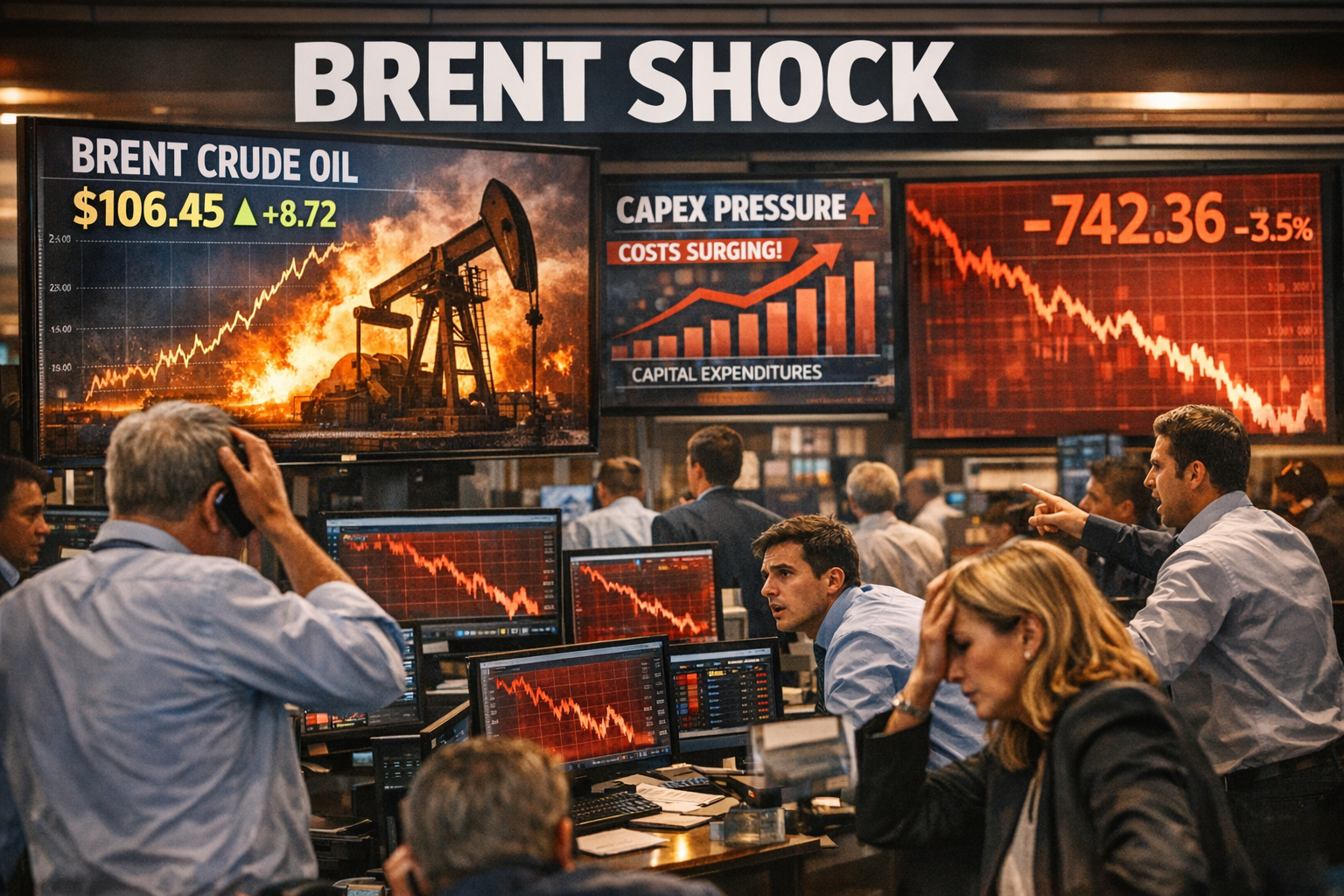
Today’s move was not a routine pullback. Markets traded a single causal chain:Middle East war risk → crude oil surge → inflation re-acceleration → delayed rate cuts → pressure on AI/semiconductor valuations.
This report consolidates, in a news-style format: the implications of Brent near $120, the signal from Bitcoin breaking below $70,000, why Micron fell despite strong results, and why a USD/KRW 1,500 regime increases downside risk for Korea.
A key under-discussed point is emphasized: the core driver of this drawdown is not earnings, but a repricing of capex and supply-shock risk.
1. US Equities at a Glance: Geopolitics Drove Cross-Asset Repricing
US equities opened broadly lower.
The S&P 500 declined by roughly 1%, the Nasdaq fell more than 1% intraday, and the Dow and Russell also weakened.
Early trading reflected a broad “risk-off” posture.
Investors reduced growth and higher-beta exposure and rotated toward cash and USD positioning.
Losses narrowed into the close.
This suggested sensitivity to oil and war headlines rather than a disorderly panic, with selective dip-buying and short covering late in the session.
2. Why Brent Near $120 Matters
2-1. Not a Simple Oil Rally: A Variable That Shifts the Macro Baseline
Brent rose intraday to around $119 before retracing to the $112–$113 area.
WTI climbed to roughly $97.
A crude surge is not confined to energy-sector tailwinds.
Higher oil feeds through transportation, airfares, manufacturing input costs, power, heating, and petrochemical feedstocks, impacting most industries.
The result is upward pressure on CPI and PPI, reducing the probability of near-term Federal Reserve easing.
Accordingly, the move should be read as a signal of renewed inflation risk, not merely higher energy prices.
2-2. Middle East Risk: Hormuz and Energy Infrastructure
The market reaction was driven less by conflict headlines and more by potential energy supply disruption.
Concerns included strikes on regional gas assets, rising Gulf tensions, and LNG-related risks, increasing the perceived probability of a prolonged supply shock.
The distinction is material: the Fed can influence demand via rates, but it cannot directly resolve war-driven supply disruptions.
This raises the risk of a macro shock that is not easily neutralized by monetary policy.
2-3. Why the Shock Is More Acute for Korea
Korea has high dependence on imported energy.
Given heavy exposure to Middle Eastern crude and LNG, a spike in oil and gas prices transmits more directly than in the US.
USD/KRW moved above 1,500, a notable regime level.
A weaker KRW amplifies imported inflation.
The combination of higher oil prices and a weaker currency increases domestic inflation pressure and weighs on local equities.
For foreign investors, deeper KRW weakness increases FX-loss risk, potentially tightening foreign flows into Korean assets.
3. Bitcoin Breaking Below $70,000: A Liquidity-Sensitivity Signal
Bitcoin fell below $70,000 again, reaching roughly $69,300 intraday.
This was more than a technical level breach.
Bitcoin has functioned as a high-frequency proxy for liquidity expectations and risk appetite.
With war risk, surging oil, and delayed rate-cut expectations, crypto became an early pressure point among risk assets.
3-1. Crypto-Linked Equities Weakened
Coinbase declined by about 4%, and Robinhood also traded lower.
When Bitcoin weakens, expectations for trading volumes, fee revenue, and leverage-driven activity typically contract, pulling related equities lower.
3-2. What Bitcoin Indicates About Market Positioning
Bitcoin’s inability to hold strength indicates the market is not in an aggressive risk-on regime.
The move is better framed as a macro-risk repricing than a purely technical correction.
Markets are effectively reassessing whether risk premia can remain elevated if rate cuts are delayed.
4. Micron Down ~6% Despite Strong Results: The Market Focused on Capex
4-1. Results Were Strong on the Surface
Micron reported very strong results.
Revenue surged close to 200% year-over-year, and DRAM revenue also rose more than 200%.
Memory pricing improved alongside AI server demand.
Nevertheless, the stock sold off sharply.
4-2. Why It Fell: “Future Cost” Over “Current Results”
Two factors dominated.
First, results were widely pre-priced.
Micron was up more than 40% year-to-date prior to the release, reducing incremental upside from an “in-line strong” print.
Second, the larger issue was capex expansion risk.
The company outlined major investment plans for new fabs and capacity expansion into fiscal 2026, with interpretation that capex could remain elevated through 2027.
In a cyclical industry, aggressive capacity additions raise the probability of future oversupply, which can compress pricing and margins.
4-3. The Market Began to Price Peak-Cycle Risk
High margins can become a valuation headwind if investors view current profitability as near-cycle peak.
Equities discount future conditions; strong current earnings can still coincide with a decline if the market shifts toward a peak-out narrative.
5. Why AI Semiconductors and Equipment Also Weakened
Weakness was not isolated to Micron.
NVIDIA declined, and Broadcom, Intel, Applied Materials, and Lam Research also traded lower.
This indicated a broader reassessment of the durability of AI-investment profitability.
5-1. AI Demand Remains, but the Question Is Profit Retention
AI remains a long-duration growth theme.
However, investors are increasingly focused on whether the investment required to capture AI demand dilutes shareholder value.
The market is shifting from “AI revenue growth” to “AI revenue minus the cost of infrastructure and capacity.”
5-2. Link to NVIDIA’s Reduced Breakout Momentum
Even with strong fundamentals, NVIDIA has not sustained prior breakout momentum.
The market focus has shifted from company quality to incremental valuation support at current multiples.
Expectations have been materially discounted into prices.
6. The Fed and Rates: The Dominant Risk Is Delayed Easing
6-1. Core Policy Messaging
The Fed maintained a cautious posture.
Chair Powell effectively acknowledged that supply-side shocks (tariffs, pandemic effects, energy disruptions) are difficult to offset through monetary policy.
If oil-driven inflation persists, rapid policy normalization becomes less feasible.
6-2. Markets Shifted Toward Longer “Higher-for-Longer” Pricing
FedWatch-type pricing implied rate-cut expectations moved further out, with some pricing pockets reflecting renewed hike risk.
This matters because many asset prices have been supported by the assumption that “rates will ultimately fall.”
If that assumption weakens amid elevated oil and geopolitics, high-duration growth and technology valuations face greater discount-rate pressure.
7. Safe Havens Were Also Dislocated: Why Gold and Silver Fell
Gold often strengthens during geopolitical stress, but both gold and silver declined sharply.
Gold fell by roughly 6%, and silver by more than 10% at points.
This reflected USD strength dominating safe-haven flows.
Capital treated the USD as the primary refuge, which reinforces pressure on emerging-market FX and assets.
8. Sector Checkpoints: Relative Winners and Losers
8-1. Stronger Areas
Energy was relatively resilient.
Oil-linked producers and gas-related names benefited from higher crude.
8-2. Weaker Areas
Semiconductors, AI-linked growth, crypto-related equities, airlines, and consumer-cyclical segments underperformed.
Airlines face direct fuel-cost pressure; growth equities face higher discount rates; crypto reflects weakened risk appetite.
9. AI Trend Implications
9-1. The Theme Is Not Over; It Has Entered a Second-Stage Validation Phase
AI has not reversed; the market is moving into a more discriminating phase.
The focus is shifting from “AI beneficiaries” to “companies that can fund AI capex while generating sustainable cash flow.”
Firms that demonstrate both infrastructure investment discipline and monetization are more likely to retain valuation support.
9-2. Mega-Cap Concentration Risk May Increase Again
In a higher-rate, higher-volatility regime, firms with scale cash flow and superior funding access tend to be advantaged.
Mega-cap platforms and core AI infrastructure leaders may again be viewed as relative shelters.
In the AI cycle, not all technology firms face the same opportunity set.
The durable winners are those with the balance sheet and cash generation to fund data centers, secure chip supply, and withstand long payback periods.
10. The Most Important Under-Discussed Point
10-1. The Core Driver: Supply Shock + Capex Repricing, Not Headlines Alone
War headlines matter, but structurally the market is repricing:
First, the risk that supply shocks re-accelerate inflation.
Second, the risk that large AI/semiconductor capex programs receive less valuation premium under tighter financial conditions.
The market is shifting from “growth” to “the cost of growth.”
10-2. Micron’s Post-Earnings Drop as a Late-Cycle Rally Pattern
“Good earnings, down stock” often emerges when narrative support fades and pre-pricing becomes the dominant driver.
This does not imply the AI rally is finished, but it does imply stronger dispersion and stricter stock selection.
10-3. Korea-Specific: FX Risk Is a Primary Constraint
US investors may focus primarily on oil; Korean investors must also account for FX, imported inflation, and foreign flow sensitivity.
A shared global shock can therefore be more difficult to manage for Korea-based portfolios.
11. How to Read the Market Now
This is not an environment where a single strong earnings print can sustain broad upside.
Markets are simultaneously discounting geopolitics, oil, inflation, rates, FX, capex, and valuation.
Near-term priority checkpoints:
1) Whether Brent re-accelerates near $120
2) Whether Bitcoin reclaims $70,000 or breaks lower
3) Whether other AI/semiconductor earnings trigger similar post-release sell-offs
4) Whether USD/KRW remains anchored above 1,500
5) Whether rate-cut expectations continue to shift later
12. Conclusion: The Market Is Pricing Sustainability Over Headlines
Brent’s surge signaled renewed inflation risk.
Bitcoin’s break below $70,000 reflected deteriorating risk appetite.
Micron’s sell-off highlighted that even in an AI-driven cycle, capex intensity and valuation ceilings remain binding constraints.
The market is now asking not whether a catalyst is positive, but how long it can persist.
As scrutiny increases, companies that demonstrate both cash-flow generation and capital-efficiency are likely to command relative preference.
< Summary >
Brent approaching $120 is primarily an inflation re-acceleration signal, not merely an energy rally.
Bitcoin breaking below $70,000 indicates weakening risk appetite and high liquidity sensitivity.
Micron’s decline was driven by capex concerns and peak-cycle risk, not poor results.
The AI semiconductor theme is transitioning into a profitability and cash-flow validation phase.
Korea is more exposed due to the combination of higher oil and USD/KRW around 1,500, intensifying imported inflation and flow risk.
Key variables to monitor include crude, US equities, inflation, rates, FX, and AI/semiconductor price action around earnings.
[Related Articles…]
Key Investment Checkpoints During USD/KRW Upside Volatility
Reassessing the AI Semiconductor Cycle: The Next Variables for NVIDIA and Memory
*Source: [ Maeil Business Newspaper ]
– 브렌트유 120달러 언저리 치솟아ㅣ비트코인, 70K 또다시 붕괴ㅣ마이크론, 자본지출 우려에 6% 급락ㅣ홍키자의 매일뉴욕