● AI Boosts Spatial Computing Rush
The real reason “spatial computing” has gotten faster: AI has flipped the game from “showing” to “understanding and helping”
Core takeaway you must watch today (Big Tech competition + China variable + a high-performing workflow)
- Apple-Meta-Google are each trying to dominate the “alliance/ecosystem/platform” with different approaches to spatial computing.
- If past XR was a race over “how real and immersive it looks,” now the contest is shifting to whether AI understands context and genuinely helps you get work done.
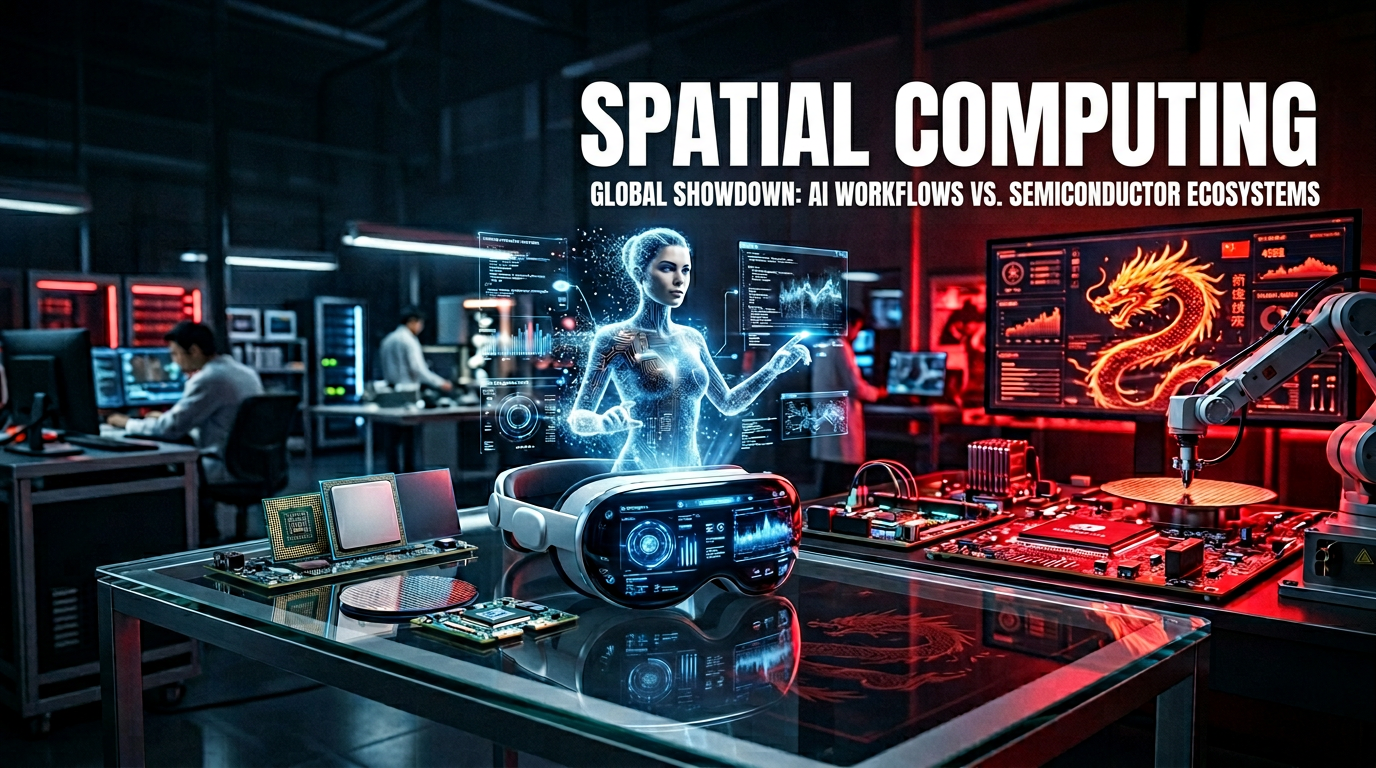
- The semiconductor/chip ecosystem isn’t just a technical issue anymore—it’s expanded into a key war that determines who leads the market’s form factor.
- And with China’s counterattack added on top, the flow is being reorganized from “Three Kingdoms vibes, but chips/devices are Warring States period.”
- Finally, from a perspective you can use right at the field, you should also take away the message: “If the report AI generated isn’t satisfying, it’s not the AI—it’s the workflow.”
(This article focuses on summarizing in one place why spatial computing is surging right now, and what you should prepare first in investing/work/strategy.)
News briefing: Spatial computing is moving toward “everyday devices” in the AI era
- The conclusion of the latest discussion is one line.
“Spatial computing is ultimately computing that uses real-world space as the interface, and AI has raised performance/utility to enter real-use stages.” - If existing smartphones/PCs centered on 2D screens and keyboard/touch, spatial computing assumes 3D context.
- So the flow is moving from an era when the learning barrier was high (“you have to learn how to use it”) toward a period where AI is helping lower that barrier.
Spatial Intelligence: from “AI that you see” to “AI that understands and helps”
-
The concept that naturally comes out as spatial computing advances is spatial intelligence.
-
Spatial intelligence can be summarized into two core points.
-
Accurately perceiving space (distance/angles/relationships between objects)
-
Understanding the user’s intent (if it malfunctions, you stop using it—so it needs to work reliably)
-
Why is this important?
Because beyond simply displaying something “convincingly” on a screen, accuracy is essential to make it enable actual work in the real world.
Why spatial computing now? (Timing when technical constraints loosen)
-
XR and metaverse concepts existed even before, but the bigger reason they didn’t cross over into “actually useful” was major friction.
-
The bottleneck being solved is the AI (vision/generation/multimodal) wave.
-
In particular, spatial computing only works when the following components improve at the same time.
-
Perception: cameras/sensors quickly and accurately grasp space
-
Generative: if digital objects float around or misalign, usability breaks
-
Intent understanding (interaction): to achieve “butler-level” usability, you have to connect hand/gaze/voice/gestures without misoperation
-
In other words, it’s a view that “sensors + hardware alone are not enough,” and the quality only reaches completion when AI boosts performance underneath.
Spatial computing vs XR vs metaverse: terminology clarified (easy to get confused)
-
Spatial computing:
“A computer that uses space itself as an input/output/interaction tool” -
XR (AR/VR/MR):
It’s an existing technology axis, and those technologies are ways the spatial computer can be realized -
Metaverse:
Activity in a virtual world is central (if spatial computing uses the real world as computing resources, then the metaverse’s core is interaction in virtual space) -
Put simply in one sentence:
If you understand spatial computing as closer to “tool/paradigm” and metaverse as closer to “world/activities,” it’s less likely to get confusing.
AI changed the “purpose”: from an “immersion race” to a “practicality race”
- In the past, the XR competition was “how realistically you can show it,” but now the viewpoint has shifted to “how well it understands” and “how much it helps with real work/life.”
- Key point:
If something becomes useful, you’ll use it even if immersion isn’t perfect—that’s the transition. - To explain with an example: even if glasses/devices don’t have a flashy display, if they provide the “information/actions you need right now,” usability still emerges.
NUI evolution (next-gen interface): from keyboard/touch to “natural input”
-
The keyword emphasized in the article is NUI (Natural User Interface).
-
Traditional GUI focused on predetermined input methods that are easy for computers to understand.
-
NUI aims to have computers understand multimodal input the way humans communicate.
-
speech (voice)
-
gaze
-
hand gestures
-
tactile/vibration/movement data
-
various inputs such as controllers
-
The conclusion is that because “a spatial computer uses space itself as the input/output tool,” NUI has no choice but to evolve into a necessity.
Device form factor outlook: centered on headsets/glasses, but mixed use will last longer
-
Short term: headsets/glasses are likely to be the core.
-
Since gaze-based interaction is key, cameras are indispensable.
-
Medium to long term: you can expect more scenarios like “a personal interface within the home/your space.”
-
Also, wearables may diversify due to the “burden of wearing.”
-
contact-based (lightly worn/strapped on)
-
non-contact (projection mapping/holograms, etc.)
-
complementary AI devices (pendants, surrounding devices, etc.)
-
Still, the core point is that the input structure will ultimately center on “my gaze/intent.”
Big Tech strategy: The “Three Kingdoms” of Apple-Meta-Google is true, but go deeper and it’s a chip/platform war
1) Apple: a vertical ecosystem + proactively preparing UX
- Apple is assessed to have started R&D first.
- The strength is its “ecosystem” and a vertical strategy to align UX in one go.
- The flow of preparing the whole lineup—MacBook/iPhone and more—for spatial computing UX has been mentioned for years.
2) Meta: early market capture + selling large numbers of devices
- Meta is evaluated as the axis that got noticed first in the market.
- The scale of Quest sales (tens of millions) created market presence, and the emphasis is on a structure where it expands the ecosystem with “ambition.”
3) Google: transplanting the Android approach into XR/platform
- Google is interpreted as taking the “platform provided + devices are partners” model it used in Android and strengthening it further by adding its AI-era strengths (content/distribution/usability).
- In particular, it’s a viewpoint that ties not only content/manufacturer collaboration but also fun/efficiency in the AI era together.
Semiconductor competition: Qualcomm-centered, with NVIDIA/Samsung/AMD also contenders… and then there’s the China variable
-
This is where the real “money is on the line” portion starts.
-
The structure mentioned is essentially: without chips, you can’t make devices.
-
The core storyline is summarized as follows.
-
like the smartphone era, Apple is a vertical axis (its own silicon)
-
Meta/Samsung lines have high reliance on Qualcomm
-
from the perspective of global device adoption rates, Qualcomm is assessed as strong
-
other candidates (NVIDIA/AMD/Intel/Samsung, etc.) are competitors
-
at the same time, China’s fast pattern of “see it—improve it—go to the next one” stands out
-
So the big picture is the Three Kingdoms of Apple/Meta/Google (platform/ecosystem), but in real chip/device execution it feels like it’s reorganizing into a Warring States period including China.
How spatial computing makes money: B2B opened first, before B2C
- The direction that repeatedly appears in the article is that “money first came from B2B.”
- The reason is that remote collaboration/education/training shows results immediately.
Individuals (B2C): productivity, information access, and turning into everyday assistance tools
- Like cases such as Vision Pro, it’s described as a form where productivity improvements can come from a large display/virtual work space.
- Even for glasses/glassware, the experience point is likely to be providing the information you need right away rather than “flashiness.”
Business (B2B): education/training, remote support, safety/on-site efficiency
- Education/training:
Previously, instructors showed objects and multiple people followed along, but there were limits—however, if you recreate 3D scenarios with VR/MR, the understanding/learning effect improves, it’s explained. - Remote guidance/practice:
Even if experts can’t be on site, the form where you give users instructions they can follow is strong in terms of cost efficiency and learning effects. - Especially because of the “time/cost” problem for skilled labor, there’s a flow where advanced training areas tend to be adopted first.
Why “materials made by AI” aren’t satisfying: the problem isn’t AI—it’s the workflow
-
This is the real-world message contained in the original text.
-
Even as AI improves, the reason the results don’t come out as expected is that
it’s not determined by “AI performance,” but by the workflow that leads from collection → analysis → writing. -
Specifically, these stages matter.
-
Information collection strategy: Markdown-based organization/search cheat keys
-
In-depth research: SWOT and PEST frameworks
-
Report design: derive the core messages + a storyline executives prefer
-
Visualization: convert text reports into PowerPoint
-
In short, it reads like the message that the real “work-ace cheat key” in the AI era isn’t prompts—it’s the process.
Watching point: the next phase runs “spatial computing + AI + the chip ecosystem” all at once
-
When looking at the market going forward, it won’t be enough to just ask “who made the device pretty.”
You need to see the following three together to lock in direction quickly. -
Does AI’s spatial perception/intent understanding connect seamlessly into actual work?
-
Does NUI start becoming usable naturally without training?
-
How reliably are chips/platforms supplied, and do they carry the ecosystem forward?
-
Especially now, since spatial computing is entering a “scalable/expandable stage” beyond mere “it’s useful,” if you’re interested in this area,
experience using it in your work looks strategically important.
The most important conclusion from the article—“things that aren’t well said elsewhere” (separate summary)
- The competition has moved from “immersion (graphics)” to “understanding and helping (task execution).”
- The success conditions for spatial computing aren’t “display specs,” but
accurate sensor perception + stable generation + minimizing misoperation of intent input. - A bigger variable than the Three Kingdoms of Big Tech is the chip dependency structure and China’s fast iteration/improvement speed.
- As AI gets better at what it does well, the “report/deliverable quality” is decided not by AI, but
the workflow including the framework (PEST/SWOT), storyline, and visualization.
One-line summary seen through SEO keywords
- This trend needs to be viewed by bundling together spatial computing, spatial intelligence, AI workflows, NUI, and semiconductor competition so you can see the whole picture.
< Summary >
- Spatial computing is “a computer that uses real-world space as an input/output tool,” and AI has raised perception/generation/intent understanding to move into real-use stages.
- Unlike XR/metaverse, spatial computing is closer to tools/paradigms, and metaverse focuses on activities in a virtual world.
- The arrival of AI shifted the purpose from an immersion race to “practicality that understands and helps.”
- NUI is a core evolution that moves beyond keyboard/touch and makes computers understand natural inputs like gaze and hand/voice.
- Apple-Meta-Google drive the market with different ecosystem/platform strategies, and the chip ecosystem’s variable is Qualcomm-centered supply plus China’s rapid iterative improvements.
- Compared with B2C, B2B saw money first in education/remote support/on-site efficiency, and individuals are likely to feel it most in productivity and information accessibility.
- The reason AI-generated results are disappointing isn’t AI itself—it’s a design issue in the workflow that goes from collection/research/reporting/visualization.
[Read related articles too]
- Spatial computing: the next interface trend created by AI
- Qualcomm: the key variable in semiconductor competition in the spatial computing era
*Source: [ 티타임즈TV ]
– 메타에 도전하는 애플과 구글. 그리고 ‘중국의 역습’ (최형욱 퓨처디자이너스 대표 & 전진수 볼드 스텝 대표)