● Musk Empire Merger Shock, Tesla xAI SpaceX Power Grab
Will Tesla, xAI, and SpaceX Ultimately Converge? Key Takeaways on a Large-Scale Integration Scenario within the Musk Ecosystem
This development should not be read as a routine Tesla new-business update.
This report consolidates the core rationale behind:
- Tesla’s push toward in-house semiconductor manufacturing,
- the concept of placing AI data centers in space rather than on Earth,
- the need to view SpaceX, xAI, and the Optimus robot as components of a single strategic architecture, and
- the potential implications for the global economy, AI semiconductors, the space industry, U.S. equities, and Tesla’s valuation framework.
A central interpretive point is that the strategic objective appears less focused on expanding vehicle sales and more on integrating intelligence, energy, and transportation infrastructure into a single ecosystem.
1. Core Thesis: Not an Auto Expansion, but an Attempt to Build a “Civilization Operating System”
While the narrative spans AI chips, space-based data centers, Starship, lunar facilities, and mass drivers, the strategic through-line is vertical integration of foundational infrastructure:
- producing intelligence,
- supplying energy,
- deploying physical embodiments (robots),
- transporting assets into space, and
- operating computation infrastructure at scale.
This should be treated as an attempt to reshape industrial structure rather than a product release cycle.
- Tesla: chips, robotics, energy, manufacturing
- xAI: AI models and software
- SpaceX: launch systems, satellites, space logistics
- Starlink: communications and data transport
- Optimus: physical execution layer for AI
If executed, the ecosystem consolidates control over five critical bottlenecks in AI:semiconductors, power, data centers, communications, and physical agents.
2. Why Tesla Would Pursue In-House AI Semiconductors
A key question is why Tesla would enter manufacturing given existing leaders (e.g., Nvidia, TSMC, Samsung).
The strategic logic can be summarized as follows.
2-1. Supply-Chain Velocity Constraints
Existing semiconductor ecosystems are optimized for scale and yield, but may not match Tesla’s desired iteration speed. The objective appears to be compressing the design-to-test loop by co-locating:design changes, prototyping, packaging, testing, and redesign.
This is framed more as a development-speed strategy than a pure cost strategy.
2-2. Different End Objectives vs. Nvidia
Nvidia’s model is centered on selling chips broadly. Tesla’s incentives appear oriented toward internal deployment across:autonomy, robotics, energy management, and space computing.
In this framing, Tesla chips function more like internal infrastructure than a stand-alone merchant product.
2-3. Expectation of Structural Compute Shortage
The argument presented is that global AI compute production capacity may be insufficient for the implied demand trajectory. If this holds, reliance on external supply chains increases exposure to sustained bottlenecks.
3. “Terafactory”-Style Integrated Semiconductor Complex: Strategic Importance
A notable element is an integrated facility concept combining design, manufacturing, packaging, and testing under one roof, diverging from standard foundry division-of-labor models.
Key implications:
- reduced development-to-production latency
- faster validation after design revisions
- improved optimization cycle time for AI chips
- lower outsourcing and allocation risk
- closed-loop efficiency aligned to internal demand
While upfront capex would be high, the strategic value increases if AI accelerators remain structurally constrained and priced at a premium.
4. Why Space-Based Data Centers: Cost Logic vs. Location
The space data center concept is positioned around long-run unit economics rather than novelty.
4-1. Energy Utilization
Terrestrial solar is intermittent and weather-dependent, increasing storage and grid costs. Space-based solar is framed as potentially more continuous and direct, with the goal of lowering effective energy cost over time.
4-2. Cooling Economics
AI data centers are constrained by power and heat dissipation. The concept frames space as a favorable thermal environment. While vacuum eliminates convective cooling, large-scale radiative cooling architectures could improve heat rejection if designed with sufficient surface area.
This implies large solar-array and radiator structures as core design features.
4-3. Latency Managed via Workload Segmentation
The proposed structure separates training and inference:
- large-scale training: primarily terrestrial
- inference/service workloads: distributed, potentially space-based
The objective appears to be shifting select cost-intensive compute functions rather than relocating all AI computation.
5. Space Logistics at 10 Million Tons per Year: Why a Mass Driver Enters the Discussion
The logistics thesis suggests that rockets alone may not support industrial-scale throughput economically.
5-1. Limits of a Starship-Only Logistics Model
Even with high-capacity launch vehicles, moving bulk mass at the scale implied would face practical limits in cadence and cost. Rockets may be suited to early build-out and high-value payloads, but less suited to sustained bulk transport.
5-2. Lunar Electromagnetic Launch Systems as a Long-Run Solution
A mass driver refers to electromagnetic acceleration for cargo launch. The Moon’s lower gravity and lack of atmosphere are cited as enabling conditions.
Potential advantages:
- reduced reliance on chemical propellant
- materially lower cost per repeated transport cycle
- improved economics for bulk materials and equipment
- enabling scale economies in a space industrial base
In this framing, the mass driver is positioned as an industrial logistics mechanism rather than a demonstration concept.
6. Why Optimus Matters in This Architecture
Optimus is positioned as labor infrastructure for space and extreme environments rather than a consumer robotics showcase.
Illustrative use cases:
- assembly of lunar surface facilities
- mass driver maintenance
- inspection and upkeep of space infrastructure
- automation of repetitive work in hazardous zones
This links Tesla robotics to space industrialization by providing a physical execution layer for AI.
7. Structural Difference vs. Nvidia
7-1. Nvidia: Chip-Centered Structure
Nvidia leads in AI chip design but operates through a customer-dependent ecosystem; production and deployment are externalized across partners and buyers.
7-2. Musk Ecosystem: End-to-End Integration Target
The integrated chain is presented as:
- xAI: software and intelligence
- Tesla chips: compute substrate
- Optimus: embodied execution
- Tesla Energy: power supply
- SpaceX: space transport
- Starlink: communications backbone
If executed, this model could address multiple AI bottlenecks simultaneously, implying potential shifts in industry bargaining power within U.S. equity markets.
8. Will Tesla and SpaceX Merge?
No outcome is confirmed. Market attention has increased.
8-1. De Facto Integration May Matter More Than Legal Merger
Integration can be achieved without a single corporate entity, via:
- holding-company structures
- cross-equity linkages
- exclusive supply agreements
- co-investment in shared infrastructure
- joint AI/semiconductor/space-logistics roadmaps
The primary issue is strategic and operational coupling.
8-2. Signaling of Convergence
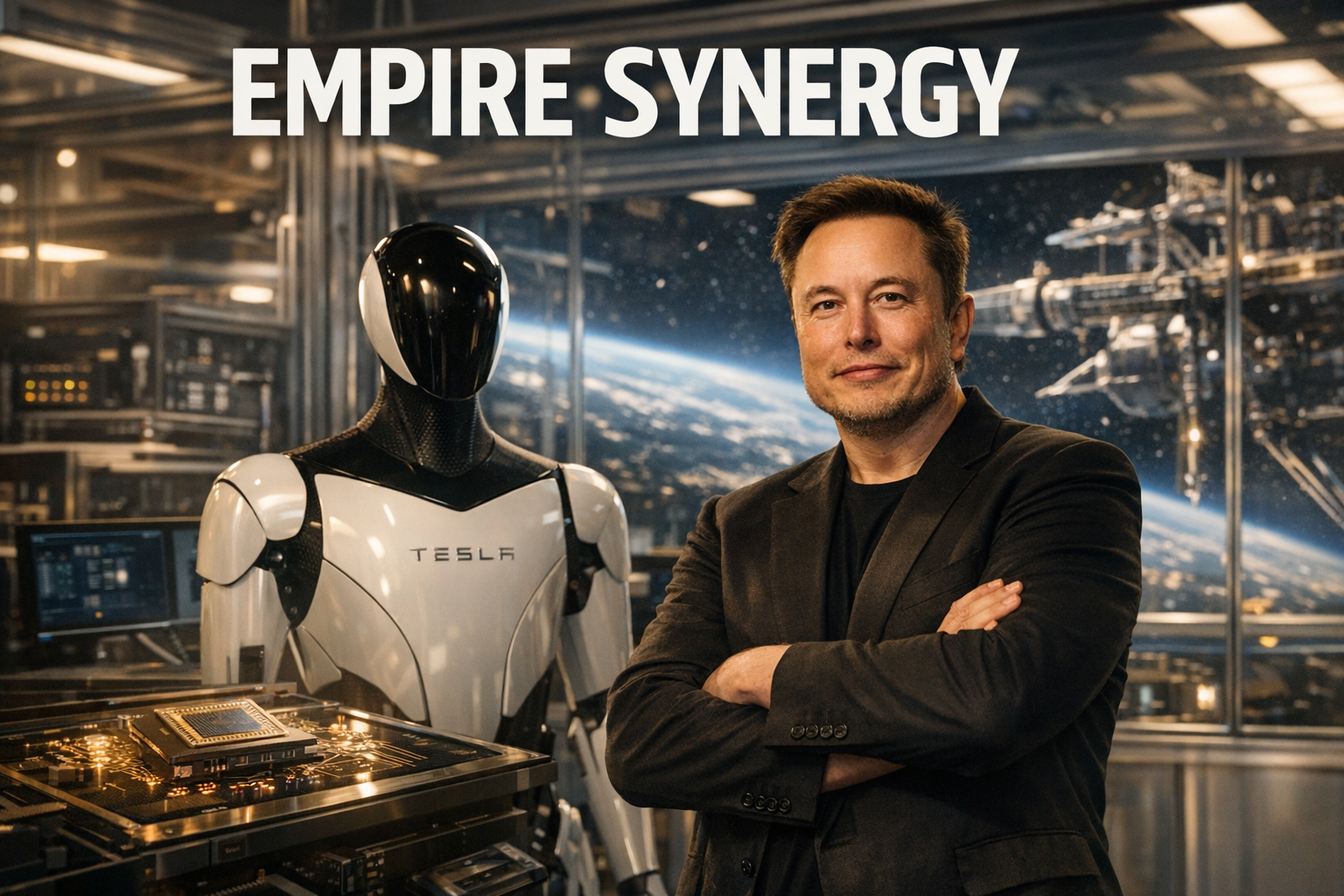
The co-presentation of Tesla, xAI, and SpaceX within a single facility concept is interpreted as strategic signaling that these entities function as components of one system.
9. Investment Lens: Tesla Valuation, SpaceX Upside Narratives, and Re-Rating Potential
9-1. Tesla Valuation Framework Could Shift
Tesla has primarily been valued as an EV manufacturer with an autonomy premium. If Tesla becomes a core supplier of chips, robotics, energy, and space-adjacent compute infrastructure, valuation may increasingly detach from vehicle unit sales as the dominant metric.
9-2. Why Multi-Trillion-Dollar SpaceX Scenarios Circulate
SpaceX is framed not only as a launch provider but as a platform spanning:space internet, satellite infrastructure, heavy-lift transport, and logistics supporting future space compute infrastructure.
This supports narratives of platform-like re-rating.
9-3. Execution Risk Dominates at This Stage
Key dependencies include:
- Starship development milestones
- AI chip production timelines
- validation of space-server unit economics
- regulatory exposure
- funding structure and capital access
- credible revenue model formation
A material miss in any category could trigger valuation compression.
10. Primary Remaining Risks
10-1. Technical Risks
- radiation effects on chips
- maintenance of large space-based data centers
- real-world efficacy of radiative cooling at scale
- long-distance communications latency and reliability
- safety and repeatability of mass driver operations
10-2. Economic Risks
- extremely high initial capex
- long time-to-monetization
- higher funding costs under unfavorable rate conditions
- AI demand growth slowing versus expectations
10-3. Policy and Regulatory Risks
- international space law
- space debris constraints
- national security considerations
- monopoly and antitrust scrutiny
Broad control across semiconductors, communications, AI, robotics, and space logistics could increase regulatory intervention probability.
11. News-Style Key Points
First.
Recent initiatives can be interpreted as an integrated strategy linking AI, energy, and space infrastructure rather than isolated Tesla initiatives.
Second.
Tesla is signaling interest in in-house chip production and vertically integrated mega-facilities due to perceived insufficiency of existing semiconductor supply chains for future AI demand.
Third.
Space data centers are framed around long-run power and cooling economics.
Fourth.
Given limits of rocket-only logistics at scale, lunar mass drivers are cited as a potential long-run transport solution.
Fifth.
Optimus may be re-rated as labor substitution infrastructure for building and maintaining space industrial assets.
Sixth.
Where Nvidia is chip-centered, the Musk ecosystem targets integration across software, chips, embodied agents, energy, logistics, and communications.
Seventh.
Regardless of legal merger outcomes, operational and supply-chain integration may already be advancing.
12. Under-Discussed Core Point
A key interpretive claim is that the strategic bet is less on “AI models” and more on controlling the infrastructure that runs AI.
Competitive advantage may increasingly derive from:
- access to low-cost power
- stable chip supply
- lower-cost siting and cooling for data centers
- deployment of robots as physical execution agents
In this view, Tesla, xAI, and SpaceX function as a coordinated team allocating ownership of future digital-civilization infrastructure categories.
13. Milestones and Monitoring Items
- official timelines for Tesla AI chips and related production facilities
- Starship V3 test progress
- collaboration structure between xAI and Tesla on chips and data infrastructure
- Optimus productivity and deployment scope
- additional disclosures (patents/designs) related to space data centers
- changes in capital cooperation structures between SpaceX and Tesla
- U.S. government and regulator responses
Two central variables for economic credibility are the chip production roadmap and the rate of Starship cost-per-launch reduction.
14. Conclusion: Operational Convergence May Matter More Than a Formal Merger
A near-term legal merger is uncertain. However, the strategic trajectory implies increasing interdependence:
- Tesla: chips, robotics, energy
- xAI: intelligence layer
- SpaceX: space transport and communications
The overarching strategy emphasizes consolidation of compute, power, transport, and physical execution capacity, with substantial technical, funding, and regulatory risk remaining.
< Summary >
The concept presented is a large-scale vertical integration strategy linking Tesla, xAI, and SpaceX into a single industrial ecosystem.
The core objective is infrastructure control across AI chip self-supply, space-based data centers, Starship-enabled transport, lunar mass drivers, and Optimus robotics.
Where Nvidia is primarily a semiconductor company, the Musk ecosystem targets combined control of chips, energy, robotics, communications, and space logistics.
Given significant technical, capital, and regulatory uncertainties, the distinction between vision-stage narratives and execution-stage evidence remains critical.
[Related Articles…]
-
Tesla AI Strategy and Re-Rating Factors for Autonomy
https://NextGenInsight.net?s=Tesla -
Space Industry Investment Flows and Next-Generation Growth Scenarios
https://NextGenInsight.net?s=Space
*Source: [ 오늘의 테슬라 뉴스 ]
– 테슬라 · xAI · SpaceX결국 하나로 합치나? 머스크 제국의 거대 통합 시나리오! 일론 머스크의 테라펩발표 분석!
● AI Money Explosion, SEO Dead, AEO Rules
In the AI Monetization Era, “AI Selection Optimization” Is Becoming More Critical Than Traditional Search Optimization
This report focuses not on generic AI usage, but on how to build monetizable structures connected to AI investment, digital marketing, equity markets, startups, and macro outlooks.
A key shift is underway: consumer choice is moving from human-led search to AI-led selection and recommendation.
As a result, market dynamics may evolve from “a good product sells” to “a product sells when AI can interpret and recommend well-structured information about it.”
This report summarizes: how AI systems ingest online information, why large portions of existing content are effectively invisible to AI, how marketing strategies must be rebuilt for AI-mediated discovery, and why Korea may have underappreciated opportunities in this transition.
1. Key Development: Monetization Mechanics in the AI Era Are Shifting
A central question in the AI industry has become: “How will AI translate into monetizable outcomes?”
Post-NVIDIA GTC, attention is moving beyond data center capex, GPU competition, and incremental model performance. The next phase centers on AI being embedded into consumption, purchasing, recommendation, advertising, customer service, and decision-making—and on who captures the first scalable revenue models.
As in the smartphone era—where platform and application ecosystems often outperformed hardware-only players—AI monetization may disproportionately accrue to companies that:
- build services where AI recommends and selects,
- use AI to materially improve marketing efficiency, or
- design AI-readable information structures.
2. Critical Point: AI Does Not Read Webpages Like Humans
A common assumption is that well-written, visually polished pages will be “read” by AI. In practice, many systems do not process pages with human-like browsing behavior (scrolling, visual context, narrative flow).
Cost and latency constraints require AI systems to prioritize content that is fast to retrieve and easy to parse. Therefore, structured and extractable data is often favored.
Implication: a meaningful share of human-oriented content may be poorly indexed, weakly extracted, or effectively absent from AI-mediated discovery.
3. Information Formats Preferred by AI: Structure, Clarity, Summarizability
AI systems more reliably ingest content with:
- Q&A formats
- FAQ structures
- list-based summaries
- numbered step sequences
- clear, explicit titles aligned with body content
- logic that can be summarized
This changes content strategy. Historically, click-driven tactics (provocative headlines, thumbnail-driven attention) dominated. In AI-mediated discovery, titles, headings, and information architecture become more important.
Example:
- Clickbait-style titles may attract humans but provide low interpretability for AI.
- Explicit, scoped titles (e.g., “2026 AI marketing strategy: five requirements for being recommended by AI”) are easier for AI to parse.
4. Why SEO Alone Is Insufficient: The Rise of AEO and GEO
Traditional digital marketing has centered on SEO. As generative AI increasingly intermediates search, SEO becomes necessary but insufficient.
Emerging concepts:
- AEO: Answer Engine Optimization
- GEO: Generative Engine Optimization
Consumer behavior is shifting toward direct AI queries (e.g., product recommendations under budget and feature constraints). AI produces shortlists; users select from AI-filtered candidates.
Implication: inclusion within AI-generated answers may become as important as, or more important than, first-page search rankings.
5. Why Answers Differ Across AI Systems: Model Policies and Priorities
Different AI systems often produce different answers due to:
- source prioritization (e.g., community content vs. official documentation),
- safety and policy filters,
- differing thresholds for inference and speculation.
For brands, this implies multi-model testing rather than a single-platform optimization approach.
6. Implications for Korean SMEs and Sole Proprietors: Elevated Risk and Opportunity
Many Korean SMEs and local businesses lack AI-readable, structured data assets:
- websites exist but are not structured for extraction,
- blogs are optimized for clicks rather than clarity and structure,
- video content may emphasize thumbnails over information density.
This increases the risk of being omitted from AI recommendations. However, it also creates opportunity: systematically organizing brand and product data (positioning, comparisons, FAQs, troubleshooting, reviews) can accelerate inclusion in AI recommendation ecosystems—potentially allowing smaller players to compete more effectively.
Korea may have relative strengths in rapid execution, digital adaptation, content production, and service design, supporting upside in applications, services, and marketing layers rather than hardware.
7. How Marketing May Change: From Click Economics to Recommendation Economics
Historical purchase flow:
- keyword search
- compare blogs/articles/videos
- check reviews
- purchase decision
Potential AI-mediated flow:
- user provides constraints to AI
- AI asks clarifying questions
- AI recommends 2–3 options
- user buys largely within that set
In this structure, brand awareness remains relevant, but AI-explainable information becomes a primary determinant of consideration.
Marketing must be designed for both:
- human persuasion, and
- AI interpretability.
8. Practical Implications for YouTube and Content Creators
A two-track strategy may be required:
- Human-facing content: engagement, storytelling, emotion, personality
- AI-facing content: information density, explicit titles, structured scripts
Thumbnail-driven content with low informational substance may be treated as noise by AI systems. Content with clear topic terms and explicit key claims in titles and scripts is more likely to be cited and reused.
9. Why AI Makes Errors and How to Reduce Hallucinations Operationally
Prompt quality matters, but the binding constraint is the availability of high-quality, accessible source information.
AI systems tend to produce plausible responses even when uncertain. Mitigation requires higher-quality, structured information within the broader ecosystem, not only better prompting.
This extends beyond productivity into brand reputation, consumer protection, financial decision-making, and societal information integrity.
10. A Broader Risk: The AI Era May Intensify “Information Integrity” Competition
If AI-generated answers are derived from available online information, then actors who publish more, and more strategically structured, content may influence what is perceived as “fact.”
This risk exceeds traditional search manipulation and may evolve into competition to shape AI answer framing. Potential spillovers include regulation, platform policy, digital ethics, and growth in verification and trust infrastructure.
11. Core Takeaways Often Underemphasized in Mainstream Coverage
-
1) Competitive advantage may shift from model performance to information-structure execution.
In many business contexts, how AI reads and retrieves a firm’s information may matter more than marginal model gains. -
2) The economy may shift from clicks to recommendations.
Search ads and keyword competition remain relevant, but AI may increasingly control pre-purchase filtering. -
3) Korea’s opportunity may be strongest in applications, marketing, and services.
Direct competition with leading GPU and hardware incumbents is difficult, while execution in AI-enabled service layers may be more attainable. -
4) “Trusted, structured data assets” may become a premium asset class.
Product specs, FAQs, customer cases, reviews, comparisons, and operating principles may become core competitive moats. -
5) AI ethics and integrity are likely to become central industry issues.
The ability to shape or manipulate AI responses can extend into finance, elections, healthcare, and education.
12. Near-Term Monetization Paths for Individuals
12-1. AI Installation and Configuration Services
Open-source and local AI tools often require setup and environment configuration. Standardizing installation playbooks can support freelance service revenue.
12-2. AI-Oriented Content Structuring Services
Rewriting and restructuring corporate blogs, websites, product materials, and video scripts into AI-readable formats. This is closer to information architecture and marketing than generic copywriting.
12-3. AEO/GEO Consulting for Local Businesses
Clinics, academies, e-commerce stores, restaurants, and professional services historically reliant on search ads may require AI recommendation exposure strategies, particularly for local intent queries.
12-4. Creation of AI-Ready Data Assets
Template-driven production of FAQs, comparison tables, customer casebooks, user guides, and product Q&A. Many firms prefer outsourcing due to internal time and capability constraints.
12-5. AI Education and Practice-Oriented Training
Demand is shifting toward operational guidance (implementation in a specific business context). Verticalized AI training, workflow automation instruction, and marketing optimization workshops are likely to expand.
13. Investment Lens: Themes to Monitor
Potential beneficiaries include:
- GPUs, semiconductors, servers, and power infrastructure
- generative AI platform companies
- AI agent service providers
- marketing automation and customer service SaaS
- data verification, security, and trust-management providers
- content productivity and workflow automation vendors
Equity markets have been led by infrastructure and chips. A key question is whether valuation premiums rotate toward application-layer companies with observable revenue and durable demand.
This may emerge earlier in US markets, while domestically the focus may shift toward AI marketing, B2B automation, and agent-oriented solution providers.
14. Macro Context: Why This Matters for the Economic Outlook
Global conditions include the lagged effects of high rates, productivity constraints, consumption polarization, and corporate cost pressures.
In this environment, firms may prioritize AI that:
- increases revenue with flat headcount,
- improves marketing efficiency,
- accelerates decisions,
- reduces operating labor costs.
Operationally deployed solutions may outperform highly technical but weakly commercialized innovations.
15. Execution Checklist: Immediate Actions
15-1. Individuals
- fully master at least one AI tool from installation to use
- develop capability in structuring information
- plan content separately for humans and for AI ingestion
- collect industry-specific automation case studies
- monetize via setup services, documentation products, and training
15-2. Companies
- restructure websites and blogs for AI-friendly extraction
- systematize product descriptions, comparison tables, FAQs, and reviews
- align messaging consistently across video, blog, and PR
- define brand claims and key points that AI can cite
- expand from search-centric marketing to AI recommendation-centric strategies
16. Conclusion: The Advantage May Belong to Those Who Produce AI-Readable Information
Near-term attention remains focused on prompts, tools, and the latest models. The more structural issue is the evidence base AI systems can retrieve and cite.
The market is moving from “using AI” to “designing the information AI will reference and recommend.” Early movers may capture opportunities across content, marketing, startups, investment, and education.
The practical benchmark may shift from “search ranking” to “inclusion in AI-generated recommendations.”
< Summary >
The core challenge is not AI usage alone, but how AI reads and recommends a brand’s information.
SEO is increasingly insufficient on its own; AEO and GEO are becoming central to AI-mediated discovery.
Because AI does not parse webpages like humans, Q&A, FAQ, list-based formats, and explicit titles are essential.
Marketing is shifting from click competition to recommendation competition; both individuals and firms must build AI-interpretable data assets.
Individuals can monetize via setup services, content structuring, and AI training; companies must redesign strategy for AI recommendation exposure.
The primary advantage may accrue less to those who use AI well and more to those who produce information AI can reliably read and cite.
[Related Articles…]
-
https://NextGenInsight.net?s=AI
“2026 AI market changes and practical monetization strategies” -
https://NextGenInsight.net?s=NVIDIA
“Post-NVIDIA investment points and global technology trends”
*Source: [ Jun’s economy lab ]
– AI 이렇게 하면 누구나 돈 법니다(ft.이재홍 대표 1부)
● Trump Ultimatum, Strait Panic, Treasury Shock
Trump’s 48-Hour Ultimatum: The Core Risk Is U.S. Treasuries, Not the Strait of Hormuz
This is not a conventional Middle East conflict headline.
While the surface narrative centers on Iran, the Strait of Hormuz, oil supply, and crude prices, markets are more sensitive to U.S. Treasury yields, inflation expectations, confidence in the dollar, and global financial-market volatility.
This report focuses on why Iran may view the Treasury market as a key U.S. vulnerability, how increasingly aggressive political messaging can transmit into U.S. equities (including the Nasdaq) through rates rather than oil alone, and the scenarios investors should monitor. The central risk is that a rise in U.S. borrowing costs may be more disruptive than a temporary Hormuz shock.
1. What happened: The meaning of the 48-hour ultimatum
Former President Trump effectively issued a 48-hour deadline to Iran.
The message was explicit: if Iran does not ensure unimpeded access through the Strait of Hormuz, the U.S. could target key Iranian power-generation assets and critical infrastructure.
This stance contradicts prior signals such as potential de-escalation or early-stage negotiation prospects.
Negotiation optimism → renewed escalation risk is typically negative for markets, as rising uncertainty increases volatility and weakens near-term directional conviction across both equities and rates.
2. Iran’s response: Why it combined calibrated and hardline messaging
Iran’s communications appear deliberately dual-tracked: diplomatic positioning and military deterrence.
2-1. Calibrated message
Iran’s foreign-ministry line framed the Strait as not formally closed, arguing that heightened risk perceptions among shippers and insurers are driven by U.S. and Israeli actions.
This supports an international narrative that Iran is not the initiating party in restricting trade flows.
2-2. Hardline message
Military-linked statements warned that a U.S. strike could trigger a full closure of the Strait, potentially maintained until damaged domestic power infrastructure is restored. They also suggested that energy infrastructure in countries hosting U.S. military assets, and firms with U.S. ownership exposure, could become targets.
This is consistent with a deterrence strategy designed to raise the perceived cost of escalation while preserving negotiating optionality.
3. Markets initially watched oil; focus is shifting toward Treasuries
Initial market attention typically centers on crude, given the Strait’s role as a critical energy chokepoint.
However, the absence of sustained panic pricing—e.g., WTI not decisively holding above USD 100—suggests markets are either discounting the probability or duration of a full disruption, or awaiting confirmation of physical constraints.
The more consequential channel may be pressure on the U.S. Treasury market rather than oil alone.
4. Why U.S. Treasuries are a key U.S. vulnerability
Messaging attributed to Iranian parliamentary sources carried implications that financial institutions supporting U.S. defense spending and, indirectly, the U.S. Treasury market are leverage points.
The strategic logic is to increase U.S. domestic economic and political costs by destabilizing funding conditions.
The U.S. is structurally dependent on the capacity to issue Treasuries at manageable yields. A material rise in yields transmits broadly into financial conditions.
4-1. What higher Treasury yields imply
If the U.S. 10-year yield moves decisively above 4.5%, markets typically price tighter financial conditions:
- Higher U.S. government interest expense
- Higher corporate funding costs
- Higher consumer borrowing rates
This can weigh on housing, capex, equity valuation multiples (particularly long-duration growth), and global capital flows.
4-2. Why this is politically sensitive for Trump
Aggressive foreign-policy messaging may support political positioning, but a combination of rising gasoline prices, broader inflation pressure, and higher rates increases voter-facing economic strain.
Gasoline, household inflation, and mortgage rates are particularly salient in an election cycle. The relevant risk is not only military escalation but domestic political cost via tighter financial conditions.
5. Why messaging appears inconsistent
Public signals have shifted rapidly between de-escalation, negotiation, and ultimatum-style threats.
This can be interpreted as a transactional approach combining pressure and bargaining. Markets, however, often penalize perceived inconsistency through higher risk premia and increased demand for liquidity and hedges.
The typical near-term effect is equity drawdowns and higher volatility across FX and commodities.
6. The meaning of the Treasury-side rationale: “Short-term pain for long-term security”
Messages from the fiscal-policy side can be summarized as: short-term costs may be acceptable to achieve longer-term security outcomes.
Markets generally prioritize immediate, measurable variables:
- Crude prices
- Treasury yields
- Inflation prints and inflation expectations
- Repricing of Federal Reserve easing expectations
Statements implying longer timelines are often interpreted as: risk may persist longer than initially discounted, raising volatility premia.
7. Five investor checkpoints
7-1. Evidence of actual Hormuz shipping disruption
Rhetorical threats are materially different from observable constraints such as reduced sailings, insurance pullbacks, or risk premia embedded in freight and coverage.
7-2. U.S. 10-year yield: the 4.5% threshold
This is the key hidden variable. A sustained move higher increases pressure on U.S. equities, particularly rate-sensitive growth and technology.
7-3. WTI: sustained hold above USD 100
Intraday spikes differ from a durable regime shift. A sustained move above USD 100 can re-accelerate inflation concerns and alter Fed-path pricing.
7-4. Actual intensity of U.S. military action
Markets differentiate between limited signaling strikes and actions intended to impose prolonged infrastructure impairment.
7-5. Iran’s asymmetric response
Non-conventional responses may be more destabilizing than direct confrontation:
- Cyber operations
- Threats to energy infrastructure
- Expanded maritime insurance stress
These can extend market impacts beyond headline conflict duration.
8. Cross-asset implications: likely winners and stress points
8-1. Equities
Near-term relative strength may occur in defense, energy, and certain commodities-linked exposures. Potential underperformance may concentrate in transport, airlines, consumer sectors, and high-multiple technology.
U.S. equities may respond more to rates than to the conflict narrative itself.
8-2. Bonds
Geopolitical risk can trigger safe-haven Treasury buying, but the combination of fiscal sensitivity, inflation pressure, and confidence channels can also produce a non-standard outcome: yields rising during risk-off conditions.
8-3. Commodities
Oil and gas are the primary transmission. Gold should be monitored as a hedge against geopolitical risk and potential stress in dollar confidence.
8-4. FX
The dollar typically benefits in risk-off regimes. If the shock evolves into concerns about U.S. fiscal credibility or Treasury-market stability, USD strength may be constrained and volatility may increase. Risk-sensitive currencies such as KRW may face higher vulnerability.
9. News-style key points
First, Trump’s 48-hour ultimatum materially raises the probability of near-term military action.
Second, Iran is running dual messaging: diplomatic calibration and military deterrence.
Third, while oil risk remains, the primary market variable is U.S. Treasury yields.
Fourth, Iran’s signaling toward financial channels reflects the view that disrupting U.S. funding conditions may be more effective than oil pressure alone.
Fifth, over the next 24–48 hours, the key variables are actual military actions, yield moves, and changes in inflation expectations.
10. The under-discussed point: Treasury-market stress can be more systemic than oil
Most coverage emphasizes “Hormuz closure → oil spike.”
A larger systemic risk is Treasury-market stress. Oil shocks can be partially mitigated through supply responses and strategic reserves, while a sustained hit to Treasury confidence changes the global discount rate framework.
Higher Treasury yields reprice:
- Equities
- Real estate
- Corporate credit
- EM FX and funding
- Venture and long-duration technology valuation
The central question is not only whether Hormuz traffic is disrupted, but whether geopolitical risk transmits into higher U.S. borrowing costs and weakened financial confidence.
11. Three forward scenarios
11-1. Scenario A: Hardline rhetoric followed by de-escalation
If rhetoric peaks and both sides avoid direct action, markets may price relief. Oil could retrace risk premia and Treasury yields could stabilize.
11-2. Scenario B: Limited military engagement
Symbolic or constrained strikes may support oil, gold, and defense exposures. If critical infrastructure is not impaired for an extended period, markets may normalize within days.
11-3. Scenario C: Concurrent stress in shipping, rates, and infrastructure
The worst-case configuration includes shipping disruption, a sharp rise in Treasury yields, and renewed inflation pressure. Global equities could reprice materially, and the implied path of Fed policy could shift.
12. Required investor posture
A checklist-based approach is preferable to directional conviction driven by headlines.
Monitor three axes simultaneously:
1) Geopolitical headlines and escalation markers
2) Crude prices and U.S. Treasury yields
3) U.S. equity sensitivity, especially Nasdaq reaction to rates
This is a combined regime of geopolitics + inflation + rates + confidence.
< Summary >
Trump’s 48-hour ultimatum raises Middle East escalation risk, but the primary market variable is U.S. Treasury yields rather than the Strait of Hormuz alone.
Iran appears to be increasing pressure not only through oil risk but via channels that could undermine U.S. financial confidence and increase borrowing costs.
Key checkpoints: observable Hormuz disruption, WTI sustained above USD 100, U.S. 10-year yield above 4.5%, the realized intensity of military action, and asymmetric Iranian responses.
This is a multi-factor risk with potential to affect global financial conditions, inflation expectations, rates, and U.S. equity direction.
[Related Articles…]
- AI Semiconductor Investment Strategy: Core Factors Behind the Next Supercycle
https://NextGenInsight.net?s=AI - Rate-Cut Delays: Key Asset-Market Checkpoints for 2H
https://NextGenInsight.net?s=금리
*Source: [ Maeil Business Newspaper ]
– [홍장원의 불앤베어] 트럼프 48시간 최후 통첩. 데드라인이 다가온다